
Market Report · July 29, 2026

Key data points: The growth forecast = 9.9% annually for the next 7 years. Scroll below to get more insights. This market report covers Trends, opportunity and forecast in law enforcement biometrics market to 2031 by technology type (biometric identification systems, biometric verification systems, multimodal biometric systems, and mobile biometric solutions), end use (law enforcement agencies, bioscanning service providers, government organizations, and private security firms), and region (North America, Europe, Asia Pacific, and the Rest of the World)
We'll send your sample report shortly.
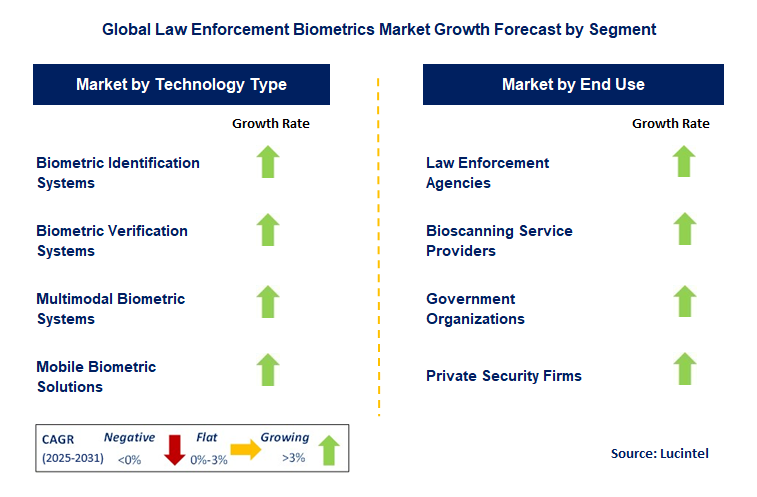
• Lucintel forecasts that, within the technology type category, biometric identification systems are expected to witness the highest growth over the forecast period.
• Within the end use category, law enforcement agencies are expected to witness the highest growth.
• In terms of region, APAC is expected to witness the highest growth over the forecast period. Gain valuable insights for your business decisions with our comprehensive 150+ page report. Sample figures with some insights are shown below.

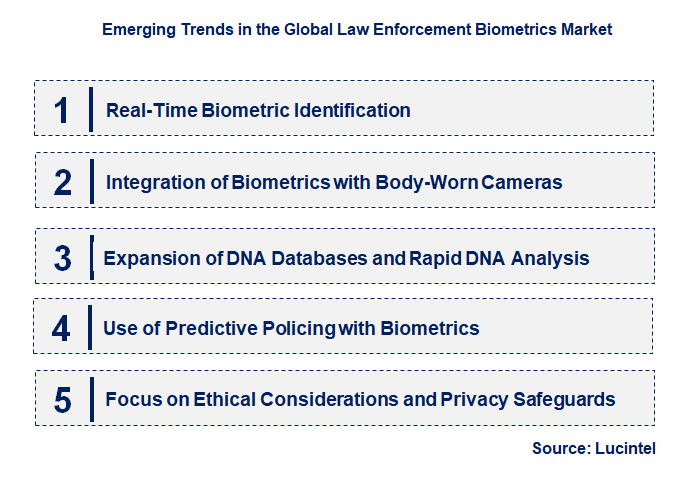
• Real-Time Biometric Identification: Implementing systems that enable real-time identification of individuals using facial recognition or other modalities in public spaces or during investigations. This allows for immediate identification of suspects or persons of interest, enhancing public safety and enabling faster response times.
• Integration of Biometrics with Body-Worn Cameras: Combining biometric identification with body-worn camera footage to enhance evidence collection and officer accountability. This provides objective evidence in investigations and improves transparency in law enforcement operations.
• Expansion of DNA Databases and Rapid DNA Analysis: Expanding DNA databases and implementing rapid DNA analysis technologies for faster identification of suspects and victims. This accelerates investigations, reduces backlogs, and improves the chances of solving cold cases.
• Use of Predictive Policing with Biometrics: Utilizing biometric data and AI algorithms to predict potential crime hotspots or identify individuals at risk of committing or becoming victims of crime. This allows for proactive policing strategies and targeted interventions.
• Focus on Ethical Considerations and Privacy Safeguards: Implementing stricter guidelines and regulations regarding the collection, storage, and use of biometric data to address privacy concerns and prevent misuse. This ensures the responsible and ethical use of biometric technologies in law enforcement. These trends are significantly reshaping the law enforcement biometrics market. Real-time identification and integration with body-worn cameras are enhancing operational efficiency and transparency. The expansion of DNA databases and rapid analysis are accelerating investigations. Predictive policing offers new opportunities for crime prevention. The focus on ethics and privacy is ensuring the responsible use of these powerful technologies. These advancements are creating a market that is more effective, efficient, and accountable, while also addressing critical ethical and privacy implications.
• Improved Accuracy and Speed of Facial Recognition: Advancements in deep learning and AI have significantly improved the accuracy and speed of facial recognition systems, even in challenging conditions like low light or with partial facial coverings. This enhances the reliability and effectiveness of facial recognition for identification and investigations.
• Mobile Biometric Devices for Field Use: Law enforcement officers are increasingly using mobile biometric devices, such as handheld fingerprint scanners and mobile facial recognition systems, for on-the-spot identification and verification. This enables faster identification of suspects in the field and streamlines law enforcement operations.
• Integration of Biometrics with Body-Worn Cameras: Combining biometric identification with body-worn camera footage enhances evidence collection, officer accountability, and transparency in law enforcement operations. This provides objective evidence in investigations and improves public trust.
• Expansion of DNA Databases and Rapid DNA Analysis: Expanding DNA databases and implementing rapid DNA analysis technologies allows for faster identification of suspects and victims, accelerating investigations and reducing backlogs. This is particularly impactful in solving cold cases and identifying missing persons.
• Focus on Addressing Bias and Ensuring Fairness in Biometric Algorithms: Growing awareness of potential bias in biometric algorithms is driving efforts to develop more fair and equitable systems. This includes using diverse datasets for training algorithms and implementing bias detection and mitigation techniques. These developments are significantly impacting the law enforcement biometrics market. Improved accuracy and speed of facial recognition and mobile biometric devices are enhancing operational efficiency and effectiveness. Integration with body-worn cameras is improving transparency and accountability. The expansion of DNA databases and rapid analysis are accelerating investigations. The focus on addressing bias is ensuring fairness and ethical use of these technologies. These advancements are creating a market that is more effective, efficient, accountable, and ethically responsible, enhancing public safety and improving trust in law enforcement.
• Criminal Identification and Investigation: Biometrics plays a crucial role in identifying suspects, linking crimes, and solving cold cases. Advanced facial recognition, DNA analysis, and fingerprint databases enhance investigative capabilities and improve the chances of solving crimes.
• Border Security and Immigration Control: Biometrics are used for traveler identification, verification, and border control, enhancing security and streamlining immigration processes. Multimodal biometric systems combining facial recognition, iris scanning, and fingerprint verification can further strengthen border security.
• Missing Persons Identification: Biometric databases, particularly DNA and fingerprint databases, can be used to identify missing persons and reunite families. Rapid DNA analysis and improved database interoperability can significantly improve the speed and efficiency of missing persons investigations.
• Post-Incident Analysis and Forensics: Biometrics can be used for analyzing crime scene evidence, identifying victims, and reconstructing crime events. Advanced forensic techniques and biometric analysis tools enhance investigative capabilities and provide crucial evidence in legal proceedings.
• Probation and Parole Monitoring: Biometric technologies can be used to monitor individuals on probation or parole, ensuring compliance with court orders and reducing recidivism. Mobile biometric devices and remote monitoring systems can enhance supervision and improve public safety. These growth opportunities are significantly impacting the law enforcement biometrics market by driving innovation and expanding its reach. The increasing use of biometrics in criminal investigations, border security, missing persons cases, forensics, and probation monitoring is fueling market growth and attracting significant investment. These applications are driving the development of more accurate, efficient, and versatile biometric solutions. This is leading to a market that is more integrated into various aspects of law enforcement operations, contributing to improved security, efficiency, and public safety.
• CrossmatcH
• 4Gid
• 3M Cogent
• M2SYS Technology
• NEc
• Safran
• Aware
• Ayonix
• BI2 Technologies
• BioEnable
• Biometric Identification Systems
• Biometric Verification Systems
• Multimodal Biometric Systems
• Mobile Biometric Solutions
• Law Enforcement Agencies
• Bioscanning Service Providers
• Government Organizations
• Private Security Firms
• North America
• Europe
• Asia Pacific
• The Rest of the World
• United States: The U.S. law enforcement agencies widely use biometrics, particularly fingerprint and facial recognition, through systems like the FBI's Next Generation Identification (NGI) system. Recent developments focus on improving facial recognition accuracy and addressing bias in algorithms, as well as expanding the use of DNA databases and rapid DNA analysis technologies.
• China: China has extensively deployed biometrics, especially facial recognition, for surveillance, citizen identification, and law enforcement. Recent developments focus on integrating facial recognition with other modalities like gait analysis and voice recognition, along with expanding the use of AI-powered surveillance systems. However, privacy concerns and the potential for misuse remain significant issues.
• Germany: The German approach to biometrics in law enforcement is characterized by a strong emphasis on data privacy and adherence to strict legal frameworks. While fingerprint and DNA analysis are widely used, there's more caution regarding facial recognition due to privacy concerns. Recent developments focus on improving data security and ensuring compliance with GDPR regulations.
• India: India has seen significant adoption of biometrics in law enforcement, particularly driven by the Aadhaar program, a national biometric identification system. Fingerprint and iris scanning are commonly used for criminal identification and verification. Recent developments focus on improving interoperability between different biometric databases and expanding the use of facial recognition for crime prevention.
• Japan: Japan is actively adopting biometrics in law enforcement, focusing on enhancing efficiency and security. Recent developments include improving the accuracy and speed of facial recognition systems and integrating them with existing police databases. There's also growing interest in using biometrics for border control and crime prevention. The focus is on leveraging technology while respecting individual privacy.


• CrossmatcH
• 4Gid
• 3M Cogent
• M2SYS Technology
• NEc
• Safran
• Aware
• Ayonix
• BI2 Technologies
• BioEnable Q5. Which law enforcement biometrics market segment will be the largest in future? Answer: Lucintel forecasts that biometric identification systems are expected to witness the highest growth over the forecast period. Q6. In law enforcement biometrics market, which region is expected to be the largest in next 5 years? Answer: APAC is expected to witness the highest growth over the forecast period. Q7. Do we receive customization in this report? Answer: Yes, Lucintel provides 10% customization without any additional cost.


Choose a license that fits your team. Instant PDF delivery.
Prices exclude taxes. Instant delivery. Custom licensing available on request.
Market Report · July 29, 2026
Market Report · July 20, 2026
Market Report · July 20, 2026
Trusted partner for strategic intelligence and business growth


Receive a complimentary market analysis tailored to your industry. Our analysts will identify key growth opportunities and competitive dynamics specific to your business.

Market size, growth rate, and key trend analysis for your specific sector.

Top competitor positioning and market share analysis.

Strategic recommendations backed by data-driven insights.
Get curated market intelligence and competitive moves straight to your inbox.
By subscribing, you agree to receive our monthly insights. Unsubscribe anytime.
Receive a complimentary market analysis tailored to your industry. Our analysts will identify key growth opportunities and competitive dynamics specific to your business.
Market size, growth rate, and key trend analysis for your specific sector.
Top competitor positioning and market share analysis.
Strategic recommendations backed by data-driven insights.
Get curated market intelligence, emerging trends, and competitive moves straight to your inbox each month.
By subscribing, you agree to receive our monthly insights. Unsubscribe anytime.
We'll send your sample report shortly.