
Market Report · July 29, 2026

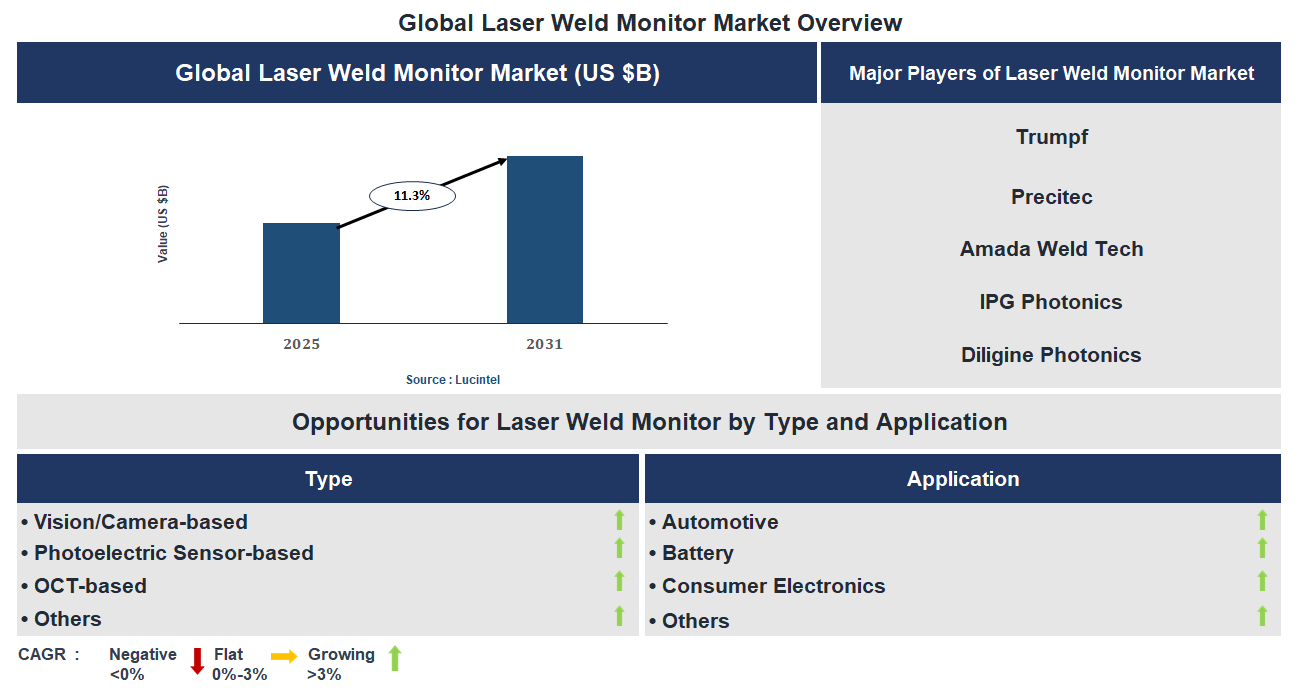
Key data points: The growth forecast = 11.3% annually for the next 7 years. Scroll below to get more insights. This market report covers trends, opportunities and forecasts in laser weld monitor market to 2031 by type (vision/camera-based, photoelectric sensor-based, OCT-based, and others), application (automotive, battery, consumer electronics, and others), and region (North America, Europe, Asia Pacific, and the Rest of the World)
We'll send your sample report shortly.
• Lucintel forecasts that, within the type category, vision/camera-based is expected to witness the highest growth over the forecast period.
• Within the application category, automotive is expected to witness the highest growth.
• In terms of region, APAC is expected to witness the highest growth over the forecast period. Gain valuable insights for your business decisions with our comprehensive 150+ page report. Sample figures with some insights are shown below.
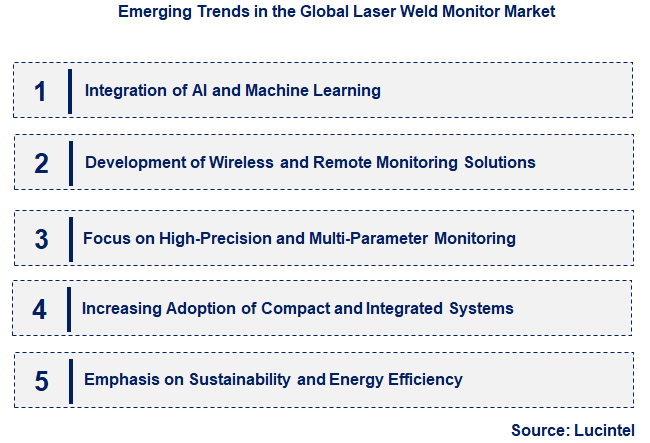
• Integration of AI and Machine Learning: The adoption of AI and machine learning algorithms in laser weld monitoring systems is revolutionizing defect detection and process optimization. These technologies enable real-time analysis of welding parameters, predictive maintenance, and adaptive control, leading to higher quality welds and reduced rework. AI-driven systems can identify subtle anomalies that traditional sensors might miss, providing manufacturers with actionable insights. This trend enhances process reliability, minimizes waste, and accelerates decision-making, making laser weld monitoring more intelligent and autonomous.
• Development of Wireless and Remote Monitoring Solutions: Wireless technology is increasingly being integrated into laser weld monitoring systems, allowing for remote data collection and analysis. This trend facilitates real-time monitoring across multiple production sites, reduces the need for extensive cabling, and improves flexibility in manufacturing setups. Remote access enables quicker troubleshooting, maintenance, and process adjustments, thereby minimizing downtime. As industries move towards Industry 4.0, wireless and remote monitoring solutions are becoming essential for seamless, connected manufacturing environments.
• Focus on High-Precision and Multi-Parameter Monitoring: The demand for high-precision welding in critical applications is driving the development of advanced monitoring systems capable of tracking multiple parameters simultaneously. These include temperature, vibration, optical signals, and weld geometry. Multi-parameter monitoring ensures comprehensive quality control, reduces the risk of defects, and supports compliance with strict industry standards. This trend is particularly significant in aerospace and medical device manufacturing, where precision is paramount, and failure is costly.
• Increasing Adoption of Compact and Integrated Systems: Miniaturization and integration of monitoring components are making laser weld monitors more compact and easier to install. These systems are suitable for small or complex welding setups, enabling manufacturers to implement monitoring without significant space or cost overheads. Integrated systems often combine multiple functionalities, such as visualization, data logging, and control, into a single unit. This trend enhances operational efficiency, simplifies maintenance, and broadens the scope of laser welding applications.
• Emphasis on Sustainability and Energy Efficiency: Environmental concerns and energy costs are prompting the development of more sustainable laser weld monitoring solutions. These systems are designed to optimize energy consumption, reduce waste, and support eco-friendly manufacturing practices. Features such as adaptive power control and efficient data processing contribute to lower operational costs and carbon footprint. This trend aligns with global sustainability goals and encourages industries to adopt greener manufacturing technologies, ultimately influencing market growth and competitiveness. In summary, these emerging trends are fundamentally reshaping the laser weld monitor market by making systems smarter, more flexible, precise, compact, and sustainable. They are driving innovation, improving process reliability, and enabling manufacturers to meet evolving industry standards and customer demands, thereby fostering a more efficient and environmentally conscious manufacturing landscape.
• Technological Integration: Adoption of AI and machine learning algorithms has improved defect detection accuracy and real-time monitoring capabilities, enabling predictive maintenance and reducing downtime.
• Miniaturization and Portability: Development of compact, portable laser weld monitors allows for easier integration into various manufacturing setups, increasing flexibility and application scope.
• Enhanced Sensor Technologies: Introduction of advanced sensors with higher sensitivity and resolution has improved defect detection, especially in complex or small welds, boosting quality assurance.
• Industry-Specific Solutions: Customized monitoring systems tailored for automotive, aerospace, and electronics industries have increased market penetration by addressing specific industry needs and standards.
• Data Analytics and Cloud Connectivity: Integration of cloud-based data management and analytics platforms has facilitated better data sharing, remote monitoring, and process optimization, leading to smarter manufacturing environments. These developments are significantly impacting the laser weld monitor market by increasing system accuracy, expanding application possibilities, and enabling smarter, more efficient manufacturing processes. The market is moving towards more integrated, intelligent solutions that enhance quality control, reduce costs, and support Industry 4.0 initiatives. As a result, manufacturers are better equipped to meet stringent quality standards and improve overall productivity.
• Automotive Industry: Enhanced Quality Control : The automotive sector is increasingly adopting laser weld monitors to ensure high-quality, defect-free welds, which are critical for vehicle safety and durability. This reduces rework costs and improves production efficiency, driving market growth.
• Aerospace Manufacturing: Precision and Safety : Aerospace applications demand stringent quality standards. Laser weld monitors enable real-time defect detection and process control, ensuring the structural integrity of aircraft components and boosting confidence in laser welding processes.
• Electronics Production: Miniaturization and Reliability : As electronic devices become smaller and more complex, laser weld monitors help maintain precise, reliable welds in delicate components. This enhances product performance and reduces failure rates, expanding market opportunities.
• Healthcare Equipment: Sterility and Compliance : In medical device manufacturing, laser weld monitors ensure sterile, high-quality welds that meet regulatory standards. This improves patient safety and accelerates approval processes, fostering growth in this segment.
• Consumer Goods Manufacturing: Efficiency and Consistency : The consumer goods industry benefits from laser weld monitors by achieving consistent, high-quality welds at high speeds. This reduces production costs and enhances product appeal, supporting market expansion. In summary, these growth opportunities across key applications are significantly impacting the laser weld monitor market by driving technological innovation, improving product quality, and increasing adoption across diverse industries. This evolution is fostering a more efficient, reliable, and competitive landscape, ultimately fueling market expansion and technological advancement.
• Technological Innovation: The continuous development of laser technology and sensor systems enhances monitoring accuracy and efficiency. Innovations such as real-time data analytics and AI integration enable manufacturers to detect defects early, reduce waste, and improve overall quality. These advancements make laser weld monitoring more reliable and accessible, encouraging widespread adoption across industries like automotive, aerospace, and electronics. As technology evolves, the market benefits from increased performance and cost-effectiveness, fostering growth and competitive advantage for early adopters.
• Growing Manufacturing Automation: The shift towards automated manufacturing processes necessitates sophisticated monitoring solutions to ensure precision and consistency. Laser weld monitors provide real-time feedback, enabling manufacturers to maintain high-quality standards while reducing manual inspection efforts. This trend is driven by the need for faster production cycles, reduced labor costs, and improved safety. As industries increasingly automate, the demand for laser weld monitoring systems rises, supporting market expansion and technological integration.
• Increasing Regulatory Standards: Stringent safety, quality, and environmental regulations compel manufacturers to adopt advanced monitoring systems. Laser weld monitors help ensure compliance by providing detailed process data and defect detection capabilities. Regulatory bodies in sectors like aerospace and automotive require rigorous quality assurance, which laser monitoring systems can facilitate. This regulatory pressure encourages investment in reliable monitoring solutions, thereby expanding the market and promoting higher standards within manufacturing processes.
• Rising Demand for High-Quality Products: Consumers and industries demand products with superior quality and durability. Laser weld monitors enable manufacturers to achieve precise welds, minimizing defects and ensuring product integrity. This demand for excellence drives companies to invest in advanced monitoring systems to meet quality benchmarks, reduce rework costs, and enhance brand reputation. As quality expectations grow, so does the market for sophisticated laser weld monitoring solutions.
• Expansion in End-User Industries: The increasing adoption of laser welding in sectors such as automotive, electronics, medical devices, and aerospace fuels market growth. These industries require high-precision welding and real-time monitoring to meet strict standards. The expansion of these sectors, coupled with technological advancements, broadens the application scope of laser weld monitors, further propelling market growth and innovation. The challenges facing this laser weld monitor market include:
• High Implementation Costs: Deploying laser weld monitoring systems involves significant capital investment in equipment, integration, and training. Small and medium-sized enterprises may find these costs prohibitive, limiting market penetration. Additionally, ongoing maintenance and upgrades add to the financial burden, potentially slowing adoption rates. Overcoming cost barriers requires technological advancements that reduce expenses and demonstrate clear ROI to stakeholders.
• Rapid Technological Changes: The fast-paced evolution of laser and sensor technologies can render existing monitoring systems obsolete quickly. Manufacturers face the challenge of continuously updating equipment to stay competitive, which involves substantial R&D investments. This rapid change can also lead to compatibility issues and increased complexity in system integration, creating uncertainty and risk for end-users considering long-term investments.
• Regulatory and Certification Complexities: Navigating diverse and evolving regulatory standards across different regions can be complex and time-consuming. Achieving compliance requires extensive testing, documentation, and certification processes, which can delay deployment and increase costs. Variations in safety and quality regulations across markets pose additional hurdles, complicating global expansion efforts and necessitating tailored solutions for different jurisdictions. In summary, the laser weld monitor market is driven by technological innovations, automation trends, regulatory standards, quality demands, and industry expansion. However, high costs, rapid technological shifts, and regulatory complexities present significant challenges. These factors collectively influence market growth, requiring stakeholders to balance innovation with strategic investments and compliance efforts. Overall, the markets future depends on how effectively these drivers are leveraged and challenges managed, shaping a landscape of opportunities and hurdles that will define its evolution.
• Trumpf
• Precitec
• Amada Weld Tech
• IPG Photonics
• Diligine Photonics
• VITRONIC
• Coherent
• Lessmueller
• Monitech
• United Winners Laser
• Vision/Camera-based
• Photoelectric Sensor-based
• OCT-based
• Others
• Automotive
• Battery
• Consumer Electronics
• Others
• North America
• Europe
• Asia Pacific
• The Rest of the World
• United States: The US market has seen rapid adoption of laser weld monitoring systems in aerospace, automotive, and medical device manufacturing. Leading companies are integrating AI-driven analytics for real-time defect detection and process optimization. Investments in R&D are fostering innovations in sensor accuracy and system integration, with increased government support for advanced manufacturing initiatives. The focus is on enhancing automation and ensuring compliance with stringent quality standards.
• China: China is experiencing substantial growth in laser weld monitor adoption, driven by its expanding automotive and electronics sectors. Domestic manufacturers are developing cost-effective, high-performance monitoring solutions to meet local demand. The government’s emphasis on Industry 4.0 and smart manufacturing is encouraging technological upgrades. Chinese firms are also investing in AI and IoT integration to improve system intelligence and data management, positioning themselves as competitive players in the global market.
• Germany: Germany remains a leader in industrial automation and precision engineering, with a strong focus on laser welding quality control. Recent developments include the deployment of advanced sensor technologies and machine learning algorithms to enhance defect detection accuracy. The country’s emphasis on Industry 4.0 and sustainable manufacturing practices is driving innovation in laser weld monitoring systems. Collaborations between research institutions and industry are fostering the development of highly reliable and scalable solutions.
• India: The Indian market is witnessing increased adoption of laser weld monitoring systems, particularly in automotive and electronics manufacturing. Local companies are focusing on affordable, scalable solutions to cater to small and medium enterprises. Government initiatives promoting Make in India and digital manufacturing are supporting market growth. There is a growing emphasis on skill development and technology transfer to enhance system deployment and maintenance capabilities across the country.
• Japan: Japan continues to innovate in laser welding technology, emphasizing high precision and reliability. Recent developments include the integration of AI and machine learning for predictive maintenance and quality assurance. The country’s focus on robotics and automation in manufacturing is driving demand for sophisticated weld monitoring systems. Japanese firms are also investing in eco-friendly and energy-efficient solutions, aligning with global sustainability goals and maintaining their competitive edge in the global market.


• Trumpf
• Precitec
• Amada Weld Tech
• IPG Photonics
• Diligine Photonics
• VITRONIC
• Coherent
• Lessmueller
• Monitech
• United Winners Laser Q5. Which laser weld monitor market segment will be the largest in future? Answer: Lucintel forecasts that, within the type category, vision/camera-based is expected to witness the highest growth over the forecast period. Q6. In laser weld monitor market, which region is expected to be the largest in next 5 years? Answer: In terms of region, APAC is expected to witness the highest growth over the forecast period. Q7. Do we receive customization in this report? Answer: Yes, Lucintel provides 10% customization without any additional cost.


Choose a license that fits your team. Instant PDF delivery.
Prices exclude taxes. Instant delivery. Custom licensing available on request.
Market Report · July 29, 2026
Market Report · July 20, 2026
Market Report · July 20, 2026
Trusted partner for strategic intelligence and business growth


Receive a complimentary market analysis tailored to your industry. Our analysts will identify key growth opportunities and competitive dynamics specific to your business.

Market size, growth rate, and key trend analysis for your specific sector.

Top competitor positioning and market share analysis.

Strategic recommendations backed by data-driven insights.
Get curated market intelligence and competitive moves straight to your inbox.
By subscribing, you agree to receive our monthly insights. Unsubscribe anytime.
Receive a complimentary market analysis tailored to your industry. Our analysts will identify key growth opportunities and competitive dynamics specific to your business.
Market size, growth rate, and key trend analysis for your specific sector.
Top competitor positioning and market share analysis.
Strategic recommendations backed by data-driven insights.
Get curated market intelligence, emerging trends, and competitive moves straight to your inbox each month.
By subscribing, you agree to receive our monthly insights. Unsubscribe anytime.
We'll send your sample report shortly.