
Market Report · July 29, 2026

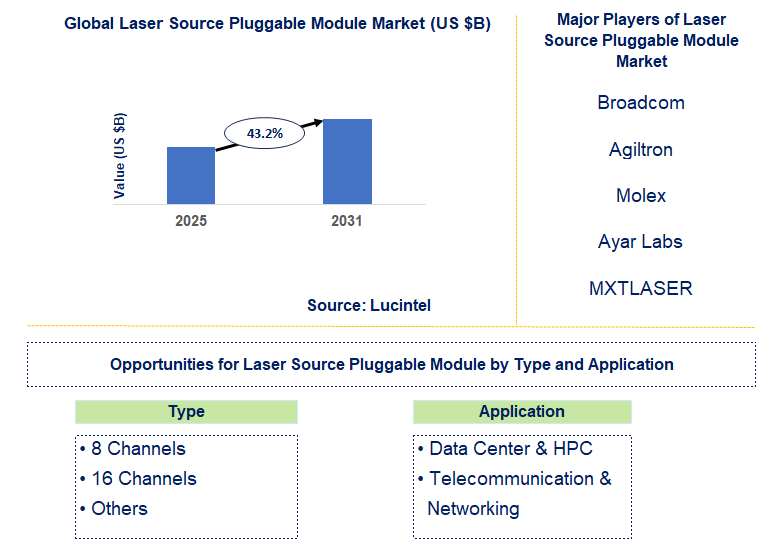
Key data points: The growth forecast = 43.2% annually for the next 7 years. Scroll below to get more insights. This market report covers trends, opportunities and forecasts in laser source pluggable module market to 2031 by type (8 channels, 16 channels, and others), application (data center & HPC and telecommunication & networking), and region (North America, Europe, Asia Pacific, and the Rest of the World)
We'll send your sample report shortly.
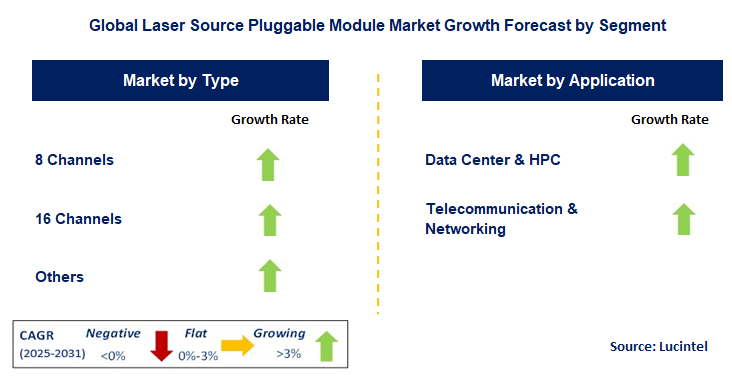
• Lucintel forecasts that, within the type category, 16 channel is expected to witness higher growth over the forecast period.
• Within the application category, data center & HPC is expected to witness higher growth.
• In terms of region, APAC is expected to witness the highest growth over the forecast period. Gain valuable insights for your business decisions with our comprehensive 150+ page report. Sample figures with some insights are shown below.
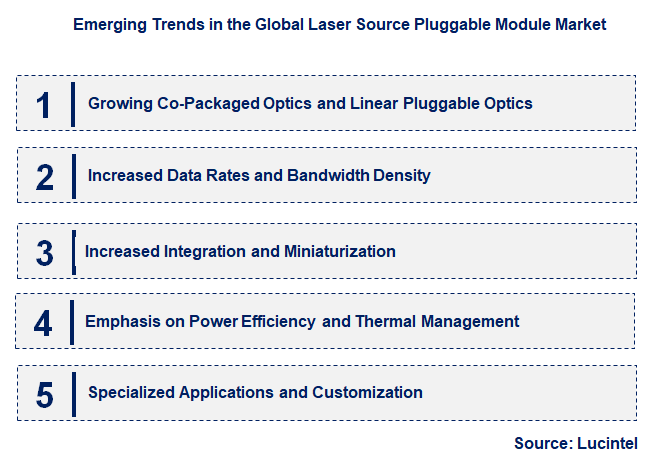
• Growing Co-Packaged Optics and Linear Pluggable Optics: This trend is a paradigm shift in the integration of optical modules. CPO is bringing the optical components near the switch ASIC, normally within the same package, to save power and latency, especially in high-speed data centers. LPO, however, eliminates the power-greedy Digital Signal Processor (DSP) from the pluggable module, making the module design easier and saving more power. Both are oriented towards meeting the power wall and bandwidth density issues caused by constantly rising data traffic. Their influence is significant, bringing in more energy-efficient and smaller data center designs.
• Increased Data Rates and Bandwidth Density: The industry is witnessing a relentless drive for increasing data rates, with 800G and 1.6T optical modules gaining wider traction. This is propelled by the boundless need for bandwidth within data centers, spurred on by technologies such as AI, machine learning, and cloud computing. To realize these speeds, there are innovations happening in modulation schemes, including 224 Gbps PAM4, and in high-speed laser source development and integrated photonic circuits. This trend indicates a perpetual competition to provide increasing amounts of data per unit area and power, which is essential for network infrastructure scaling.
• Increased Integration and Miniaturization: Miniaturization is still an essential trend, fueled by requirements for greater port density and greater flexibility of network topology within smart computing facilities. This entails advanced packaging technologies and integrated circuit design, enabling more sophisticated functionalities to be confined to smaller form factors. Silicon photonics is assuming center stage here, with high integration levels for hot-pluggable and co-packaged optical solutions. The effect is a decrease in the physical size and overall expense of optical interconnects, allowing for denser and more power-efficient network deployments.
• Emphasis on Power Efficiency and Thermal Management: The higher data rates, the more power is consumed, which is a major challenge to data center operators. Much focus is being placed on creating more efficient laser sources, low-power drive circuits, and innovative thermal management techniques, such as liquid cooling. Technologies such as LPO, by eliminating the DSP, address this directly. This trend is vital to sustainability and cost reduction in operations since it alleviates the huge amounts of energy required by high-performance computing and communication infrastructure.
• Specialized Applications and Customization: Going beyond general data communication, the market is witnessing growth in demand for specialized pluggable laser source modules designed for particular applications. These include modules for industrial high-power lasers to be applied in manufacturing, sophisticated medical diagnostics, and even quantum technologies. Companies are now providing customized modules meeting exact specifications in terms of wavelength, beam profile, and power levels. This movement represents a maturation in the market where the standardized offerings are supplemented by extremely specialized ones to address various and specialized industrial needs. These new trends are collectively transforming the laser source pluggable module market by expanding its limits of performance, efficiency, and integration. The transition to CPO and LPO, in combination with the ever-increasing quest for enhanced data rates and miniaturization, is developing a next generation of optical interconnects that are more efficient, smaller, and power-friendly. Greater emphasis on power savings and enhanced thermal management is mitigating key operational issues, while enhanced needs for specialized applications are stimulating customization and diversification in product offerings. Ultimately, these trends are facilitating the basic infrastructure needed for further growth in digital communication and advanced industrial processes.
• Development of Linear Pluggable Optics Solutions: LPO is a key innovation intended to cut power consumption in optical transceivers by removing the power-intensive Digital Signal Processor (DSP) normally present in legacy modules. By relocating DSP functionality to the host switch, LPO modules provide a more streamlined design with less latency and radically lower power consumption. This innovation is most important for hyperscale data centers, where power efficiency is an uppermost priority, allowing for greener and cost-saving operations at higher data rates.
• Advances in Co-Packaged Optics: CPO is a more fundamental integration in which optical devices are co-packaged alongside the switch ASIC. This innovation is intended to address the electrical interconnect restrictions of conventional pluggable modules, significantly minimizing signal loss and power dissipation. Though in its nascent stages of broad commercial deployment, CPO is considered a long-term proposition for ultra-high-bandwidth future data center interconnects. Its significance is in making unprecedented levels of integration and performance possible, drastically altering network topology.
• Push to 800G and 1.6T Modules: The industry has witnessed sharp evolution in data speeds, with 800 Gigabit per second (G) modules becoming increasingly popular and 1.6 Terabit per second (T) modules going into commercial rollout. This sharp speed boost is a direct consequence of the humongous data traffic that is created by AI, machine learning, and cloud computing. These faster-speed modules require next-generation laser technology, complex modulation formats (such as PAM4), and enhanced thermal management, stimulating tremendous R&D activity throughout the industry.
• Growing Emphasis on Silicon Photonics Integration Silicon photonics remains an important development area, providing the potential for integrative optical functionality on a silicon chip through standard semiconductor processing techniques. High-volume, low-cost manufacturing of low-power laser source modules is possible with the technology. Its influence can be felt with the rapidly expanding use of silicon photonics-based transceivers in data centers and other high-volume uses, opening the door to more integrated and scalable photonic solutions.
• Development of External Laser Source Modules: For the purpose of overcoming thermal management and serviceability issues of high-power lasers in co-packaged optics, the emerging trend is to develop External Laser Source (ELS) modules. The high-power continuous-wave lasers are remotely placed in these pluggable modules, which provide optical power to the CPO tiles. Optical eye safety, cabling, and maintenance are all made simple through this methodology, and it provides a workable solution for the deployment of CPO in harsh environments. These are the critical advances that are greatly influencing the laser source pluggable module market by propelling innovation on several fronts. They are causing a new generation of modules to be developed that not only deliver greater speeds and more integration, but are also considerably more energy efficient. The emphasis on LPO and CPO is transforming data center design, while the quest for greater data rates is breaking new ground in optical transmission. Silicon photonics is facilitating mass production and miniaturization, and ELS modules are working to overcome practical deployment issues.
• Hyperscale Data Centers and Cloud Computing: The explosive growth in hyperscale data centers fueled by cloud computing, artificial intelligence, and machine learning is a huge growth opportunity. Hyperscale data centers demand ultra-high-speed (800G, 1.6T) and power-efficient pluggable modules for intra-rack and intra-data center connectivity. Increasing demand for higher bandwidth density and lower latency optical interconnects continues unabated, and therefore, this market is a key driver for pluggable laser module innovation, particularly for linear pluggable optics (LPO) and co-packaged optics (CPO) solutions.
• 5G Telecommunications Infrastructure: The worldwide deployment of 5G networks is generating strong demand for laser source pluggable modules, especially for applications in fronthaul and backhaul. 5G infrastructure demands optical transceivers with high capacity to accommodate the enormity of data traffic and low latency. This encompasses modules for base stations, central office, and data aggregation nodes. The growth of 5G will continue to propel the requirement for robust, stable, and cost-efficient optical modules, providing a steady growth path for manufacturers.
• Industrial and Advanced Manufacturing Lasers: The growth of precision laser processing used in manufacturing, such as cutting, welding, marking, and additive manufacturing, represents a good opportunity for growth. High-power, stable, and frequently customized laser source pluggable modules to operate in harsh environments are needed for industrial applications. The automation and high-quality, efficient manufacturing process demands are leading to the use of these modules in more kinds of industrial laser systems, broadening the market into non-traditional communication applications.
• Medical and Healthcare Devices: The healthcare industry is an expanding market for laser source pluggable modules, especially in segments such as diagnostics, imaging (e.g., OCT), surgical interventions, and therapeutic treatments. These applications require highly dependable, accurate, and often wavelength-selective laser modules. Portability and miniaturization demands on medical devices are also driving the demand for small and efficient pluggable laser sources, establishing niche but high-value growth opportunities.
• Automotive and LiDAR Systems: The growing autonomous vehicle market and expanding use of Advanced Driver-Assistance Systems (ADAS) are fueling demand for laser source pluggable modules, particularly LiDAR applications. LiDAR requires reliable, high-performance laser sources for precise distance measurement and mapping. As carmakers add increasingly advanced sensor technologies, the need for compact, reliable, and mass-producible laser modules for automotive-grade LiDAR will present a considerable long-term growth opportunity. These growth opportunities are having a significant impact on the laser source pluggable module market in terms of expanding its application base and propelling specialized product development. Hyperscale data center and 5G network demand is challenging the limits of speed and efficiency, while industrial, medical, and automotive uses are driving innovation around power, accuracy, and environmental resilience. By concentrating on these primary application domains, industry players can capitalize on established know-how and create custom solutions for ensuring continued growth and applicability in a changing technological environment.
• Broadcom
• Agiltron
• Molex
• Ayar Labs
• MXTLASER
• 8 Channels
• 16 Channels
• Others
• Data Center & HPC
• Telecommunication & Networking
• North America
• Europe
• Asia Pacific
• The Rest of the World
• United States: The United States is the hotbed of pluggable laser module innovation, with impressive progress in high-speed optical transceivers for data centers. Vendors are making a heavy bet on technologies such as Linear Pluggable Optics (LPO) and Co-Packaged Optics (CPO) to minimize power consumption and maximize bandwidth density. There is also an emphasis on inculcating high-end functionalities, including embedded Optical Time Domain Reflectometers, into pluggable modules for real-time network analysis, meeting the growing demands of AI and machine learning workloads.
• China: China has become a leading player in the laser source pluggable module market based on its strong manufacturing capabilities and a fast-growing telecommunications and data center infrastructure. The nation is making rapid strides in the development of high-power, compact laser sources, such as deep UV lasers for next-generation lithography and quantum technology. Chinese companies are engaged in high-data-rate optical transceiver production, both for the domestic and global markets, frequently at competitive pricing.
• Germany: Germany is a leader in industrial laser module technology with a focus on precision, dependability, and individualization. German manufacturers are recognized for high-precision manufacturing of laser modules for use in industrial automation, medical technology, and metrology. There is significant research and development, and the result is sophisticated laser systems that fit extremely well into Industry 4.0 environments with high engineering standards and long-term stability in critical applications.
• India: India is also experiencing tremendous growth in the optical module production industry, driven by the surge in demand for 5G technology as well as growing data center infrastructure. India is looking at localizing the production and building partnerships in a bid to promote its capabilities in producing optical transceivers. Growing internet use and the rollout of VoIP as well as LTE networks are the driving factors for a growing need for sophisticated networking equipment, bringing great opportunities for India's optical transceiver market.
• Japan: Japan remains a leading contributor to photonics and integrated laser sources, with high performance and novel material development as the central focus. The latest developments involve the creation of glass Faraday elements for high-power lasers, which are essential in applications involving laser fusion and advanced industrial processing. Japanese industry leaders are in the lead in the pursuit of compact and efficient laser technology, enabling breakthroughs in fields ranging from optical communications, medical diagnosis, and precision manufacturing.


• Broadcom
• Agiltron
• Molex
• Ayar Labs
• MXTLASER Q5. Which laser source pluggable module market segment will be the largest in future? Answer: Lucintel forecasts that, within the type category, 16 channel is expected to witness higher growth over the forecast period. Q6. In laser source pluggable module market, which region is expected to be the largest in next 5 years? Answer: In terms of region, APAC is expected to witness the highest growth over the forecast period. Q7. Do we receive customization in this report? Answer: Yes, Lucintel provides 10% customization without any additional cost.


Choose a license that fits your team. Instant PDF delivery.
Prices exclude taxes. Instant delivery. Custom licensing available on request.
Market Report · July 29, 2026
Market Report · July 20, 2026
Market Report · July 20, 2026
Trusted partner for strategic intelligence and business growth


Receive a complimentary market analysis tailored to your industry. Our analysts will identify key growth opportunities and competitive dynamics specific to your business.

Market size, growth rate, and key trend analysis for your specific sector.

Top competitor positioning and market share analysis.

Strategic recommendations backed by data-driven insights.
Get curated market intelligence and competitive moves straight to your inbox.
By subscribing, you agree to receive our monthly insights. Unsubscribe anytime.
Receive a complimentary market analysis tailored to your industry. Our analysts will identify key growth opportunities and competitive dynamics specific to your business.
Market size, growth rate, and key trend analysis for your specific sector.
Top competitor positioning and market share analysis.
Strategic recommendations backed by data-driven insights.
Get curated market intelligence, emerging trends, and competitive moves straight to your inbox each month.
By subscribing, you agree to receive our monthly insights. Unsubscribe anytime.
We'll send your sample report shortly.