
Market Report · July 29, 2026

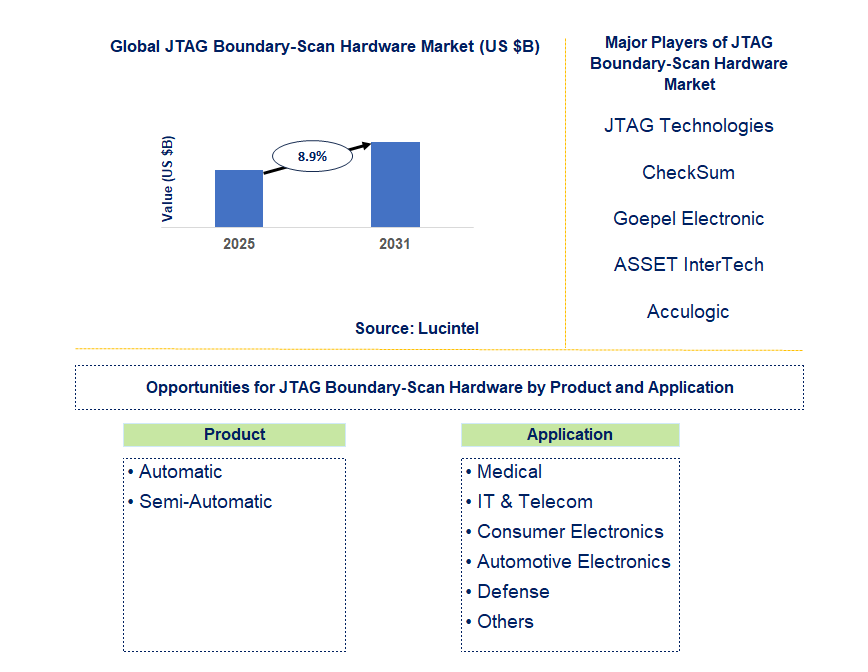
Key data points: The growth forecast = 8.9% annually for the next 7 years. Scroll below to get more insights. This market report covers Trends, opportunity and forecast in JTAG boundary-scan hardware market to 2031 by product (automatic and semi-automatic), application (medical, it & telecom, consumer electronics, automotive electronics, defense, and others), and region (North America, Europe, Asia Pacific, and the Rest of the World)
We'll send your sample report shortly.
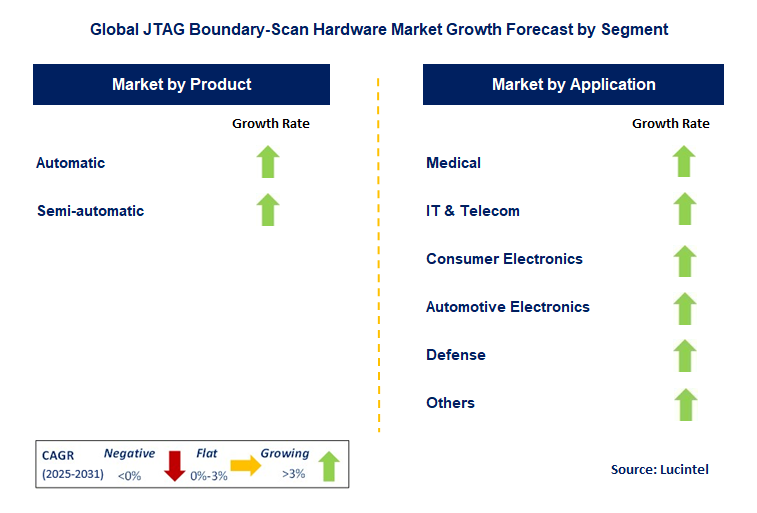
• Lucintel forecasts that, within the product category, automatic is expected to witness higher growth over the forecast period.
• Within the application category, medical is expected to witness the highest growth.
• In terms of region, APAC is expected to witness the highest growth over the forecast period. Gain valuable insights for your business decisions with our comprehensive 150+ page report. Sample figures with some insights are shown below.
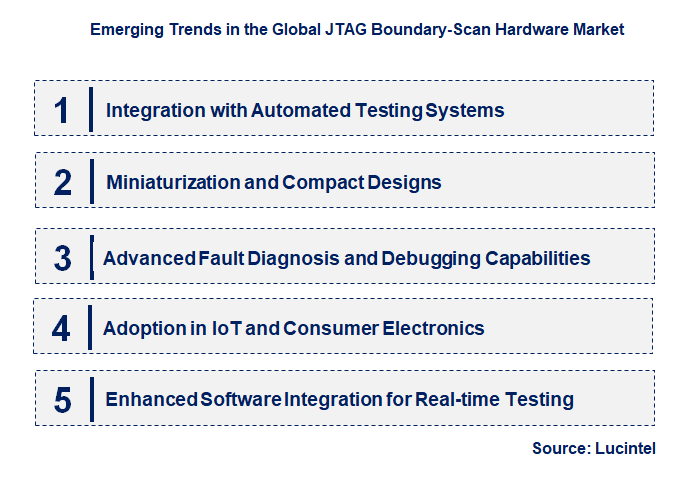
• Integration with Automated Testing Systems: The integration of JTAG boundary-scan hardware with automated testing systems is enhancing test efficiency and accuracy. Manufacturers are increasingly adopting automated test equipment (ATE) that utilizes boundary-scan for faster and more reliable defect detection. This integration allows for high-volume testing while reducing the manual effort required in traditional test setups. Automation streamlines the testing process, reduces human error, and accelerates the time-to-market for products. The trend is helping manufacturers deliver higher-quality electronic systems with fewer defects and faster production timelines, ultimately increasing operational efficiency.
• Miniaturization and Compact Designs: As electronic devices continue to become smaller and more powerful, JTAG boundary-scan hardware is evolving to meet the demands of miniaturized designs. The push for smaller and more integrated circuit boards in consumer electronics, automotive applications, and industrial devices has driven the development of compact, high-density boundary-scan solutions. Manufacturers are focusing on designing smaller testing devices capable of managing complex interconnections in highly compact electronic systems. This trend allows for improved performance in space-constrained environments, ensuring that testing and diagnostics remain effective even in miniature designs.
• Advanced Fault Diagnosis and Debugging Capabilities: Boundary-scan technology is evolving to offer advanced fault diagnosis and debugging capabilities, including more sophisticated analysis of electrical and functional failures. As systems become more complex, there is a growing need for detailed insights into how components interact within a device. JTAG boundary-scan hardware is now capable of providing deeper diagnostic information, enabling engineers to identify issues at both the component and system levels more effectively. This trend is improving the accuracy of troubleshooting, reducing the time needed to identify faults, and enhancing the overall quality and reliability of products.
• Adoption in IoT and Consumer Electronics: The Internet of Things (IoT) and consumer electronics markets are increasingly adopting JTAG boundary-scan technology for testing purposes. With the explosion of connected devices and wearables, testing requirements are becoming more demanding. JTAG boundary scan offers a cost-effective and non-invasive method for checking the functionality and reliability of IoT devices. This trend is significant in industries where rapid development and deployment are critical. JTAG is becoming essential in ensuring the performance and durability of IoT devices, allowing for high-quality standards without sacrificing time or cost.
• Enhanced Software Integration for Real-time Testing: The development of software tools that integrate with JTAG boundary-scan hardware is revolutionizing real-time testing and monitoring of electronic systems. These advanced software tools offer capabilities such as real-time data analysis, reporting, and seamless integration with existing design and simulation tools. As a result, engineers can perform more comprehensive and immediate tests on devices, allowing for faster adjustments during development and production. This integration improves collaboration between hardware and software teams, reducing product development cycles and enabling better control over manufacturing quality. The emerging trends in the JTAG boundary-scan hardware market are reshaping the landscape of electronic testing and diagnostics. Integration with automated systems, miniaturization of designs, enhanced fault diagnosis, adoption of IoT and consumer electronics, and improved software tools are all contributing to a more efficient and effective testing process. These trends enable manufacturers to meet the increasing demand for faster, smaller, and more reliable electronic products while reducing costs and improving quality. As these trends continue to evolve, JTAG boundary-scan technology will remain a critical enabler of innovation in electronic product development and production.
• Integration with Automated Test Equipment (ATE): Recent advancements in integrating JTAG Boundary-Scan with Automated Test Equipment (ATE) have enabled more efficient testing processes. By automating the test procedures, manufacturers can significantly reduce test times and human error while improving the reliability of results. This integration has enhanced the ability to perform high-volume testing, making it particularly valuable in industries like consumer electronics and automotive, where product reliability is critical. As more manufacturers adopt automated testing, the market is seeing an increase in demand for more sophisticated and adaptable Boundary-Scan solutions that can be easily incorporated into ATE setups.
• Miniaturization of Boundary-Scan Hardware: The trend towards miniaturization in electronics has had a significant impact on the JTAG boundary-scan hardware market. With the increasing need for smaller, more compact electronic devices, the size and complexity of the testing equipment must also shrink. Manufacturers have responded by developing smaller, more efficient Boundary-Scan tools that can fit into increasingly compact designs without compromising performance. This miniaturization is especially important for industries like mobile devices, wearables, and automotive, where space constraints are a major factor in the design process. The demand for miniaturized solutions is driving innovation and expanding the potential applications for JTAG technology.
• Improved Software Tools for Diagnostics and Analysis: Recent developments in software tools for Boundary-Scan diagnostics and analysis have significantly enhanced the efficiency and accuracy of testing. New software solutions offer more powerful algorithms for faster fault detection and root cause analysis, enabling quicker turnaround times in product development cycles. These tools are now capable of handling increasingly complex circuit designs, which are common in modern electronics. As a result, manufacturers can detect issues earlier in the production process, reducing the cost of rework and improving overall product quality. The increased sophistication of software is playing a crucial role in boosting the adoption of Boundary-Scan technology.
• Increased Adoption in Automotive and Aerospace Industries: Boundary-Scan technology has become increasingly vital in the automotive and aerospace industries, where the complexity of electronics continues to grow. These sectors require high levels of precision, reliability, and performance in their electronic systems, making JTAG Boundary-Scan an essential tool for ensuring quality and compliance with stringent safety standards. Recent developments have seen the technology applied more extensively in areas like advanced driver-assistance systems (ADAS), electric vehicle electronics, and avionics. The growing reliance on high-performance electronics in these industries is driving demand for more robust and versatile Boundary-Scan solutions, further expanding the market’s reach.
• Cloud-Based Boundary-Scan Solutions: The rise of cloud-based solutions has also impacted the JTAG boundary-scan hardware market, enabling more flexible and scalable testing environments. Cloud-based platforms allow for remote testing, collaboration, and data storage, making it easier for teams across different locations to work together on test and diagnostic processes. This development has been particularly useful in the semiconductor industry, where global teams often need to access test results and collaborate in real-time. Cloud integration is also reducing the cost of infrastructure, enabling smaller manufacturers to access advanced testing capabilities without significant capital investment. This trend is contributing to the democratization of Boundary-Scan technology. These developments have collectively advanced the JTAG boundary-scan hardware market, improving its efficiency, accessibility, and adaptability. The integration with automated testing equipment, miniaturization of hardware, and improved software tools are making it easier for manufacturers to incorporate this technology into their production lines. Meanwhile, the increased adoption in industries like automotive and aerospace and the shift toward cloud-based solutions are broadening the applications of Boundary-Scan testing. As a result, the market is poised for continued growth, with more industries and applications relying on JTAG technology for faster, more reliable testing solutions.
• Automotive Industry Testing: The automotive sector is witnessing rapid advancements in autonomous vehicles, electric cars, and connected technologies, all of which require precise and efficient testing. JTAG boundary-scan technology provides a non-intrusive way to test complex electronic control units (ECUs) in vehicles. It is used to ensure the functionality of critical systems like infotainment, safety features, and powertrain controls. With the increasing complexity of automotive electronics, the demand for JTAG-based solutions will grow, providing automotive manufacturers with faster, more reliable testing methods, which ultimately improve safety, performance, and time-to-market.
• Consumer Electronics Development: The consumer electronics industry is booming with the continuous release of advanced products such as smartphones, wearables, and smart home devices. JTAG boundary-scan technology is increasingly adopted for testing and debugging these complex devices. It allows for efficient testing of miniaturized and multi-functional components, ensuring higher product quality and faster time to market. As consumer electronics continue to evolve with more intricate designs, JTAG offers a valuable solution for manufacturers to meet the growing demand for seamless and reliable electronic products.
• Telecommunications Equipment Manufacturing: Telecommunications infrastructure, including 5G networks, IoT devices, and communication systems, requires advanced hardware that is highly reliable and efficient. JTAG boundary-scan technology enables testing and validation of these systems' complex circuits, including antennas, processors, and power management units. As global demand for high-speed internet and smart devices increases, JTAG tools will play a crucial role in ensuring the reliability and performance of telecom equipment. This creates a growth opportunity for JTAG solutions, enabling telecom manufacturers to meet stringent quality standards while reducing production costs and time-to-market.
• Aerospace and Defense Sector: Aerospace and defense applications require robust and reliable hardware for mission-critical systems, such as navigation, communication, and radar equipment. JTAG boundary-scan technology supports testing of complex military and aerospace systems, ensuring they meet stringent reliability and safety standards. As these industries continue to develop advanced technologies like drones, satellites, and defense communication systems, the demand for JTAG solutions will increase. By enabling efficient in-system testing, JTAG technology enhances the operational readiness of these systems while reducing the risk of failures in high-stakes environments.
• Industrial Automation and Robotics: As the industrial automation and robotics markets expand, the demand for advanced testing solutions for automated systems and robotic components grows. JTAG boundary-scan technology is used to ensure that robots and automation systems are functioning as intended, from sensors to control units. This market is expanding with the rise of Industry 4.0 and the increasing need for precision and reliability in manufacturing environments. JTAG technology is a cost-effective solution for ensuring the performance of complex robotic systems, offering manufacturers the opportunity to reduce downtime, improve system reliability, and accelerate production. The strategic growth opportunities in the JTAG boundary-scan hardware market are substantial, driven by applications in key industries such as automotive, consumer electronics, telecommunications, aerospace, and industrial automation. As these sectors continue to evolve, JTAG technology provides an efficient and cost-effective means of testing and ensuring the functionality of increasingly complex systems. The growing demand for high-quality, reliable, and faster-to-market products is pushing manufacturers to adopt advanced boundary-scan solutions. These opportunities not only help companies reduce costs and time-to-market but also ensure that products meet the high standards required by modern industries, positioning JTAG as a critical enabler of innovation and operational excellence.
• JTAG Technologies
• CheckSum
• Goepel Electronic
• ASSET InterTech
• Acculogic
• Flynn Systems
• XJTAG Limited
• EWA Technologie
• Keysight Technologies
• Teradyne
• Automatic
• Semi-automatic
• Medical
• IT & Telecom
• Consumer Electronics
• Automotive Electronics
• Defense
• Others
• North America
• Europe
• Asia Pacific
• The Rest of the World
• United States: In the United States, JTAG Boundary-Scan Hardware has seen widespread adoption, driven by technological advancements and increasing demand for high-performance electronic systems. Innovations have focused on improving speed and accuracy, supporting the country’s competitive position in semiconductor testing. The development of more compact, cost-effective solutions has also been critical for the expansion of its use across various industries. Furthermore, the automotive sector has been leveraging Boundary-Scan technology to meet the rising complexity of in-vehicle electronics.
• China: The Chinese growing electronics manufacturing industry has made it a key player in the JTAG boundary-scan hardware market. With an increasing number of electronics being produced, the need for advanced testing tools has accelerated. Chinese companies have made significant strides in enhancing the functionality of Boundary-Scan systems, offering more integrated solutions that combine testing and diagnostics in a single platform. This shift has helped boost the adoption of this technology across sectors such as telecommunications, automotive, and consumer electronics.
• Germany: Germany remains a leader in precision engineering, and its JTAG boundary-scan hardware market has evolved to support industries such as automotive and aerospace. Recent advancements have centered on improving the scalability and adaptability of testing systems to meet the stringent standards set by German manufacturers. With a strong focus on automation and the integration of advanced diagnostics, the country has seen increasing demand for high-performance, reliable testing solutions to support its world-class manufacturing base.
• India: The Indian JTAG boundary-scan hardware market has been rapidly expanding as the country’s electronics and automotive sectors grow. With the rise of smart devices and electric vehicles, Indian manufacturers are increasingly adopting Boundary-Scan technology to improve product quality and reduce testing time. Technological improvements in software tools and test automation have enhanced the effectiveness of these systems, making them more accessible and affordable for domestic manufacturers. This trend is likely to continue as India increases its footprint in global manufacturing and technology.
• Japan: In Japan, JTAG boundary-scan hardware is widely used in the automotive, robotics, and consumer electronics industries. The focus in recent years has been on refining the testing process to handle the increased integration of complex electronics in these sectors. Japanese manufacturers have been at the forefront of developing multi-functional testing platforms, making it easier to implement Boundary-Scan technology alongside other diagnostic techniques. As the demand for precision in electronics manufacturing continues to grow, Japan’s role in advancing Boundary-Scan solutions remains significant.


• JTAG Technologies
• CheckSum
• Goepel Electronic
• ASSET InterTech
• Acculogic
• Flynn Systems
• XJTAG Limited
• EWA Technologie
• Keysight Technologies
• Teradyne Q5. Which JTAG boundary-scan hardware market segment will be the largest in future? Answer: Lucintel forecasts that automatic is expected to witness higher growth over the forecast period. Q6. In JTAG boundary-scan hardware market, which region is expected to be the largest in next 5 years? Answer: APAC is expected to witness the highest growth over the forecast period. Q7. Do we receive customization in this report? Answer: Yes, Lucintel provides 10% customization without any additional cost.


Choose a license that fits your team. Instant PDF delivery.
Prices exclude taxes. Instant delivery. Custom licensing available on request.
Market Report · July 29, 2026
Market Report · July 20, 2026
Market Report · July 20, 2026
Trusted partner for strategic intelligence and business growth


Receive a complimentary market analysis tailored to your industry. Our analysts will identify key growth opportunities and competitive dynamics specific to your business.

Market size, growth rate, and key trend analysis for your specific sector.

Top competitor positioning and market share analysis.

Strategic recommendations backed by data-driven insights.
Get curated market intelligence and competitive moves straight to your inbox.
By subscribing, you agree to receive our monthly insights. Unsubscribe anytime.
Receive a complimentary market analysis tailored to your industry. Our analysts will identify key growth opportunities and competitive dynamics specific to your business.
Market size, growth rate, and key trend analysis for your specific sector.
Top competitor positioning and market share analysis.
Strategic recommendations backed by data-driven insights.
Get curated market intelligence, emerging trends, and competitive moves straight to your inbox each month.
By subscribing, you agree to receive our monthly insights. Unsubscribe anytime.
We'll send your sample report shortly.