
Market Report · July 16, 2026

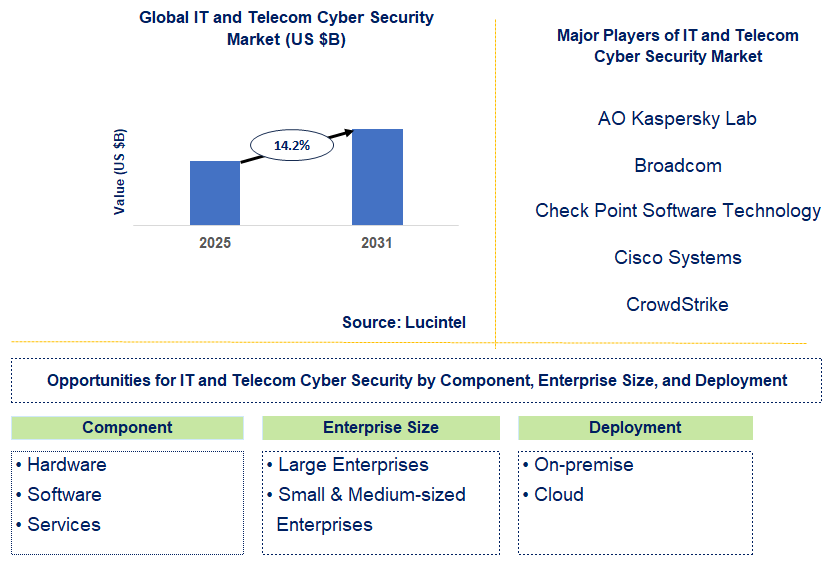
Key data points: The growth forecast = 14.2% annually for the next 7 years. Scroll below to get more insights. This market report covers trends, opportunities and forecasts in IT and telecom cyber security market to 2031 by component (hardware, software, and services), enterprise size (large enterprises and small & medium-sized enterprises), deployment (on-premise and cloud), and region (North America, Europe, Asia Pacific, and the Rest of the World)
We'll send your sample report shortly.
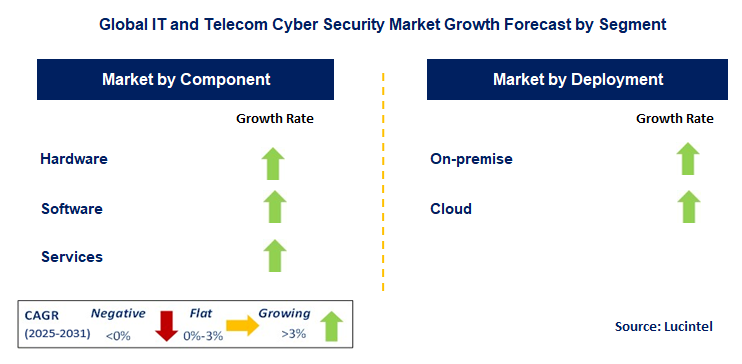
• Lucintel forecasts that, within the component category, software will remain the largest segment over the forecast period.
• Within the deployment category, on-premise will remain a larger segment.
• In terms of region, North America will remain the largest region over the forecast period. Gain valuable insights for your business decisions with our comprehensive 150+ page report. Sample figures with some insights are shown below.
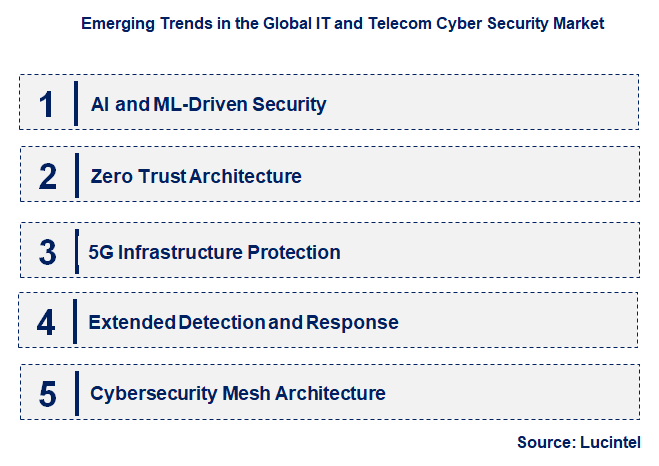
• AI and ML-Driven Security: Artificial intelligence and machine learning are being used to improve threat detection, automate responses, and anticipate future attacks. AI algorithms will be able to scan huge sets of data to detect anomalies and patterns that point to malicious activity, leading to a more proactive defense for IT and telecom networks. This enables quicker response to incidents and less workload for security teams.
• Zero Trust Architecture: The old perimeter-based security model is being replaced by zero trust, under which no user or device is trusted by default. In IT and telecom, it translates into incessant authentication of all access requests, both inside and outside the network. Zero trust entails micro-segmentation, multi-factor authentication, and least privilege access to contain the effect of breaches.
• 5G Infrastructure Protection: The deployment of 5G networks presents new security threats based on its greater speed, density, and number of connected devices. Trends in emerging technology are directed towards the protection of 5G infrastructure with sophisticated encryption, secure network slicing, and strong authentication mechanisms to safeguard against eavesdropping and service theft.
• Extended Detection and Response: XDR is evolving from legacy endpoint detection and response to delivering an integrated security incident detection and response across endpoints, networks, email, and cloud. The comprehensive approach provides improved visibility into the threat environment within IT and telecom, allowing for quick and efficient resolution of incidents.
• Cybersecurity Mesh Architecture: CSMA is a distributed architecture that seeks to deliver unified security across a diverse and dispersed digital presence. In IT and telecommunications, where resources tend to be distributed among on-premises, cloud, and edge domains, CSMA facilitates the establishment of a more scalable and interoperable framework for security. These trends are restructuring the IT and telecom cyber security market by fueling the growth and adoption of more intelligent, adaptive, and integrated security solutions that can tackle the sophistication of contemporary digital and communication infrastructures.
• Elevated Threat Intelligence: There is increasing focus on using advanced threat intelligence systems that collect and analyze information from different sources to offer real-time information about new threats against IT and telecom infrastructure. This helps organizations actively protect themselves against possible attacks.
• Security Automation and Orchestration: To manage the scale and pace of cyber-attacks, security automation and orchestration (SOAR) technologies are gaining wider uptake. SOAR technologies automate routine security tasks, simplify incident response, and enhance the efficiency of security operations in IT and telecom organizations.
• Cloud-Native Security Solutions: As the IT and telecommunication services continue to migrate to the cloud, there is growing need for security solutions that are native to the cloud. They provide scalable security for cloud applications, data, and infrastructure.
• Supply Chain Security Focus: Since vulnerabilities in the supply chain can also influence IT and telecom networks, recent moves have seen an increased focus on ensuring the security of third-party vendors and infrastructure providers. It entails rigorous vetting procedures and ongoing monitoring.
• Improved Endpoint Security: With the explosion of devices that connect to IT and telecom networks, endpoint security advancements are important. This involves AI-driven endpoint detection and response (EDR) capabilities that can detect and neutralize threats at the device level better. These advances are affecting the IT and telecom cyber security marketplace by creating a move towards more proactive, automated, and cloud-based security approaches that can more effectively safeguard the critical infrastructure and enormous pools of data within these industries.
• Safeguarding 5G Networks: The adoption of 5G technology offers a major growth opportunity for security vendors. Securing the new infrastructure, edge compute elements, and vast numbers of connected devices on 5G networks necessitates security solutions with specialized capabilities.
• OT and IoT Security: The intersection of IT with Operational Technology (OT) in industries, enabled by telecom networks and IoT devices, generates a need for cybersecurity products that can safeguard both spaces. This includes protecting industrial control systems and IoT devices in telecom networks.
• Cloud Security Services: With IT and telecom companies adopting cloud services more and more, the requirement for secure cloud security solutions, such as data safeguarding, identity management, and threat defense specifically designed for cloud environments, provides huge growth opportunities.
• Managed Security Services: With the complexity of the threat environment and the lack of qualified cybersecurity experts, the need for managed security services within the IT and telecom industries is on the increase. MSSPs offer outsourced security monitoring, threat detection, and incident response.
• Smart City Cybersecurity: Smart city development, which is highly dependent on interconnected IT and telecommunication infrastructure, offers a growth prospect for cybersecurity solutions that can defend urban digital environments, such as transportation, energy, and public safety systems. These growth prospects are affecting the IT and telecom cyber security market by stimulating the creation of specialized security products aligned with the specific challenges and needs of these disparate application segments, resulting in market growth and innovation.
• AO Kaspersky Lab
• Broadcom
• Check Point Software Technology
• Cisco Systems
• CrowdStrike
• IBM Corporation
• McAfee
• Microsoft
• Palo Alto Networks
• Sophos
• Hardware
• Software
• Services
• Large Enterprises
• Small & Medium-sized Enterprises
• North America
• Europe
• Asia Pacific
• The Rest of the World
• United States: The American market is dominated by a high emphasis placed on innovation in AI-powered threat detection and response within the telecom and IT industries. The latest updates include mass investments in securing 5G networks and increasing zero-trust security models across private and federal organizations. The market also witnesses an immense need for managed security services in order to overcome the lack of cybersecurity experts.
• China: China is focusing on indigenous development of cybersecurity technologies for its IT and telecom infrastructure in line with national security goals. Recent developments have seen it implement tighter data security laws and its efforts to fortify its growing 5G network both internally and from foreign attacks.
• Germany: Recent trends in Germany are driven mostly by rigorous data protection regulations and high focus on privacy. The market is seeing an upsurge in demand for GDPR-compliant cybersecurity solutions, especially for the telecommunications industry with a massive influx of user data. There is also emphasis on industrial IoT security in the manufacturing industry, which has high dependence on telecom infrastructure.
• India: India's IT and telecom cybersecurity market is growing fast, led by growing internet penetration and the government's Digital India program. Recent activities include the launch of national cybersecurity plans and a rising use of cloud-based security solutions to secure the growing digital infrastructure and telecom networks.
• Japan: Japan is concentrating on improving the strength of its IT and telecom infrastructure against advanced cyberattacks and natural disasters. Recent strides include investments in next-generation threat intelligence platforms and an initiative to move towards more coordination between the government and private sector in order to fortify the overall cybersecurity stance, primarily for mission-critical telecom services.


• AO Kaspersky Lab
• Broadcom
• Check Point Software Technology
• Cisco Systems
• CrowdStrike
• IBM Corporation
• McAfee
• Microsoft
• Palo Alto Networks
• Sophos Q5. Which IT and telecom cyber security market segment will be the largest in future? Answer: Lucintel forecasts that, within the component category, software will remain the largest segment over the forecast period. Q6. In IT and telecom cyber security market, which region is expected to be the largest in next 5 years? Answer: In terms of region, North America will remain the largest region over the forecast period. Q7. Do we receive customization in this report? Answer: Yes, Lucintel provides 10% customization without any additional cost.


Choose a license that fits your team. Instant PDF delivery.
Prices exclude taxes. Instant delivery. Custom licensing available on request.
Market Report · July 16, 2026
Market Report · May 18, 2026
Market Report · May 18, 2026
Trusted partner for strategic intelligence and business growth


Receive a complimentary market analysis tailored to your industry. Our analysts will identify key growth opportunities and competitive dynamics specific to your business.

Market size, growth rate, and key trend analysis for your specific sector.

Top competitor positioning and market share analysis.

Strategic recommendations backed by data-driven insights.
Get curated market intelligence and competitive moves straight to your inbox.
By subscribing, you agree to receive our monthly insights. Unsubscribe anytime.
Receive a complimentary market analysis tailored to your industry. Our analysts will identify key growth opportunities and competitive dynamics specific to your business.
Market size, growth rate, and key trend analysis for your specific sector.
Top competitor positioning and market share analysis.
Strategic recommendations backed by data-driven insights.
Get curated market intelligence, emerging trends, and competitive moves straight to your inbox each month.
By subscribing, you agree to receive our monthly insights. Unsubscribe anytime.
We'll send your sample report shortly.