
Market Report · July 22, 2026

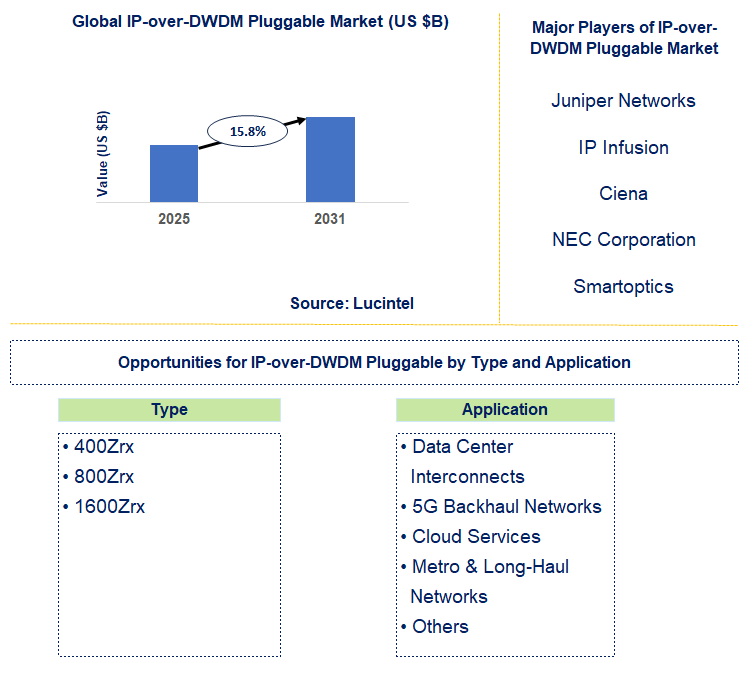
Key data points: The growth forecast = 15.8% annually for the next 7 years. Scroll below to get more insights. This market report covers trends, opportunities and forecasts in IP-over-DWDM pluggable market to 2031 by type (400ZRx, 800ZRx, and 1600ZRx), application (data center interconnects, 5G backhaul networks, cloud services, metro & long-haul networks, and others), and region (North America, Europe, Asia Pacific, and the Rest of the World)
We'll send your sample report shortly.
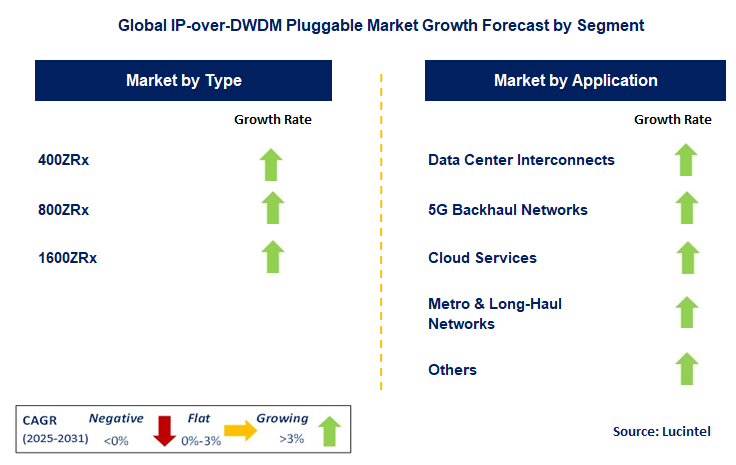
• Lucintel forecasts that, within the type category, 1600zrx is expected to witness the highest growth over the forecast period.
• Within the application category, data center interconnect is expected to witness the highest growth.
• In terms of region, APAC is expected to witness the highest growth over the forecast period. Gain valuable insights for your business decisions with our comprehensive 150+ page report. Sample figures with some insights are shown below.
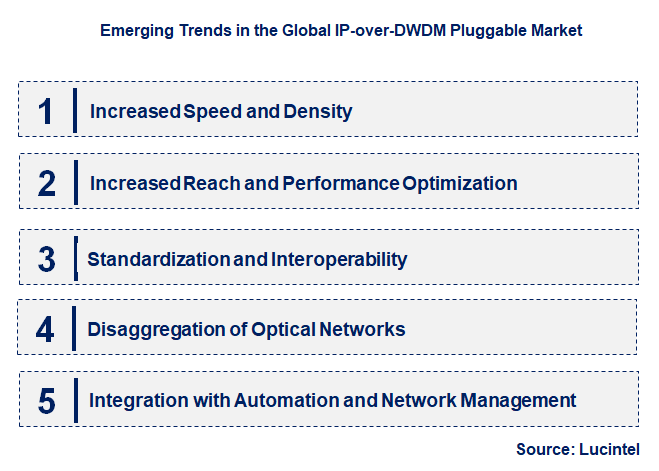
• Increased Speed and Density: The insatiable need for bandwidth is driving the industry towards pluggable higher-speed coherent optics. Although 400ZR and 400ZR+ are popular, there is a high level of development and interest in 800G and even 1.2T pluggable modules. Higher speeds are essential for scaling data center interconnects (DCIs), metro networks, and ultimately long-haul networks, to transport more data on fewer fibers. Higher density, providing higher port numbers per router line card, increases network scalability even more and diminishes physical footprint, which results in huge cost and power efficiencies for operators.
• Increased Reach and Performance Optimization: Originally intended for short DCI and metro scenarios, IP-over-DWDM pluggable are being optimized for longer reaches and more demanding network environments. This involves innovations in digital signal processing (DSP) technologies and optical components to enhance signal-to-noise ratio and chromatic dispersion tolerance. The creation of modules with increased transmit power (e.g., 0dBm for ZR+) is making them suitable for brownfield deployments over existing reconfigurable optical add/drop multiplexer (ROADM) networks, broadening their scope beyond greenfield deployments.
• Standardization and Interoperability: The market is becoming more open standards and multi-vendor interoperability-based. Efforts such as Open ZR+ and Open ROADM play an important role in making pluggable coherent optics from various vendors capable of working smoothly together. This direction eliminates vendor lock-in, promotes competition, and allows network operators to have better flexibility in choosing components. It also boosts the adoption of IP-over-DWDM by lowering deployment risk and making network integration easier, which is vital for mass market deployment.
• Disaggregation of Optical Networks: IP-over-DWDM pluggable play a crucial enabling role in the optical network disaggregation, splitting hardware and software apart and enabling interoperability across components from different vendors. The trend gives network operators the power to select best-of-breed solutions for every layer of the network, promoting increased flexibility, efficiency, and cost savings. It shifts from monolithic, vertically integrated systems to an increasingly open and agile network architecture that is aligned with the tenets of software-defined networking (SDN) and network function virtualization (NFV).
• Integration with Automation and Network Management: As networks grow more complicated with the implementation of IP-over-DWDM, sophisticated automation and integrated network management solutions are increasingly essential. The trend here is creating software tools and platforms that have end-to-end visibility and control for both the IP and optical layers. Automation of provisioning, diagnostics, and optimization functions lowers operational costs and enhances network agility, ensuring the full value of IP-over-DWDM is captured. These trends are inherently transforming the IP-over-DWDM pluggable market by facilitating levels of network efficiency, scalability, and flexibility that have never been seen before. Increased speeds and longer reach are broadening the use case for these modules across the different network segments. Standardization and disaggregation are creating an open and competitive ecosystem, providing operators with more choice and control. The integration with automation and advanced management solutions is streamlining operations and resulting in substantial Cap Ex and Op Ex reductions. Together, these trends are driving the global adoption of IP-over-DWDM at an ever-faster pace, cementing its position as a foundation technology for next-generation high-capacity networks.
• 400ZR/ZR+ Commercialization and Mass Adoption: The most notable advancement is the commercial success and swift uptake of 400ZR and 400ZR+ pluggable coherent optics. These modules, which fit directly into router and switch ports, have demonstrated their ability to ease network architectures and provide high-capacity transmission across metro and regional distances. Their commonality from several vendors, along with better performance and economies of scale, has established them as the go-to for data center interconnects and metro network upgrades, changing the provisioning of bandwidth.
• Developments in Digital Signal Processors: Recent advances in digital signal processor (DSP) technology have played a crucial role in making possible increased performance and reduced power consumption for IP-over-DWDM pluggable. The next-generation DSP makes more advanced modulation formats, superior error correction codes, and higher tolerance to fiber impairments possible. This allows increased reach and increased data rate in the small form factors, pushing the use of IP-over-DWDM from its original target short-reach data center interconnect use case into more challenging metro and even regional deployment scenarios.
• Introduction of High-Power 0dBm Pluggable: The availability of 0dBm (transmit power) coherent pluggable, especially for 400ZR/ZR+, is an important step. Previous pluggable tended to have less transmit power, either in reduced reach or needing external amplification, especially in brownfield installations where there is a legacy ROADM infrastructure. High-power pluggable can plug directly into open line systems and cross multiple stages of ROADM without amplification, streamlining network designs and lowering overall system cost and operational complexity for operators by a wide margin.
• Greater Interoperability and Maturity of Ecosystem: The market for IP-over-DWDM has witnessed increased interoperability, with several vendors showcasing their pluggable modules coexisting cohesively. Industry organizations such as the Optical Internetworking Forum (OIF) have contributed to the standardization of interfaces and performance metrics. The increasing maturity of the ecosystem combined with plug-and-play features boosts the confidence of network operators, driving increased adoption and reducing the shift from proprietary, vertically integrated solutions toward open, disaggregated optical networks.
• Prioritize Sustainability and Energy Efficiency: As there is more concern for environmental footprint and escalating energy expenses, one of the key developments is that sustainability and power efficiency are becoming big deals in IP-over-DWDM pluggable. Since these modules exclude unnecessary intermediate transponder layers, they naturally save power as well as cooling needs. The newer designs target optimizing power performance within the pluggable form factor itself, and thus they represent a tempting solution for network operators seeking to construct more environmentally friendly and sustainable optical networks. These advancements are profoundly influencing the IP-over-DWDM pluggable market. Global availability and uptake of 400ZR/ZR+ are promoting a router-centric optical network direction. Developments in DSP and high-power pluggable are increasing reach and performance, widening their use. Greater interoperability is building a more aggressive and adaptable ecosystem, with emphasis on sustainability aligning with global environmental ambitions. Together, all these advances are speeding up the convergence of IP and optical layers, resulting in future network architectures that are less complex, more efficient, and more scalable.
• Data Center Interconnect: The runaway growth of cloud services and artificial intelligence (AI) is driving an unprecedented need for high-capacity and low-latency interconnects between data centers. IP-over-DWDM pluggable present a highly attractive solution for DCI, providing direct, cost-effective, and energy-efficient optical links. Strategic areas include building faster-speed pluggable (e.g., 800G and 1.2T), reaching further for geographically distributed data centers, and offering enhanced telemetry for network visibility and automation to address hyperscale’s' and enterprises' dynamic requirements.
• Metro and Regional Networks: Conventional metro and regional networks are being massively upgraded to accommodate 5G backhaul, enhanced residential broadband, and distributed cloud services. IP-over-DWDM pluggable provide a cost-effective and streamlined mechanism for adding capacity and reach in such networks, obviating the use of standalone optical transponders. Opportunities for growth include introducing pluggable with enhanced optical performance to support various fiber types and complicated ROADM configurations, as well as strong management solutions with carrier-grade reliability and ease of installation.
• 5G Fronthaul and Madhul: 5G network deployments, with their distributed radio access network (RAN) architecture, offer an unprecedented opportunity for IP-over-DWDM pluggable in fronthaul and mi haul segments. The applications call for high-bandwidth, low-latency connectivity between central units and base stations. Pluggable coherent optics can demystify the optical layer in these segments, lowering tower space, power usage, and mobile network operator operating expenses. Tailoring solutions to different distances and conditions in different 5G deployment environments is a central theme.
• Enterprise and Campus Networks: Campus networks and large enterprises are looking more and more to upgrade their backbone infrastructure to handle bandwidth-hungry applications, inter-building connections, and hybrid cloud models. IP-over-DWDM pluggable represent a convenient and affordable alternative to legacy optical transport for private networks. Strategic opportunities involve creating plug-and-play solutions with ease of use, offering end-to-end technical support for enterprise IT departments, and presenting embedded security functionalities to meet specialized enterprise needs for secure and dependable data transmission.
• Emerging Subsea and Long-Haul Networks: Although mainly focused on metro and DCI, the ongoing performance advancement of IP-over-DWDM pluggable suggests potential prospects for the future in subsea and long-haul networks. As coherent technology evolves, pluggable with higher optical launch power, longer reach, and improved spectral efficiency might derail conventional long-haul transponder markets. Strategic expansion in this case would entail overcoming ultra-long-haul transmission, amplifier span, and subsea cable-specific challenges, which is a high-value but early-stage opportunity. These strategic expansion opportunities are having a significant influence on the IP-over-DWDM pluggable market by expanding its base of applications and driving targeted innovation. The massive demand from DCI is forcing speed and density, whereas metro and regional networks demand optimized performance for the current infrastructure. 5G rollout is generating a demand for efficient and small-sized solutions at the edge of the network. Businesses are looking for easy-to-deploy, cost-efficient, and secure solutions, and new potential in subsea and long-haul holds out future high-value opportunities. These varied application requirements combined are driving faster development of more agile and capable IP-over-DWDM pluggable solutions.
• Juniper Networks
• IP Infusion
• Ciena
• NEC Corporation
• Smartoptics
• Huawei
• Cisco
• Nokia
• ADVA Optical Networking
• Extreme Networks
• 400Zrx
• 800Zrx
• 1600Zrx
• Data Center Interconnects
• 5G Backhaul Networks
• Cloud Services
• Metro & Long-Haul Networks
• Others
• North America
• Europe
• Asia Pacific
• The Rest of the World
• United States: The United States is a major growth driver of the IP-over-DWDM pluggable market, driven mainly by hyperscale cloud providers and large enterprises. Recent advancements concentrate on the mass uptake of 400ZR and 400ZR+ pluggable for data center interconnects (DCIs) and metro networks with the goals of streamlined operations and major cost savings. Major network equipment providers and optical component suppliers are actively working together to extend the performance boundaries, such as creating 800G and even 1600G pluggable coherent optics to help keep pace with ever-growing bandwidth requirements. Interoperability and open standards feature prominently as well.
• China: China is a fast-growing market for IP-over-DWDM pluggable, spurred by enormous investments in 5G infrastructure, data centers, and national digital transformation programs. Chinese telecommunications operators and vendors are actively building and deploying their own coherent pluggable products, with a keen focus on cost savings and local production. The concentration ranges from metropolitan to long-haul networks, with growing use of 400G and even higher-speed pluggable. Support from government and a huge local market are driving the speed of innovation and deployment in China.
• Germany: The German IP-over-DWDM pluggable market is marked by high focus on network reliability, effectiveness, and sophisticated industrial usage. German telcos and business organizations are implementing these solutions for metro and regional networks to improve scalability and minimize operational complexity. Examples include combining IP-over-DWDM with installed optical transport infrastructure and an emphasis on high-quality management systems. Research and development work is also investigating using these pluggable in specialized industrial communication networks and energy-efficient data transmission.
• India: India's IP-over-DWDM pluggable market is at a growth stage, driven by its fast-expanding broadband infrastructure, data centers, and 5G deployment. Latest activity includes ramping up trials and deployments of 400G ZR/ZR+ modules by telecommunication service providers and a stepping up of interest in deploying these solutions in metro and long-haul networks to address growing data requirements. The market also observes attempts at creating local intelligence and supply chains to minimize reliance on foreign import, with an emphasis on cost-efficient and scalable solutions appropriate for the Indian market's specific needs.
• Japan: Japan's IP-over-DWDM pluggable market highlights high-performance, reliability, and leading-edge technology integration. Japanese network operators and equipment suppliers are leading the adoption of state-of-the-art coherent pluggable optics for metro and long-haul networks, with emphasis on high spectral efficiency and reduced power consumption. Advances involve research in next-generation coherent technology beyond 400G and integration of IP-over-DWDM with emerging optical switching technologies. Network stability and ensuring optimum performance for critical national infrastructure is a key emphasis.


• Juniper Networks
• IP Infusion
• Ciena
• NEC Corporation
• Smartoptics
• Huawei
• Cisco
• Nokia
• ADVA Optical Networking
• Extreme Networks Q5. Which IP-over-DWDM pluggable market segment will be the largest in future? Answer: Lucintel forecasts that, within the type category, 1600zrx is expected to witness the highest growth over the forecast period. Q6. In IP-over-DWDM pluggable market, which region is expected to be the largest in next 5 years? Answer: In terms of region, APAC is expected to witness the highest growth over the forecast period. Q7. Do we receive customization in this report? Answer: Yes, Lucintel provides 10% customization without any additional cost.


Choose a license that fits your team. Instant PDF delivery.
Prices exclude taxes. Instant delivery. Custom licensing available on request.
Market Report · July 22, 2026
Market Report · July 17, 2026
Market Report · July 17, 2026
Trusted partner for strategic intelligence and business growth


Receive a complimentary market analysis tailored to your industry. Our analysts will identify key growth opportunities and competitive dynamics specific to your business.

Market size, growth rate, and key trend analysis for your specific sector.

Top competitor positioning and market share analysis.

Strategic recommendations backed by data-driven insights.
Get curated market intelligence and competitive moves straight to your inbox.
By subscribing, you agree to receive our monthly insights. Unsubscribe anytime.
Receive a complimentary market analysis tailored to your industry. Our analysts will identify key growth opportunities and competitive dynamics specific to your business.
Market size, growth rate, and key trend analysis for your specific sector.
Top competitor positioning and market share analysis.
Strategic recommendations backed by data-driven insights.
Get curated market intelligence, emerging trends, and competitive moves straight to your inbox each month.
By subscribing, you agree to receive our monthly insights. Unsubscribe anytime.
We'll send your sample report shortly.