
Market Report · May 18, 2026

This market report covers trends, opportunities, and forecasts in the global iot communication technology market to 2031 by technology (wi-fi, bluetooth, bluetooth smart, zigbee, wireless hart, dsrc, and others), end use industry (aerospace & defense, automotive, computing, information and communication technology, automation, power & energy, medical/healthcare, and others), and region (North America, Europe, Asia Pacific, and the Rest of the World)
We'll send your sample report shortly.
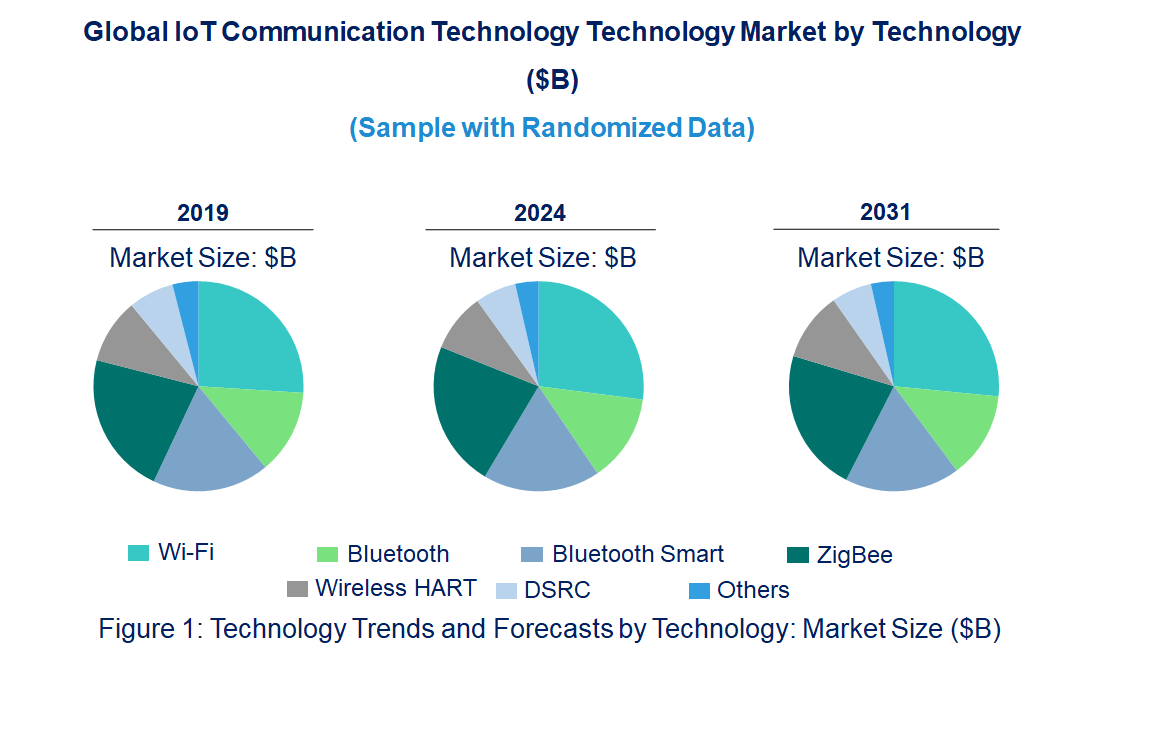
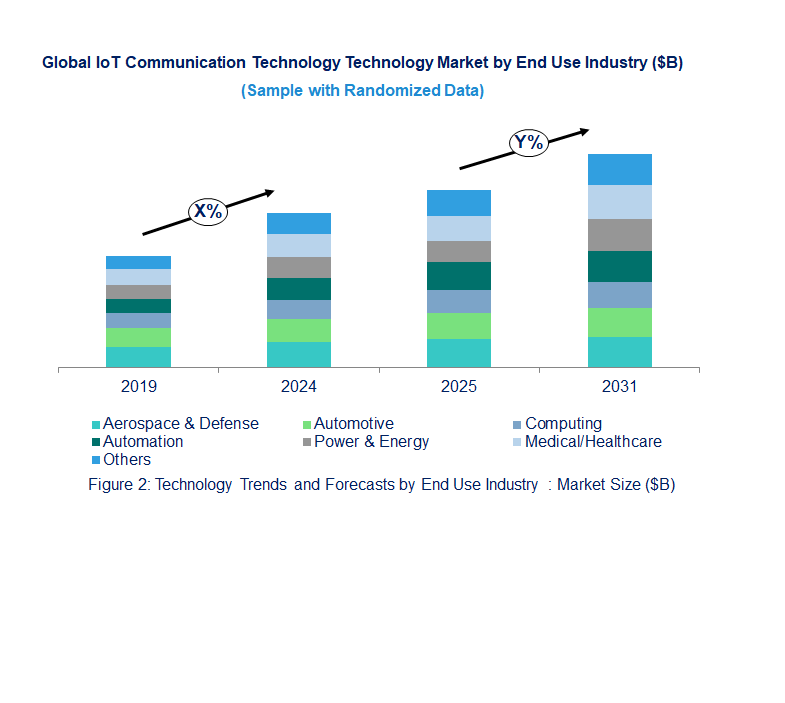
• Adoption of Wi-Fi 6 and Wi-Fi 7: These newer Wi-Fi standards offer higher speeds, lower latency, and improved capacity, making them ideal for dense IoT environments and real-time applications.
• Advancements in Bluetooth Technology: Bluetooth 5.3 and Bluetooth Low Energy (BLE) provide enhanced energy efficiency, improved security features, and better connection stability, benefiting wearables, healthcare devices, and smart home applications.
• Integration of Edge Computing: Processing data closer to the source reduces latency and bandwidth usage, enabling real-time decision-making crucial for applications like industrial automation and autonomous vehicles.
• Emergence of NearLink Technology: Developed by the NearLink Alliance, NearLink combines the advantages of traditional wireless technologies, offering ultra-low latency and high reliability, suitable for industrial control and real-time applications.
• Enhanced Security Measures: With the proliferation of connected devices, there's an increased emphasis on implementing robust security protocols, including end-to-end encryption and secure authentication mechanisms, to safeguard against potential vulnerabilities. These trends are reshaping the IoT communication technology market by enabling more efficient, secure, and scalable communication solutions across various industries.
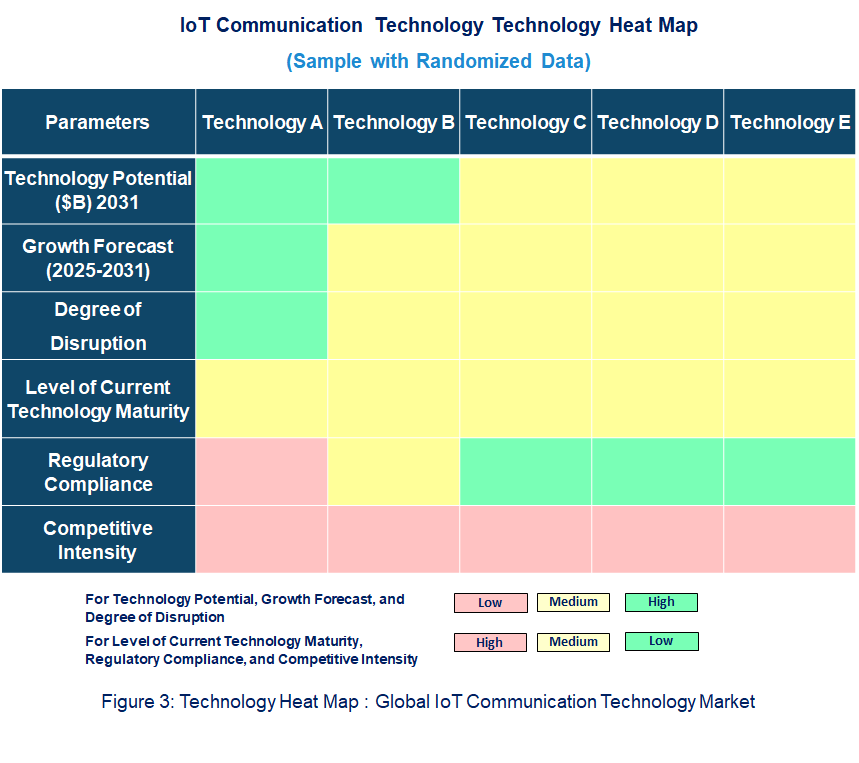
• Technology Potential: Technologies like Wi-Fi 6/7 and Bluetooth 5.3 are mature and widely adopted, offering improved performance for various applications.
• Degree of Disruption: The degree of disruption varies, with mature technologies providing incremental improvements, while emerging protocols could redefine communication paradigms in specific sectors.
• Level of Current Technology Maturity: Emerging technologies such as NearLink and UWB present disruptive potential by addressing specific needs like ultra-low latency and precise location tracking.
• Regulatory Compliance: Regulatory compliance remains crucial, with standards like IEEE 802.11 for Wi-Fi, Bluetooth SIG specifications, and regional regulations ensuring interoperability and security across devices. High competition among chipset manufacturers; compliance with IEEE standards ensures interoperability.
• STMicroelectronics: Launched the STM32WL5MOC, a System-in-Package module featuring dual-core wireless SoC, enhancing interoperability and design flexibility for IoT applications.
• NXP Semiconductors: Continued to innovate in NFC and secure connectivity solutions, supporting applications in automotive, industrial, and consumer markets.
• Synopsys: Offers DesignWare Bluetooth Low Energy IP, providing ultra-low-power wireless connectivity solutions for IoT applications such as wearables and smart home devices.
• CEVA: Develops wireless connectivity IPs, including Bluetooth and Wi-Fi, enabling efficient integration into various IoT devices.
• Texas Instruments: Introduced new Wi-Fi 6 companion chips, CC3300 and CC3301, enhancing interoperability and design flexibility for IoT applications.
• Proliferation of Connected Devices: The increasing number of IoT devices across various industries necessitates robust and scalable communication technologies.
• Advancements in Wireless Technologies: Continuous improvements in protocols like Wi-Fi 6/7 and Bluetooth 5.3 enhance performance and energy efficiency.
• Demand for Low-Latency Communication: Applications such as autonomous vehicles and industrial automation require real-time data transmission, driving the adoption of advanced communication protocols. Challenges in the IoT communication market are:
• Security Concerns: The expansion of IoT networks increases the attack surface, necessitating robust security measures to protect data and devices.
• Interoperability Issues: The diversity of devices and protocols can lead to compatibility challenges, hindering seamless communication.
• Regulatory Compliance: Navigating varying regional regulations and standards can be complex for global deployments. In summary, the IoT Communication Technology Market is undergoing significant transformations, driven by technological advancements and the growing demand for efficient, secure, and scalable communication solutions. Addressing the challenges related to security, interoperability, and regulatory compliance will be crucial for sustained growth and innovation in this sector.
• Stmicroelectronics
• Nxp Semiconductors
• Synopsy
• Ceva
• Texas Instruments
• Technology Readiness by Technology Type: IoT communication technologies show varied readiness levels depending on their type. Mature technologies like Wi-Fi, Bluetooth, and 4G LTE are widely deployed and standardized across consumer and industrial applications. Emerging technologies such as 5G, NB-IoT, and LoRaWAN are rapidly advancing, with 5G offering high bandwidth for critical IoT and LoRaWAN providing long-range, low-power connectivity for remote sensors.
• Competitive Intensity and Regulatory Compliance: The IoT communication technology market is highly competitive, with major telecom providers, chipset manufacturers, and platform vendors vying for dominance across different verticals. Regulatory compliance is critical, involving spectrum allocation, data privacy laws, and interoperability standards, which vary across regions. Global and regional bodies are increasingly tightening regulations to ensure secure, reliable, and standardized IoT deployments.
• Disruption Potential by Technology Type: IoT communication technologies hold significant disruption potential, especially with 5G enabling ultra-reliable, low-latency connections that unlock advanced applications like autonomous vehicles and smart cities. Low-power wide-area networks (LPWAN) such as NB-IoT and LoRaWAN disrupt traditional short-range connectivity by enabling massive, energy-efficient sensor deployments. Together, these technologies are reshaping how devices connect, interact, and scale across industries.
• Wi-Fi
• Bluetooth
• Bluetooth Smart
• ZigBee
• Wireless HART
• DSRC
• Others
• Aerospace & Defense
• Automotive
• Computing
• Information and Communication Technology
• Automation
• Power & Energy
• Medical/Healthcare
• Others
• North America
• Europe
• Asia Pacific
• The Rest of the World
• Latest Developments and Innovations in the IoT Communication Technology Technologies
• Companies / Ecosystems
• Strategic Opportunities by Technology Type


Choose a license that fits your team. Instant PDF delivery.
Prices exclude taxes. Instant delivery. Custom licensing available on request.
Market Report · May 18, 2026
Market Report · May 18, 2026
Market Report · May 18, 2026
Trusted partner for strategic intelligence and business growth


Receive a complimentary market analysis tailored to your industry. Our analysts will identify key growth opportunities and competitive dynamics specific to your business.

Market size, growth rate, and key trend analysis for your specific sector.

Top competitor positioning and market share analysis.

Strategic recommendations backed by data-driven insights.
Get curated market intelligence and competitive moves straight to your inbox.
By subscribing, you agree to receive our monthly insights. Unsubscribe anytime.
Receive a complimentary market analysis tailored to your industry. Our analysts will identify key growth opportunities and competitive dynamics specific to your business.
Market size, growth rate, and key trend analysis for your specific sector.
Top competitor positioning and market share analysis.
Strategic recommendations backed by data-driven insights.
Get curated market intelligence, emerging trends, and competitive moves straight to your inbox each month.
By subscribing, you agree to receive our monthly insights. Unsubscribe anytime.
We'll send your sample report shortly.