
Market Report · July 15, 2026

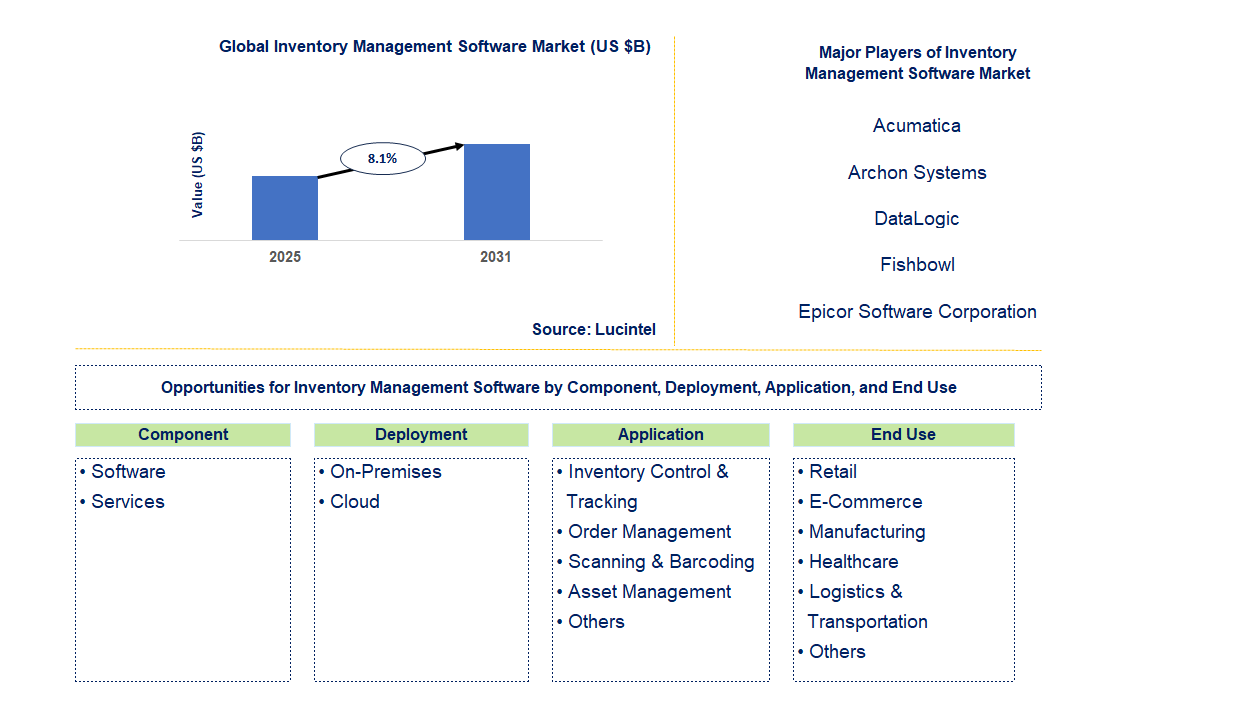
Key data points: The growth forecast = 8.1% annually for the next 7 years. Scroll below to get more insights. This market report covers trends, opportunities and forecasts in inventory management software market to 2031 by component (software and services), deployment (on-premises and cloud), application (inventory control & tracking, order management, scanning & barcoding, asset management, and others), end use (retail, E-commerce, manufacturing, healthcare, logistics & transportation, and others), and region (North America, Europe, Asia Pacific, and the Rest of the World)
We'll send your sample report shortly.
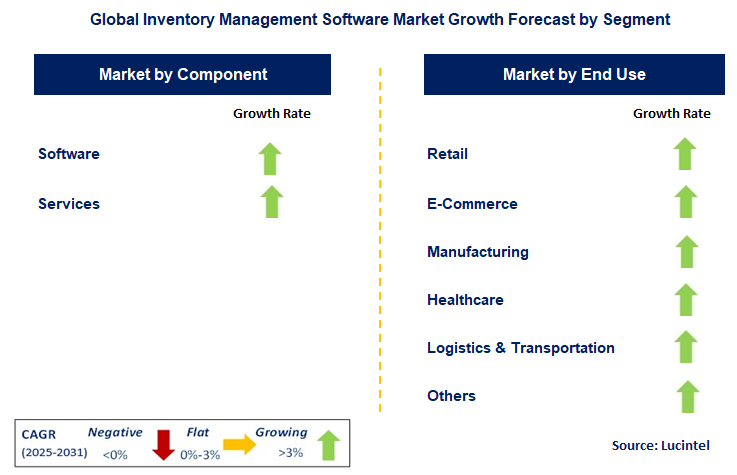
• Lucintel forecasts that, within the component category, software is expected to witness higher growth over the forecast period.
• Within the end use category, manufacturing is expected to witness the highest growth.
• In terms of region, North America is expected to witness the highest growth over the forecast period. Gain valuable insights for your business decisions with our comprehensive 150+ page report. Sample figures with some insights are shown below.
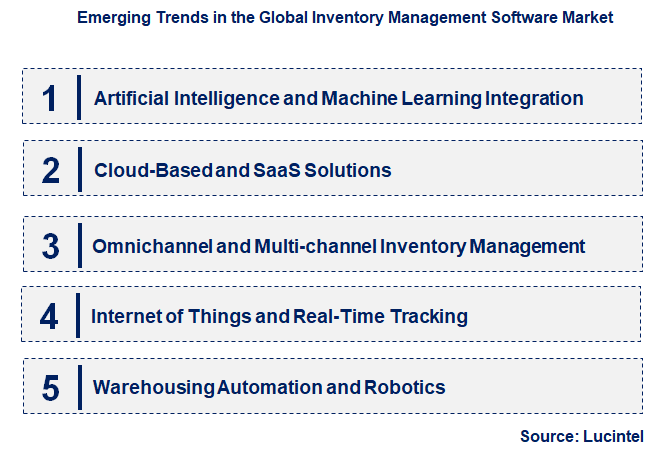
• Artificial Intelligence and Machine Learning Integration: The most important trend is the in-depth integration of AI and ML into inventory management tools. AI processes past sales data, market trends, and other external elements such as weather conditions to give excellent demand projections. This enables companies to maximize their inventories, reducing the chances of overstocking and stockouts. This brings about a change from reactive, traditional inventory management to a proactive and predictive model.
• Cloud-Based and SaaS Solutions: The market is now mainly focused on cloud-based and SaaS solutions. These models have a number of benefits over their traditional on-premise counterparts, such as reduced initial expenditure, quicker deployment, and continual updates. They also have the kind of flexibility and scalability that companies require to keep up with shifting market trends. The result is that inventory management software is now within reach of small and medium-sized businesses (SMEs) that could not afford the investment in large-scale IT before.
• Omnichannel and Multi-channel Inventory Management: With businesses increasing the number of sales channels to physical stores, ecommerce sites, and online marketplaces, the requirement for omnichannel and multi-channel inventory management has become an important trend. It is keeping a single, consolidated view of inventory across all sales channels. The effect is a smoother customer experience and increased operational effectiveness. With an integrated system, companies are able to avoid overselling and automate order fulfillment, whether it is for a purchase online or in-store pickup.
• Internet of Things and Real-Time Tracking: The integration of IoT technology is an emerging trend that is revolutionizing inventory tracking. IoT sensors, such as RFID tags and QR codes, are being used to provide real-time data on the location, condition, and status of inventory. The impact is unparalleled accuracy and visibility across the supply chain. This technology minimizes human errors, streamlines cycle counting, and offers complete information about product movement. For instance, in the pharmaceutical and food industries, IoT sensors can track temperature and humidity to provide product quality and compliance, which is a breakthrough for storing sensitive commodities.
• Warehousing Automation and Robotics: The wave of automation and robotics in warehousing is a major development in the inventory management industry. Automated Guided Vehicles (AGVs) and Autonomous Mobile Robots (AMRs) are being used to automate tasks such as picking, packing, and moving inventory. The impact is a massive increase in warehouse efficiency and a reduction in operational costs. This trend also addresses labor shortages and improves accuracy by minimizing human error in repetitive tasks. The information created by these computerized systems is directly input to inventory management software, generating an entirely integrated and highly effective warehouse process that can manage the large volumes of today’s business. These new trends are altogether transforming the market for inventory management software by making it more intelligent, integrated, and responsive. They are empowering companies of all sizes to transition from a reactive to a proactive mindset, saving costs, enhancing efficiency, and improving the customer experience. The collective effect is a more dynamic and indispensable marketplace for making sense of the dynamics of a digital, globalized economy, which will propel ongoing innovation and growth in the future.
• Emergence of AI-Driven Forecasting and Analytics: One of the prominent developments is the pairing of AI and machine learning for forecasting. Current inventory software employs sophisticated algorithms to compare vast sets of data points, such as sales history, seasonal trends, and even social media sentiment, in order to make highly accurate predictions of future demand. The effect is that companies can maximize their inventory levels, minimizing the chances of overstocking and stockouts.
• Rising Use of Cloud-Based Solutions: The move from on-premise to cloud-based inventory management software has been the most significant development. Cloud solutions provide greater flexibility, scalability, and accessibility, enabling businesses to control their inventory anywhere and anytime. The effect is that this has enabled advanced inventory management software to become affordable for small and medium-sized businesses (SMEs) that were otherwise unable to meet the high initial investment costs of conventional software.
• Seamless Integration with E-commerce Platforms: A more recent innovation is the capacity of inventory software to integrate seamlessly with a wide range of e-commerce platforms and marketplaces. This enables companies to gain a single, combined view of their inventory across all sales channels. The effect is that it avoids overselling and facilitates accurate stock synchronization, which is paramount in sustaining customer trust and an excellent brand reputation.
• Real-Time Tracking via IoT and Mobile Technology: The use of the Internet of Things (IoT) and mobile technology has made it possible to track inventory in real-time. With technologies like RFID, barcodes, and mobile applications, companies can now monitor the exact location and status of all items in their warehouse or supply chain. The result is a sudden boost to inventory accuracy and a lessening of errors caused by human factors. This innovation gives companies unprecedented visibility, which enables them to make rapid, data-driven decisions.
• Sustainability and Returns Management Focus: Another emerging trend is the emphasis on integrating sustainability and returns management capabilities within inventory software. Contemporary solutions are assisting companies with tracking product lifecycles, handling returned merchandise with ease, and reducing waste. The effect is that this assists businesses in achieving environmental, social, and governance (ESG) targets and lowers their environmental impact. Streamlining the returns process also allows companies to recover value on returned goods and enhance customer satisfaction. All these advances are collectively contributing to the inventory management software market by making it more intelligent, connected, and responsive to the demands of contemporary businesses. They are encouraging manufacturers to innovate in terms of AI, cloud computing, and mobile technology to offer solutions not only to track inventory but also to enable businesses to optimize their entire supply chain. The net effect is a market that is shifting from a mere necessity to a strategic tool for businesses looking to succeed in a competitive, digital world.
• E-commerce and Omnichannel Retail: One of the major growth opportunities is in the fastest-growing e-commerce and omnichannel retail market. When companies sell across various channels, from their sites to online marketplaces as well as physical locations, they require a single, integrated solution that can handle their inventory. The result is a huge opportunity for software that can deliver real-time inventory synchronization, automated order fulfillment, and hassle-free returns management.
• Supply Chain and Manufacturing Optimization: Another growth opportunity exists in the manufacturing and supply chain area. Producers require advanced software to handle intricate bills of materials, monitor raw materials, and allocate production schedules to avoid shortages and overproduction. The effect is a call for specialized inventory software that can interface with Enterprise Resource Planning (ERP) and supply chain management (SCM) systems.
• Healthcare and Pharmaceutical Inventory Management: The healthcare and pharmaceutical industries are a special and high-growth market. These industries need stringent control over inventory to maintain regulatory compliance, monitor lot numbers and date of expiration, and handle a huge range of drugs and medical supplies. The result is the need for special software that is capable of delivering traceability, audit trails, and security so that drugs cannot be counterfeited and patients are kept safe. By creating solutions that meet these sophisticated needs, businesses will be able to access a high-value market that is focused on accuracy and compliance, and this will represent a solid and lucrative revenue stream.
• Small and Medium-Sized Enterprises: The SME market offers tremendous growth potential, especially with the growth in cloud-based and SaaS solutions. Most SMEs are still employing manual or basic spreadsheet practices to handle inventory, which is cumbersome and error-prone. The effect is an unserved market for low-cost, easy-to-use, and scalable inventory management software. By providing tiered pricing, streamlined onboarding procedures, and robust customer support, businesses can target this huge and increasing segment. This is a pivotal opportunity to grow the market beyond large businesses and create a platform for sustained growth.
• Third-Party Logistics and Warehousing: The 3PL and warehousing industry presents a vast growth opportunity. With increased companies outsourcing their logistics, 3PL providers require strong inventory software to handle the inventory of multiple customers, streamline warehouse configurations, and facilitate fulfillment processes. The effect is a requirement for highly customizable and scalable software that supports a vast range of products and business rules. By offering solutions that provide superior analytics, automation, and deeper integration with client systems, businesses can become a critical partner for 3PL providers, which will allow them to grow with the growing outsourcing industry. These strategic growth opportunities are influencing the inventory management software market by fueling a shift towards specialization and diversification. They are compelling firms to create purpose-designed solutions for new use cases, from e-commerce and healthcare to manufacturing and 3PL. Overall, it is a market becoming more intelligent, flexible, and deeply embedded within the operational nucleus of an increasingly broad set of industries, thus assuring its future expansion and applicability within the global economy.
• Acumatica
• Archon Systems
• DataLogic
• Fishbowl
• Epicor Software Corporation
• IBM Corporation
• Intuit
• Lightspeed Commerce
• Manhattan Associates
• Microsoft Corporation
• Software
• Services
• On-Premises
• Cloud
• Inventory Control & Tracking
• Order Management
• Scanning & Barcoding
• Asset Management
• Others
• Retail
• E-Commerce
• Manufacturing
• Healthcare
• Logistics & Transportation
• Others
• North America
• Europe
• Asia Pacific
• The Rest of the World
• United States: The market for inventory management software in the United States is highly technologically innovative and has a high emphasis on cloud-based platforms. The growth of e-commerce has encouraged demand for solutions that can provide real-time visibility, multi-channel integration, and sophisticated data analytics. Firms are resorting to AI and ML increasingly to enhance forecasted demand and automate re-ordering, which prevents stockouts as well as overstocking. The market is also experiencing a consolidation of the providers, with incumbents and startups both providing an array of features to suit all sizes of businesses, from small and medium-sized enterprises (SMEs) to large companies.
• China: The market for inventory management software is growing rapidly, driven by its huge manufacturing and ecommerce industries. New trends are aimed at developing scalable and resilient solutions for dealing with intricate supply chains domestically as well as globally. Chinese enterprises are heavily investing in blending IoT and automation technologies to make warehouses more efficient and inventory more accurate. The market is also boosted by the government’s initiative for digitalization and intelligent manufacturing, which is inspiring companies to shift to new-generation software solutions.
• Germany: The German inventory management software industry is characterized by a strong focus on accuracy, dependability, and integration with the manufacturing industry, which is the backbone of the country’s economy. Recent trends are closely related to the Industry 4.0 program, where inventory software is to be connected with Enterprise Resource Planning (ERP) and automated factory systems. German companies, especially small and medium-sized enterprises (SMEs), are increasingly using cloud-based platforms to enhance supply chain transparency and operational effectiveness.
• India: In India, the inventory management software market is a high-growth industry, driven by the surging e-commerce market and the demand for organized retail. One of the key advancements is the mass adoption of cloud-based technologies among small and medium enterprises, which are looking for cost-effective and scalable solutions for managing their inventory. Solutions providers are developing solutions with high integration capabilities across different e-commerce platforms such as Amazon and Flipkart. The market is also experiencing an increased usage of AI-enabled solutions for predictive analysis and demand forecasting. This development is imperative in assisting companies in streamlining their operations and coping with the complexity of an increasingly emerging and fragmented retail environment.
• Japan: The Japanese market for inventory management software is extremely advanced, with recent advances focused on taking advantage of emerging technologies to drive operational efficiency. The market is witnessing increasing usage of AI and IoT to drive optimization of logistics and asset management. Japanese firms are also concentrating on developing systems that deliver accurate data at high levels and real-time visibility, needed to effectively manage their intricate supply chains. The market is fueled by a desire to enhance productivity and counter a shrinking population, emphasizing automation and minimizing processes. This has created robust demand for integrated solutions with the capability to deliver in-depth insights and enable strategic decision-making.


• Acumatica
• Archon Systems
• DataLogic
• Fishbowl
• Epicor Software Corporation
• IBM Corporation
• Intuit
• Lightspeed Commerce
• Manhattan Associates
• Microsoft Corporation Q5. Which inventory management software market segment will be the largest in future? Answer: Lucintel forecasts that, within the component category, software is expected to witness higher growth over the forecast period. Q6. In inventory management software market, which region is expected to be the largest in next 5 years? Answer: In terms of region, North America is expected to witness the highest growth over the forecast period. Q7. Do we receive customization in this report? Answer: Yes, Lucintel provides 10% customization without any additional cost.


Choose a license that fits your team. Instant PDF delivery.
Prices exclude taxes. Instant delivery. Custom licensing available on request.
Market Report · July 15, 2026
Market Report · June 26, 2026
Market Report · June 24, 2026
Trusted partner for strategic intelligence and business growth


Receive a complimentary market analysis tailored to your industry. Our analysts will identify key growth opportunities and competitive dynamics specific to your business.

Market size, growth rate, and key trend analysis for your specific sector.

Top competitor positioning and market share analysis.

Strategic recommendations backed by data-driven insights.
Get curated market intelligence and competitive moves straight to your inbox.
By subscribing, you agree to receive our monthly insights. Unsubscribe anytime.
Receive a complimentary market analysis tailored to your industry. Our analysts will identify key growth opportunities and competitive dynamics specific to your business.
Market size, growth rate, and key trend analysis for your specific sector.
Top competitor positioning and market share analysis.
Strategic recommendations backed by data-driven insights.
Get curated market intelligence, emerging trends, and competitive moves straight to your inbox each month.
By subscribing, you agree to receive our monthly insights. Unsubscribe anytime.
We'll send your sample report shortly.