
Market Report · July 15, 2026

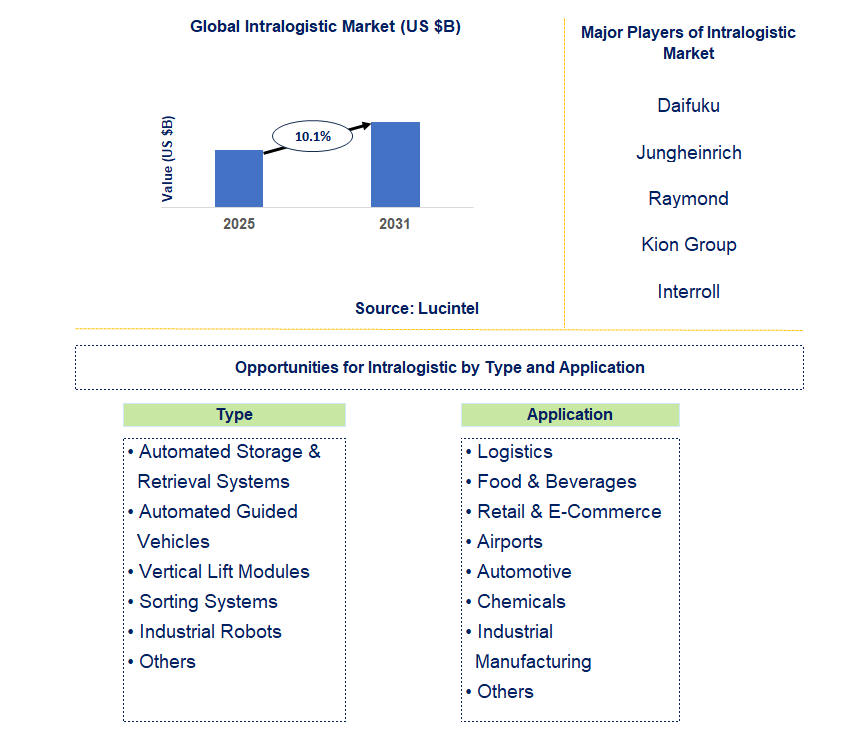
Key data points: The growth forecast = 10.1% annually for the next 7 years. Scroll below to get more insights. This market report covers trends, opportunities and forecasts in intralogistic market to 2031 by type (automated storage & retrieval systems, automated guided vehicles, vertical lift modules, sorting systems, industrial robots, and others), application (logistics, food & beverages, retail & e-commerce, airports, automotive, chemicals, industrial manufacturing, and others), and region (North America, Europe, Asia Pacific, and the Rest of the World)
We'll send your sample report shortly.
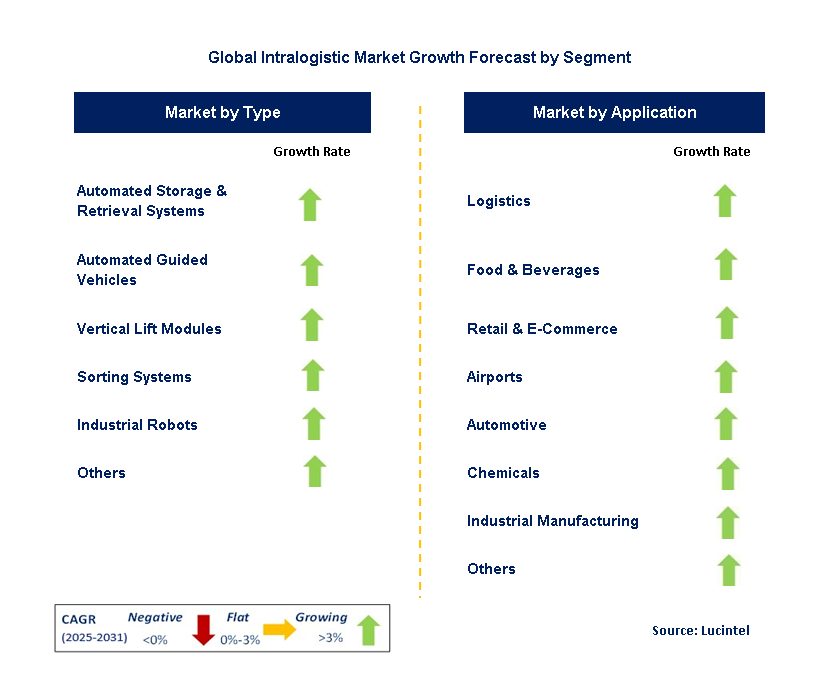
• Lucintel forecasts that, within the type category, industrial robot is expected to witness the highest growth over the forecast period.
• Within the application category, retail & e-commerce is expected to witness the highest growth.
• In terms of region, APAC is expected to witness the highest growth over the forecast period. Gain valuable insights for your business decisions with our comprehensive 150+ page report. Sample figures with some insights are shown below.
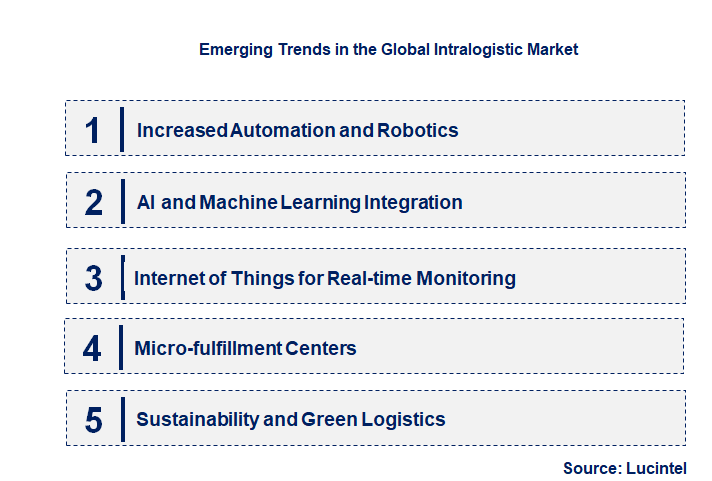
• Increased Automation and Robotics: There is a strong and continuous trend towards adopting more advanced automation and robotics, including Automated Guided Vehicles (AGVs) and Autonomous Mobile Robots (AMRs). These technologies address labor shortages, improve productivity by handling repetitive tasks efficiently, and minimize errors in warehouse operations.
• AI and Machine Learning Integration: Artificial Intelligence and Machine Learning (ML) are increasingly integrated into intralogistic systems for enhanced decision-making and optimization. AI/ML enables predictive analytics for better inventory management, demand forecasting, and equipment maintenance, leading to more resilient and responsive supply chains.
• Internet of Things for Real-time Monitoring: The widespread adoption of IoT devices allows for real-time monitoring of intralogistic processes. Sensors on equipment, goods, and infrastructure provide immediate data, enabling better tracking, improved asset utilization, and proactive identification of bottlenecks or potential issues within the warehouse.
• Micro-fulfillment Centers: The rise of micro-fulfillment centers, particularly in urban areas, is a key trend to optimize last-mile delivery. MFCs, often automated, bring inventory closer to customers, significantly reducing delivery times and transportation costs, catering to the growing demand for rapid e-commerce fulfillment.
• Sustainability and Green Logistics: A growing emphasis on sustainable intralogistic practices, including the use of electric vehicles, optimized routes, and energy-efficient warehouse automation. Companies are prioritizing eco-friendly solutions to reduce their carbon footprint, comply with environmental regulations, and meet consumer demand for sustainable operations. These emerging trends are fundamentally reshaping the intralogistic market by fostering a move towards highly automated, intelligent, and interconnected systems. The focus on efficiency, real-time insights, and environmental responsibility is transforming traditional warehouses into smart, agile, and sustainable hubs crucial for modern supply chains.
• Surge in Warehouse Automation: A prominent development is the substantial surge in warehouse automation, driven by labor shortages and the need for higher throughput. This includes wider adoption of Automated Storage and Retrieval Systems (AS/RS), robotic picking solutions, and advanced conveyor systems, leading to optimized space utilization and faster order fulfillment.
• Increased Adoption of Mobile Robotics: The deployment of Autonomous Mobile Robots (AMRs) and Automated Guided Vehicles (AGVs) has significantly increased. These robots offer flexible and scalable solutions for material transport, reducing reliance on manual labor, improving safety, and enhancing the speed and accuracy of internal logistics operations within facilities.
• Integration of AI and Machine Learning: The integration of Artificial Intelligence (AI) and Machine Learning (ML) into intralogistic software is a key development. AI-powered systems optimize inventory management, predict demand patterns, and facilitate real-time decision-making, leading to more intelligent and adaptive warehouse operations.
• Rise of Software-Defined Intralogistics: There’s a growing shift towards software-defined intralogistic, where powerful Warehouse Management Systems (WMS) and Warehouse Execution Systems (WES) orchestrate automated equipment. This enhances overall system flexibility, allows for dynamic adjustments to workflows, and provides greater visibility into operations.
• Emphasis on Retrofitting and Modernization: Many companies are focusing on retrofitting existing warehouses with automation rather than building entirely new facilities. This development is driven by high industrial land prices and the need to optimize current operations, making automation more accessible and cost-effective for a broader range of businesses. These key developments are profoundly impacting the intralogistic market by pushing towards highly automated, data-driven, and adaptable internal logistics systems. The focus on efficiency, flexibility, and intelligent optimization is transforming traditional warehouses into smart, interconnected hubs that are essential for modern supply chain competitiveness.
• E-commerce and Retail Fulfillment: Growth opportunity: Developing scalable and high-speed automated solutions for e-commerce order fulfillment and last-mile delivery. Impact: Enables faster order processing, reduces delivery times, and manages fluctuating demand, crucial for meeting rising consumer expectations and maintaining competitiveness in the rapidly expanding online retail sector.
• Food and Beverage Industry: Growth opportunity: Providing automated cold chain logistics and hygienic material handling solutions. Impact: Ensures product freshness, reduces spoilage, and meets stringent food safety regulations. This enhances operational efficiency in temperature-controlled environments, minimizing waste and optimizing supply chain integrity for perishable goods.
• Automotive Manufacturing: Growth opportunity: Implementing flexible and precise intralogistic systems for Just-In-Time (JIT) parts delivery on assembly lines. Impact: Optimizes production flow, reduces inventory holding costs, and supports mass customization. This is crucial for improving manufacturing efficiency and adapting to dynamic production schedules in the automotive sector.
• Pharmaceutical and Healthcare Logistics: Growth opportunity: Offering automated storage and retrieval systems (AS/RS) and secure transport solutions for sensitive and high-value medical products. Impact: Ensures precise inventory control, maintains product integrity (e.g., temperature control), and complies with strict regulatory traceability requirements, vital for patient safety and supply chain security.
• Third-Party Logistics Providers: Growth opportunity: Equipping 3PL warehouses with modular, multi-user automated intralogistic systems. Impact: Allows 3PLs to offer diverse services to multiple clients, scale operations efficiently, and reduce operational costs. This enhances their service offerings and competitiveness in the outsourcing logistics market. These strategic growth opportunities are significantly impacting the intralogistic market by driving specialized and highly efficient solutions across various industry verticals. By addressing the unique challenges and demands of each application, manufacturers and solution providers can unlock new revenue streams and solidify their position in a dynamic market.
• Daifuku
• Jungheinrich
• Raymond
• Kion Group
• Interroll
• Korber
• GBI
• DLL
• Smartlog Group
• Rozitek
• Automated Storage & Retrieval Systems
• Automated Guided Vehicles
• Vertical Lift Modules
• Sorting Systems
• Industrial Robots
• Others
• Logistics
• Food & Beverages
• Retail & E-Commerce
• Airports
• Automotive
• Chemicals
• Industrial Manufacturing
• Others
• North America
• Europe
• Asia Pacific
• The Rest of the World
• United States: The US market for automated intralogistic material handling solutions is experiencing strong growth, propelled by the adoption of AI-driven robotics and machine learning algorithms. Companies are focusing on lean manufacturing and Just-In-Time (JIT) strategies, with advanced equipment streamlining workflows, reducing errors, and improving overall efficiency in warehouses and distribution centers.
• China: China’s intralogistic market is witnessing drastic growth, largely fueled by its dominant e-commerce sector. Increased investment in automation technologies like conveyor systems, AS/RS, and robotics is driven by the need to handle high order volumes efficiently. Government initiatives also incentivize companies to adopt advanced automation solutions.
• Germany: Germany’s intralogistic market is projected for significant growth, primarily driven by the expanding e-commerce and automotive sectors, along with the increasing adoption of industrial robots. There’s a strong emphasis on improving internal logistics processes through automation, optimization, and data-driven solutions to achieve faster delivery times and cost reductions.
• India: India’s intralogistic market is rapidly expanding, marked by a significant increase in warehouse storage capacity and the adoption of clad rack warehouses. The implementation of GST has consolidated storage, while integration of Automated Storage and Retrieval Systems (AS/RS) from the planning stages is boosting efficiency and reducing installation costs.
• Japan: Japan’s intralogistic market is accelerating due to its developed manufacturing industry, the rise of e-commerce, and a strong focus on Industry 4.0. Government initiatives, such as those strengthening supply chains by supporting new plant construction and facility introduction, further fuel demand for automation and robotics.


• Daifuku
• Jungheinrich
• Raymond
• Kion Group
• Interroll
• Korber
• GBI
• DLL
• Smartlog Group
• Rozitek Q5. Which intralogistic market segment will be the largest in future? Answer: Lucintel forecasts that, within the type category, industrial robot is expected to witness the highest growth over the forecast period. Q6. In intralogistic market, which region is expected to be the largest in next 5 years? Answer: In terms of region, APAC is expected to witness the highest growth over the forecast period. Q7. Do we receive customization in this report? Answer: Yes, Lucintel provides 10% customization without any additional cost.


Choose a license that fits your team. Instant PDF delivery.
Prices exclude taxes. Instant delivery. Custom licensing available on request.
Market Report · July 15, 2026
Market Report · June 26, 2026
Market Report · June 24, 2026
Trusted partner for strategic intelligence and business growth


Receive a complimentary market analysis tailored to your industry. Our analysts will identify key growth opportunities and competitive dynamics specific to your business.

Market size, growth rate, and key trend analysis for your specific sector.

Top competitor positioning and market share analysis.

Strategic recommendations backed by data-driven insights.
Get curated market intelligence and competitive moves straight to your inbox.
By subscribing, you agree to receive our monthly insights. Unsubscribe anytime.
Receive a complimentary market analysis tailored to your industry. Our analysts will identify key growth opportunities and competitive dynamics specific to your business.
Market size, growth rate, and key trend analysis for your specific sector.
Top competitor positioning and market share analysis.
Strategic recommendations backed by data-driven insights.
Get curated market intelligence, emerging trends, and competitive moves straight to your inbox each month.
By subscribing, you agree to receive our monthly insights. Unsubscribe anytime.
We'll send your sample report shortly.