
Market Report · July 13, 2026

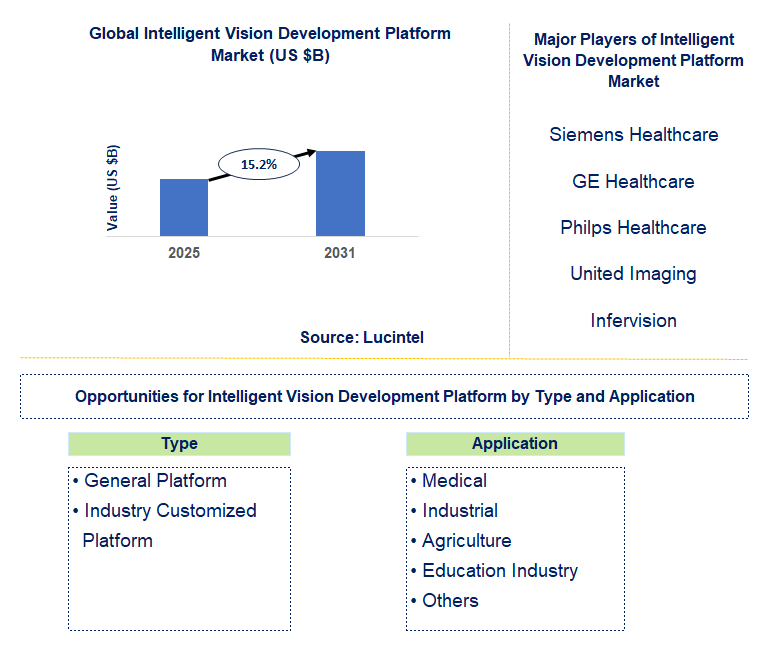
Key data points: The growth forecast = 15.2% annually for the next 7 years. Scroll below to get more insights. This market report covers Trends, opportunities and forecasts in intelligent vision development platform market to 2031 by type (general platform and industry customized platform), application (medical , industrial , agriculture , education industry, and others), and region (North America, Europe, Asia Pacific, and the Rest of the World)
We'll send your sample report shortly.
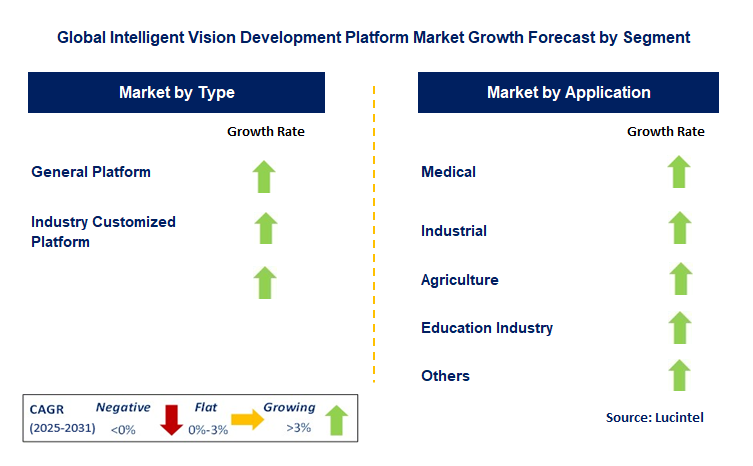
• Lucintel forecasts that, within the type category, industry customized platform is expected to witness higher growth over the forecast period.
• Within the application category, industrial is expected to witness the highest growth.
• In terms of region, APAC is expected to witness the highest growth over the forecast period.
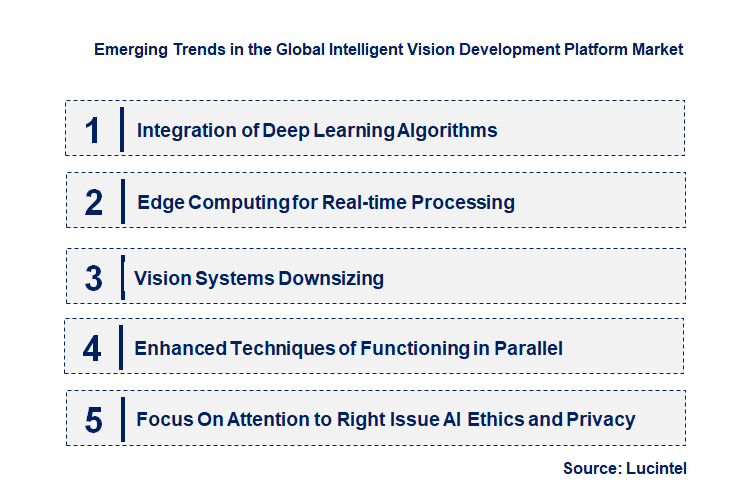
• Integration of Deep Learning Algorithms: The application of schemes within the area of machine learning, known as deep learning, are especially done through the use of Convolutional Neural Networks (CNNs) and have been proven to increase a machine vision systems accuracy and efficiency. Such algorithms make it possible for systems to learn how to perform better from prior data. This improves object detection as well as image recognition and the ability to make decisions. The integration of deep learning is broadening the range of places where vision systems can be used, especially in very complicated and fluid settings.
• Edge Computing for Real-time Processing: Real-time processing of information is made possible with edge computing which entails performing computations close to the source of data. This increases the speed of the processing and reduces the amount of bandwidth used which is vital to some application that need instantaneous reaction like industrial automation and autonomous vehicles. Self-sufficient edge-enabled vision systems are devoid of any operational dependency on cloud infrastructure which makes them reliable and efficient.
• Vision Systems Downsizing: The development of sophisticated miniature and lightweight hardware is contributing to achieving compact vision systems. The ability to downsize miniaturized systems enables their incorporation in a broader set of devices, and portable robots. These systems are flexible to maneuver in different sectors while maintaining optimal performance.
• Enhanced Techniques of Functioning in Parallel: Advanced vision systems are now hybrid by incorporating audio and touch data alongside visual information including audio, and tactile stimuli. Such all-encompassing approaches offer sophisticated interactions and manipulations with the surroundings improving the robotic, healthcare, and human-computer interaction domain.
• Focus On Attention to Right Issue AI Ethics and Privacy: The widespread use of these vision systems elicits emphasis on ethics and privacy issues. The developers’ implementation of transparency and fairness of AI-driven biases gives room to hold them answerable for the outcome of their algorithms. Legislation is being formulated to control vision intelligence technology use concerning data discrimination and creative perception. Technological advances typically fuel the IVDP market like in many other product markets. Coupled with a surge in demand for these intelligent systems in multiple industries, the growth is further accelerated. The combination of deep learning along with edge and multimodal computing capabilities boosts the performance and flexibility of vision systems. At the same time, responsible AI and privacy considerations are guiding how these systems are built and used. These trends together are paving the way towards a future where smart vision systems will be integral in automation, healthcare, security, and many other fields.
• Incorporation of Edge AI Function: The integration of Edge AI with intelligent vision systems is enabling raw data to be processed in real-time within devices themselves, minimizing cloud dependencies. NVIDIA and Intel are incorporating AI accelerators into edge hardware, which allows the faster and more responsive robotic, surveillance, and self-driving vehicle applications to be processed on the platforms. This development achieves a higher operational efficiency while improving security on the sensitive data and reducing costs. In IoT settings, Edge AI allows quick and centralized data processing which supports higher levels of scalability. There is a growing industry demand for automated systems and real-time actionable intel that is instantly available without disruption, which accelerated the edge computing market.
• Open Source Collaboration and SDK Development: Through collaboration, open source is spurring advancement towards intelligent vision systems and other development platforms. Primary market players are broadening the scope of their software development kits (SDKs) to include multi-camera systems, depth, and 3D reconstruction. Other platforms, frameworks like OpenCV and Google MediaPipe, are well-known for their ease and flexibility, thus are widely accepted and used. These developments promote industry wide collaboration and attract talented developers and innovative startups. Vendors are improving participation by freely providing adequate documentation, which lowers the barrier to entry. The ecosystem becomes more robust and nurtures development for AR/VR, telemedicine, smart cities, and many more.
• Advanced Neural Network Architectures: Intelligent vision frameworks now incorporate advanced neural networks, including Vision Transformers (ViTs) and Generative Adversarial Networks (GANs). These architectures deepen understanding and improve contextual accuracy in vision-related processes such as object recognition, image segmentation, and anomaly detection. More companies are using these models, as they achieve higher accuracy with less training data. This advancement is particularly beneficial in fields such as medical imaging and manufacturing, which require complex visual reasoning. More capable models increase the reach of vision-based AI and its sophistication as underspecified model efficiency grows.
• Cloud-Native Development Platforms: Specialized intelligent vision system providers have also developed cloud-native platforms that allow effortless deployment, increased scalability, and streamlined integration with other cloud services. Amazon Web Services, Google Cloud, and Microsoft Azure have started offering vision-specific AI functionalities with hands-free APIs and model training sets. These platforms exhibit effortless collaborative processes, auto-scaling, and high availability, reducing time to market. The ease of adaptation in the performance of cloud-native systems enables enterprises to test different AI model frameworks and optimize them while reducing the complexity and overhead associated with infrastructure. This is instrumental for companies that seek to deploy vision solutions across multiple locations without the overwhelming expense of local infrastructure.
• Security and Ethical AI Improvement: Following the rise of privacy concerns and data bias, intelligent vision platforms are now incorporating security-centric features and tools for responsible AI supervisions. These developments consist of encrypted data pipelines, explainable AI modules, and compliance-ready frameworks supporting global regulatory requirements such as GDPR and HIPAA. These attributes are gaining prominence in sensitive applications such as facial recognition and surveillance. Vendors are prioritizing trust and responsibility as their main focus, positioning their platforms for enterprise and government use. This integration of responsible AI strengthens the credibility of intelligent vision systems, enhancing broader adoption across privacy-reserved domains. Developments in the Intelligent Vision Development Platform are transforming its market towards heightened efficiency, greater accessibility, and improved security. The adoption of edge AI and cloud-native frameworks boosts operational flexibility, while open-source components and high-performance neural engines drive innovation and precision. Enhancements to security frameworks and responsible AI provisions address concerns around ethical AI integration, making the platforms suitable for mission-critical applications. These collective advancements enable growth across industries, providing more sophisticated decision and interaction capabilities with machines. Evolving technological and regulatory conditions will sustain the market's growth and diversification for a long time.
• Robotics and Process Automation in Quality Control: In modern manufacturing, intelligent vision systems are already in use for processes like defect detection, component recognition, and task optimization. Such processes enhance productivity by eliminating human error and minimizing resource wastage. Deep learning models are now capable of detecting micro-levels anomalies resolving product quality inconsistency. With robotic integration, modifications to production systems can be performed using automated, sight-guided adjustments. This area is witnessing substantial growth, particularly in the automotive, semiconductor, and food packaging sectors. The expansion of advanced factories will rely heavily on the incorporation of intelligent vision technology for predictive maintenance, safety compliance and active participation in initiatives aimed at zero-defect manufacturing.
• Healthcare Imaging and Diagnostics: Intelligent vision platforms in healthcare enable advanced imaging analytics and assist in diagnostics with pattern recognition and anomaly detection. They are applied in radiology, dermatology, and pathology for early disease detection far more accurately than traditional methods. Automated interfaces for interpreting images can lessen the time required for diagnosis, enabling personalized treatment strategies to be crafted ahead of time. These platforms are being embedded into telemedicine systems and diagnostic devices, especially in areas with limited resources. The integration of ethical AI policies adds normative values and trust in the clinical setting. This enables autonomous decision-making and promises to drastically enhance the results patients achieve and the efficiency with which hospitals and clinics operate.
• Retail Analytics and Customer Behavior Monitoring: Retailers now use intelligent vision development platforms for in-store metrics, inventory, and shopper behavior at the store level. These systems assist in enhancing store layout, foot traffic monitoring, and customer engagement in real time. Vision-based platforms monitor emotions, gestures, and demographic characteristics, which provide accurate tailored advertisements and improved customer service. Integration with POS systems and mobile applications helps build a comprehensive multi-channel identity of the client. As multi-channel retail becomes fashionable, intelligent vision technology becomes essential in linking offline and online shopping experiences. The technology demonstrates substantial Return On Investment (ROI), owing to higher sales and more efficient controlled stock.
• Self Driving Cars and Smart Moving System: The need for intelligent vision systems in self-driving cars and smart traffic management is at an all time high. With vision platforms, real time object identification, lane tracking, and even recognizing pedestrians is possible, all of which aid in vehicle navigation and accident prevention. Such platforms can also be employed for traffic management by automating traffic signals and managing vehicle parking. As the system of transportation is more intertwined and automated, there is a greater demand for safe, reliable and scalable vision systems. Intelligent vision systems will be instrumental in achieving smart mobility, strengthening the global operational networks of commercial transportation, as well as public transport.
• Defense and Monitoring System: Public infrastructure, banking, and enterprise campuses have deployed dome cameras that are able to take high resolution shots of rooms and open areas to protect them from unauthorized access, keeping in mind the protective consideration of anonymizing video streams and archival footage. These systems are monitoring systems capable of performing real time facial recognition, tracking and monitoring regions, intrusion detection and supervision. Such systems receive threat prediction, anomaly detection, automatic alerting, responsiveness enhancement, and human dependency lowering, which significantly increases efficiency and reliability of human oversight. The need for smart city initiatives and critical infrastructure center protection fuels demand even more. The need for privacy compliant frameworks is a unique selling proposition for those capable of accomplishing the paradox of effective execution and ethical performance, balanced regulation-adapted slab-compliance. Specific high-impact industries hold intelligent vision development platforms growth opportunities. AI-based vision systems are highly sought within industrial automation, healthcare, retail, transportation, and security due to their specific use case needs. Market leaders will be the providers of precision and compliant multi-step scalable applications. In addition, proprietary frameworks accelerate the market's intelligent infrastructure precision and revenue-generating autonomous decision-making power. Businesses that mitigate industry’s specific pain points with ethical crafting will gain substantial leverage amidst heightened competition and ethical framing within these fast-evolving intelligent infrastructure decision-making markets.
• Siemens Healthcare
• GE Healthcare
• Philps Healthcare
• United Imaging Intelligence
• Infervision
• Deepwise
• SenseTime
• Megvii
• YITU Technology
• Hikvision
• General Platform
• Industry Customized Platform
• Medical
• Industrial
• Agriculture
• Education Industry
• Others
• North America
• Europe
• Asia Pacific
• The Rest of the World
• United States: AI's consideration has also been the highlight for the IVDP market the US which is making significant capital investment into AI's industry. The vision automation by the AI powered IvDP-enhanced systems for all market sectors is being vigorously pursued by large and small computer companies and even single entrepreneurs. This involves the integration of deep learning systems into the imaging frameworks so as to make them faster and more precise. The autonomous cars, industrial processes, and automated diagnostics in different branches of healthcare are all highly dependant on this technology. Better innovations are being brought forth due to academic industry partnerships as regulations concerning ethics of AI usage are being deliberated.
• China: The IVDP sector is witnessing rapid growth in China and this is being greatly supplemented by Government sponsorship along with additional help from the Private sector. The founding of the Intelligent Vision Industry Innovation Alliance in the year 2024 is a remarkable event in the history of the country and enhances collaboration of companies to work with research and university institutions. This plan seeks to increase practice and technology development in the field. Companies in China are concentrating on smart cities, manufacturing, and surveillance because AI models need extensive datasets.
• Germany: Germany places great importance on precision and accuracy in relation to the IVDP market which is in line with the country’s advanced manufacturing and engineering industries. The addition of machine vision systems into production lines helps streamline quality assurance and increases automation. Applications in medical imaging, logistics, and safety in automobiles is also being researched by German companies. Inter-EU partnerships are aiding in the unification and cross-border technological exchange of vision systems within the region.
• India: India archives one of the fastest growing IVDP markets due to the rise in automation and digitization of processes in various sectors. In healthcare, machine vision is being used for diagnostic imaging while in manufacturing, vision systems are to ensure the product meets the quality standards. Local needs are served by startups and research institutions that are offering affordable options. The government's plans to bolster AI and digital infrastructure are also contributing to the rapid development of the market.
• Japan: Japan's IVDP is characterized by automation and robotics which dominate the market. Vision systems assist industrial robots with functions such as assembly tasks, inspection, and arrangement or packaging. There is an increasing need for vision-based technologies that assist the elderly to cope with aging population. Japanese companies are also using advanced imaging technologies for public surveillance and security AI systems, which helps improve public safety.


• Siemens Healthcare
• GE Healthcare
• Philps Healthcare
• United Imaging Intelligence
• Infervision
• Deepwise
• SenseTime
• Megvii
• YITU Technology
• Hikvision Q5. Which intelligent vision development platform market segment will be the largest in future? Answer: Lucintel forecasts that, within the type category, industry customized platform is expected to witness higher growth over the forecast period. Q6. In intelligent vision development platform market, which region is expected to be the largest in next 5 years? Answer: In terms of region, APAC is expected to witness the highest growth over the forecast period. Q7. Do we receive customization in this report? Answer: Yes, Lucintel provides 10% customization without any additional cost.


Choose a license that fits your team. Instant PDF delivery.
Prices exclude taxes. Instant delivery. Custom licensing available on request.
Market Report · July 13, 2026
Market Report · July 13, 2026
Market Report · July 2, 2026
Trusted partner for strategic intelligence and business growth


Receive a complimentary market analysis tailored to your industry. Our analysts will identify key growth opportunities and competitive dynamics specific to your business.

Market size, growth rate, and key trend analysis for your specific sector.

Top competitor positioning and market share analysis.

Strategic recommendations backed by data-driven insights.
Get curated market intelligence and competitive moves straight to your inbox.
By subscribing, you agree to receive our monthly insights. Unsubscribe anytime.
Receive a complimentary market analysis tailored to your industry. Our analysts will identify key growth opportunities and competitive dynamics specific to your business.
Market size, growth rate, and key trend analysis for your specific sector.
Top competitor positioning and market share analysis.
Strategic recommendations backed by data-driven insights.
Get curated market intelligence, emerging trends, and competitive moves straight to your inbox each month.
By subscribing, you agree to receive our monthly insights. Unsubscribe anytime.
We'll send your sample report shortly.