
Market Report · July 15, 2026

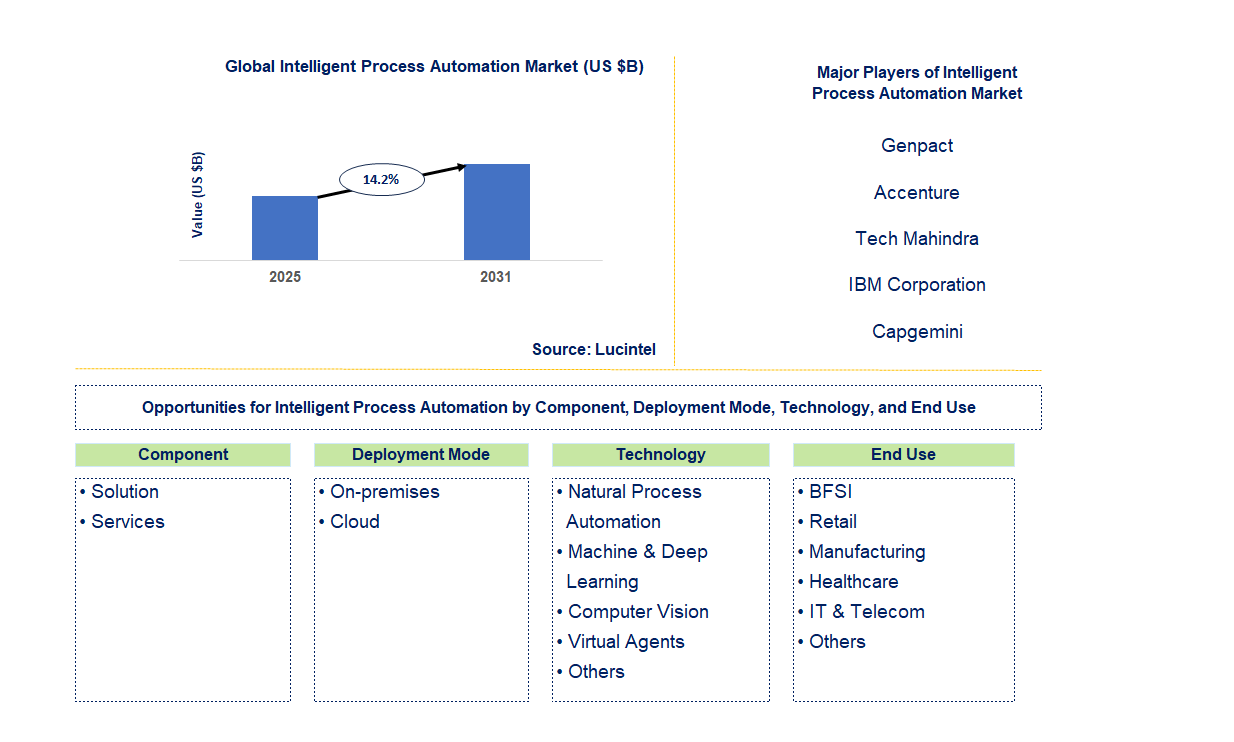
Key data points: The growth forecast = 14.2% annually for the next 7 years. Scroll below to get more insights. This market report covers trends, opportunities and forecasts in intelligent process automation market to 2031 by component (solution and services), deployment mode (on-premises and cloud), technology (natural process automation, machine & deep learning, computer vision, virtual agents, and others), end use (BFSI, retail, manufacturing, healthcare, IT & telecom, and others), and region (North America, Europe, Asia Pacific, and the Rest of the World)
We'll send your sample report shortly.
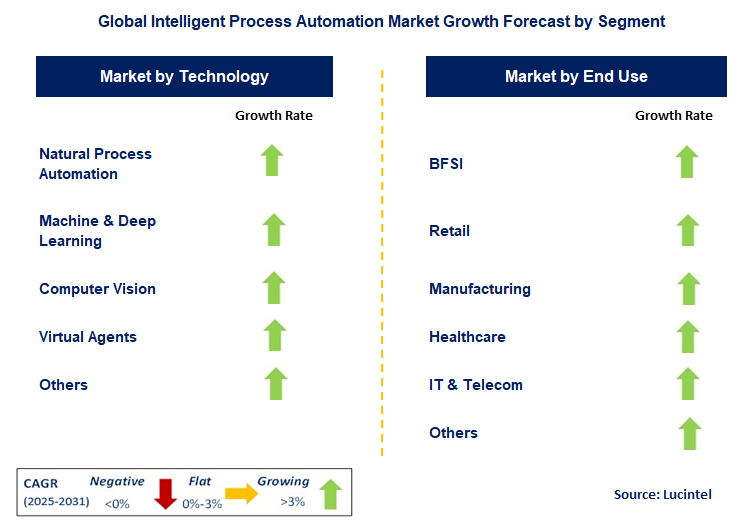
• Lucintel forecasts that, within the technology category, machine & deep learning are expected to witness the highest growth over the forecast period.
• Within the end use category, BFSI is expected to witness the highest growth.
• In terms of region, North America is expected to witness the highest growth over the forecast period. Gain valuable insights for your business decisions with our comprehensive 150+ page report. Sample figures with some insights are shown below.
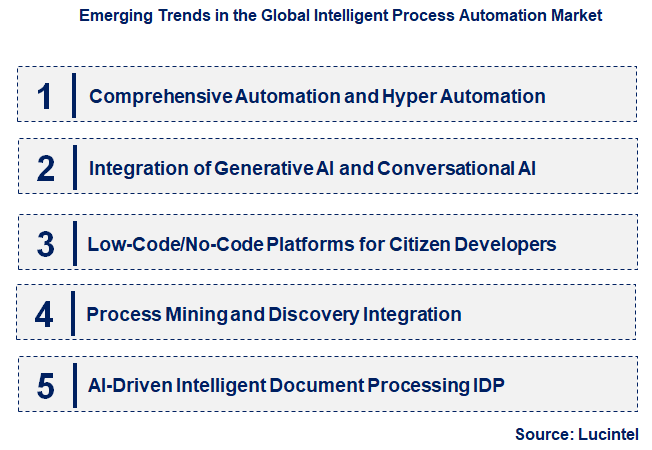
• Comprehensive Automation and Hyper Automation: One of the top trends is hyper automation, where several advanced technologies like Robotic Process Automation RPA, Artificial Intelligence AI, Machine Learning ML, process mining, and Intelligent Document Processing IDP are being merged. These aim at automating all business and IT processes as much as possible, developing end-to-end automated processes. Hyper automation exceeds task-by-task automation and orchestrates complex processes by using AI to manage unstructured data and adaptive decision-making, resulting in end-to-end operational efficiency.
• Integration of Generative AI and Conversational AI: The convergence of Generative AI and sophisticated Conversational AI is transforming IPA. Generative AI is utilized to generate human-like answers, produce content, and even aid in code generation for automation sequences to decrease hands-on effort in both development. Conversational AI, through sophisticated chatbots and virtual assistants, allows more intuitive and savvy conversations with automated systems, enhancing customer experience and internal communication by managing complex queries and tasks.
• Low-Code/No-Code Platforms for Citizen Developers: One of the major trends is the proliferation of low-code and no-code platforms in the IPA ecosystem. These provide business users, or "citizen developers," with little coding expertise, the ability to create, develop, and deploy automation workflows using visual tools and drag-and-drop capabilities. This opens up automation to everyone, expedites development cycles, lowers dependency on specialized IT groups, and facilitates rapid scaling of automation initiatives across the company.
• Process Mining and Discovery Integration: More and more, IPA solutions are being integrated with process mining and discovery platforms. This movement takes advantage of analytics to automatically discover, map, and analyze as-is business processes to find opportunities for automation, bottlenecks, and inefficiencies. Process mining gives actionable insights into how processes really execute, enabling organizations to simplify and refine workflows prior to automating them, thus ensuring that efforts at automation are focused and result in optimal impact.
• AI-Driven Intelligent Document Processing IDP: Intelligent Document Processing IDP, driven by sophisticated AI technologies such as Natural Language Processing NLP and Computer Vision, is a fast-growing trend in IPA. IDP offerings can extract, understand, and process information from unstructured and semi-structured documents like invoices, contracts, and forms with great accuracy. This lessens manual data entry considerably, speeds document-oriented processes, and allows organizations to derive valuable insights from massive amounts of unstructured data. These nascent trends are deeply transforming the intelligent process automation market in a way that is making automation more inclusive, intelligent, and accessible. End-to-end process re-engineering is being triggered by Hyper automation, whereas Generative AI and Conversational AI are enriching human-machine conversation. Low-code/no-code is democratizing development for automation, and process mining is ensuring strategic and effective automation programs. Additionally, AI-driven IDP is transforming data extraction from unstructured content. Together, these trends are shifting IPA away from straightforward task processing into a core focus area of enterprise digital strategy, allowing for more agility, efficiency, and data-driven decision-making.
• Augmentation of Cognitive Capabilities through AI and ML: Another major advancement is the extensive augmentation of IPA’s cognitive capabilities through further integration of Artificial Intelligence AI and Machine Learning ML. This enables automation solutions to comprehend unstructured data, make better decisions, learn from previous interactions, and respond to changing situations. This advancement allows IPA to automate more advanced, knowledge-intensive tasks, for example, sentiment analysis for customer services or intelligent document extraction, breaking through the rules-based automation.
• Growth of Cloud-Based IPA Solutions: Cloud-based intelligent process automation solutions have witnessed a very swift growth in the market. This trend provides better scalability, flexibility, and lower initial infrastructure expenses for companies. Cloud deployment facilitates quicker deployment, simpler upgrades, and anytime, anywhere accessibility, which is especially useful for enabling remote workers and dispersed operations. This trend makes IPA more accessible to small and medium-sized businesses SMEs, enabling them to use powerful automation capabilities.
• Increased Integration with Enterprise Systems: Latest developments see considerable strengthening of IPA platforms’ integration capabilities with different enterprise systems, including Enterprise Resource Planning ERP, Customer Relationship Management CRM, and legacy systems. This enables IPA solutions to orchestrate workflows with ease across different systems, breaking data silos and enabling entirely end-to-end automated processes. Better APIs and connectors make it easier to deploy and unlock maximum value from existing IT investments.
• Process Mining and Discovery Tools Focus: There is increased focus on directly embedding process discovery and process mining tools within IPA suites. With this evolution, organizations can map, analyze, and visualize their business processes automatically from event logs in IT systems. Businesses can then make informed decisions based on data on where to best use automation, by determining the bottlenecks, inefficiencies, and best routes.
• Human-in-the-Loop Automation Improvements: One of the important advancements is the improvement of human-in-the-loop HIL automation, which combines human involvement with automated processes in a targeted manner for tasks that require subtle judgment or exception processing. This enables humans and bots to collaborate seamlessly, improving the resilience of automation for sophisticated processes. HIL makes sure that automation can process exceptions elegantly, taking advantage of human intelligence where machines are still short, thereby increasing the domain of automation while ensuring control. These newer advancements are notably transforming the intelligent process automation market by rendering solutions more intelligent, scalable, and flexible. The integration of cognitive abilities with AI and ML makes automation possible for sophisticated tasks, whereas the growth of cloud-based solutions expands accessibility and flexibility. Better integration with enterprise systems facilitates smoother end-to-end processes, and concentrating on process discovery ensures precise and effective automation. In addition, advances in human-in-the-loop automation enable fruitful human-bot collaboration, mutually developing IPA into a potent driver of business efficiency and innovation.
• Financial Services and Banking: The banking and financial services industry has tremendous growth opportunities for IPA. It abounds in repetitive, rule-based business processes like loan origination, fraud prevention, customer onboarding, and regulatory checking. These processes can be automated by IPA to eliminate manual errors, speed up transaction times, increase data accuracy, and speed up query resolution to enhance customer service. This also allows human staff to concentrate on complicated advisory functions, increasing efficiency and compliance.
• Life Sciences and Healthcare: Healthcare and life sciences are one sector that holds high growth potential for IPA, particularly in functions such as patient onboarding, claims, appointment scheduling, revenue cycle management, and clinical trial data management. IPA can automate administrative tasks, eliminate manual errors in data input, and speed up data processing. This enables healthcare providers to spend more time on patient care, enhances operational effectiveness, and assists with managing difficult regulatory environments, with improved patient outcomes and cost savings.
• Consumer Goods and Retail: In consumer goods and retail, IPA provides strategic expansion by maximizing supply chain management, inventory management, customer service, order fulfillment, and targeted marketing. Product information can be managed by automation, return processing, customer support through chatbots, and purchasing behavior analysis to enhance sales forecasts. This results in quicker order fulfillment, increased customer satisfaction, lower operational costs, and better inventory management in an extremely dynamic market.
• Manufacturing and Logistics: The manufacturing and logistics areas are the best bets for IPA implementation, especially for automating processes in production planning, supply chain management, quality assurance, inventory control, and vendor interactions. IPA can automate order processing, data flow between systems, track shipments, and handle robotic process automation in plants. This generates better production efficiency, shorter lead times, optimal logistics, and enhanced resource utilization, leading to a competitive edge and operational excellence.
• IT and Telecommunications Services: The IT and telecommunications industry presents unending growth prospects for IPA in functions like IT infrastructure management, network surveillance, service desk automation, cybersecurity incident response, and data center operations. IPA can automate repetitive IT activities, fix typical support issues, and identify security threats sooner. This decreases operational cost, enhances the quality of service, and enables IT teams to concentrate on strategic initiatives such as innovation and system architecture to build strong and efficient digital infrastructure. These strategic growth opportunities are significantly influencing the intelligent process automation market by enabling industry-specific solutions development and broadening the addressable market. The healthcare and financial services industries are using IPA for compliance and improved service, and retail and manufacturing industries are using it for supply chain optimization and operational efficiency. The IT and telecom industries are adopting IPA for efficient management of infrastructure. All of these applications cumulatively showcase the revolutionary capability of IPA, thereby resulting in expanding adoption, specialized products, and strong market growth across various business environments.
• Genpact
• Accenture
• Tech Mahindra
• IBM Corporation
• Capgemini
• Cognizant
• Pegasystems
• HCL Technologies
• Atos
• Infosys
• Solution
• Services
• On-premises
• Cloud
• Natural Process Automation
• Machine & Deep Learning
• Computer Vision
• Virtual Agents
• Others
• BFSI
• Retail
• Manufacturing
• Healthcare
• IT & Telecom
• Others
• North America
• Europe
• Asia Pacific
• The Rest of the World
• United States: The United States continues to lead the intelligent process automation market due to a strong emphasis on digital transformation across multiple industries, such as finance, healthcare, and manufacturing. Recent trends highlight the need for advanced AI and generative AI capabilities to be combined with RPA in order to manage more sophisticated, unstructured data and cognitive processes. Hyper automation, focusing on automating as many of the business and IT processes as possible, is a strong trend. Early cloud-based IPA solution adoption for scalability and flexibility is also prevalent.
• China: The Chinese intelligent process automation market is growing strongly with accelerating industrialization and strong support for cutting-edge manufacturing under programs such as Made in China 2025. Recent news reports the deployment of industrial robots driven by AI algorithms to enhance production efficiency and minimize labor costs, especially in the automotive and electronics sectors. The government’s investment and policies to support AI are fueling the growth of advanced automation solutions, intent on improving manufacturing quality and international competitiveness.
• Germany: The German intelligent process automation market is solid, well entrenched in its powerful manufacturing base and widespread application of Industry 4.0 concepts. Recent advances emphasize the integration of AI, machine learning, and IoT to turn classical manufacturing processes into highly integrated and smart systems. There is a growing need for process automation in the automobile, chemicals, pharmaceuticals, and food processing sectors for improved operational efficiency and accuracy. Digital twins and collaborative robots Cobots are also contributing significantly to recent developments.
• India: Intelligent process automation in India is expected to see great growth with the rising penetration of advanced technologies like AI, machine learning, and cloud computing. Recent trends reflect a strong direction towards smart automation to transform industries and processes, specifically in construction, manufacturing, and IT services. Supportive government policies, such as the National Program on Artificial Intelligence of the Indian government, are promoting the growth of AI-driven solutions for diverse sectors, focusing on efficiency, paperwork reduction, and improved customer experiences.
• Japan: Japan, being a leader in automation and robotics worldwide, is witnessing steady growth in its intelligent process automation market. Recent trends highlight the embrace of AI, IoT, and cloud technologies to improve automation and decision-making capabilities. The declining birth rate and an aging population are the main drivers for demanding more automation across industries such as manufacturing, logistics, and healthcare. Projects such as Society 5.0 also accelerate the embracing of digital technology and human capabilities to create a super-smart society.


• Genpact
• Accenture
• Tech Mahindra
• IBM Corporation
• Capgemini
• Cognizant
• Pegasystems
• HCL Technologies
• Atos
• Infosys Q5. Which intelligent process automation market segment will be the largest in future? Answer: Lucintel forecasts that, within the technology category, machine & deep learning are expected to witness the highest growth over the forecast period. Q6. In intelligent process automation market, which region is expected to be the largest in next 5 years? Answer: In terms of region, North America is expected to witness the highest growth over the forecast period. Q7. Do we receive customization in this report? Answer: Yes, Lucintel provides 10% customization without any additional cost.


Choose a license that fits your team. Instant PDF delivery.
Prices exclude taxes. Instant delivery. Custom licensing available on request.
Market Report · July 15, 2026
Market Report · June 26, 2026
Market Report · June 24, 2026
Trusted partner for strategic intelligence and business growth


Receive a complimentary market analysis tailored to your industry. Our analysts will identify key growth opportunities and competitive dynamics specific to your business.

Market size, growth rate, and key trend analysis for your specific sector.

Top competitor positioning and market share analysis.

Strategic recommendations backed by data-driven insights.
Get curated market intelligence and competitive moves straight to your inbox.
By subscribing, you agree to receive our monthly insights. Unsubscribe anytime.
Receive a complimentary market analysis tailored to your industry. Our analysts will identify key growth opportunities and competitive dynamics specific to your business.
Market size, growth rate, and key trend analysis for your specific sector.
Top competitor positioning and market share analysis.
Strategic recommendations backed by data-driven insights.
Get curated market intelligence, emerging trends, and competitive moves straight to your inbox each month.
By subscribing, you agree to receive our monthly insights. Unsubscribe anytime.
We'll send your sample report shortly.