
Market Report · July 13, 2026

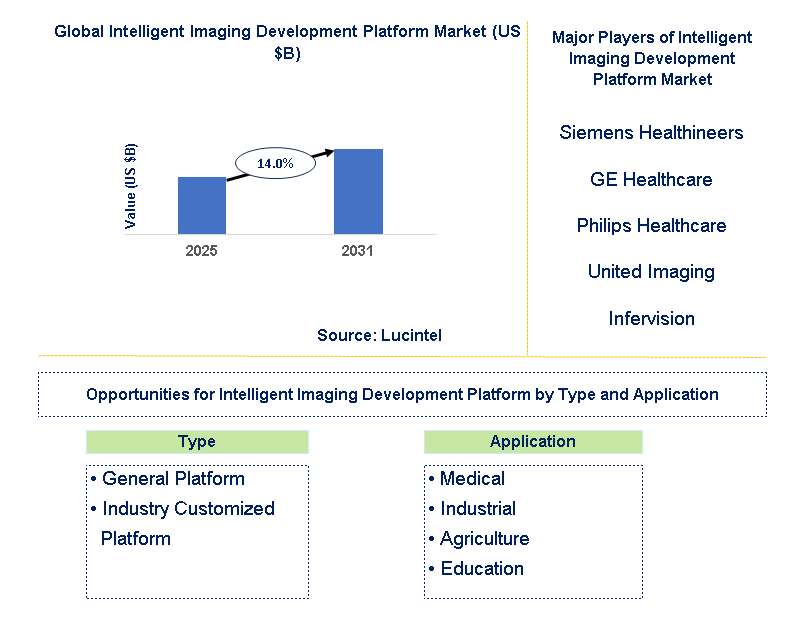
Key data points: The growth forecast = 14% annually for the next 7 years. Scroll below to get more insights. This market report covers Trends, opportunities and forecasts in intelligent imaging development platform market to 2031 by type (general platform and industry customized platform), application (medical, industrial, agriculture, and education), and region (North America, Europe, Asia Pacific, and the Rest of the World)
We'll send your sample report shortly.
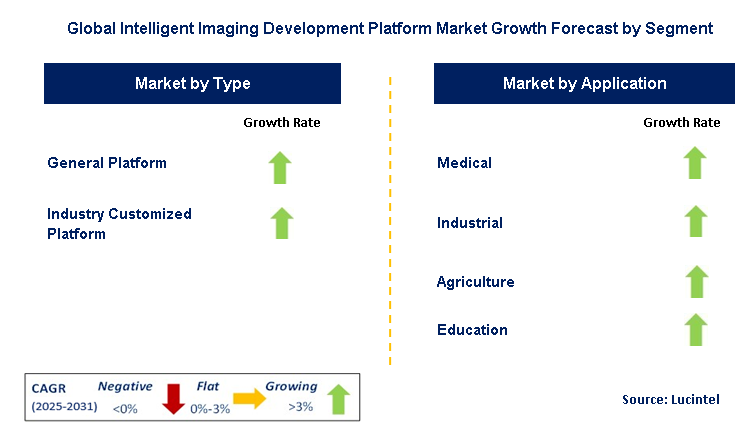
• Lucintel forecasts that, within the type category, general platform is expected to witness higher growth over the forecast period.
• Within the application category, medical is expected to witness the highest growth.
• In terms of region, APAC is expected to witness the highest growth over the forecast period.
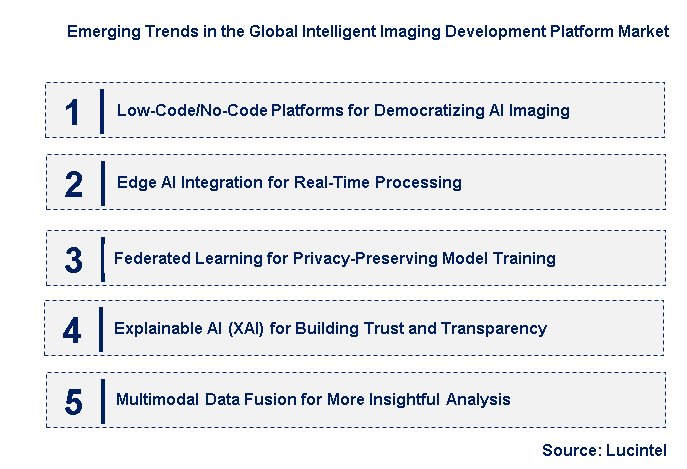
• Low-Code/No-Code Platforms for Democratizing AI Imaging: One prominent trend is the emergence of low-code/no-code intelligent imaging development platforms. Low-code/no-code platforms offer visual, intuitive interfaces and pre-configured building blocks that enable the development and deployment of advanced AI-based imaging applications by developers with minimal or no programming skills. The effect is democratization of AI imaging technology, facilitating quicker prototyping and broader adoption in multiple industries by lowering the entry obstacle for non-AI experts.
• Edge AI Integration for Real-Time Processing: Increasingly, there is a move toward bringing AI capabilities directly into edge devices (e.g., cameras, industrial sensors, medical equipment) for real-time intelligent image analysis. Development platforms are more commonly providing tools and frameworks to optimize AI models for deployment on resource-limited edge hardware. The effects include quicker processing speeds, lower latency, increased privacy through local processing of data, and the facilitation of real-time decision-making in applications such as autonomous systems and industrial automation.
• Federated Learning for Privacy-Preserving Model Training: Federated learning is becoming one of the main trends in intelligent imaging development, especially within privacy-critical applications such as healthcare. This method enables training AI models from decentralized data without exposing raw image data, maintaining patient privacy and data security. Development platforms are beginning to include federated learning frameworks and tools. The result is the possibility of constructing strong AI models from distributed data without violating strict privacy regulations and promoting collaboration among institutions.
• Explainable AI (XAI) for Building Trust and Transparency: As smart imaging systems are being used in mission-critical applications, the requirement for transparency and interpretability of AI decisions is increasing. New platforms are including Explainable AI (XAI) methods that offer explanations on why an AI model generated a specific prediction. The effect is greater trust and accountability in AI-based imaging systems, enabling enhanced understanding and verification of model behavior, particularly in regulated sectors such as healthcare and finance.
• Multimodal Data Fusion for More Insightful Analysis: There is an increasing trend towards platforms that enable fusion of imaging data with other modalities of data, including text, sensor data, and time-series data, to provide more holistic and insightful analysis. Development platforms are giving developers tools for integrating and synchronizing various streams of data into combined AI processing. The effects are richer context understanding, greater accuracy in operations such as diagnostics and predictive maintenance, and greater ability to handle more complex challenges by combining complementary sources of information. These new trends in total are remaking the intelligent imaging development platform market by increasing access to AI imaging, its efficiency, privacy safeguards, transparency, and insights. The emphasis on low-code/no-code, edge AI, federated learning, XAI, and multimodal data fusion is opening advanced imaging analytics to wider audiences and broadening where they can be applied across industries.
• Pre-trained models and Model Zoos Improved: Latest advancements involve offering more advanced and varied pre-trained AI models for specific imaging applications (e.g., object detection, image segmentation, classification). Platform vendors also maintain comprehensive model zoos through which developers can take advantage of pre-existing models and tune them to specialized applications, minimally cutting training time and resources.
• Enhanced Data Annotation Tools and Workflows: Effective and efficient data annotation is important for training effective AI models. Platforms are providing better annotation tools with capabilities such as automated labeling support, collaborative annotation workflows, and support for multiple types of annotations (e.g., bounding boxes, polygons, semantic segmentation). These enhancements make the data preparation process more efficient, a major bottleneck in AI development.
• Hyperparameter Tuning and Model Training Simplified: Development platforms are adding more intuitive interfaces and automated tools for hyperparameter tuning and model training. Automated machine learning (Autum) features are making it simpler to discover best-performing model architectures and hyperparameters, so developers can find high-performing models more easily without manual trial and error.
• Flexible Deployment Options and Infrastructure Support: Platforms are providing more flexible deployment options and supporting deployment on cloud infrastructure, on-premise servers, and edge devices. They are also improving integration with multiple hardware accelerators (e.g., GPUs, TPUs) to improve model inference performance in different deployment environments.
• Extensive SDKs and APIs for Integration: Intelligent image development platforms are offering extensive Software Development Kits (SDKs) and Application Programming Interfaces (APIs) enabling developers to incorporate intelligent imaging features into their applications and workflows with ease. These enable smooth integration with a range of programming languages and development environments. These breakthroughs are fundamentally transforming the intelligent imaging development platform market by speeding up the development cycle, enhancing the performance and accuracy of AI models, making deployment across various environments easier, and allowing for simpler integration of intelligent imaging functions into more varied applications.
• Healthcare Diagnostics and Imaging: One of the most promising growth areas is delivering specialized platforms for medical image analysis, such as radiology, pathology, and ophthalmology. These platforms can provide pre-trained models for disease detection, segmentation tools for medical images, and compliance features for managing sensitive patient data, facilitating quicker and more accurate diagnoses.
• Automation and Industrial Quality Inspection: Smart imaging platforms can be customized for manufacturing sectors to automate visual inspection of quality, identify defects in products, and control robotic systems for automation. Opportunities for growth include offering software for integrating with industrial cameras, creating custom models for defect detection, and implementing robustness and reliability in adverse industrial environments.
• Security and Surveillance: There is a huge and increasing demand for intelligent video analytics in surveillance and security. Solutions that have features such as object detection, facial recognition, anomaly detection, and real-time event analysis have huge growth potential for improving situational awareness and enhancing security systems.
• Autonomous Vehicles and Robotics: Autonomous vehicle and robotics development is highly dependent on intelligent image processing for perception and navigation. Platforms that offer tools for sensor fusion, object tracking, scene understanding, and real-time processing on embedded systems have significant growth opportunities in this fast-growing market.
• Retail Analytics and Customer Experience: Intelligent imaging can be applied to retail for purposes such as product recognition, shelf monitoring, customer behavior analysis, and personalized recommendations. Opportunities for growth lie in creating platforms that are integrated with in-store cameras, offer real-time analytics dashboards, and improve the customer shopping experience. These strategic growth areas point to the prospects of the intelligent imaging development platform market to grow by targeting the distinctive needs of healthcare, industrial automation, security, autonomous systems, and retail analytics. Platform customization and domain-specific tools and pre-trained models can open up enormous value and market share in these high-growth use cases.
• Siemens Healthineers
• GE Healthcare
• Philips Healthcare
• United Imaging Intelligence
• Infervision
• Deepwise
• SenseTime
• Megvii
• YITU Technology
• Hikvision
• General Platform
• Industry Customized Platform
• Medical
• Industrial
• Agriculture
• Education
• North America
• Europe
• Asia Pacific
• The Rest of the World
• United States: The US market is experiencing heavy action in the space of intelligent imaging development platforms with high activity being driven by an active AI startup ecosystem and long-established technology titans. Latest trends and advances involve the proliferation of cloud-based platforms that provide integrated suites of tools for image annotation, model training, and deployment. Strong focus is given towards building platforms with industry-specific solutions, and this includes medical imaging and autonomous driving. Partnerships between research institutions and platform providers are also driving innovation.
• China: The market for China's intelligent imaging development platforms is growing very fast, driven by the government's vigorous promotion of AI implementation and enormous volumes of image data being created in a wide range of industries. Recent activities involve the appearance of a number of local platforms providing comparable functionality and inducing computer vision-related applications in security, intelligent cities, and industrial manufacturing. National independence in AI technologies is creating strong pressure for investing heavily in local platform development.
• Germany: Germany's strategy for the intelligent imaging development platform market is focused on industrial use and high-precision imaging. The focus has been on adapting AI to existing industrial systems for quality inspection, predictive maintenance, and automation. A strong focus on data privacy and security has resulted in the creation of platforms that are compliant with strict European regulations. Interactions between research institutions and industry partners are important for fueling innovation in this area.
• India: The market for intelligent imaging development platforms in India is in the growth stage, fueled by growing digitization in industries and a large pool of available AI talent. Recent trends are the appearance of local start-ups that provide AI-based imaging solutions and adoption of international platforms by Indian companies. The most significant areas of application are healthcare, agriculture, and security. Emphasis is on creating cost-effective and scalable solutions to meet the unique requirements of the Indian market.
• Japan: Japan's smart imaging development platform market is distinguished by high imaging quality and precision in industries such as manufacturing and healthcare. Advances recently have incorporated AI with the latest imaging hardware to improve diagnosis capabilities and simplify quality inspection routines. Reliability and safety play a significant part in driving developments, with developers seeking to develop highly tested and solid platforms. There is increased collaboration between industry, academia and government is fostering innovation in this market.


• Siemens Healthineers
• GE Healthcare
• Philips Healthcare
• United Imaging Intelligence
• Infervision
• Deepwise
• SenseTime
• Megvii
• YITU Technology
• Hikvision Q5. Which intelligent imaging development platform market segment will be the largest in future? Answer: Lucintel forecasts that, within the type category, general platform is expected to witness higher growth over the forecast period. Q6. In intelligent imaging development platform market, which region is expected to be the largest in next 5 years? Answer: In terms of region, APAC is expected to witness the highest growth over the forecast period. Q7. Do we receive customization in this report? Answer: Yes, Lucintel provides 10% customization without any additional cost.


Choose a license that fits your team. Instant PDF delivery.
Prices exclude taxes. Instant delivery. Custom licensing available on request.
Market Report · July 13, 2026
Market Report · July 13, 2026
Market Report · July 2, 2026
Trusted partner for strategic intelligence and business growth


Receive a complimentary market analysis tailored to your industry. Our analysts will identify key growth opportunities and competitive dynamics specific to your business.

Market size, growth rate, and key trend analysis for your specific sector.

Top competitor positioning and market share analysis.

Strategic recommendations backed by data-driven insights.
Get curated market intelligence and competitive moves straight to your inbox.
By subscribing, you agree to receive our monthly insights. Unsubscribe anytime.
Receive a complimentary market analysis tailored to your industry. Our analysts will identify key growth opportunities and competitive dynamics specific to your business.
Market size, growth rate, and key trend analysis for your specific sector.
Top competitor positioning and market share analysis.
Strategic recommendations backed by data-driven insights.
Get curated market intelligence, emerging trends, and competitive moves straight to your inbox each month.
By subscribing, you agree to receive our monthly insights. Unsubscribe anytime.
We'll send your sample report shortly.