
Market Report · July 15, 2026

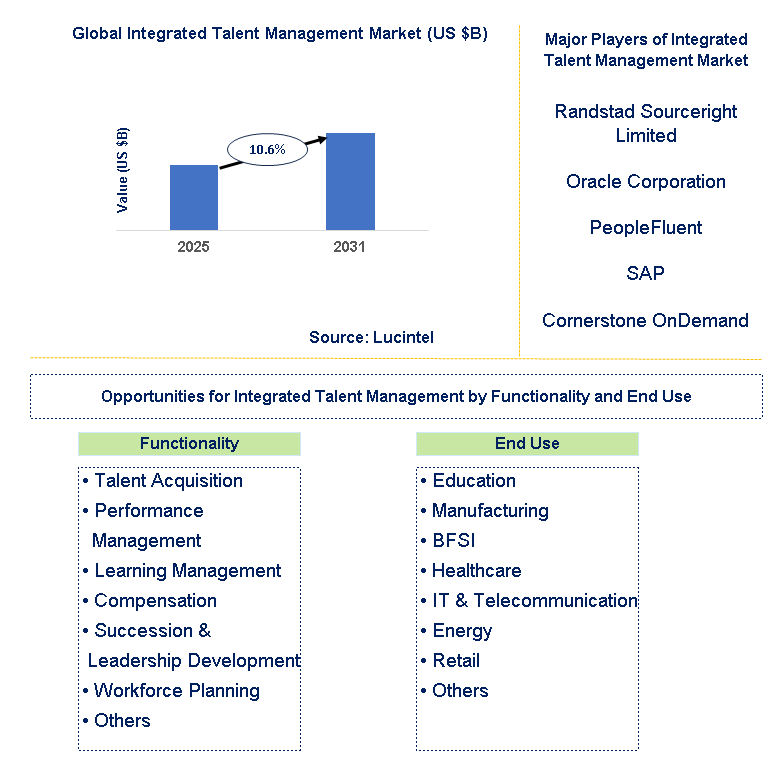
Key data points: The growth forecast = 10.6% annually for the next 7 years. Scroll below to get more insights. This market report covers trends, opportunities and forecasts in integrated talent management market to 2031 by functionality (talent acquisition, performance management, learning management, compensation, succession & leadership development, workforce planning, and others), end use (education, manufacturing, BFSI, healthcare, IT & telecommunication, energy, retail, and others), and region (North America, Europe, Asia Pacific, and the Rest of the World)
We'll send your sample report shortly.
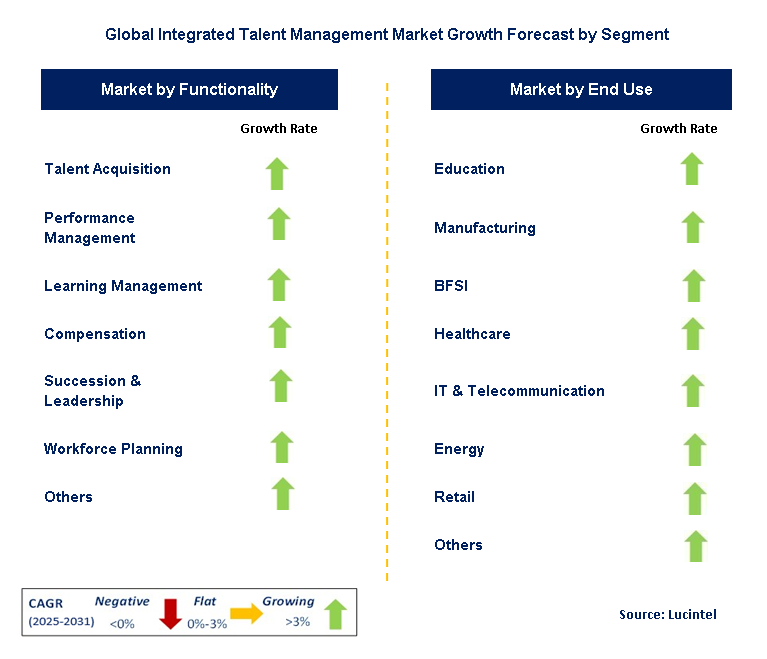
• Lucintel forecasts that, within the functionality category, talent acquisition is expected to witness the highest growth over the forecast period.
• Within the end use category, IT & telecommunication is expected to witness the highest growth.
• In terms of region, APAC is expected to witness the highest growth over the forecast period. Gain valuable insights for your business decisions with our comprehensive 150+ page report. Sample figures with some insights are shown below.
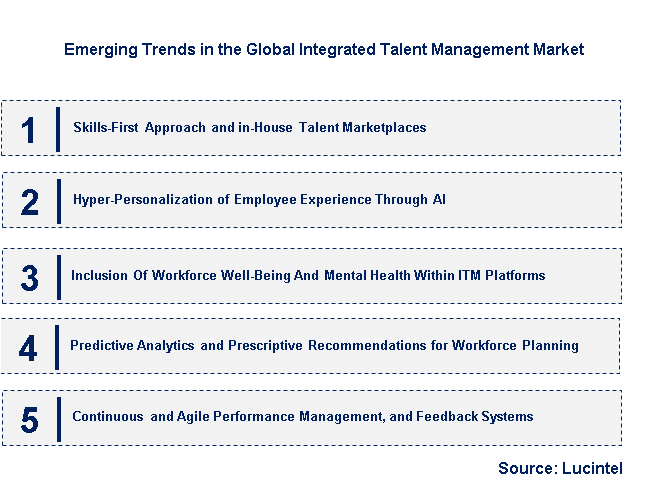
• Skills-First Approach and in-House Talent Marketplaces: One of the major emerging trends is the movement away from a conventional role-based model towards a skills-first model in talent management. Companies are more interested in discovering, monitoring, and cultivating individual employees’ skills and not merely their job titles. This is resulting in the development of internal talent marketplaces, where the employees are able to discover development opportunities, gig tasks, or fresh roles based on their capabilities, driving internal mobility and minimizing external recruitment. This methodology increases the agility of the workforce and remedies skill shortages in advance.
• Hyper-Personalization of Employee Experience Through AI: The market is seeing a robust trend towards hyper-personalizing the employee experience right through the entire talent lifecycle, driven by artificial intelligence to a large extent. AI algorithms process individual employee data, performance, and preferences to provide customized learning recommendations, career path suggestions, personalized feedback, and personalized onboarding experiences. Personalization to this extent is intended to have a dramatic positive impact on employee engagement, satisfaction, and retention by making every individual feel valued and supported in their professional development journey.
• Inclusion Of Workforce Well-Being And Mental Health Within ITM Platforms: There is a growing understanding that employee well-being, including mental health, is central to talent management. ITM platforms are now incorporating features that facilitate employee well-being, such as stress management tools, mindfulness initiatives, virtual coaching, and work-life balance trackers. This is being fueled by greater sensitivity to mental health concerns, a wish to avoid burnout, and the fact that a healthy and engaged workforce is more productive and resilient.
• Predictive Analytics and Prescriptive Recommendations for Workforce Planning: Application of advanced analytics, especially predictive and prescriptive analytics, is fast becoming a cornerstone of ITM. Companies are using big data from their HR systems to predict future talent requirements, detect potential risk of flight, forecast performance trends, and examine the impact of different HR interventions. These provide inputs for proactive workforce planning, strategic hiring, and fact-based decisions, transforming HR into a more strategic and forward-looking organization.
• Continuous and Agile Performance Management, and Feedback Systems: Traditional yearly performance reviews are giving way to more nimble and continuous performance management paradigms. This is focusing on regular check-ins, feedback in real-time, and continuous coaching between managers and staff. ITM platforms are changing to enable these flexible approaches, providing features for continuous feedback, goal alignment, and 360-degree feedback, so as to promote a culture of continuous learning and improvement that responds better to quick changes in the business environment and the evolving needs of employees. These new trends are basically transforming the integrated talent management market by designing more adaptive, data-based, and employee-focused systems. The transition towards a skills-first and hyper-personalization are empowering people and driving internal development. The merging of well-being, combined with advanced analytics and flexible performance management, is making solutions for ITM more holistic and strategic and allowing organizations to develop highly engaged, productive, and resilient workforces in a volatile global world.
• Increased Integration with Wider HR Ecosystems And Business Solutions: Primary importance is greater integration of ITM platforms with other HR systems (e.g., payroll, HRIS) and more general business applications (e.g., CRM, project management solutions). This leads to a more cohesive data environment, with information flowing seamlessly across functions. The result is better data consistency, less manual effort on the part of HR teams, and stronger cross-functional collaboration, enabling a more integrated view of employee data and business performance.
• Wider Adoption of Artificial Intelligence and Machine Learning: The market has witnessed a sharp uptick in AI and machine learning adoption within ITM solutions. AI is utilized for smart candidate matching, resume screening, personalized learning suggestions, employee feedback sentiment analysis, and attrition risk predictive analytics. This innovation dramatically enhances efficiency in talent processes, eliminates bias, gives greater insights, and enables HR to make more data-led and proactive decisions.
• Personalized Learning and Development Paths: Latest trends focus on customization of learning and development activities according to the specific needs and career goals of employees. ITM platforms today provide enhanced learning management systems (LMS) with AI-powered content suggestions, micro-learning units, and adaptive learning routes. This increases continuous skill acquisition, fills precise skill gaps, enhances employee participation, and enables internal mobility so that the workforce is future-proof.
• Rise of "Skills-Based" Talent Management Models: There is a significant trend towards skills-based talent management, with skills, not roles, emerging as the key currency for talent choices. ITM solutions are building capabilities to map, measure, and track skills within the organization, supporting the development of in-house talent marketplaces and enabling skill-based hiring, deployment, and growth. This evolution improves organizational responsiveness, enhances talent optimization, and makes workforce planning more dynamic and responsive to business requirements.
• Addition of Employee Well-Being and Engagement Modules: Recent ITM innovations witness a greater emphasis on employee well-being and engagement. Solutions are adding modules for mental health care, stress management, work-life balance initiatives, and continuous employee feedback and sentiment gathering tools. This integrated perspective acknowledges that employee well-being is paramount to productivity, retention, and overall organizational performance, thereby resulting in more holistic and empathetic talent initiatives. These new innovations are collectively influencing the integrated talent management market in making it smarter, more connected, and people-focused. The improvements in AI, learning at scale, and skills platforms are driving more efficiency and effectiveness in talent processes. In addition, the focus on integration and employee well-being is shaping ITM into a genuine strategic business necessity, allowing organizations to create more engaged, flexible, and resilient workforces.
• Talent Acquisition and Onboarding Optimization: A major growth area is optimizing talent sourcing and onboarding processes even further. This includes using AI for enhanced candidate matching, auto-scheduling interviews, and tailored onboarding experiences. Strategic growth can be realized through providing solutions that lower time-to-hire, enhance candidate experience, and increase new hire productivity and retention. Intelligent resume parsing, automated background checks, and tailored first-day experiences are at the forefront in this competitive talent market.
• Continuous Feedback and Performance Management Systems: The transition from traditional annual reviews to continuous performance management is a huge growth opportunity. ITM providers can ride the wave by providing solid platforms that enable regular check-ins, instant feedback, goal alignment, and peer rewards. Opportunities are to build AI-driven analytics to spot high performers and coaching requirements, add 360-degree feedback, and make feedback based on skills, all towards a culture of continuous growth and enhanced employee productivity and engagement.
• Development and Learning with Tailored Pathways: The ongoing demand for reskilling and upskilling opens a potent growth prospect in the learning and development (L&D) space. Strategic growth entails constructing ITM platforms with embedded, AI-powered Learning Management Systems (LMS) that provide customized learning routes, micro-learning components, and skills gap assessments. This enables organizations to anticipate changing skill demands, enable continuous learning culture, and retain professionals by showcasing investment in employee development.
• Leadership Development and Succession Planning: With leadership succession and the necessity of internal talent pipelines looming on the horizon, succession planning and leadership development become compelling growth prospects. ITM solutions have the ability to offer powerful tools for high-potential employee identification, leadership competency assessment, and structured development program design. Strategic growth entails providing predictive analytics for succession potential, management of mentorship programs, and talent mapping capabilities to ensure a robust leadership pipeline and organizational sustainability.
• Predictive Analytics and Workforce Insights: The need for data-driven HR decision-making is a huge strategic growth opportunity. ITM platforms with strong workforce analytics, predictive and prescriptive ones at that, are extremely sought after. Potential exists in creating sophisticated dashboards, reporting capabilities, and AI-driven engines to crunch varied HR data to predict talent requirements, detect attrition risk, track engagement, and align HR expenditure. This enables HR leaders to become strategic business partners, taking fact-based decisions that have a direct impact on organizational performance. These strategic expansion opportunities are set to have a significant impact on the integrated talent management market by bettering the value proposition of ITM solutions throughout the entire employee life cycle. By leveraging the demand for optimized talent acquisition, continuous performance management, tailored development, solid succession planning, and penetrating workforce analytics, the market can bring enhanced efficiency, increase employee engagement, and better tie human capital plans to overall business plans, resulting in long-term growth and competitive differentiation.
• Randstad Sourceright Limited
• Oracle Corporation
• PeopleFluent
• SAP
• Cornerstone OnDemand
• Saba Software
• IBM Corporation
• SilkRoad technology
• Lumesse
• SumTotal Systems
• Talent Acquisition
• Performance Management
• Learning Management
• Compensation
• Succession & Leadership Development
• Workforce Planning
• Others
• Education
• Manufacturing
• BFSI
• Healthcare
• IT & Telecommunication
• Energy
• Retail
• Others
• North America
• Europe
• Asia Pacific
• The Rest of the World
• United States: United States ITM market is dominated by a high focus on the utilization of artificial intelligence and advanced analytics for predictive workforce planning and personalized employee development. Recent trends include the growth in the adoption of skills-based talent management platforms that help organizations identify skill gaps and facilitate internal mobility through talent marketplaces. Also, there is a huge emphasis on creating an employee experience through the integration of various HR technologies, powered by a highly competitive labor market and changes in employee expectations for career development and well-being.
• China: China’s ITM market is growing at a fast pace, driven by its vast workforce and shift towards a knowledge-based economy. Recent trends emphasize a significant investment in digital transformation of HR, with a strong emphasis on adopting AI to automate recruitment, detect skill gaps, and improve talent pipeline building. Workforce planning is becoming a key focus area for Chinese organizations to respond to changing demands, primarily in technology and finance industries. The market is also witnessing greater emphasis on employee development programs to tackle the misalignment between educational achievement and industry requirements, frequently with government initiatives.
• Germany: The German ITM market is led by attention to strong regulatory compliance, data protection, and promoting employee development through formal learning frameworks. Recent trends involve growing uptake of cloud-based ITM solutions, providing scalability and ease of integration with current enterprise systems. German corporations are actively looking into AI-powered solutions for tailored talent experience, skill mapping, and ongoing performance management, frequently with a focus on keeping transparency and data security at the forefront. The market demonstrates a high dedication to optimizing the workforce and employee engagement, especially among its large and mature corporate market.
• India: India’s market for ITM is expanding fast, driven by a young and expanding labor pool and a growing use of online technologies. Recent trends reveal a strong movement towards using Generative AI to recognize skill gaps as well as optimize employee mobility initiatives, with the vast majority of Indian employers employing such tools. There is considerable emphasis placed on aligning talent strategy with mobility initiatives, acknowledging that mobility assignments are career-altering for individuals. The market also places a premium on skill building as a primary driver of talent, in tune with the "Viksit Bharat" vision and requirement for an AI-powered education system.
• Japan: Japan’s ITM market is developing to meet its specific demographic issues, specifically an aging workforce and declining population. Recent trends include a significant thrust in leveraging AI in hiring to offset manpower shortages and improve recruitment efficiency. Japanese businesses are putting their emphasis on upskilling and reskilling initiatives to make their employees ready to handle emerging technologies and new job functions. There is also an increasing openness to flexible work arrangements, remote work, and gig work to leverage varying pools of talent, reflecting a transition away from conventional employment models towards more nimble workforce approaches to stay competitive internationally.


• Randstad Sourceright Limited
• Oracle Corporation
• PeopleFluent
• SAP
• Cornerstone OnDemand
• Saba Software
• IBM Corporation
• SilkRoad technology
• Lumesse
• SumTotal Systems Q5. Which integrated talent management market segment will be the largest in future? Answer: Lucintel forecasts that, within the functionality category, talent acquisition is expected to witness the highest growth over the forecast period. Q6. In integrated talent management market, which region is expected to be the largest in next 5 years? Answer: In terms of region, APAC is expected to witness the highest growth over the forecast period. Q7. Do we receive customization in this report? Answer: Yes, Lucintel provides 10% customization without any additional cost.


Choose a license that fits your team. Instant PDF delivery.
Prices exclude taxes. Instant delivery. Custom licensing available on request.
Market Report · July 15, 2026
Market Report · June 26, 2026
Market Report · June 24, 2026
Trusted partner for strategic intelligence and business growth


Receive a complimentary market analysis tailored to your industry. Our analysts will identify key growth opportunities and competitive dynamics specific to your business.

Market size, growth rate, and key trend analysis for your specific sector.

Top competitor positioning and market share analysis.

Strategic recommendations backed by data-driven insights.
Get curated market intelligence and competitive moves straight to your inbox.
By subscribing, you agree to receive our monthly insights. Unsubscribe anytime.
Receive a complimentary market analysis tailored to your industry. Our analysts will identify key growth opportunities and competitive dynamics specific to your business.
Market size, growth rate, and key trend analysis for your specific sector.
Top competitor positioning and market share analysis.
Strategic recommendations backed by data-driven insights.
Get curated market intelligence, emerging trends, and competitive moves straight to your inbox each month.
By subscribing, you agree to receive our monthly insights. Unsubscribe anytime.
We'll send your sample report shortly.