
Market Report · July 29, 2026

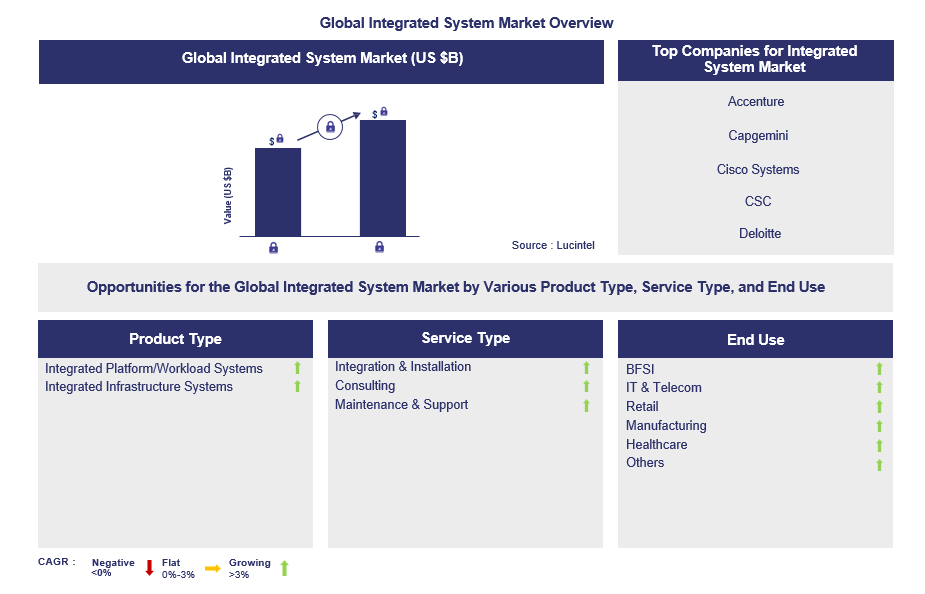
Key data points: The market size in 2031 = $77.5 billion, growth forecast = 15.6% annually for the next 7 years. Scroll below to get more insights. This market report covers trends, opportunities, and forecasts in the global integrated system market to 2031 by product type (integrated platform/workload systems and integrated infrastructure systems), service type (integration & installation, consulting, and maintenance & support), end use (BFSI, IT & telecom, retail, manufacturing, healthcare, and others), and region (North America, Europe, Asia Pacific, and the Rest of the World)
We'll send your sample report shortly.
• Lucintel forecasts that, within the product type category, integrated infrastructure system is expected to witness the higher growth over the forecast period due to growing adoption of autonomous driving technologies.
• Within the end use category, BFSI will remain the largest segment due to rapidly evolving trend of mobile banking and digital transactions.
• In terms of regions, North America will remain the largest region over the forecast period due to technological developments and increasing adoption of cloud-based services among large organizations. Gain valuable insights for your business decisions with our comprehensive 150+ page report.
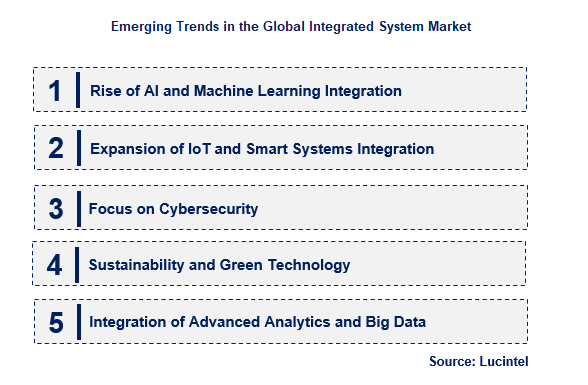
• Rise of AI and Machine Learning Integration: Decision-making and automation in several systems now incorporate more AI and machine learning. This enables better management of system performance, maintenance, and use through highly sophisticated real-time systems.
• Expansion of IoT and Smart Systems Integration: IoT technology is fostering the advancement of smart systems capable of connecting multiple devices and facilitating instant communication. This is improving system integration, reactive behavior, and efficiency of operations in manufacturing, logistics, smart cities, and other industries.
• Focus on Cybersecurity: The increasingly integrated systems have raised, without a question, the issue of cybersecurity. New measures have been adopted in efforts to safeguard against data breaches as well as cyber intrusions. This is important for ensuring that the systems remain dependable for different uses.
• Sustainability and Green Technology: There is increased attention towards the inclusion of sustainable and green technology in the systems developed. This includes the adoption of renewable energy and the reduction of energy usage. The trend is in line with environmental expectations and aids in the creation of sustainable and intelligent systems.
• Integration of Advanced Analytics and Big Data into the System: Additional technologies, such as advanced analytics and big data, have contributed to more efficient decision-making and operational intelligence. This development provides an opportunity for organizations to sift through large amounts of data for better performance, efficiency, and strategic planning. These trends are changing the integrated system market by inducing operational processes, efficiency engineering, and focusing on sustainability and security.
• Advanced AI and Automation Solutions: Integration of AI and automation technologies is optimizing productivity levels in various sectors. Such solutions allow decisions and processes to be made and optimized in real-time, leading to integrated systems that are more intelligent and responsive.
• Growth of Smart City Initiatives: More resources are being directed toward smart city initiatives, expanding the scope of integrated urban systems. There are improvements in infrastructure, traffic control, and public utilities aimed at making cities more interconnected and easier to navigate.
• Improved Cybersecurity: The notions of system security and security measures have changed in favor of integrated security for systems. Advanced system protection from malicious attacks has become more important when system operations are intended to withstand both known and unknown threats.
• Implementation of Renewable Energy Technologies: Interfacing different distributed energy resources with grid management systems is encouraging the green agenda. This development ushers in the shift to environmentally friendly energy solutions and makes integrated systems more efficient in energy use.
• Growth in Healthcare and Industrial Applications: Healthcare and industrial users are increasingly adopting integrated systems. Telemedicine, smart manufacturing technologies, and automation will drive more growth and enhance operational performance in these areas. These transformations are distinguishing the integrated system market as they improve the functionality of integrated systems, security, stability, and efficiency in other areas of application.
• Smart City Development: There are ample opportunities for growth in infrastructure and intelligent city systems. Urban management systems and integrated administration systems (for urban traffic monitoring, social utilities provision, etc.) will help make contemporary cities better integrated and easier to manage.
• Healthcare Integration: Other opportunities for expansion include deepening integrated systems in healthcare, such as telehealthcare systems and EHR systems. The development of advanced patient monitoring and data systems improves the efficiency and quality of healthcare.
• Industrial Automation: There is also an opportunity for growth in industrial automation. Using integrated systems in manufacturing for robotics, process engineering control, and data analytics improves production, cuts operating costs, and helps in the execution of Industry 4.0 strategies.
• Energy Management Systems: The deployment of renewable energy sources along with smart grid measures provides vast room for expansion. The formulation of energy management and optimization systems promotes environmental coherence and increases energy efficiency.
• IoT and Connectivity Solutions: Partnerships and investments in IoT and connectivity solutions will enhance the growth of integrated systems. Increased device interconnectivity and real-time data transfer will improve operational efficiency and enable the creation of smart applications. These growth opportunities are shaping the integrated system market in terms of innovation, efficiency, and broadening application scope across several sectors.
• Technological Advancements: The fast development of artificial intelligence, the Internet of Things, and automation has increased the market for integration systems. These technologies boost the efficiency, automation, and data processing capabilities of systems.
• Increasing Demand for Automation: The growing need for automation in processes across cutting-edge industries such as manufacturing and healthcare has led to a rise in integrated system development. Automation increases operational efficiencies and reduces labor costs.
• Focus on Sustainability: There is continuous pressure for systems to incorporate green technologies due to the importance placed on sustainable measures and energy efficiency. This trend helps enhance environmental objectives and promotes greener approaches.
• Smart City Initiatives: The boom in smart city projects is creating opportunities for the convergence of systems within city governance. Constructing systems that efficiently manage traffic, civic services, and infrastructure improves the effectiveness of cities and their connectivity.
• Rising Cybersecurity Concerns: Increasing concerns over cybersecurity and the need for measures against cyber-attacks are driving the engineering of integrated systems focused on security. Protecting systems from information leakage and damage by hackers is crucial for system effectiveness. Challenges in the integrated system market include:
• High Implementation Costs: The integration of high-end technologies and systems comes at significant costs. Many companies face challenges in ensuring that these costs are offset by the expected returns.
• Complexity of Integration: Technologies and systems are often highly complex, making integration a challenge. For different components to work together effectively, designers must emphasize compatibility and seamless usage.
• Regulatory Compliance: Adhering to regulations and standards is not always easy. Compliance with regulatory requirements can also affect operational processes and increase costs. Such drivers and challenges delineate the integrated system market and the ways in which market growth patterns, available technologies, and the overall market will be influenced.
• Accenture
• Capgemini
• Cisco Systems
• CSC
• Deloitte
• Integrated Platform/Workload Systems
• Integrated Infrastructure Systems
• Integration & Installation
• Consulting
• Maintenance & Support
• BFSI
• IT & Telecom
• Retail
• Manufacturing
• Healthcare
• Others
• North America
• Europe
• Asia Pacific
• The Rest of the World
• United States: The US is progressing further in integrated systems evolution thanks to advancements in AI and machine learning technologies. The world is witnessing these advancements as many very large companies are incorporating them into all aspects of production and logistics industries. Also, more budgets are coming on board to address the increased investment in security issues.
• China: China is leading the development of integrated systems for urban areas and industries where smart city and IoT integration are in high demand. Several reasons for this stem from the fact that the government has been undertaking measures to encourage the building of digital infrastructure, as well as renovations in technology with huge spending on 5G and AI.
• Germany: Germany is also improving its formula and systems by embracing the technologies of Industry 4.0, with an emphasis on the construction of smart factories having superior robotics and automation systems. Most importantly, Germany is also a front runner in wind power integration into the grid for sustainable energy.
• India: India is ready to integrate modern technologies in agriculture and healthcare. The increase in the use of telemedicine in healthcare and the application of smart farming continue to contribute to the growing count. Due to the government’s interest in digitalization and the development of smart interventions, a network of integrated systems is emerging in all sectors.
• Japan: Japan is leveraging the development of integrated systems through the use of robots and automation systems, with the manufacturing and auto industries being key areas. The aging population is a key driver as the country is actively involved in efforts to incorporate nanotechnology into current systems. A rapid pace of change is also achieved due to the increasing focus on the development and commercialization of new technologies.


• Accenture
• Capgemini
• Cisco Systems
• CSC
• Deloitte Q6. Which integrated system market segment will be the largest in future? Answer: Lucintel forecasts that integrated infrastructure system is expected to witness the higher growth over the forecast period due to growing adoption of autonomous driving technologies. Q7. In integrated system market, which region is expected to be the largest in next 5 years? Answer: North America will remain the largest region over the forecast period due to technological developments and increasing adoption of cloud-based services among large organizations. Q8. Do we receive customization in this report? Answer: Yes, Lucintel provides 10% customization without any additional cost.


Choose a license that fits your team. Instant PDF delivery.
Prices exclude taxes. Instant delivery. Custom licensing available on request.
Market Report · July 29, 2026
Market Report · July 20, 2026
Market Report · July 20, 2026
Trusted partner for strategic intelligence and business growth


Receive a complimentary market analysis tailored to your industry. Our analysts will identify key growth opportunities and competitive dynamics specific to your business.

Market size, growth rate, and key trend analysis for your specific sector.

Top competitor positioning and market share analysis.

Strategic recommendations backed by data-driven insights.
Get curated market intelligence and competitive moves straight to your inbox.
By subscribing, you agree to receive our monthly insights. Unsubscribe anytime.
Receive a complimentary market analysis tailored to your industry. Our analysts will identify key growth opportunities and competitive dynamics specific to your business.
Market size, growth rate, and key trend analysis for your specific sector.
Top competitor positioning and market share analysis.
Strategic recommendations backed by data-driven insights.
Get curated market intelligence, emerging trends, and competitive moves straight to your inbox each month.
By subscribing, you agree to receive our monthly insights. Unsubscribe anytime.
We'll send your sample report shortly.