
Market Report · July 15, 2026

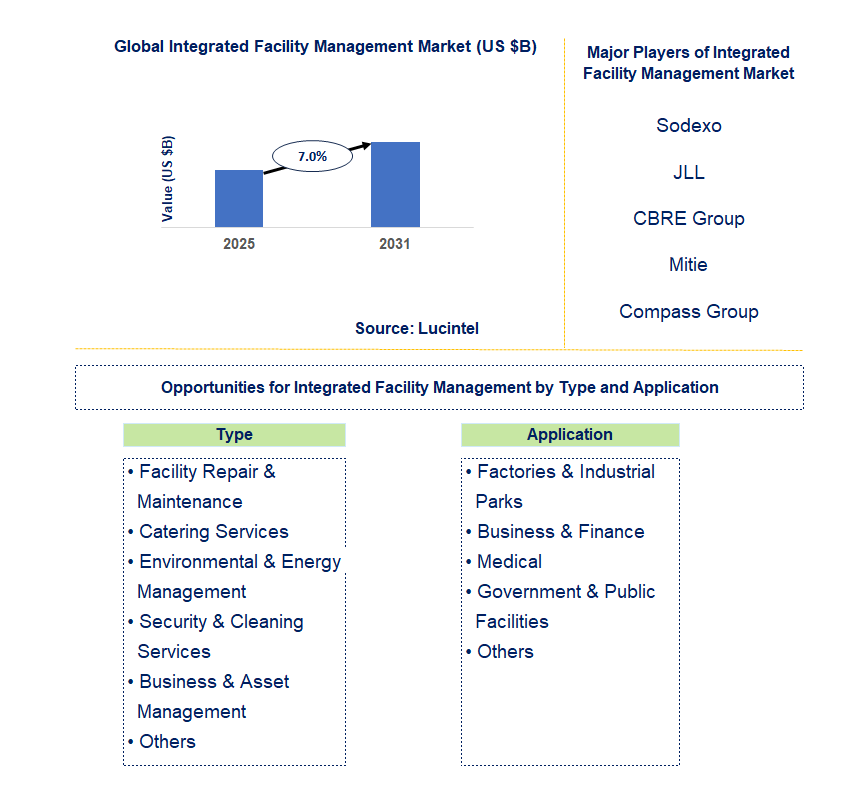
Key data points: The growth forecast = 7% annually for the next 7 years. Scroll below to get more insights. This market report covers trends, opportunities and forecasts in integrated facility management market to 2031 by type (facility repair & maintenance, catering services, environmental & energy management, security & cleaning services, business & asset management, and others), application (factories & industrial parks, business & finance, medical, government & public facilities, and others), and region (North America, Europe, Asia Pacific, and the Rest of the World)
We'll send your sample report shortly.
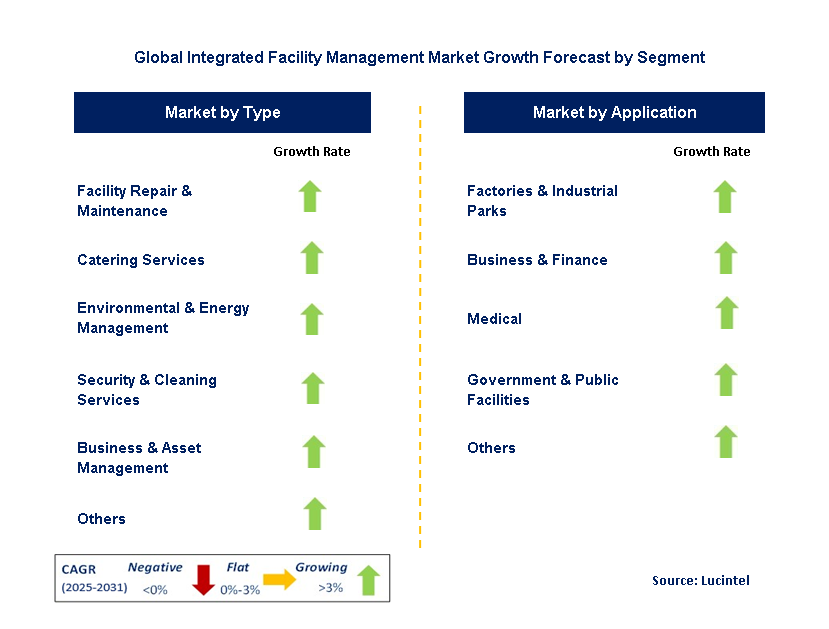
• Lucintel forecasts that, within the type category, environmental & energy management is expected to witness the highest growth over the forecast period.
• Within the application category, factory & industrial park is expected to witness the highest growth.
• In terms of region, APAC is expected to witness the highest growth over the forecast period. Gain valuable insights for your business decisions with our comprehensive 150+ page report. Sample figures with some insights are shown below.
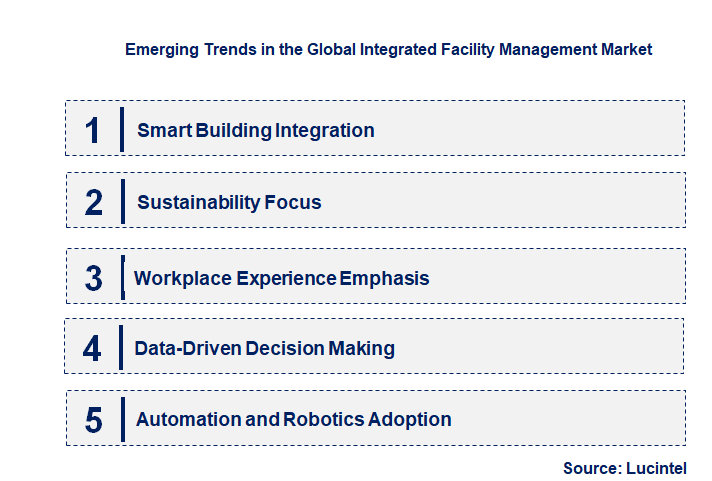
• Smart Building Integration: This trend involves seamlessly integrating IoT sensors, AI, and automation with facility management systems. It enables real-time monitoring of building performance, energy consumption, and occupancy, leading to predictive maintenance, optimized resource allocation, and enhanced operational efficiency.
• Sustainability Focus: IFM is increasingly prioritizing environmental, social, and governance (ESG) goals. This trend involves implementing energy-efficient systems, waste reduction strategies, and green building certifications, not only for regulatory compliance but also to enhance corporate reputation and achieve significant long-term cost savings.
• Workplace Experience Emphasis: There is a growing focus on creating engaging and productive work environments. This trend includes integrating smart meeting room booking, indoor air quality monitoring, and personalized climate control, aiming to improve employee well-being, satisfaction, and ultimately, productivity within the facility.
• Data-Driven Decision Making: Leveraging big data analytics is transforming how facilities are managed. This trend involves collecting and analyzing data from various sources to gain insights into building performance, occupant behavior, and operational efficiency, enabling more informed and proactive decision-making for resource optimization and strategic planning.
• Automation and Robotics Adoption: The integration of automation and robotics is streamlining routine facility tasks. This includes autonomous cleaning robots, automated security systems, and drone inspections, which reduce labor costs, improve task precision, and allow human staff to focus on more complex, strategic facility management activities. These trends are fundamentally reshaping the integrated facility management market by driving towards more intelligent, sustainable, and human-centric facility operations. They enable IFM providers to deliver higher value, optimize resources, and create dynamic, responsive environments that support business objectives and occupant well-being.
• Digital Twin Adoption: The use of digital twins, virtual replicas of physical buildings and their systems, is gaining traction. This allows facility managers to monitor, simulate, and analyze building performance in real-time, optimizing energy use, predicting maintenance needs, and improving overall operational efficiency without physical intervention.
• AI-Powered Predictive Maintenance: Advanced AI and machine learning algorithms are enabling predictive maintenance strategies. By analyzing data from IoT sensors on equipment, IFM systems can anticipate potential failures, schedule maintenance proactively, and minimize costly downtime, significantly extending asset lifespan and reducing repair costs.
• Enhanced Cybersecurity for Smart Buildings: With the increasing connectivity of smart building systems, there’s a strong focus on robust cybersecurity measures. Recent developments involve implementing advanced encryption, intrusion detection systems, and secure network protocols to protect sensitive facility data and prevent unauthorized access.
• Cloud-Based IFM Platforms: The shift towards cloud-based IFM platforms is a significant development, offering greater flexibility, scalability, and accessibility. These platforms facilitate real-time data sharing, remote monitoring, and seamless collaboration among stakeholders, optimizing resource allocation and improving responsiveness to facility needs.
• Integration with ESG Reporting: Integrated facility management solutions are increasingly incorporating features for ESG (Environmental, Social, and Governance) reporting. This allows organizations to track and report on their environmental footprint, social impact, and governance practices, aiding compliance and demonstrating commitment to sustainability. These developments are collectively impacting the integrated facility management market by driving greater efficiency, enhancing predictive capabilities, strengthening security, and supporting sustainability initiatives. They are transforming IFM into a more strategic and data-driven discipline, enabling organizations to optimize their physical assets and create more responsive environments.
• Energy Management: Significant growth lies in offering advanced energy management solutions within IFM. This includes implementing smart meters, AI-driven energy optimization algorithms, and renewable energy integration, helping clients reduce their carbon footprint and achieve substantial cost savings on utility bills.
• Space Utilization and Optimization: Opportunities exist in developing IFM solutions focused on intelligent space management. This involves using sensor data to analyze occupancy patterns, optimize desk and room allocation, and facilitate agile workspaces, leading to improved employee productivity and reduced real estate costs.
• Asset Performance Management: There is a strong growth avenue in providing comprehensive asset performance management through IFM. This includes predictive maintenance tools, lifecycle costing analysis, and remote monitoring of critical assets, ensuring maximum uptime, extended asset life, and optimized maintenance schedules.
• Workplace Health and Safety: Growth opportunities are emerging in offering integrated health and safety solutions. This encompasses indoor air quality monitoring, contact tracing capabilities, emergency response systems, and compliance management, creating safer and healthier environments for occupants, particularly post-pandemic.
• Data Analytics and Reporting: A key growth area is in providing advanced data analytics and customizable reporting features within IFM platforms. This allows organizations to gain deeper insights into their facility operations, identify trends, and make informed decisions for continuous improvement and strategic planning. These strategic growth opportunities are reshaping the integrated facility management market by pushing for more specialized, technologically advanced, and data-driven services. They are vital for enabling organizations to achieve operational excellence, optimize resource allocation, and adapt to evolving demands for sustainable and intelligent building management.
• Sodexo
• JLL
• CBRE Group
• Mitie
• Compass Group
• Aramark
• Cushman&Wakefield
• Siemens
• ISS Facilities Services
• Johnson Controls
• Facility Repair & Maintenance
• Catering Services
• Environmental & Energy Management
• Security & Cleaning Services
• Business & Asset Management
• Others
• Factories & Industrial Parks
• Business & Finance
• Medical
• Government & Public Facilities
• Others
• North America
• Europe
• Asia Pacific
• The Rest of the World
• United States: The U.S. market is leading in the adoption of advanced IFM technologies, particularly IoT, AI, and predictive analytics for optimizing energy consumption and asset maintenance. There’s a strong emphasis on workplace experience and sustainability, with a growing trend of outsourcing IFM services to specialized providers for cost efficiency.
• China: China’s IFM market is rapidly expanding, fueled by significant infrastructure development and urbanization. The focus is on implementing smart building technologies and integrating IFM with digital platforms to manage vast commercial and industrial complexes, with government support promoting digitalization and large-scale projects.
• Germany: Germany’s IFM market is characterized by a strong emphasis on efficiency, regulatory compliance, and energy management. There’s a growing adoption of advanced software solutions for integrated building management, with a keen interest in sustainable practices and the integration of digital twins for facility lifecycle management.
• India: India’s IFM market is experiencing robust growth driven by rapid urbanization, infrastructure expansion, and a burgeoning commercial real estate sector. The market is witnessing increased adoption of technology-driven solutions for cost optimization, improved service delivery, and addressing the growing demand for professional facility management.
• Japan: Japan’s IFM market is focused on enhancing operational efficiency and resilience through technological integration. There’s a strong push for smart building solutions, including robotics for cleaning and security, and the use of data analytics to optimize facility performance, particularly in response to an aging workforce.


• Sodexo
• JLL
• CBRE Group
• Mitie
• Compass Group
• Aramark
• Cushman&Wakefield
• Siemens
• ISS Facilities Services
• Johnson Controls Q5. Which integrated facility management market segment will be the largest in future? Answer: Lucintel forecasts that, within the type category, environmental & energy management is expected to witness the highest growth over the forecast period. Q6. In integrated facility management market, which region is expected to be the largest in next 5 years? Answer: In terms of region, APAC is expected to witness the highest growth over the forecast period. Q7. Do we receive customization in this report? Answer: Yes, Lucintel provides 10% customization without any additional cost.


Choose a license that fits your team. Instant PDF delivery.
Prices exclude taxes. Instant delivery. Custom licensing available on request.
Market Report · July 15, 2026
Market Report · June 26, 2026
Market Report · June 24, 2026
Trusted partner for strategic intelligence and business growth


Receive a complimentary market analysis tailored to your industry. Our analysts will identify key growth opportunities and competitive dynamics specific to your business.

Market size, growth rate, and key trend analysis for your specific sector.

Top competitor positioning and market share analysis.

Strategic recommendations backed by data-driven insights.
Get curated market intelligence and competitive moves straight to your inbox.
By subscribing, you agree to receive our monthly insights. Unsubscribe anytime.
Receive a complimentary market analysis tailored to your industry. Our analysts will identify key growth opportunities and competitive dynamics specific to your business.
Market size, growth rate, and key trend analysis for your specific sector.
Top competitor positioning and market share analysis.
Strategic recommendations backed by data-driven insights.
Get curated market intelligence, emerging trends, and competitive moves straight to your inbox each month.
By subscribing, you agree to receive our monthly insights. Unsubscribe anytime.
We'll send your sample report shortly.