
Market Report · July 15, 2026

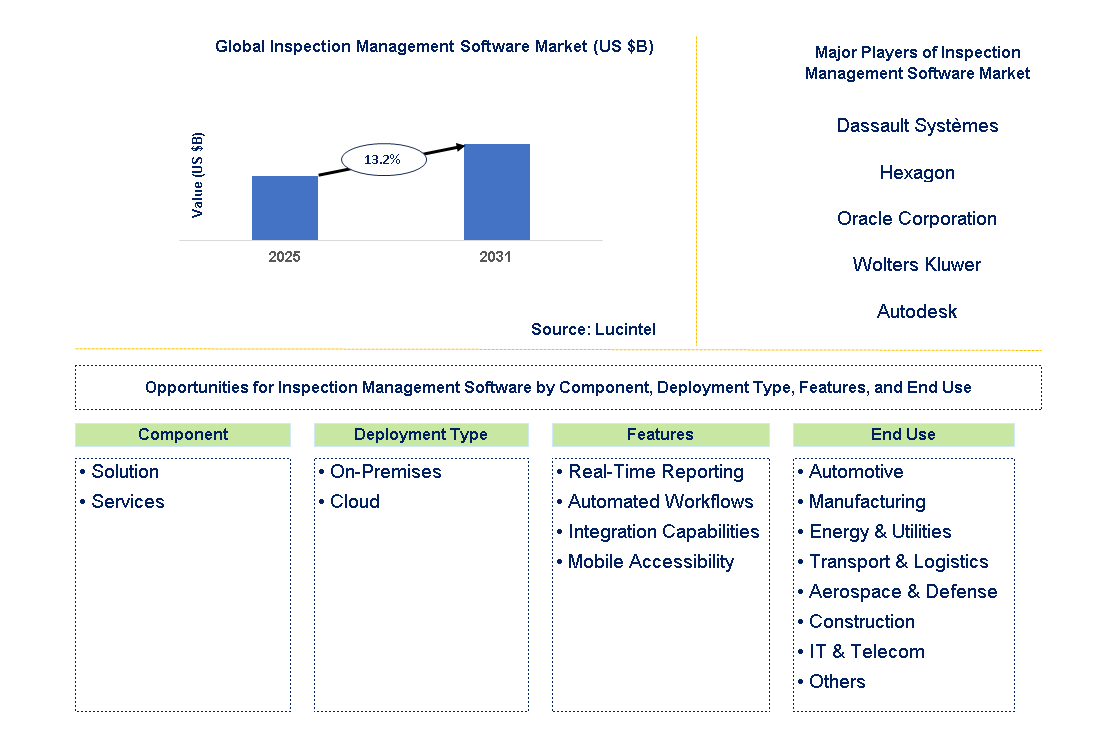
Key data points: The growth forecast = 13.2% annually for the next 7 years. Scroll below to get more insights. This market report covers trends, opportunities and forecasts in inspection management software market to 2031 by component (solution and services), deployment type (on-premises and cloud), features (real-time reporting, automated workflows, integration capabilities, and mobile accessibility), end use (automotive, manufacturing, energy & utilities, transport & logistics, aerospace & defense, construction, it & telecom, and others), and region (North America, Europe, Asia Pacific, and the Rest of the World)
We'll send your sample report shortly.
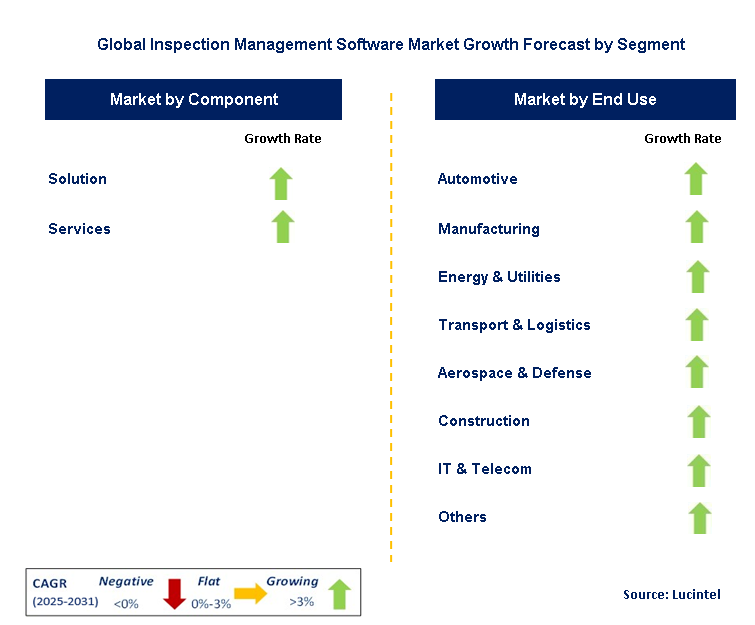
• Lucintel forecasts that, within the component category, service is expected to witness higher growth over the forecast period.
• Within the end use category, manufacturing is expected to witness the highest growth.
• In terms of region, APAC is expected to witness the highest growth over the forecast period. Gain valuable insights for your business decisions with our comprehensive 150+ page report. Sample figures with some insights are shown below.
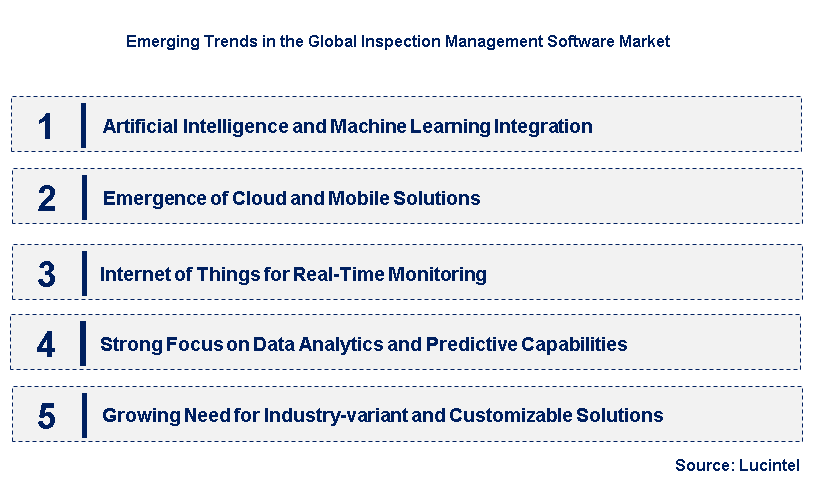
• Artificial Intelligence and Machine Learning Integration: This trend is about integrating AI and ML algorithms into IMS platforms to automate inspection aspects. AI can examine a large volume of data, such as images and sensor data, to detect defects, forecast failures, and highlight anomalies with improved accuracy compared to human inspection. The effect is a dramatic boost in efficiency, minimizing human error, and predictive maintenance. This makes it possible for proactive problem-solving, reduces downtime, and maintains consistent quality control through ongoing learning from previous inspection history.
• Emergence of Cloud and Mobile Solutions: This trend involves an increased migration away from legacy on-premise systems to mobile-first and cloud-native IMS applications. Cloud deployment provides scalability, remote accessibility, and central data storage, while mobile applications provide field inspectors with real-time data capture, offline access, and instant reporting through smartphones or tablets. The effect is greater flexibility, enhanced collaboration between inspection groups, and lower infrastructure expenditures. This makes it possible to conduct remote inspections, accelerate data synchronization, and have more responsive decision-making, greatly simplifying field operations.
• Internet of Things for Real-Time Monitoring: This phenomenon is about combining IMS with IoT sensors and devices on equipment, infrastructure, or products. Sensors capture real-time data about temperature, vibration, pressure, or visual indicators and directly feed into the IMS. The effect is a shift away from scheduled, reactive inspections towards continuous, proactive monitoring. This enables real-time identification of abnormalities, automated notifications for possible faults, and data-informed insights that guide predictive maintenance programs, ensuring greater operational safety and efficiency in industrial assets.
• Strong Focus on Data Analytics and Predictive Capabilities: This trend concentrates on leveraging raw inspection data into usable insights with sophisticated analytics and predictive modeling in IMS systems. In addition to mere reporting of results, the software picks out trends, causes of failures, and foretells possible future failures based on past experience. The effect is a transition from problem-solving in a reactive mode to risk management in a proactive mode. This allows organizations to optimize maintenance schedules, pinpoint systemic problems, and make sound choices to avoid recurring defects, ultimately enhancing overall asset performance and compliance.
• Growing Need for Industry-variant and Customizable Solutions: This trend calls out the increasing demand for IMS platforms that are designed to the unique demands and regulatory requirements of distinct industries like manufacturing, construction, oil and gas, or healthcare. Off-the-shelf products are giving way to highly customizable software that deals with industry-specific inspection procedures, reporting structures, and compliance requirements. The effect is increased relevance and usefulness for end-users, resulting in increased adoption and better management of compliance. This specialization guarantees that the software has direct support for distinctive operation challenges and regulatory landscapes. These new trends are redefining fundamentally the inspection management software market by rendering inspections more intelligent, efficient, and integrated. The integration of AI and IoT is streamlining processes and facilitating predictive capabilities, while cloud and mobile-based solutions improve ease of accessibility and collaboration. The intense emphasis on analytics and sector-specific tailoring guarantees that IMS provides accurate, actionable intelligence shaped for varied operational requirements. As a whole, these trends are revolutionizing the function of inspection management from being a response-oriented process into a forward-thinking, analytics-backed pillar of operational excellence and regulatory adherence.
• AI and Machine Learning Integration for Defect Detection: One recent trend of great significance is the growing integration of Artificial Intelligence and Machine Learning features in IMS platforms. This enables the software to automatically process images, videos, and sensor data to detect defects, anomalies, and potential faults with high accuracy. The effect is a tremendous decrease in human intervention, resulting in quicker and more uniform defect detection, especially in manufacturing and quality inspection. This improves inspection accuracy and allows predictive maintenance by detecting minute signs of wear on equipment.
• Increased Mobile and Offline Functionality for On-Site Inspections: Recent trends have concentrated on enhancing the usability and user experience of IMS-enabled mobile applications, such as strong offline functionality. Field inspectors are now able to carry out inspections, take data, photos, and notes on tablets or smartphones without any form of internet connection, automatically syncing the same when online. The effect is tremendous productivity and accuracy enhancement for remote and field inspections, paper-based procedures eradication, real-time data assurance, and overall operational efficiency in various environments.
• In-depth Integration with IoT and Sensor Data: IMS platforms are now more and more being designed with in-depth integration capabilities for Internet of Things devices and other sensors. This enables the automatic gathering of real-time operating data from equipment, infrastructure, and environmental sensors straight into the inspection system. The effect is a move towards continuous monitoring and automatic notification, allowing proactive discovery of maintenance requirements or compliance excursions. This offers a comprehensive picture of asset health and operating condition, going beyond regular manual inspections to data-based information.
• Growth into New Industry Verticals and Niche Applications: Historically dominant in manufacturing, IMS has been recently growing fast in emerging industry verticals including construction, energy and utilities, healthcare, and retail. In addition, targeted specialty applications such as supply chain audits, vehicle inspections, and environmental compliance are increasing in popularity. The result is an expanded market reach and greater general applicability of IMS solutions, responding to varied industry-specific regulatory pressures and operational issues, thereby propelling overall market growth and diversification.
• Emphasis on Advanced Analytics and Reporting Capabilities: IMS recent updates have focused strongly on advanced data analytics, configurable dashboards, and extended reporting capabilities. These features enable users to derive better insights from inspection data, recognize trends, monitor key performance indicators, and produce compliant reports without effort. The results are enhanced decision-making, enhanced risk management, and greater transparency for regulatory audits. This enables organizations to progress from merely capturing data to using it for ongoing improvement and strategic planning. These newer innovations are all contributing to the inspection management software market in aggregate by making inspections smarter, more efficient, and more accessible. The convergence of AI and IoT is transforming the way defects are detected and tracked, while improved mobile features simplify field operations. The move into new industry verticals and emphasis on advanced analytics are expanding the market‘s reach and value proposition. These developments are placing IMS at the forefront as a critical tool for implementing quality, compliance, and business excellence in a diverse range of industries.
• Quality Control and Assurance in Manufacturing: This application is a main and ongoing strategic opportunity. IMS plays a crucial role in maintaining product quality from raw material inspection to final product testing in discrete and process manufacturing. The effect is significantly lower defects, better consistency of products, and compliance with international quality standards such as ISO. Areas of opportunity include creating specialist IMS modules for certain manufacturing processes, interfacing with ERP, and using AI for visual inspection, thus maximizing the whole quality life cycle and minimizing rework expenses.
• Safety and Compliance Audits Across Industries: One of the largest opportunities for growth is offering IMS for safety and compliance audits across highly regulated industries such as oil and gas, construction, healthcare, and transportation. These include workplace safety inspections, environmental compliance audits, and regulatory audits. The effect is increased worker safety, reduced environmental threats, and preventing costly fines for non-compliance. IMS provides hierarchical tracking of findings, corrective measures, and audit trails, rendering it crucial in ensuring regulatory compliance and proving due diligence.
• Asset Performance Management and Predictive Maintenance: Utilizing IMS for asset inspections for input into asset performance management (APM) and predictive maintenance programs is a growing opportunity. It entails utilizing IMS to plan, perform, and analyze inspections of strategic infrastructure, equipment, and machinery. The effect is longer asset life, less unplanned downtime, and better maintenance costs. IoT sensor integration and advanced analytics turn IMS into an anticipatory tool for detecting impending failures before they happen, with optimal operational uptime.
• Construction and Infrastructure Project Management: The construction sector presents a massive, comparatively unexploited growth potential for IMS, considering the intricacy of projects and the requirements of stringent quality and safety inspections. IMS can be applied to site visits, quality checks of materials, monitoring progress, and conformance with building codes. The effect is enhanced quality on projects, fewer delays, and increased safety on sites. Mobile-first IMS solutions enabling real-time data capture and collaboration across different stakeholders are highly beneficial in this industry.
• Supply Chain and Vendor Audits: With more complex global supply chains, using IMS for supplier audits and quality control across the supply chain is a key strategic growth opportunity. This entails evaluating supplier compliance with quality requirements, ethical sourcing, and environmental rules. The effect is decreased supply chain risk, better product quality from third-party vendors, and increased brand image. IMS enables standardized auditing processes, effective data collection, and strong reporting for the management of complex vendor relationships and protection of product integrity from source to end user. These strategic development opportunities are having a deep influence in the inspection management software market by fueling innovation and adoption across various industrial horizons. Through their concentration on key applications like quality control, safety audits, asset management, construction monitoring, and supply chain integrity, IMS providers are well-positioned to add substantial value. By focusing in this manner, not only does market reach increase, but so does the positioning of IMS as a necessary digital resource for operational excellence, compliance, and informed decision-making across many industries.
• Dassault Systèmes
• Hexagon
• Oracle Corporation
• Wolters Kluwer
• Autodesk
• Ideagen
• Zoho Corporation
• Intelex Technologies
• ComplianceQuest
• Penta Technologies
• Solution
• Services
• On-Premises
• Cloud
• Real-Time Reporting
• Automated Workflows
• Integration Capabilities
• Mobile Accessibility
• Automotive
• Manufacturing
• Energy & Utilities
• Transport & Logistics
• Aerospace & Defense
• Construction
• IT & Telecom
• Others
• North America
• Europe
• Asia Pacific
• The Rest of the World
• United States: The market for Inspection Management Software in the United States is established and a front-runner in adoption, buoyed by strong regulatory environments and a high priority on digital transformation in manufacturing, aerospace, and healthcare. Emerging trends are closer integration of AI and machine learning for predictive maintenance and automated defect recognition. Cloud and mobile are gaining ground, enabling real-time access to data and enhanced field-level collaboration. Strategic alliances between software vendors and industry-specialized solution providers are also a major trend, broadening application scope.
• China: China‘s Inspection Management Software market is growing rapidly, driven by its large manufacturing base, rising automation, and growing emphasis on quality control and safety standards. Recent trends include major government investment in smart manufacturing programs, which include IMS for real-time monitoring and assurance of quality. Local software companies are innovating to provide competitive solutions, usually blending IoT and big data analytics. The large number of small and medium-sized businesses also offers a huge potential for affordable and scalable IMS adoption.
• Germany: Germany‘s Inspection Management Software market is dominated by robust industrial sectors, especially automotive and machinery, and a high need for precision and quality. Recent trends involve deep integration of IMS with Industry 4.0 technologies, including IoT and smart robotics, for highly automated inspection processes. Strong emphasis is on data security and compliance with stringent European regulations such as GDPR. Robust on-premise, hybrid deployment models, and strong data integrity and system control are the preferences of German companies.
• India: India‘s Inspection Management Software market is in its early stages but growing fast, boosted by rising industrialization, infrastructure growth, and a growing focus on quality and safety measures. Developments in the recent past have seen an expanding use of cloud-based IMS solutions by small and medium-sized businesses as they are cost-effective and scalable. Growing awareness among companies regarding the advantages of automating inspection activities to enhance efficiency and meet local regulations is another development. The market looks for opportunities in areas such as construction, manufacturing, and food processing.
• Japan: Japan‘s Inspection Management Software market is highly advanced, and it emphasizes precision, reliability, and automation in its manufacturing and automotive industries. Recent trends include sophisticated integrations with robotics and vision systems for extremely accurate automated inspection, especially in quality control. Emphasis is strong on data integrity and stable system longevity. Japanese firms are also studying the application of AI to predictive maintenance and quality control to reduce downtime and improve product consistency.


• Dassault Systèmes
• Hexagon
• Oracle Corporation
• Wolters Kluwer
• Autodesk
• Ideagen
• Zoho Corporation
• Intelex Technologies
• ComplianceQuest
• Penta Technologies Q5. Which inspection management software market segment will be the largest in future? Answer: Lucintel forecasts that, within the component category, service is expected to witness higher growth over the forecast period. Q6. In inspection management software market, which region is expected to be the largest in next 5 years? Answer: In terms of region, APAC is expected to witness the highest growth over the forecast period. Q7. Do we receive customization in this report? Answer: Yes, Lucintel provides 10% customization without any additional cost.


Choose a license that fits your team. Instant PDF delivery.
Prices exclude taxes. Instant delivery. Custom licensing available on request.
Market Report · July 15, 2026
Market Report · June 26, 2026
Market Report · June 24, 2026
Trusted partner for strategic intelligence and business growth


Receive a complimentary market analysis tailored to your industry. Our analysts will identify key growth opportunities and competitive dynamics specific to your business.

Market size, growth rate, and key trend analysis for your specific sector.

Top competitor positioning and market share analysis.

Strategic recommendations backed by data-driven insights.
Get curated market intelligence and competitive moves straight to your inbox.
By subscribing, you agree to receive our monthly insights. Unsubscribe anytime.
Receive a complimentary market analysis tailored to your industry. Our analysts will identify key growth opportunities and competitive dynamics specific to your business.
Market size, growth rate, and key trend analysis for your specific sector.
Top competitor positioning and market share analysis.
Strategic recommendations backed by data-driven insights.
Get curated market intelligence, emerging trends, and competitive moves straight to your inbox each month.
By subscribing, you agree to receive our monthly insights. Unsubscribe anytime.
We'll send your sample report shortly.