
Market Report · July 15, 2026

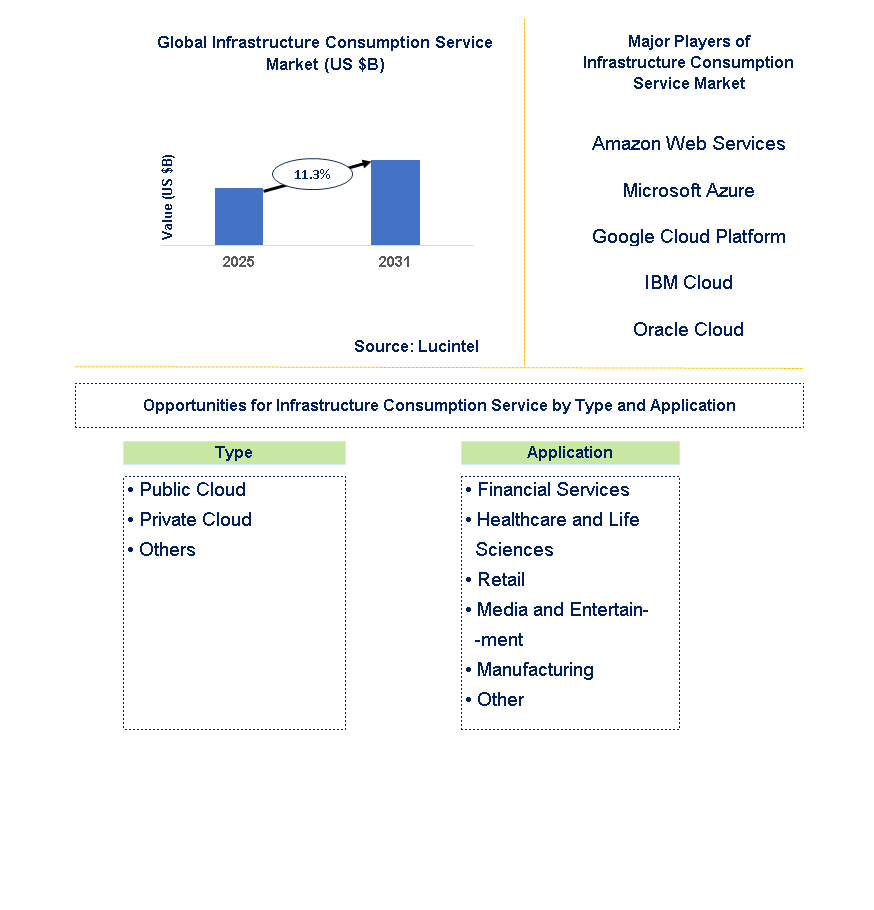
Key data points: The growth forecast = 11.3% annually for the next 7 years. Scroll below to get more insights. This market report covers Trends, opportunity and forecast in infrastructure consumption service market to 2031 by type (public cloud, private cloud, and others), application (financial services, healthcare and life sciences, retail, media and entertainment, manufacturing, and others), and region (North America, Europe, Asia Pacific, and the Rest of the World)
We'll send your sample report shortly.
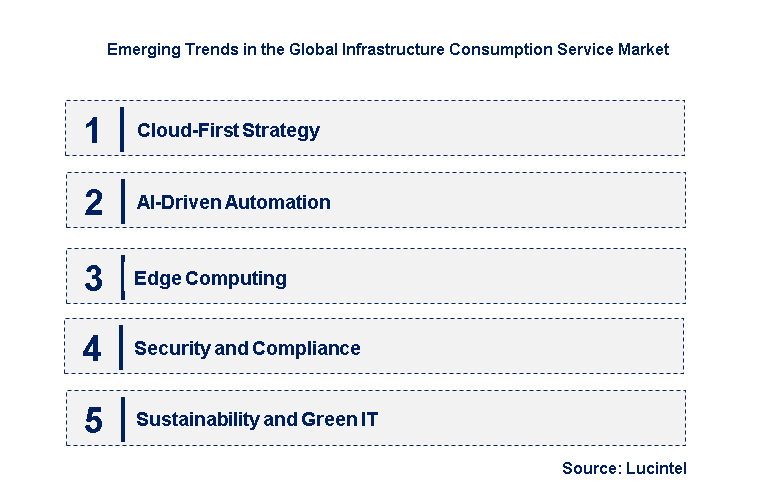
• Cloud-First Strategy: Organizations across the globe are moving with a cloud-first approach toward consumption of infrastructure. Scalability, flexibility, and cost efficiency offered by cloud computing are essential in today's fast-paced digital economy for businesses. This has led companies to migrate workloads to public, private, or hybrid cloud environments in their pursuit of agility and operational cost reduction. Operations end. This shift towards cloud infrastructure allows businesses to scale resources based on demand, thus accelerating time to market and improving service delivery. The cloud-first strategy is expected to continue growing as more enterprises move their services to the cloud.
• AI-Driven Automation: Artificial intelligence (AI) and machine learning are playing a central role in automating infrastructure management. By utilizing AI-driven tools, organizations can optimize resource allocation, predict failures, and automate routine tasks. These technologies improve operational efficiency and reduce the risk of human error. AI-driven automation is also helping businesses achieve more predictive and proactive infrastructure management, allowing them to resolve issues before they impact performance. With advancements in AI technology, its use in infrastructure services will be more evolved and help the organizations seeking the improvement of IT operations.
• Edge Computing: Edge computing is becoming important these days because latency reduction and the speed of processing data are a need for all businesses. Since edge computing deals with the processing of data nearer to the source, it increases the speed of decision-making, and the performance of applications related to real-time data will increase. This is very useful in the manufacturing, automotive, and healthcare industries, as instant insights and fast responses are very critical. The increasing numbers of IoT devices and the ever-growing amount of data generated by connected devices create a need for edge computing solutions. The demand for edge computing will continue to rise as more businesses look for efficient and responsive infrastructure.
• Security and Compliance: Migration to digital platforms, coupled with adoption of cloud-based infrastructure consumption, has compelled the need to prioritize security and compliance in ensuring these services' safety. Fears of breaches in data along with regulatory compliances have urged investment in massive security solutions by these organizations, which include implementation of encryption, multi-factor authentication, and safe storage of data. The businesses must comply with the global regulations, including GDPR in Europe and other privacy laws. With growth in the market, security and compliance will be major driving forces behind the adoption of infrastructure services.
• Sustainability and Green IT: With increasing environmental concerns, businesses are moving towards more sustainable infrastructure consumption models. Demand for green IT solutions, which are energy-efficient data centers and hardware that are not harmful to the environment, is increasing with firms trying to cut their carbon footprints. Besides, the need to fulfill the sustainability requirements in the firm also drives the pressure. Firms are emphasizing less energy usage and renewable sources for infrastructure services. As sustainability becomes a greater priority, businesses are looking for infrastructure solutions that align with their environmental commitments. Emerging trends in infrastructure consumption services-the cloud-first approach, AI-driven automation, edge computing, security and compliance, and sustainability-may reshape this market. In fact, it is these very trends that may be driving more innovation and propelling businesses towards more flexible, scalable, and secure infrastructure models. As companies continue to head toward digital transformation, these are the trends that will define infrastructure services in the future and allow businesses to stay ahead of competition by making new opportunities for improvement in efficiency, cost savings, and staying afloat.
• Cloud Migration and Hybrid Infrastructure: The shift to cloud computing continues to accelerate with more businesses using hybrid infrastructure. Hybrid cloud environments allow organizations to integrate private and public cloud services, providing flexibility in scaling the infrastructure as needed. Cloud migration is becoming the priority for the organizations that look to modernize their IT systems and improve efficiency overall. The hybrid approach will, again, enable the businesses to be in control of their sensitive data while taking up the benefits of cloud computing only for the less-sensitive workloads.
• AI and Automation: The involvement of AI and automation is more integrated with infrastructure consumption services to optimize management and improve operational efficiency. Using such AI-enabled solutions, organizations can automate tasks like resource provisioning, system monitoring, and troubleshooting with minimal need for intervention through human means. This integration will improve the predictability of system failures, optimize resource usage, and enhance service delivery. As AI technology advances, its influence on infrastructure consumption services will be more significant, and the industry will witness further automation.
• 5G Network Adoption: The wide-scale deployment of 5G technology is having a huge impact on the Infrastructure Consumption Services market. 5G networks allow businesses to upgrade their infrastructure management and application performance with faster speeds, lower latency, and greater connectivity. The development is more beneficial for those industries that depend on real-time data processing, such as manufacturing, healthcare, and logistics. As 5G networks are rolled out more widely, businesses will be able to take advantage of enhanced infrastructure capabilities to drive digital transformation.
• Edge Computing Hubs: The increasing demand for low latency and real-time processing of data is forcing the growth of edge computing infrastructure consumption services. With edge computing, organizations can process data closer to where it is being generated thus eliminating many delay issues, and can improve performance. Such industries, therefore, include those where IoT devices and other interlinked technologies dominate. Edge computing helps business organizations to decide faster, manage data efficiently, and scale well. With time, more solutions of edge computing will become easily accessible and get implemented in many industries.
• Security and Privacy Regulations: There is an increase in data security and privacy; thus, more and more organizations are investing in secure infrastructure consumption solutions. With the existence of stricter rules such as GDPR and other data protection laws, organizations have had to ensure their infrastructure services were aligned with the privacy standards required. This in turn has generated an increased need for secure data storage, encryption, and the provision of secured communication channels. Privacy-focused infrastructure solutions are supporting businesses in answering regulatory requirements by ensuring the safe handling of sensitive information. The last few developments of infrastructure consumption service are high in demand for flexible, scalable, and secure solutions. Cloud migration, AI integration, 5G adoption, edge computing, and security regulations would be taken as drivers moving this market forward. As the business environment continues to change with the digital transformation trend, these developments will play important roles in shaping infrastructure services in the future.
• Cloud Infrastructure Services: The cloud infrastructure services market will be an attractive growth area because of increasing demand for the services. The reason is that business organizations are opting for cloud-based solutions, which require a flexible, scalable, and secure infrastructure. Organizations have started opting for hybrid and multi-cloud environments, as this can help in finding a balance between the advantages offered by public and private clouds. The use of cloud infrastructure services will be growing as the organizations seek more agility, lower cost, and performance.
• AI-Powered Infrastructure Management: AI-powered infrastructure management solutions present a unique opportunity to grow through the automation of operations and optimized resource utilization. AI tools predict system failures, automate routine functions, and enhance overall infrastructure management. As AI becomes increasingly pervasive, companies will increasingly embrace such solutions to cut costs, deliver efficiency, and make better decisions. AI-powered infrastructure management is going to be one of the most critical aspects of infrastructure services.
• Edge Computing Solutions: The growth in edge computing offers a significant growth opportunity for infrastructure consumption services. Edge computing allows businesses to process data closer to where it is generated, reducing latency and improving real-time data handling. This is particularly beneficial for industries relying on IoT devices and connected technologies. As the demand for low-latency solutions increases, edge computing will play a pivotal role in driving growth in the infrastructure services market.
• 5G-Enabled Infrastructure: The integration of 5G technology has the potential to be a key growth driver for infrastructure services. 5G facilitates faster data transfer speeds, lower latency, and better connectivity, which in turn enables businesses to enhance their infrastructure performance. The deployment of 5G networks will fast-track the need for infrastructure solutions that can take advantage of these improvements. Businesses that can provide 5G-enabled infrastructure services will be better placed for growth in the market.
• Sustainable Infrastructure Solutions As sustainability becomes an ever more crucial issue, the demand for green IT solutions in the Infrastructure Consumption Services market has been growing. Businesses look for energy-efficient data centers, green-powered infrastructure, and eco-friendly hardware. The drive towards sustainability is pushing for solutions that will help in carbon footprints and improve energy efficiency. Sustainable infrastructure services mean new avenues for growth because companies want to phase their operations in light of ecological pursuits. Strategic growth opportunities in the Infrastructure Consumption Services market are extensive, including cloud infrastructure, AI integration, edge computing, 5G adoption, and sustainability. These areas are driving innovation and offering business new ways to improve their infrastructure and services. As these trends continue to change, companies will be better equipped to position themselves for success focusing on these areas.
• Amazon Web Services (AWS)
• Microsoft Azure
• Google Cloud Platform (GCP)
• IBM Cloud
• Oracle Cloud Infrastructure (OCI)
• Alibaba Cloud
• Digitalocean
• Rackspace Technology
• Vmware Cloud
• Hewlett Packard Enterprise (Hpe)
• Public Cloud
• Private Cloud
• Others
• Financial Services
• Healthcare And Life Sciences
• Retail
• Media And Entertainment
• Manufacturing
• Others
• North America
• Europe
• Asia Pacific
• The Rest of the World
• United States: The United States has seen a major growth in Infrastructure Consumption Services market due to the increasing demand for cloud computing, automation, and advanced analytics. The hybrid and multi-cloud environment being followed by US-based companies can provide efficient business alignment by making integration with both private and public cloud resources efficient. Technologies associated with AI and machine learning further optimize the efficiency of managing infrastructures. On the part of government support, a focus towards 5G and digital infrastructures can significantly further amplify infrastructure consumption services within the US region. Business, moving increasingly in digital transformation mode, have requirements in infrastructure services as business evolves their operation style.
• China: China's Infrastructure Consumption Services market is growing at a fast pace, driven by the country's rapid technological advancements and government initiatives like "Made in China 2025". The growth of cloud infrastructure, AI adoption, and the implementation of 5G technology are transforming the market. Chinese companies are also investing in next-generation data centers to support the growth of big data, IoT, and cloud applications. These developments are fostering an environment of digital transformation, enabling businesses to streamline operations, improve scalability, and enhance overall infrastructure management through more flexible and efficient consumption models.
• Germany: Germany is witnessing a strong demand for infrastructure consumption services, particularly in industries such as manufacturing, automotive, and logistics. The focus is on cloud-based solutions, edge computing, and automation to increase productivity and efficiency. This also includes further impetus regarding the emphasis laid on Industry 4.0 and data-privacy regulations across Germany, meaning that businesses opt for infrastructure options that are secure yet scalable for the business need. The ability of IoT-integrated devices into the business procedure along with further analytics is an important factor toward companies investing into flexible infrastructure options for staying effective in the overall global market.
• India: Infrastructure Consumption Services is growing rapidly in India as companies adopt more cloud and automation solutions. Demand for data centers and managed services is on the rise, with Indian companies shifting toward digital platforms and hybrid cloud infrastructures. Indian IT services are well-equipped to fuel this growth with the infrastructure tools providing the backbone for scaling businesses. The demand to register faster and more reliable infrastructure services is driving demand from the government's Digital India initiative and the expanding e-commerce space. India is likely to see a growing demand for its infrastructure services market as businesses expand, with market evolution around flexibility and cost-effectiveness.
• Japan: Infrastructure Consumption Services market in Japan is being driven by the adoption of 5G technology, AI, and IoT. Japanese companies are heavily investing in automation and digital infrastructure to enhance efficiency and reduce costs. The manufacturing sector in Japan, especially automotive and robotics, is integrating advanced communication and computing solutions to remain competitive. Japan's focus on cybersecurity and data privacy is also driving the market, as organizations look for infrastructure services that not only meet regulatory standards but also enhance their technological capabilities.


• Amazon Web Services (AWS)
• Microsoft Azure
• Google Cloud Platform (GCP)
• IBM Cloud
• Oracle Cloud Infrastructure (OCI)
• Alibaba Cloud
• Digitalocean
• Rackspace Technology
• Vmware Cloud
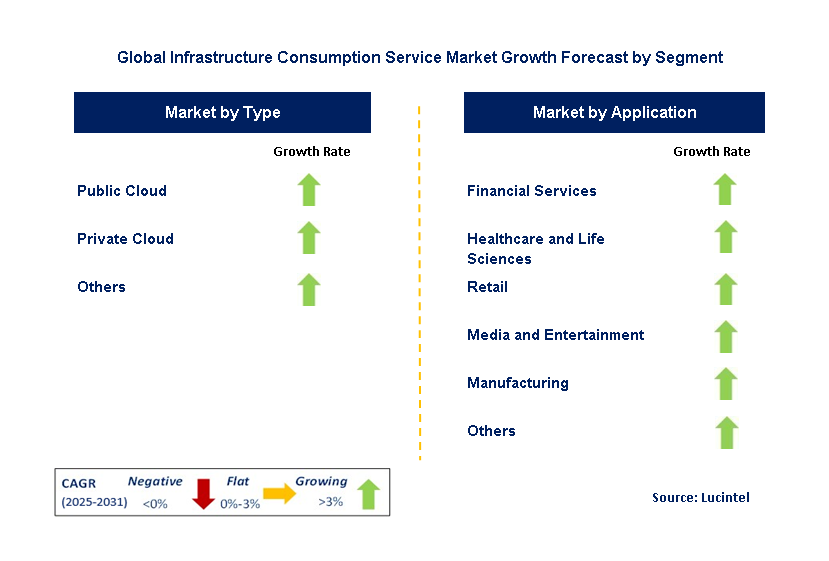
• Hewlett Packard Enterprise (Hpe) Q5. Which infrastructure consumption service market segment will be the largest in future? Answer: Lucintel forecasts that, within the type category, public cloud is expected to witness higher growth over the forecast period. Q6. In infrastructure consumption service market, which region is expected to be the largest in next 5 years? Answer: In terms of region, APAC is expected to witness the highest growth over the forecast period. Q7. Do we receive customization in this report? Answer: Yes, Lucintel provides 10% customization without any additional cost.


Choose a license that fits your team. Instant PDF delivery.
Prices exclude taxes. Instant delivery. Custom licensing available on request.
Market Report · July 15, 2026
Market Report · June 26, 2026
Market Report · June 24, 2026
Trusted partner for strategic intelligence and business growth


Receive a complimentary market analysis tailored to your industry. Our analysts will identify key growth opportunities and competitive dynamics specific to your business.

Market size, growth rate, and key trend analysis for your specific sector.

Top competitor positioning and market share analysis.

Strategic recommendations backed by data-driven insights.
Get curated market intelligence and competitive moves straight to your inbox.
By subscribing, you agree to receive our monthly insights. Unsubscribe anytime.
Receive a complimentary market analysis tailored to your industry. Our analysts will identify key growth opportunities and competitive dynamics specific to your business.
Market size, growth rate, and key trend analysis for your specific sector.
Top competitor positioning and market share analysis.
Strategic recommendations backed by data-driven insights.
Get curated market intelligence, emerging trends, and competitive moves straight to your inbox each month.
By subscribing, you agree to receive our monthly insights. Unsubscribe anytime.
We'll send your sample report shortly.