
Market Report · July 29, 2026

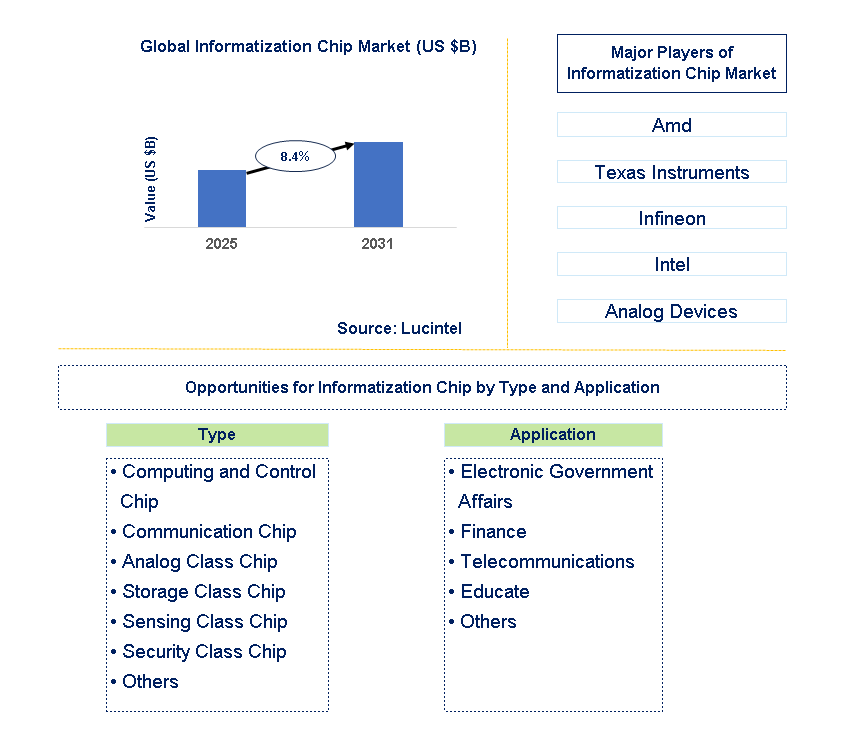
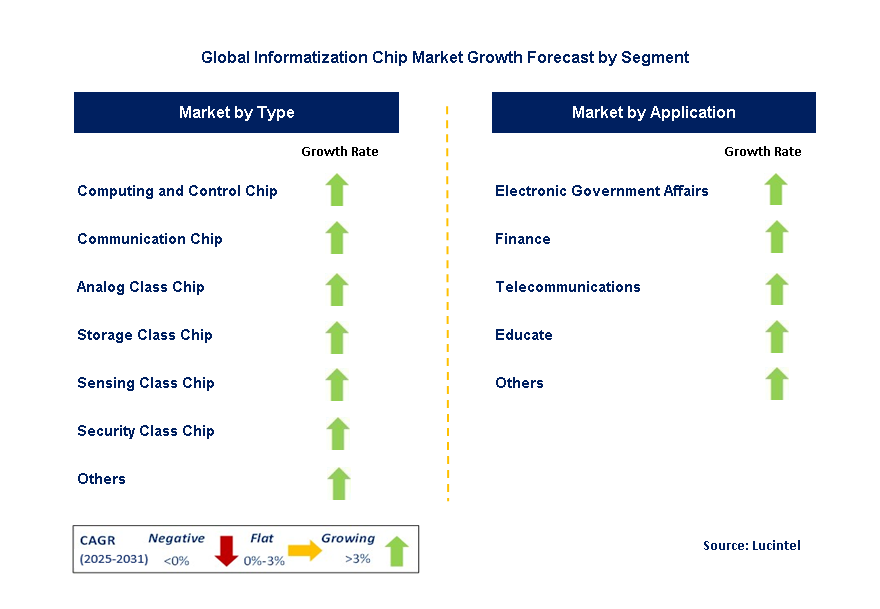
Key data points: The growth forecast = 8.4% annually for the next 7 years. Scroll below to get more insights. This market report covers Trends, opportunity and forecast in informatization chip market to 2031 by type (computing and control chip, communication chip, analog class chip, storage class chip, sensing class chip, security class chip, and others), application (electronic government affairs, finance, telecommunications, educate, and others), and region (North America, Europe, Asia Pacific, and the Rest of the World)
We'll send your sample report shortly.
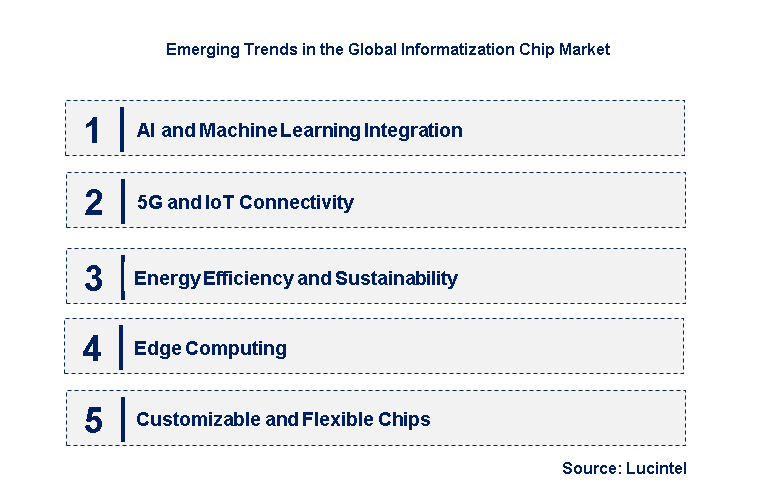
• AI and Machine Learning Integration: Informatization chips are increasingly designed to support AI and machine learning applications. These chips enable faster processing, real-time data analysis, and decision-making. The growing demand for AI-powered devices, such as smart speakers, autonomous vehicles, and industrial automation systems, is driving the need for specialized chips that can handle the intense computational requirements of AI algorithms. This trend is reshaping industries from healthcare to finance, where AI is being used to drive innovation.
• 5G and IoT Connectivity: As the world transitions to 5G, informatization chips are evolving to support the higher data throughput and low latency required for 5G networks. These chips are crucial for enabling faster and more reliable connectivity for IoT devices across industries such as smart cities, healthcare, and manufacturing. The widespread adoption of IoT applications is creating a huge demand for low-power, efficient chips that can process large volumes of data quickly and securely, accelerating digital transformation.
• Energy Efficiency and Sustainability: With growing concerns about environmental impact, there is an increasing focus on developing energy-efficient informatization chips. These chips are designed to consume less power while delivering high performance, a critical requirement for applications like data centers, edge computing, and consumer electronics. Energy-efficient chips are essential to reducing the carbon footprint of the digital economy, helping businesses meet sustainability goals while maintaining performance in a power-conscious world.
• Edge Computing: Edge computing is gaining momentum as companies look to process data closer to where it is generated, reducing latency and bandwidth costs. Informatization chips that are optimized for edge computing are becoming more prevalent. These chips are crucial for applications such as autonomous vehicles, smart manufacturing, and real-time analytics, where quick data processing is critical. As the demand for edge computing grows, the need for specialized chips that can handle local data processing efficiently and securely is increasing.
• Customizable and Flexible Chips: The demand for customizable chips is growing as industries require tailored solutions for specific applications. Companies are increasingly developing chips that can be configured to meet unique performance, size, and power consumption requirements. This trend is particularly prominent in industries like automotive, healthcare, and robotics, where applications often require chips that can be finely tuned for specific tasks, such as sensor integration, high-speed data processing, and security features. These emerging trends are reshaping the informatization chip market by increasing the need for more specialized, energy-efficient, and flexible chips. They are enabling the rapid adoption of AI, 5G, IoT, and edge computing technologies across industries, transforming business operations and consumer experiences.
• Advancement in AI Chips: Companies like NVIDIA and Google are developing specialized AI chips, such as NVIDIA’s A100 and Google’s Tensor Processing Units (TPUs), designed for high-performance AI tasks. These chips support deep learning, data analytics, and machine learning applications, revolutionizing sectors like healthcare, finance, and autonomous vehicles. The increased processing power and efficiency of these chips are accelerating AI adoption.
• 5G Chipsets and Infrastructure: The rollout of 5G networks is driving demand for specialized chipsets that can handle higher speeds, lower latency, and greater connectivity. Companies like Qualcomm and Media Teak are leading the charge with chips that power 5G smartphones, infrastructure, and IoT devices. The demand for 5G chips is expected to continue rising as more regions adopt 5G technology.
• IoT-Enabled Informatization Chips: The proliferation of IoT devices is creating a massive demand for informatization chips that can support low-power, high-efficiency applications. Chips developed for IoT devices focus on ensuring secure data processing and efficient energy consumption, driving innovation in sectors such as smart homes, industrial automation, and agriculture. Companies like Intel and ARM are developing solutions optimized for IoT ecosystems.
• Automotive Chips for Autonomous Driving: The automotive industry is a key driver of informatization chip innovation, with chips designed to support autonomous vehicles, electrification, and connected systems. Companies like NVIDIA and Intel’s Mobileye are creating chips that power vehicle sensors, navigation systems, and AI-driven safety features. As the automotive industry moves towards electric and autonomous vehicles, the demand for highly specialized chips is increasing.
• Focus on Advanced Semiconductor Manufacturing: The global chip shortage has highlighted the need for advanced semiconductor manufacturing capabilities. Companies like Taiwan Semiconductor Manufacturing Company (TSMC) and Samsung are investing heavily in developing next-generation chips that offer higher performance and lower power consumption. These advancements are helping meet the growing demand for informatization chips in a variety of sectors, from consumer electronics to industrial applications. These developments reflect the growing importance of informatization chips in powering emerging technologies. The market is expanding rapidly as industries look for more efficient, specialized chips to support the demands of AI, 5G, IoT, and autonomous systems.
• AI and Deep Learning Applications: AI and deep learning technologies require powerful and specialized chips to process large amounts of data. The demand for AI chips, such as GPUs and TPUs, is growing as sectors like healthcare, finance, and automotive increasingly adopt AI-driven solutions. Companies that focus on developing chips optimized for AI workloads will see substantial growth opportunities.
• 5G Infrastructure and Mobile Devices: The global rollout of 5G presents significant opportunities for informatization chips that support faster connectivity and lower latency. As 5G networks expand, there will be continued demand for chips in mobile devices, IoT systems, and communication infrastructure. Companies that develop chips capable of handling 5G data speeds and applications will be well-positioned to capitalize on this trend.
• IoT Devices and Smart Cities: The growth of IoT applications in smart cities, industrial automation, and home automation is driving demand for informatization chips. Chips optimized for low power consumption, real-time data processing, and secure connectivity are critical to the growth of IoT ecosystems. Companies that focus on developing chips for IoT devices will find significant opportunities in this rapidly growing market.
• Automotive Industry and Autonomous Vehicles: The automotive industry is a key growth sector for informatization chips, particularly with the shift toward autonomous driving, electrification, and connected car systems. Companies focusing on developing chips for vehicle sensors, AI-powered navigation, and safety features are well-positioned to benefit from the expanding automotive market.
• Edge Computing and Data Centers: Edge computing is transforming how data is processed and stored. Informatization chips designed for edge devices and data centers are in high demand as businesses seek to reduce latency and bandwidth costs. Companies that can provide chips optimized for edge computing and high-performance data centers will see significant growth opportunities. These strategic growth opportunities highlight the expanding role of informatization chips in emerging technologies. The market is experiencing robust demand across sectors, driven by advancements in AI, 5G, IoT, and automotive systems.
• Amd
• Texas Instruments
• Infineon
• Intel
• Analog Devices
• Stmicroelectronics
• Renesas
• Micron Technology
• Microchip
• Onsemi
• Computing and Control Chip
• Communication Chip
• Analog Class Chip
• Storage Class Chip
• Sensing Class Chip
• Security Class Chip
• Others
• Electronic Government Affairs
• Finance
• Telecommunications
• Educate
• Others
• North America
• Europe
• Asia Pacific
• The Rest of the World
• United States: In the U.S., the informatization chip market is experiencing significant growth driven by advancements in AI, IoT, and 5G technologies. Leading companies such as Intel, NVIDIA, and Qualcomm are pioneering the development of chips that can process massive amounts of data at high speeds, enabling the growth of AI applications, autonomous vehicles, and high-speed networking. The U.S. government’s push for technological leadership, coupled with increased funding for research in semiconductor technologies, is spurring innovation in the chip sector. This has led to more robust chips designed for both consumer electronics and industrial applications.
• China: China’s informatization chip market is rapidly advancing as the country seeks to reduce its dependence on foreign chip manufacturers and boost its domestic capabilities. Companies like Huawei and SMIC (Semiconductor Manufacturing International Corporation) are making strides in producing high-performance chips, especially in the context of 5G and AI applications. The Chinese government’s ambitious goals, including the “Made in China 2025” initiative, aim to strengthen local semiconductor manufacturing. Despite facing challenges in accessing advanced chip technologies due to geopolitical tensions, China remains focused on expanding its domestic capabilities, with continued investments in R&D to produce cutting-edge chips for various applications.
• Germany: Germany is strengthening its position in the informatization chip market by focusing on automotive, industrial, and IoT applications. German companies like Infineon and Bosch are developing chips for automotive safety, automation, and electrification, which are central to the country’s "Industry 4.0" vision. The European Union’s focus on semiconductor self-sufficiency, exemplified by the European Chips Act, is driving investments in local chip manufacturing. Germany is also looking to expand its role in AI and machine learning, with an increasing focus on chips that can handle the massive computing requirements for these technologies in both commercial and industrial sectors.
• India: India’s informatization chip market is in its early stages but is rapidly growing due to increased digitalization, rising demand for consumer electronics, and a push for local semiconductor manufacturing. Companies such as Tata Electronics are exploring the potential for chip production, while India’s National Policy on Electronics aims to boost semiconductor manufacturing. India’s key focus is on creating affordable, energy-efficient chips to support industries such as telecommunications, agriculture, and education. As the country seeks to leverage its talent pool and manufacturing capacity, India’s informatization chip sector is set to play a significant role in the region’s digital transformation.
• Japan: Japan has been at the forefront of semiconductor innovation for decades, and its informatization chip market continues to evolve with a focus on AI, robotics, and IoT. Companies like Sony, Toshiba, and Renessa are developing chips that support smart manufacturing, autonomous systems, and IoT devices. Japan’s emphasis on robotics, particularly in manufacturing and healthcare, has led to the development of highly specialized chips. Japan also plays a key role in the global semiconductor supply chain and is investing heavily in next-generation chip technologies to maintain its leadership in the industry, particularly in the context of emerging AI-driven applications.


• Amd
• Texas Instruments
• Infineon
• Intel
• Analog Devices
• Stmicroelectronics
• Renesas
• Micron Technology
• Microchip
• Onsemi Q5. Which informatization chip market segment will be the largest in future? Answer: Lucintel forecasts that communication chip is expected to witness the highest growth over the forecast period due to rise of 5g and telecom infrastructure, global increase in connected devices. Q6. In informatization chip market, which region is expected to be the largest in next 5 years? Answer: APAC will remain the largest region over the forecast period due to world’s largest telecommunications infrastructure and consumer electronics markets. Q7. Do we receive customization in this report? Answer: Yes, Lucintel provides 10% customization without any additional cost.


Choose a license that fits your team. Instant PDF delivery.
Prices exclude taxes. Instant delivery. Custom licensing available on request.
Market Report · July 29, 2026
Market Report · July 20, 2026
Market Report · July 20, 2026
Trusted partner for strategic intelligence and business growth


Receive a complimentary market analysis tailored to your industry. Our analysts will identify key growth opportunities and competitive dynamics specific to your business.

Market size, growth rate, and key trend analysis for your specific sector.

Top competitor positioning and market share analysis.

Strategic recommendations backed by data-driven insights.
Get curated market intelligence and competitive moves straight to your inbox.
By subscribing, you agree to receive our monthly insights. Unsubscribe anytime.
Receive a complimentary market analysis tailored to your industry. Our analysts will identify key growth opportunities and competitive dynamics specific to your business.
Market size, growth rate, and key trend analysis for your specific sector.
Top competitor positioning and market share analysis.
Strategic recommendations backed by data-driven insights.
Get curated market intelligence, emerging trends, and competitive moves straight to your inbox each month.
By subscribing, you agree to receive our monthly insights. Unsubscribe anytime.
We'll send your sample report shortly.