
Market Report · July 29, 2026

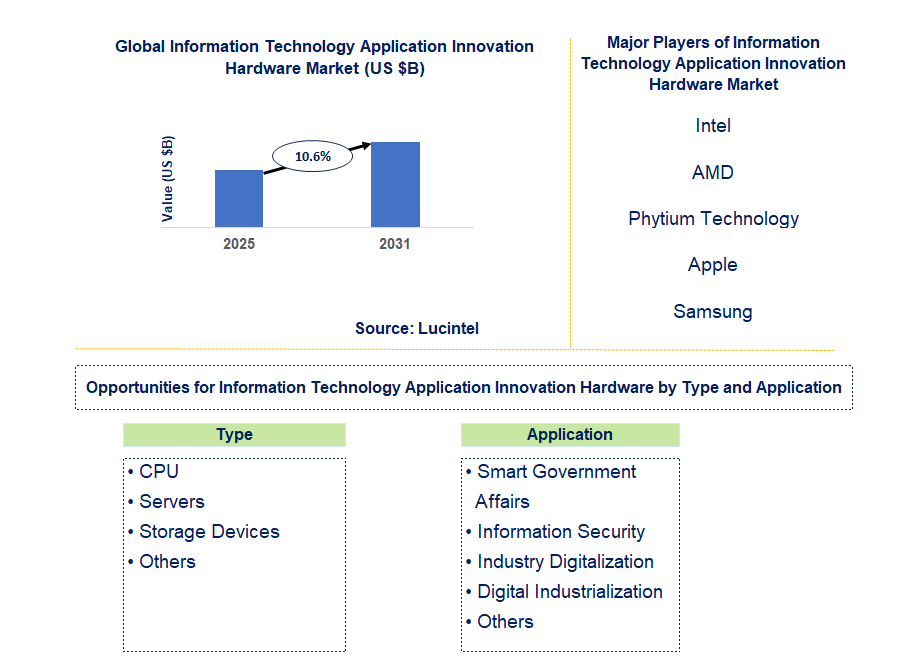
Key data points: The growth forecast = 10.6% annually for the next 7 years. Scroll below to get more insights. This market report covers Trends, opportunity and forecast in information technology application innovation hardware market to 2031 by type (CPU, servers, storage devices, and others), application (smart government affairs, information security, industry digitalization, digital industrialization, and others), and region (North America, Europe, Asia Pacific, and the Rest of the World)
We'll send your sample report shortly.
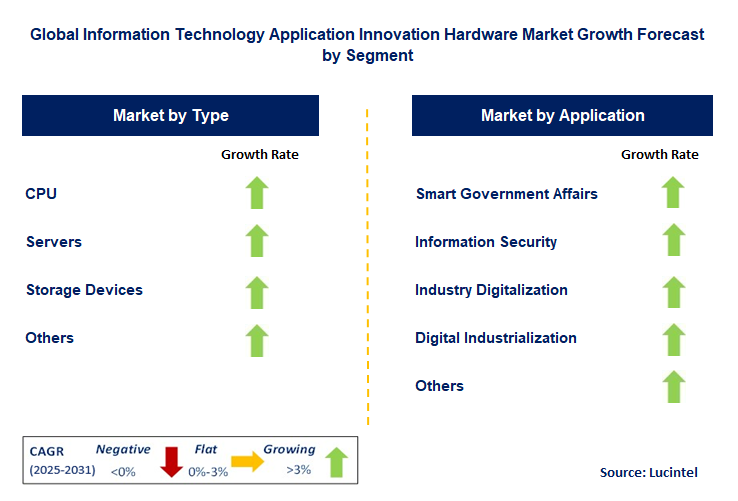
• Lucintel forecasts that, within the type category, the CPU is expected to witness the highest growth over the forecast period.
• Within the application category, smart government affairs is expected to witness the highest growth.
• In terms of region, APAC is expected to witness the highest growth over the forecast period. Gain valuable insights for your business decisions with our comprehensive 150+ page report. Sample figures with some insights are shown below.
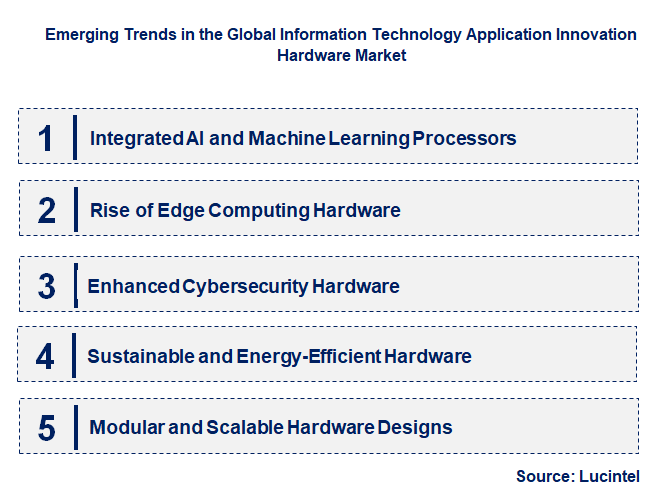
• Integrated AI and Machine Learning Processors: AI processors integrated directly into hardware are a key trend, enabling faster, more efficient data processing for applications like real-time analytics and automation. These specialized chips improve processing speed, reduce latency, and enhance energy efficiency. For industries like autonomous vehicles and healthcare, this innovation allows devices to operate with greater accuracy and reliability. The demand for AI hardware is growing as businesses seek competitive advantages through intelligent systems, fostering partnerships between hardware manufacturers and AI solution providers.
• Rise of Edge Computing Hardware: The proliferation of IoT devices is driving demand for edge computing hardware, which processes data locally rather than relying on centralized systems. This trend reduces latency, enhances data security, and supports real-time decision-making, which is critical for industries like manufacturing and logistics. Edge devices with advanced processing capabilities also decrease the burden on cloud infrastructure. As industries adopt more connected systems, the development of robust and efficient edge hardware solutions is becoming a priority, reshaping how organizations manage and process data.
• Enhanced Cybersecurity Hardware: With increasing cyber threats, hardware-level security features are becoming essential. Innovations like hardware encryption modules and secure boot processes ensure the integrity of systems and data. These features provide an additional layer of protection beyond software-based solutions, which are more vulnerable to breaches. Industries handling sensitive information, such as finance and healthcare, are driving the demand for secure hardware solutions. The focus on cybersecurity is fostering innovation, ensuring that IT infrastructure can withstand evolving threats.
• Sustainable and Energy-Efficient Hardware: Sustainability is a growing concern, leading to innovations in energy-efficient hardware. This trend includes hardware components designed to consume less power and utilize recyclable materials. Energy-efficient devices reduce operational costs and align with corporate sustainability goals, attracting eco-conscious consumers and businesses. Governments and organizations are also incentivizing the adoption of green technology, accelerating innovation in sustainable hardware. This trend supports both environmental and economic objectives, positioning the IT hardware industry as a leader in sustainability efforts.
• Modular and Scalable Hardware Designs: Modular hardware designs are gaining traction, offering flexibility and scalability for organizations. Modular systems allow components to be upgraded or replaced individually, reducing costs and improving adaptability. This design approach is particularly beneficial for data centers and IT infrastructure, enabling efficient scaling without the need for full system replacements. The modular trend aligns with the increasing demand for customized and future-proof hardware solutions, ensuring longevity and cost-efficiency in IT investments. The information technology application innovation hardware market is undergoing significant transformation, driven by trends like integrated AI processors, edge computing, and sustainable designs. These innovations are addressing challenges related to efficiency, security, and scalability, making IT hardware more aligned with modern application needs. Enhanced cybersecurity and modular systems are further reshaping industry standards, providing organizations with reliable and adaptable solutions. As these trends continue to influence the market, they are fostering a new era of IT hardware innovation, ensuring the technology remains a cornerstone for application development and deployment across diverse sectors.
• Semiconductor Innovation and Miniaturization: The ongoing advancements in semiconductor technology, particularly miniaturization and the development of smaller, more efficient chips, have significantly enhanced IT hardware capabilities. Companies like Intel, AMD, and TSMC are pushing the boundaries of chip manufacturing with smaller nodes and faster processors. These innovations enable the creation of more powerful, energy-efficient devices that are crucial for AI, IoT, and edge computing applications. The drive for smaller, high-performance semiconductors is key to meeting the demands of next-generation applications and is fostering innovation in everything from personal devices to data centers and supercomputing.
• AI and Machine Learning Hardware Accelerators: The demand for AI and machine learning (ML) solutions has led to a surge in specialized hardware designed to accelerate these processes. Companies such as NVIDIA and Google have pioneered AI-specific chips like GPUs and TPUs, which have revolutionized the capabilities of AI applications. These accelerators are designed to handle massive amounts of data and perform complex computations at higher speeds. As industries increasingly leverage AI for automation, predictive analytics, and data processing, the market for AI hardware continues to expand, fostering further innovations that push the boundaries of what AI can achieve.
• Cloud Computing Infrastructure Development: Cloud computing infrastructure is evolving to meet the growing demand for scalable, high-performance computing resources. Innovations in cloud hardware, such as advanced storage solutions, hyper-converged infrastructures, and improved data center servers, are enabling more efficient and cost-effective cloud services. Providers like Amazon Web Services (AWS), Microsoft Azure, and Google Cloud are investing heavily in new hardware to support their expanding portfolios of services, which include everything from computing power to storage and networking. These advancements are driving the widespread adoption of cloud solutions across industries, enhancing data accessibility, collaboration, and security.
• Edge Computing Hardware: Edge computing hardware has gained momentum as businesses seek to process data closer to where it is generated, reducing latency and bandwidth requirements. Edge devices such as microservers, IoT devices, and specialized hardware accelerators are playing a crucial role in this transformation. Companies like Cisco and HPE are advancing edge computing platforms that integrate AI, analytics, and storage capabilities directly at the data source. The demand for these solutions is particularly high in sectors like automotive, healthcare, and manufacturing, where real-time data processing is critical for operational efficiency and decision-making.
• Quantum Computing Hardware Advancements: Quantum computing is poised to revolutionize the IT hardware market with breakthroughs in processing power and problem-solving capabilities. Companies like IBM, Google, and Intel are developing quantum processors designed to solve problems that traditional computers cannot. These advancements open up new possibilities for industries such as drug discovery, cryptography, and logistics. While quantum hardware is still in its early stages, the progress being made in quantum bits (qubits) and error correction is accelerating the realization of quantum computing’s potential. These developments are expected to drive significant advancements in research and application innovation in the coming years. These recent developments in the information technology application innovation hardware market are paving the way for more efficient, scalable, and specialized solutions across various industries. The innovations in semiconductor technology, AI accelerators, cloud infrastructure, edge computing, and quantum computing hardware are creating new opportunities for businesses to improve performance, streamline operations, and unlock new capabilities. As these technologies continue to evolve, they are shaping the future of IT hardware and driving transformational changes in sectors like AI, IoT, cloud services, and beyond. The market is set for continued growth as these advancements enable more intelligent and responsive systems.
• AI and Machine Learning Hardware Solutions: The growing adoption of AI and machine learning technologies presents a significant growth opportunity for hardware providers. As these applications demand high computational power, specialized hardware such as GPUs, FPGAs, and AI-specific processors are essential for real-time data analysis, automation, and intelligent decision-making. AI and machine learning have become integral to industries such as healthcare, automotive, and manufacturing, where performance, speed, and efficiency are critical. Hardware manufacturers can capitalize on this demand by developing specialized, AI-optimized systems that accelerate machine learning tasks and enhance overall system efficiency, positioning themselves as key enablers of AI innovation.
• Edge Computing Hardware Solutions: Edge computing is a rapidly growing field as businesses seek to process data closer to the source rather than relying on centralized cloud systems. This is particularly relevant for IoT applications, where real-time data processing is essential. Hardware designed for edge computing, including compact processors and high-speed connectivity solutions, allows industries like smart cities, agriculture, and autonomous vehicles to function with reduced latency and improved operational efficiency. The shift toward edge computing opens a strategic growth opportunity for hardware providers to develop purpose-built solutions that enable better data processing and storage on the edge, increasing demand for localized hardware solutions.
• Cybersecurity Hardware Solutions: The increasing frequency and sophistication of cyberattacks present a strong growth opportunity for hardware designed to improve cybersecurity. Hardware solutions such as trusted platform modules (TPMs), hardware security modules (HSMs), and secure processors provide advanced encryption and authentication capabilities essential for protecting sensitive data. With the rise of data breaches, especially in sectors like finance, healthcare, and government, there is a high demand for robust security hardware. This presents a market opportunity for manufacturers to develop specialized, tamper-resistant hardware solutions to meet growing cybersecurity demands, positioning hardware as an essential element in modern data protection strategies.
• Sustainable and Energy-Efficient Hardware: Sustainability is increasingly important across all industries, and the IT hardware market is no exception. As energy consumption concerns grow, there is a significant opportunity to develop energy-efficient hardware solutions that reduce operational costs and align with environmental goals. This includes creating processors and components that consume less power, use recyclable materials, and meet green certification standards. Hardware manufacturers that invest in sustainable innovation can gain a competitive edge, as both businesses and governments are pushing for eco-friendly technologies. This trend drives demand for hardware solutions that reduce environmental impact while providing performance and reliability.
• Modular and Scalable IT Hardware Solutions: As businesses scale operations and adopt cloud-based technologies, there is a growing need for modular and scalable IT hardware. Modular systems allow components to be upgraded or replaced without overhauling entire systems, which is crucial for data centers and growing enterprises. Scalable hardware solutions enable businesses to expand their infrastructure as needed without incurring the cost of significant system reconfigurations. This growth opportunity is particularly important in industries like telecommunications, where data and computational power needs to evolve rapidly. Hardware manufacturers can leverage this trend by offering flexible, modular solutions that cater to the growing demand for adaptable, long-term infrastructure investments. The strategic growth opportunities in the information technology application innovation hardware market are driven by several transformative trends, including AI, edge computing, cybersecurity, sustainability, and modular hardware solutions. Each of these opportunities opens avenues for hardware manufacturers to create high-performance, energy-efficient, and secure systems that meet the evolving needs of modern industries. As businesses continue their digital transformation journeys, these growth areas provide manufacturers with significant potential to expand their market presence, foster innovation, and support the next wave of technological advancements across multiple sectors.
• Intel
• AMD
• Phytium Technology
• Apple
• Samsung
• Huawei
• Broadcom
• Institute of Computing Technology
• Chinese Academy of Sciences
• Hygon
• CPU
• Servers
• Storage Devices
• Others
• Smart Government Affairs
• Information Security
• Industry Digitalization
• Digital Industrialization
• Others
• North America
• Europe
• Asia Pacific
• The Rest of the World
• United States: The United States remains a leader in IT hardware innovation, driven by advancements in semiconductor technology, AI accelerators, and cloud-based hardware solutions. Companies like NVIDIA and Intel have introduced cutting-edge GPUs and processors optimized for AI and machine learning workloads. The U.S. government's focus on boosting domestic chip manufacturing through initiatives like the CHIPS Act also bolsters innovation. Additionally, the rise of edge computing and quantum hardware R&D is transforming industries such as healthcare, defense, and finance. These developments position the U.S. as a key driver of next-generation IT application hardware.
• China: The Chinese IT application innovation hardware market is characterized by rapid advancements in 5G infrastructure, AI chips, and domestic semiconductor manufacturing. Companies like Huawei and Alibaba are developing proprietary hardware solutions to reduce reliance on imports and strengthen local supply chains. The government’s strategic investment in semiconductor self-sufficiency accelerates R&D in advanced chips for AI and IoT applications. Additionally, China's advancements in supercomputing and green IT hardware are setting benchmarks for energy-efficient solutions. These developments are positioning China as a global hub for IT hardware innovation, with growing influence across industries like telecommunications, e-commerce, and smart cities.
• Germany: Germany is driving IT hardware innovation through its emphasis on industrial automation, smart manufacturing, and cybersecurity. The integration of IT hardware with Industry 4.0 applications is a key focus, enabling advancements in edge computing and IoT hardware. German companies are developing robust hardware solutions to enhance connectivity and data processing capabilities in industrial settings. Additionally, Germany's commitment to sustainability is fostering innovations in energy-efficient IT hardware. Collaborations between research institutions and tech firms are furthering advancements in specialized hardware for automotive, healthcare, and renewable energy sectors, reinforcing Germany's position as a leader in industrial IT hardware.
• India: The Indian IT application innovation hardware market is experiencing significant growth, driven by the government’s initiatives to boost domestic manufacturing and R&D. The "Make in India" program is attracting investments in semiconductor and hardware production. India is also emerging as a hub for affordable and scalable IT hardware solutions tailored for SMEs and startups. The country’s focus on cloud computing, data centers, and IoT applications is fueling demand for innovative hardware. Collaboration with global tech companies and the rise of indigenous startups are fostering advancements in energy-efficient and AI-enabled hardware. These developments are strengthening India's role in the global IT hardware ecosystem.
• Japan: The Japanese IT application hardware market is centered on robotics, semiconductor miniaturization, and high-performance computing. Companies like Fujitsu and Sony are leading the development of hardware for AI, edge computing, and advanced imaging applications. Japan’s focus on quantum computing hardware and sustainable IT solutions aligns with its long-term vision for technological leadership. The country’s investments in R&D for 6G networks and IoT hardware are further driving innovation. Additionally, Japan’s expertise in manufacturing precision hardware for healthcare and automotive applications reinforces its position as a key player in the IT hardware market.


• Intel
• AMD
• Phytium Technology
• Apple
• Samsung
• Huawei
• Broadcom
• Institute of Computing Technology
• Chinese Academy of Sciences
• Hygon Q5. Which information technology application innovation hardware market segment will be the largest in future? Answer: Lucintel forecasts that the CPU is expected to witness the highest growth over the forecast period. Q6. In information technology application innovation hardware market, which region is expected to be the largest in next 5 years? Answer: APAC is expected to witness the highest growth over the forecast period. Q7. Do we receive customization in this report? Answer: Yes, Lucintel provides 10% customization without any additional cost.


Choose a license that fits your team. Instant PDF delivery.
Prices exclude taxes. Instant delivery. Custom licensing available on request.
Market Report · July 29, 2026
Market Report · July 20, 2026
Market Report · July 20, 2026
Trusted partner for strategic intelligence and business growth


Receive a complimentary market analysis tailored to your industry. Our analysts will identify key growth opportunities and competitive dynamics specific to your business.

Market size, growth rate, and key trend analysis for your specific sector.

Top competitor positioning and market share analysis.

Strategic recommendations backed by data-driven insights.
Get curated market intelligence and competitive moves straight to your inbox.
By subscribing, you agree to receive our monthly insights. Unsubscribe anytime.
Receive a complimentary market analysis tailored to your industry. Our analysts will identify key growth opportunities and competitive dynamics specific to your business.
Market size, growth rate, and key trend analysis for your specific sector.
Top competitor positioning and market share analysis.
Strategic recommendations backed by data-driven insights.
Get curated market intelligence, emerging trends, and competitive moves straight to your inbox each month.
By subscribing, you agree to receive our monthly insights. Unsubscribe anytime.
We'll send your sample report shortly.