
Market Report · July 22, 2026

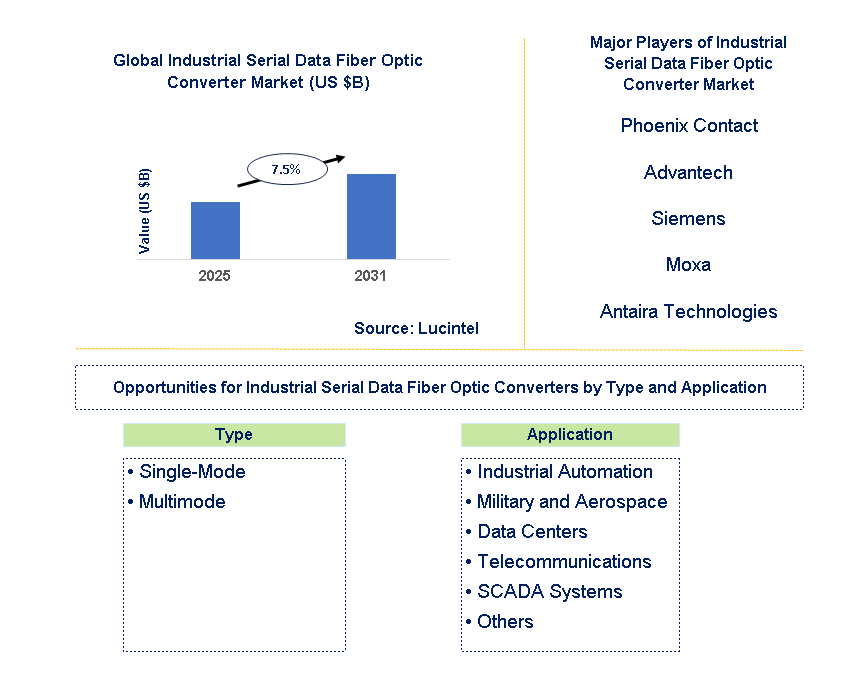
Key data points: The growth forecast = 7.5% annually for the next 7 years. Scroll below to get more insights. This market report covers Trends, opportunity and forecast in industrial serial data fiber optic converter market to 2031 by type (single-mode and multimode), application (industrial automation, military and aerospace, data centers, telecommunications, scada systems, and others), and region (North America, Europe, Asia Pacific, and the Rest of the World)
We'll send your sample report shortly.
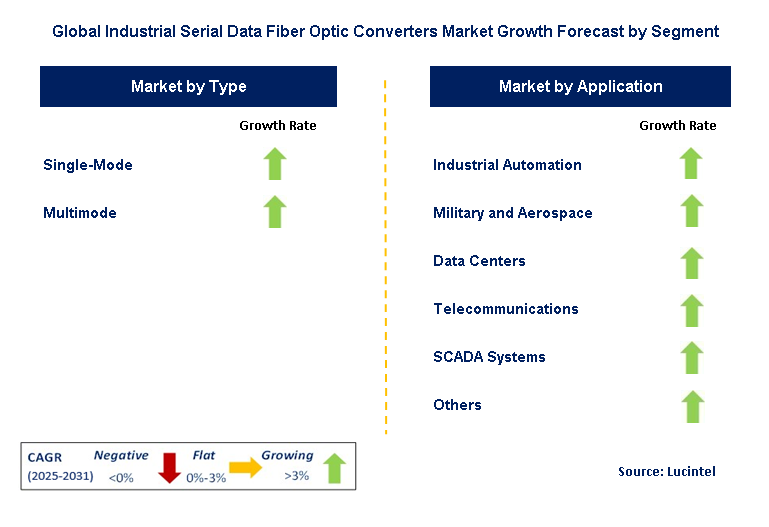
• Lucintel forecasts that, within the type category, single-mode is expected to witness higher growth over the forecast period due to its ability to transmit data over longer distances with less signal loss and higher bandwidth.
• Within the application category, telecommunication is expected to witness the highest growth due to significant use of optic converters in supporting mobile, internet, and data transmission services.
• In terms of region, North America is expected to witness the highest growth over the forecast period due to strong demand for reliable data communication solutions in the region. Gain valuable insights for your business decisions with our comprehensive 150+ page report. Sample figures with some insights are shown below.
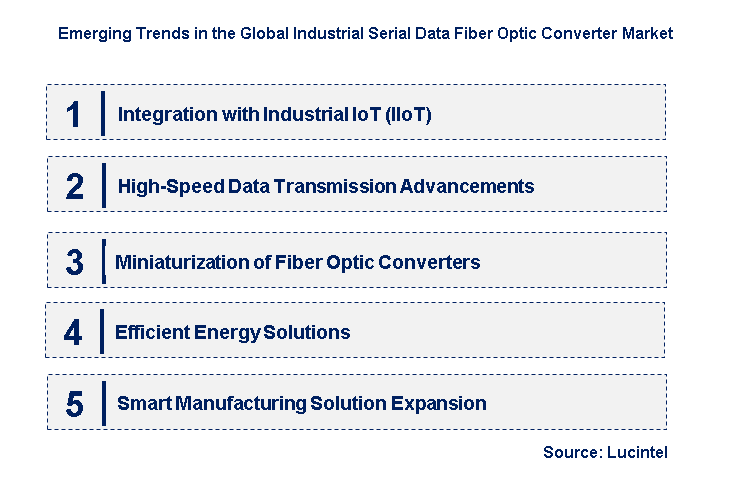
• Integration with Industrial IoT (IIoT): Fiber optic converter integration with IIoT devices represents the most important trend in this market. Increased demand for IoT technology among industrial variants is creating demand for high-reliability data transmission solutions to connect multiple devices and systems. Industrial-grade fiber optic converters may increase communication speed, distance, and reliability between IIoT devices, thus enhancing automation and efficiency. Furthermore, the high deployment of IIoT systems is driving the demand for fiber optic converters to provide smooth connectivity and data flow.
• High-Speed Data Transmission Advancements: The trend toward increasing data speeds becomes particularly crucial in industries where a large amount of data needs to be processed quickly, such as in real-time, in manufacturing, transportation, and energy sectors. Fiber optic converters can transfer data faster and more efficiently as compared to traditional copper-based systems. With applications turning more data-intensive, the need for fiber optics that can be capable of delivering gigabit-level or even terabit-level speed is on an increase. It is changing how industrial systems are designed and engineered, with an increase in more efficient communication and automation.
• Miniaturization of Fiber Optic Converters: Miniaturization is emerging as a popular trend in the Industrial Serial Data Fiber Optic Converters Market. There is a large demand for miniature and compact versions of converters today. The fact that space-conscious solutions are greatly in demand is due to various industrial applications and needs. They are smaller with the same output performance as that of the much larger counterparts while occupying less volume in installation, thus suitable especially for applications confined or restricted places like control panels, machinery, and industrial automation systems where volume is a restraint.
• Efficient Energy Solutions: As sustainability is increasingly becoming the basis of industrial systems, energy efficiency is one of the new trends in the fiber optic converter market. The focus of manufacturers is now more on developing energy-efficient fiber optic converters that do not only guarantee reliable data transmission but also consume less power. This trend follows the general industrial trend of minimizing energy consumption and operation costs. These are particularly attractive solutions in large industrial facilities where the consumption of energy is a substantial operational cost and businesses are focusing on reducing environmental impact
• Smart Manufacturing Solution Expansion: Increased adoption of smart manufacturing technologies boosts the demand for Industrial Serial Data Fiber Optic Converters. With the advent of Industry 4.0, smart factories rely more and more on fiber optics to ensure communication between different systems, such as sensors, robots, and control units. Fiber optic converters are crucial for developing an integrated, high-performance data network that supports real-time monitoring, predictive maintenance, and automated decision-making. This trend is pushing the demand for more reliable and scalable communication solutions that are critical for smart manufacturing environments. Emerging trends in the market are IIoT integration, high-speed data transmission, miniaturization, energy efficiency, and smart manufacturing solutions. All these trends are driving the Industrial Serial Data Fiber Optic Converters Market as industrial applications are seeking advanced, scalable, and efficient communication systems. This provides immense opportunities for growth in the market.
• Introduction of Advanced Multi-Protocol Support: Fiber optic converters that are advanced in terms of multi-protocol support have been developed, which have opened up possibilities in supporting several industrial communication protocols. These can include Modbus, Profibus, and CANbus, thus providing versatility and adaptability for industrial applications. It is quite helpful in diverse communication standards utilized by industries; thus, a flexible and scalable solution is made available for the upgrade of the existing systems into fiber optics with minimal modifications in the infrastructure.
• Development of Rugged and Industrial-Grade Converters: Another key development is the rugged, industrial-grade fiber optic converter. Its application is for immediate use in an environment that has extreme temperature fluctuations, vibrational interference, as well as electromagnetic interference, typical of mining, oil and gas, and manufacturing industries. Increased ruggedness and reliability have promoted their application in areas where other forms of data communication are not ideally suited, thus opening them to important industrial applications.
• Advancement in Low-Latency Solutions: Advances in high-performance converters with minimized data-transmission delay for low-latency solutions in industrial applications are fundamental to the drive towards faster conversion. Real-time data applications such as in the robotics, automotive manufacturing and transportation sectors where instant communication between machines is critical, make these developments more important as they help reduce latency that improves system response and contributes to the efficiency of systems, having given way to more precise automation
• Integrating the Fiber Optic Converter into SCADA Systems: It integrated fiber optic converters with SCADA (Supervisory Control and Data Acquisition) systems to increase the efficiency of industrial automation and monitoring. The SCADA systems are applied extensively in energy, water treatment, and manufacturing for real-time monitoring and control. The new generation of fiber optic converters ensures the seamless communication of SCADA systems with remote industrial devices, increasing operational efficiency and data integrity in large-scale industrial environments.
• Concentrate on low-cost fiber optic converters for small and medium-sized enterprises (SMEs): More affordable fiber optic converters have made the above-mentioned solutions more accessible to small and medium-sized enterprises. Traditionally, fiber optics were some kind of high-cost solution accessible only to the largest corporations in the world. However, innovations also meant that SMEs could now replace fiber optic technology in their industrial data networks. This would demote the need for huge capital investment, thus opening new areas for growth in the market. The recent trends in the Industrial Serial Data Fiber Optic Converters Market, such as multi-protocol support with advanced designs, rugged designs, low-latency solutions, SCADA integration, and cost-effective options for SMEs, are significantly expanding the scope of applications. These innovations are driving the market forward by offering more adaptable, reliable, and cost-effective solutions to industries seeking to modernize their data communication systems.
• Manufacturing Industry: The manufacturing industry is one of the primary sectors benefiting from fiber optic converters, as they provide reliable, high-speed data transmission for automated systems. The demand for strong data communication solutions is accelerating the shift towards Industry 4.0 and smart factories. Fiber optic converters allow different parts to be efficiently communicated to enhance efficiency, minimize downtime, and optimize the process of production. This growth in manufacturing automation, therefore, represents a high opportunity for market expansion in fiber optic converters.
• Energy Sector: The other major area of growth for fiber optic converters is the energy sector, especially in smart grids and renewable energy projects. These systems require fast, secure, and reliable data transmission over long distances, which fiber optics can provide. With the global push toward energy efficiency and sustainability, fiber optic technology has emerged as imperative for energy monitoring and management, opening avenues for innovation and growth in this sector.
• Transport Systems: Fiber optic converters have become highly imperative in the area of transportation system, wherein fiber optics is increasingly used in a data communication that is incorporated within signaling, monitoring, and control systems. Because of smart transportation systems, together with growing intelligent traffic management, and the system for safety demands, a highly reliable solution of data communication, fiber optics promises to be indispensable for the desired speed and distances in the areas of transportation infrastructures.
• Telecom and Networking: Increasing use of fiber optic converters is a widespread trend in telecommunications companies looking to accommodate large data flows over their networks. With the deployment of more 5G networks as well as high-speed broadband services, there is an ability to manage the required data bandwidth through fiber optics. With increasing global data usage, the outlook for fiber optic solutions in telecommunications is positive and bodes well for market players to increase their share in this market.
• Smart City Projects: Fiber optic converters are the infrastructure required for smart city projects to support interlinked systems. From traffic management to surveillance and utility monitoring, smart cities need high-speed and reliable data transmission. Fiber optic converters ensure the efficient transmission of data across different urban systems. The growth of smart city projects worldwide is, therefore, an opportunity for manufacturers of fiber optic converters. The strategic growth opportunities in the Industrial Serial Data Fiber Optic Converters Market come from the industrial sectors, namely manufacturing, energy, transportation, telecommunications, and smart cities. As the various industries move on to adopt more automation and digital transformation, demand for reliable high-speed data communication solutions will create further growth for this market.
• Phoenix Contact
• Advantech
• Siemens
• Moxa
• Antaira Technologies
• CommFront
• Omnitron Systems Technology
• Single-Mode
• Multimode
• Industrial Automation
• Military and Aerospace
• Data Centers
• Telecommunications
• SCADA Systems
• Others
• North America
• Europe
• Asia Pacific
• The Rest of the World
• United States: In the United States, the Industrial Serial Data Fiber Optic Converters Market has grown steadily because of the increased use of automation systems and IoT technologies in different industries. Companies have adopted fiber optic converters to improve the performance and reliability of data communication systems in harsh environments. Furthermore, the U.S. government is investing in modernizing infrastructure such as smart cities and transportation systems that fuel demand for these solutions. Companies such as GarrettCom and Moxa spearhead innovations in providing strong fiber optic solutions that support industrial automation and networking needs.
• China: China is on the road to rapid growth for Industrial Serial Data Fiber Optic Converters in the country; this has largely been because of the fast pace of growth the manufacturing sector there is gaining at the moment with the increased rate of going to smart factory operations. In order to accelerate automations and digitalization processes especially in the auto, energy and telecommunication sector, the government of China increased its investment with a huge investment in infrastructures. Therefore, China companies are spending a lot in fiber optic converter technology for industrial applications with respect to smart grids and manufacturing processes to achieve high-speed, reliable communication.
• Germany: Germany remains the Industrial Serial Data Fiber Optic Converters Market leader in Europe with widespread adoption in sectors such as automotive, energy, and industrial automation. The country has been directed to opt for the technology associated with fiber optic networks in the aspects of factory automation and control systems, the requirements at which are emphasized on efficiency and reliability in terms of data transmission. Germany is completely promoting Industry 4.0 and smart manufacturing, which raises the demand for fiber optic converters with better data integrity and longer-distance communication. Companies like Phoenix Contact and Siemens are working to provide innovative solutions to the growing industrial demand.
• India: India's industrial sector is rapidly moving toward digitization. The area of smart manufacturing, infrastructure, and automation also gets priority in this Indian Industrial Serial Data Fiber Optic Converters Market. Digitization by the Indian government, in its push, focuses on the sectors of manufacturing, agriculture, and utilities. Fiber optic technology is increasingly used in overcoming the limitations of traditional copper-based systems, especially for long-distance data transmission. As the Indian government pours in a large amount of funds into smart city projects and industrial automation, a demand for cheap, efficient, and reliable solutions for data communications like fiber optic converters is bound to rise.
• Japan: Focus on industrial automation and IoT application in manufacturing and automotive sectors by Japan has fueled the Industrial Serial Data Fiber Optic Converter market. With high-speed and reliable communication between machines and control systems becoming increasingly essential, fiber optics have emerged as one of the most promising options for industrial applications. Industry 4.0 technologies to create smarter factories in Japan boost this market even more. Players like Mitsubishi Electric and Omron are at the forefront of using these fiber optic solutions to meet industrial data transmission needs.


• Phoenix Contact
• Advantech
• Siemens
• Moxa
• Antaira Technologies
• CommFront
• Omnitron Systems Technology Q5. Which industrial serial data fiber optic converter market segment will be the largest in future? Answer: Lucintel forecasts that single-mode is expected to witness higher growth over the forecast period due to its ability to transmit data over longer distances with less signal loss and higher bandwidth. Q6. In industrial serial data fiber optic converter market, which region is expected to be the largest in next 5 years? Answer: North America is expected to witness the highest growth over the forecast period due to strong demand for reliable data communication solutions in the region. Q7. Do we receive customization in this report? Answer: Yes, Lucintel provides 10% customization without any additional cost.


Choose a license that fits your team. Instant PDF delivery.
Prices exclude taxes. Instant delivery. Custom licensing available on request.
Market Report · July 22, 2026
Market Report · July 17, 2026
Market Report · July 17, 2026
Trusted partner for strategic intelligence and business growth


Receive a complimentary market analysis tailored to your industry. Our analysts will identify key growth opportunities and competitive dynamics specific to your business.

Market size, growth rate, and key trend analysis for your specific sector.

Top competitor positioning and market share analysis.

Strategic recommendations backed by data-driven insights.
Get curated market intelligence and competitive moves straight to your inbox.
By subscribing, you agree to receive our monthly insights. Unsubscribe anytime.
Receive a complimentary market analysis tailored to your industry. Our analysts will identify key growth opportunities and competitive dynamics specific to your business.
Market size, growth rate, and key trend analysis for your specific sector.
Top competitor positioning and market share analysis.
Strategic recommendations backed by data-driven insights.
Get curated market intelligence, emerging trends, and competitive moves straight to your inbox each month.
By subscribing, you agree to receive our monthly insights. Unsubscribe anytime.
We'll send your sample report shortly.