
Market Report · July 16, 2026

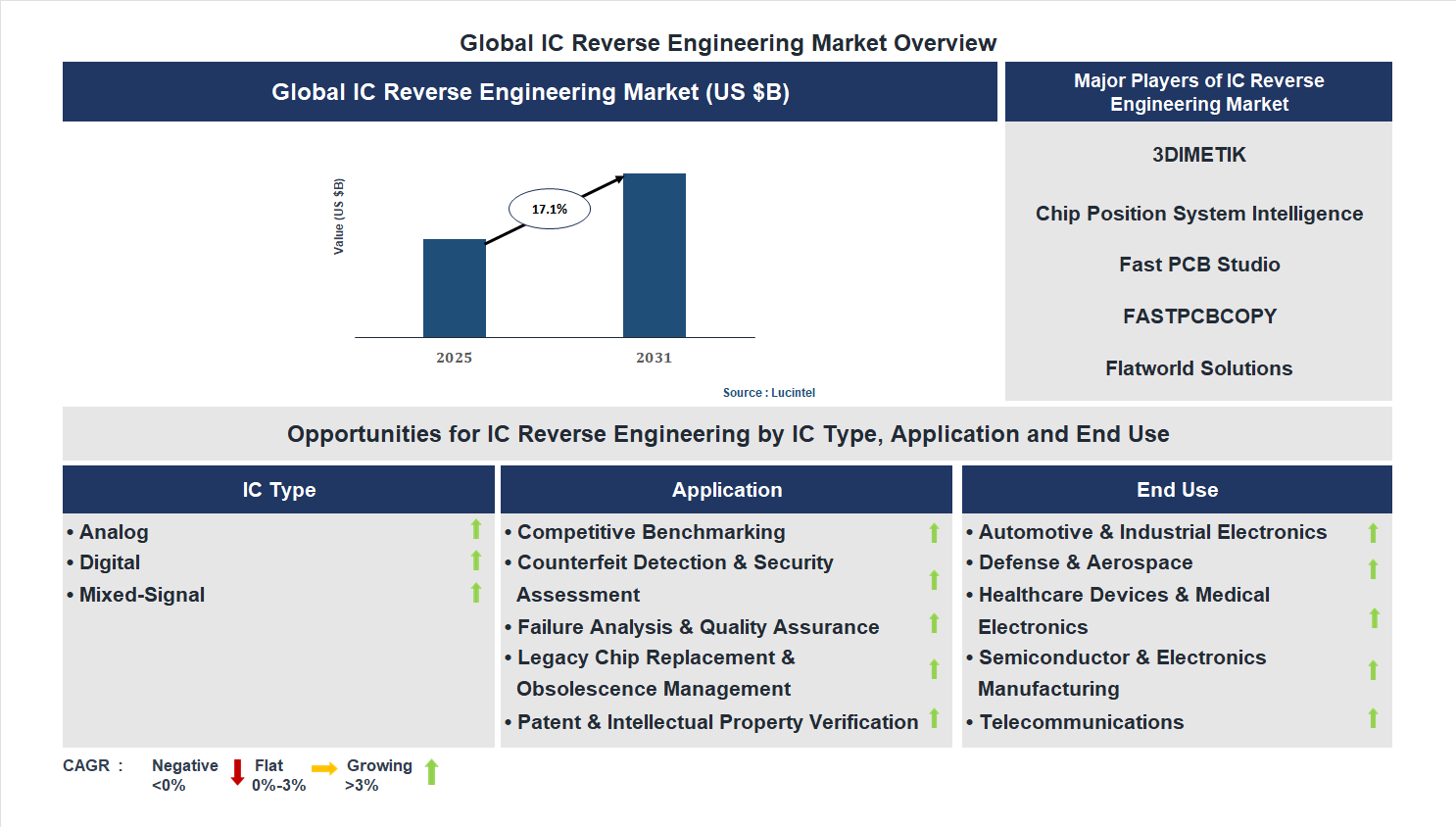
Key data points: The growth forecast = 17.1% annually for the next 7 years. Scroll below to get more insights. This market report covers trends, opportunities and forecasts in IC reverse engineering market to 2031 by IC type (analog, digital, and mixed-signal), application (competitive benchmarking, counterfeit detection & security assessment, failure analysis & quality assurance, legacy chip replacement & obsolescence management, and patent & intellectual property verification), end use (automotive & industrial electronics, defense & aerospace, healthcare devices & medical electronics, semiconductor & electronics manufacturing, and telecommunications), and region (North America, Europe, Asia Pacific, and the Rest of the World)
We'll send your sample report shortly.
• Lucintel forecasts that, within the IC type category, mixed-signal is expected to witness the highest growth over the forecast period.
• Within the end use category, defense & aerospace is expected to witness the highest growth.
• In terms of region, APAC is expected to witness the highest growth over the forecast period. Gain valuable insights for your business decisions with our comprehensive 150+ page report. Sample figures with some insights are shown below.
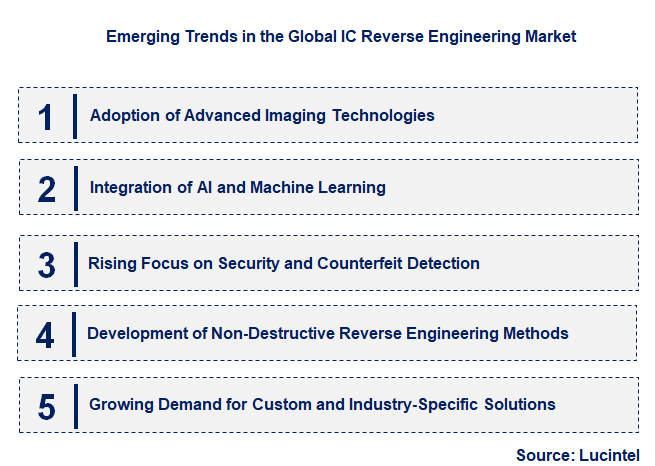
• Adoption of Advanced Imaging Technologies: The use of high-resolution microscopy, 3D imaging, and X-ray tomography is increasing. These technologies enable detailed visualization of ICs without destructive methods, allowing for precise analysis of complex architectures. This trend enhances the ability to reverse engineer highly integrated chips efficiently, reducing time and costs. It also improves accuracy in identifying design features, which is crucial for security assessments and intellectual property verification. As imaging technology advances, the depth and clarity of IC analysis continue to improve, making reverse engineering more effective and less invasive.
• Integration of AI and Machine Learning: Artificial intelligence and machine learning algorithms are being integrated into reverse engineering processes. These tools automate data analysis, pattern recognition, and anomaly detection within ICs, significantly speeding up the process. AI-driven analysis helps identify hidden features, design flaws, or counterfeit components more accurately. This trend reduces manual effort, minimizes errors, and enhances the ability to handle large volumes of complex data. As AI becomes more sophisticated, it will enable predictive insights and smarter decision-making in IC reverse engineering, transforming traditional methodologies.
• Rising Focus on Security and Counterfeit Detection: With the proliferation of counterfeit ICs and security threats, the market is emphasizing advanced reverse engineering for authentication and verification. Techniques such as side-channel analysis and fault injection are being employed to detect tampering or malicious modifications. This trend is driven by the need for supply chain security and intellectual property protection. Companies are investing in specialized tools to trace the origin of chips and ensure authenticity. As counterfeit and security concerns grow, reverse engineering becomes a critical component in safeguarding electronic devices and infrastructure.
• Development of Non-Destructive Reverse Engineering Methods: There is a significant shift towards non-destructive techniques that preserve the integrity of ICs during analysis. Methods like scanning electron microscopy (SEM), focused ion beam (FIB) milling combined with imaging, and advanced X-ray techniques allow detailed examination without damaging the chip. This approach is vital for analyzing valuable or limited samples, reducing costs, and enabling repeated testing. The trend reflects a move towards more sustainable and less invasive analysis methods, broadening the scope of reverse engineering applications across industries such as aerospace, defense, and consumer electronics.
• Growing Demand for Custom and Industry-Specific Solutions: As industries like automotive, healthcare, and IoT expand, there is an increasing need for tailored reverse engineering solutions that address specific industry requirements. Custom tools and methodologies are being developed to analyze specialized ICs, such as those used in medical devices or autonomous vehicles. This trend fosters innovation in reverse engineering techniques, ensuring compliance with industry standards and security protocols. It also enables companies to better understand proprietary designs, facilitate interoperability, and enhance product security, thereby driving market growth and diversification. In summary, these emerging trends are fundamentally transforming the IC reverse engineering market by making analysis more precise, efficient, and secure. The integration of advanced imaging, AI, and non-destructive methods, coupled with a focus on security and industry-specific needs, is enabling stakeholders to better protect intellectual property, detect counterfeits, and innovate more rapidly. These developments are leading to a more sophisticated, versatile, and resilient market landscape, poised to meet the evolving demands of the electronics industry.
• Advancements in Automated Reverse Engineering Tools: The integration of AI and machine learning has led to highly automated tools that accelerate IC analysis, reduce costs, and improve accuracy. This development enables faster identification of design features and vulnerabilities, making reverse engineering more accessible and efficient for a broader range of users. It also enhances the ability to analyze complex, multi-layered ICs, thereby expanding market applications and increasing competitive pressure among service providers.
• Growing Use of 3D Imaging and X-ray Technologies: The adoption of 3D imaging and high-resolution X-ray techniques has revolutionized IC reverse engineering by allowing non-destructive analysis of internal structures. These technologies provide detailed insights into multi-layered chips, facilitating precise replication and security assessments. Their impact includes improved accuracy, reduced damage to samples, and the ability to analyze more complex ICs, which broadens the scope of reverse engineering applications across industries such as defense, automotive, and consumer electronics.
• Increased Focus on Intellectual Property (IP) Protection: As reverse engineering becomes more sophisticated, companies are investing in advanced security measures to safeguard their IP. This includes developing tamper-proof designs and employing encryption techniques. The market response involves a rise in demand for IP protection services and tools, which influences the competitive landscape by encouraging innovation in security solutions. This trend underscores the importance of balancing reverse engineering capabilities with robust IP safeguards.
• Expansion into Emerging Markets: The IC reverse engineering market is witnessing growth in emerging regions such as Asia-Pacific and Latin America, driven by expanding electronics manufacturing and increasing R&D investments. Local companies are adopting reverse engineering techniques to improve product design, quality control, and counterfeit detection. This regional expansion enhances market diversity, creates new revenue streams, and fosters innovation, while also posing challenges related to intellectual property rights and regulatory compliance.
• Increasing Regulatory and Ethical Considerations: The evolving legal landscape around reverse engineering, IP rights, and cybersecurity is shaping market practices. Governments and industry bodies are establishing guidelines to prevent misuse while promoting innovation. Companies are adopting more transparent and compliant practices, which influence market strategies and collaborations. This development emphasizes the need for ethical standards and legal clarity, impacting how reverse engineering services are offered and utilized across sectors. In summary, these recent developments are transforming the IC reverse engineering market by enhancing technological capabilities, expanding application areas, and emphasizing security and ethical considerations. The market is becoming more sophisticated, competitive, and globally integrated, with innovations driving growth and new challenges emerging. Stakeholders must navigate these changes to capitalize on opportunities while managing risks associated with IP protection and regulatory compliance.
• Consumer Electronics: Innovation and IP Protection : The demand for reverse engineering in consumer electronics is driven by the need to analyze competitors products, improve designs, and protect intellectual property. This fosters faster product development and helps companies stay ahead in a highly competitive market.
• Automotive Industry: Autonomous Vehicles and Safety Systems : Reverse engineering enables automakers to analyze complex electronic control units (ECUs) and safety systems, facilitating the development of autonomous vehicles and advanced driver-assistance systems (ADAS). This accelerates innovation and compliance with safety standards.
• Aerospace and Defense: Security and Maintenance : In aerospace, reverse engineering helps in analyzing legacy systems, ensuring security, and facilitating maintenance and upgrades. It supports the development of new components and enhances the safety and reliability of critical systems.
• Semiconductor Industry: Process Optimization and Failure Analysis : Reverse engineering in semiconductors aids in process optimization, failure analysis, and quality control. It allows manufacturers to identify defects, improve manufacturing processes, and develop next-generation chips.
• Healthcare and Medical Devices: Product Innovation and Compliance : The healthcare sector leverages reverse engineering to analyze medical devices, ensure regulatory compliance, and innovate new solutions. This enhances device performance and patient safety. In summary, these growth opportunities are significantly impacting the IC reverse engineering market by driving innovation, enhancing security, and enabling faster product development across key industries. As companies adopt advanced reverse engineering techniques, the market is poised for sustained expansion, fostering competitive advantages and technological progress.
• Technological Innovation: Rapid advancements in semiconductor technology and miniaturization drive the need for reverse engineering to analyze complex ICs, facilitate design improvements, and troubleshoot issues. As ICs become more intricate, reverse engineering tools and techniques evolve to decode sophisticated architectures, enabling companies to stay competitive and foster innovation. This technological progression also supports the development of new applications across industries such as consumer electronics, automotive, and aerospace, expanding market opportunities.
• Intellectual Property (IP) Protection and Litigation: As companies invest heavily in R&D, protecting proprietary designs becomes critical. Reverse engineering is used to verify IP rights, detect counterfeit components, and prevent infringement. Conversely, it also raises concerns about IP theft, prompting stricter legal frameworks. The need to balance IP protection with the ability to analyze and improve ICs fuels market growth, especially in regions with robust legal enforcement, making reverse engineering an essential tool for legal and competitive strategies.
• Increasing Demand for Quality Assurance and Reliability Testing: Manufacturers require thorough analysis of ICs to ensure product quality, reliability, and compliance with industry standards. Reverse engineering enables detailed inspection of ICs to identify defects, verify specifications, and validate manufacturing processes. This demand is particularly high in sectors like aerospace, defense, and medical devices, where failure can have severe consequences. Consequently, the market benefits from the rising need for comprehensive testing and validation services, driving growth in reverse engineering solutions.
• Growing Need for Competitive Analysis: Companies utilize reverse engineering to analyze competitors’ products, understand design strategies, and identify market trends. This intelligence helps in benchmarking performance, reducing time-to-market, and developing innovative features. As the competitive landscape intensifies, organizations increasingly rely on reverse engineering to gain strategic insights, fueling market expansion. The ability to dissect complex ICs provides a significant advantage in fast-paced industries, making reverse engineering a vital component of strategic planning.
• Expansion of Electronics and Semiconductor Markets: The proliferation of electronic devices and the expansion of the semiconductor industry globally create a substantial demand for reverse engineering services. As new markets emerge in developing regions, the need to analyze and adapt IC designs to local requirements grows. This expansion supports the development of customized solutions and accelerates innovation cycles, further propelling the market forward. The increasing complexity and volume of ICs produced worldwide underpin sustained growth in reverse engineering activities. The challenges facing this IC reverse engineering market include:-
• Stringent Intellectual Property Laws: While reverse engineering is essential for innovation and verification, strict IP regulations can limit access to proprietary information. Legal restrictions and enforcement vary across regions, creating uncertainty and potential legal risks for companies engaged in reverse engineering activities. Navigating these legal frameworks requires careful consideration to avoid infringement claims, which can hinder market growth and restrict the scope of analysis.
• Ethical and Privacy Concerns: Reverse engineering often raises ethical questions regarding the violation of IP rights and trade secrets. Companies may be reluctant to share designs or collaborate due to fears of IP theft, leading to a cautious approach that can slow market development. Additionally, concerns about privacy and data security in reverse engineering processes can create barriers, especially in sensitive sectors like defense and healthcare.
• Technological Barriers and Complexity: As ICs become more advanced with features like 3D stacking, system-on-chip (SoC) integration, and encryption, reverse engineering becomes increasingly challenging. Advanced security measures, such as anti-tampering and obfuscation techniques, complicate analysis efforts. These technological barriers require sophisticated tools and expertise, which can be costly and limit market participation to well-funded organizations, thereby constraining growth. In summary, the IC reverse engineering market is driven by technological progress, IP considerations, quality assurance needs, competitive analysis, and industry expansion. However, legal restrictions, ethical issues, and technological complexities pose significant challenges. These factors collectively shape the market landscape, influencing growth trajectories and strategic approaches. While opportunities abound for innovation and competitive advantage, stakeholders must navigate legal and technical hurdles carefully to sustain long-term growth in this evolving sector.
• 3DIMETIK
• Chip Position System Intelligence
• Fast PCB Studio
• FASTPCBCOPY
• Flatworld Solutions
• Fullbax
• GHB Intellect
• Icmasters
• Kinectrics
• LTEC Corporation
• Analog
• Digital
• Mixed-Signal
• Competitive Benchmarking
• Counterfeit Detection & Security Assessment
• Failure Analysis & Quality Assurance
• Legacy Chip Replacement & Obsolescence Management
• Patent & Intellectual Property Verification
• Automotive & Industrial Electronics
• Defense & Aerospace
• Healthcare Devices & Medical Electronics
• Semiconductor & Electronics Manufacturing
• Telecommunications
• North America
• Europe
• Asia Pacific
• The Rest of the World
• United States: The United States leads in IC reverse engineering with advanced technological infrastructure and strong intellectual property laws. Companies focus on security analysis, patent infringement detection, and product verification. The government invests in R&D to develop sophisticated reverse engineering tools, fostering innovation. The market is driven by defense, semiconductor, and electronics sectors, with increasing emphasis on cybersecurity and counterfeit detection. U.S. firms also collaborate with academia to develop cutting-edge techniques, maintaining a competitive edge globally.
• China: China has rapidly expanded its IC reverse engineering capabilities to support its domestic semiconductor industry and reduce reliance on foreign technology. The government promotes reverse engineering for technology transfer, intellectual property analysis, and counterfeit detection. Chinese firms are investing in AI-powered tools and automation to improve efficiency and accuracy. The market is also influenced by national policies aimed at technological self-sufficiency, with a focus on developing indigenous reverse engineering solutions to bolster local innovation and manufacturing.
• Germany: Germanys IC reverse engineering market is characterized by a strong emphasis on quality, precision, and compliance with European regulations. The country leverages its expertise in automotive, industrial automation, and electronics sectors. German firms focus on detailed analysis for product verification, failure analysis, and security testing. The market benefits from collaborations between industry and research institutions, emphasizing innovation and technological standards. Increasing demand for secure supply chains and counterfeit prevention further propels growth in this region.
• India: India is emerging as a key player in IC reverse engineering, driven by a growing electronics and semiconductor industry. The country invests in developing skilled workforce and advanced reverse engineering tools to support local manufacturing and R&D. Indian firms focus on reverse engineering for product development, quality control, and intellectual property analysis. Government initiatives promoting electronics manufacturing and innovation are fueling market growth. The increasing need for cost-effective solutions and local expertise positions India as a promising market for future expansion.
• Japan: Japan maintains a strong presence in IC reverse engineering, primarily serving its electronics, automotive, and robotics sectors. The country emphasizes high-precision analysis, security, and intellectual property protection. Japanese companies utilize advanced imaging and analysis techniques to ensure product integrity and counterfeiting. Collaboration with global technology firms and research institutions enhances innovation. The market is also driven by the need for secure supply chains and compliance with international standards, supporting Japan’s reputation for technological excellence and security.


• 3DIMETIK
• Chip Position System Intelligence
• Fast PCB Studio
• FASTPCBCOPY
• Flatworld Solutions
• Fullbax
• GHB Intellect
• Icmasters
• Kinectrics
• LTEC Corporation Q5. Which IC reverse engineering market segment will be the largest in future? Answer: Lucintel forecasts that, within the IC type category, mixed-signal is expected to witness the highest growth over the forecast period. Q6. In IC reverse engineering market, which region is expected to be the largest in next 5 years? Answer: In terms of region, APAC is expected to witness the highest growth over the forecast period. Q7. Do we receive customization in this report? Answer: Yes, Lucintel provides 10% customization without any additional cost.


Choose a license that fits your team. Instant PDF delivery.
Prices exclude taxes. Instant delivery. Custom licensing available on request.
Market Report · July 16, 2026
Market Report · May 18, 2026
Market Report · May 18, 2026
Trusted partner for strategic intelligence and business growth


Receive a complimentary market analysis tailored to your industry. Our analysts will identify key growth opportunities and competitive dynamics specific to your business.

Market size, growth rate, and key trend analysis for your specific sector.

Top competitor positioning and market share analysis.

Strategic recommendations backed by data-driven insights.
Get curated market intelligence and competitive moves straight to your inbox.
By subscribing, you agree to receive our monthly insights. Unsubscribe anytime.
Receive a complimentary market analysis tailored to your industry. Our analysts will identify key growth opportunities and competitive dynamics specific to your business.
Market size, growth rate, and key trend analysis for your specific sector.
Top competitor positioning and market share analysis.
Strategic recommendations backed by data-driven insights.
Get curated market intelligence, emerging trends, and competitive moves straight to your inbox each month.
By subscribing, you agree to receive our monthly insights. Unsubscribe anytime.
We'll send your sample report shortly.