
Market Report · July 16, 2026

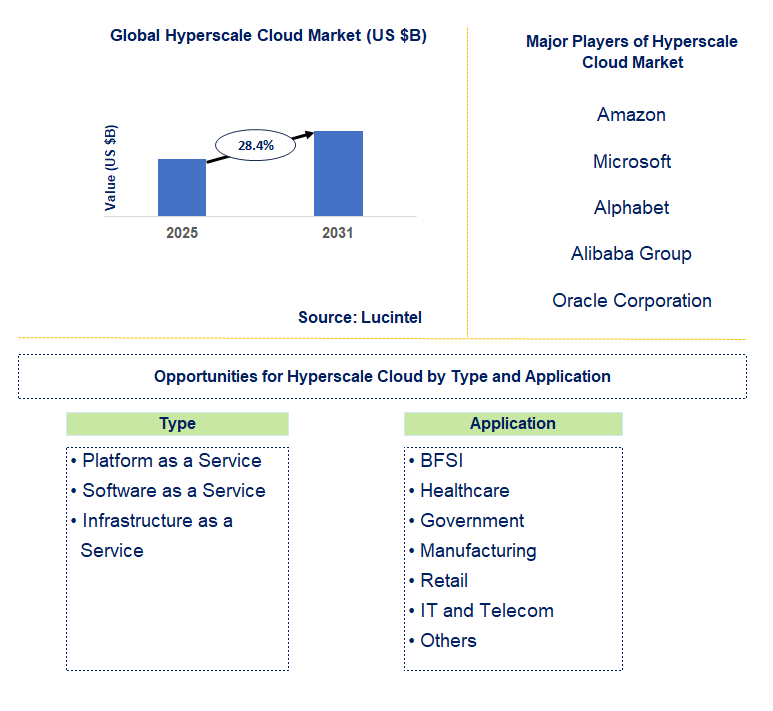
Key data points: The growth forecast = 28.4% annually for the next 7 years. Scroll below to get more insights. This market report covers Trends, opportunity and forecast in hyperscale cloud market to 2031 by type (platform as a service, software as a service, and infrastructure as a service), application (BFSI, healthcare, government, manufacturing, retail, IT and telecom, and others), and region (North America, Europe, Asia Pacific, and the Rest of the World)
We'll send your sample report shortly.
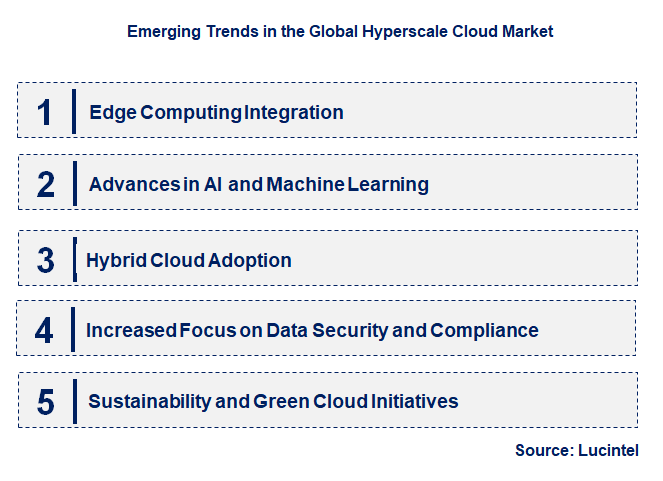
• Edge Computing Integration: Edge computing is becoming a key trend as companies seek to process data closer to where it is generated. By reducing latency and improving response times, edge computing enhances the performance of cloud services. The integration of edge computing with hyperscale cloud platforms allows businesses to handle real-time data more efficiently, improving applications in IoT, autonomous vehicles, and smart cities.
• Advances in AI and Machine Learning: Hyperscale cloud providers are now more and more embracing artificial intelligence and machine learning capabilities in their cloud platforms. It allows businesses to analyze vast amounts of data and gain valuable insights. AI-powered services are revolutionizing industries like finance, healthcare, and retail, providing automation, predictive analytics, and personalized experiences.
• Hybrid Cloud Adoption: Hybrid cloud environments are gaining traction as businesses seek to leverage the benefits of both public and private clouds. Companies are using hyperscale cloud services for scalability while retaining control over sensitive data in private clouds. Hybrid clouds offer enhanced flexibility, security, and cost optimization, driving growth in the market as businesses look for tailored cloud solutions.
• Increased Focus on Data Security and Compliance: With the rise of cloud computing, ensuring data security and compliance has become a top priority for hyperscale cloud providers. Companies are investing in advanced security measures such as encryption, identity management, and threat detection to safeguard sensitive information. Regulations like GDPR and CCPA are also influencing the adoption of cloud services, as businesses seek to comply with evolving data protection laws.
• Sustainability and Green Cloud Initiatives: Sustainability is an emerging focus in the hyperscale cloud market, with providers looking to reduce their carbon footprint. Cloud companies are investing in renewable energy, energy-efficient data centers, and sustainable practices to power their operations. This trend is not only addressing environmental concerns but also helping companies meet their corporate social responsibility goals while reducing operational costs. These emerging trends are driving significant changes in the hyperscale cloud market. The integration of edge computing, AI, and hybrid cloud solutions is enabling businesses to optimize their operations. The focus on data security and sustainability is shaping how providers develop and deliver services. These trends are making hyperscale cloud services more versatile, secure, and environmentally friendly, propelling market growth.
• Expansion of global data centers: The hyperscale cloud providers are investing heavily in the expansion of their global data center network. This is to ensure the delivery of low-latency, high-performance services for customers throughout different regions. Companies are building new data centers and increasing their footprint to position themselves to meet growing worldwide demands for cloud resources and digital transformation.
• Cloud-Native Technology Adoption: The adoption of cloud-native technologies such as containers and microservices is accelerating within the hyperscale cloud market. These technologies allow for greater scalability, faster deployments, and improved system efficiency. Cloud-native technologies are enabling businesses to develop and deploy applications more effectively, driving the demand for hyperscale cloud infrastructure.
• Shift Toward AI-Driven Cloud Services: Hyperscale cloud providers are increasingly incorporating AI-driven capabilities into their services. This includes offering machine learning models, analytics platforms, and AI-powered tools to help businesses harness data more effectively. The shift toward AI-driven cloud services is reshaping how companies use the cloud for innovation and competitive advantage.
• Rise of Serverless Computing: Serverless computing is gaining traction within the hyperscale cloud market as businesses look for more flexible and cost-efficient cloud solutions. With serverless computing, companies no longer need to manage infrastructure, enabling them to focus on application development. This trend is reshaping cloud architectures and enabling faster, more scalable application deployments.
• Focus on Multi-Cloud Strategies: Organizations are increasingly adopting multi-cloud strategies, where they use services from multiple cloud providers to avoid vendor lock-in and optimize performance. Hyperscale cloud providers are responding by offering seamless integration across different cloud environments. This strategy allows businesses to choose the best services from each provider based on their unique needs. These recent developments are reshaping the hyperscale cloud market by making cloud services more scalable, efficient, and tailored to customer needs. The expansion of data centers, adoption of AI, and shift toward serverless computing are enhancing the versatility of hyperscale clouds, while multi-cloud strategies are enabling businesses to create more flexible and robust cloud infrastructures.
• Cloud for Digital Transformation: Hyperscale cloud providers are positioning themselves as essential partners for companies undergoing digital transformation. By offering scalable and flexible cloud solutions, businesses in industries such as retail, healthcare, and manufacturing can accelerate their digital transformation efforts. The demand for cloud-based solutions that support innovation and operational efficiency is driving growth in the hyperscale cloud market.
• Cloud for Big Data and Analytics: The need for big data and advanced analytics is fueling the demand for hyperscale cloud services. Companies are leveraging cloud platforms to store and analyze vast amounts of data for better decision-making. As data-driven insights become essential for competitive advantage, hyperscale cloud providers are capitalizing on this opportunity by offering robust data storage and analytics solutions.
• Cloud for Artificial Intelligence and Machine Learning: Hyperscale cloud providers are tapping into the growing demand for AI and machine learning capabilities. These technologies require immense computing power, making hyperscale clouds an ideal platform for businesses looking to implement AI-driven applications. By offering specialized AI services and tools, cloud providers are positioning themselves as leaders in the rapidly expanding AI market.
• Cloud for Industry-Specific Solutions: Hyperscale cloud providers are focusing on developing industry-specific cloud solutions tailored to sectors such as finance, healthcare, and government. These specialized solutions help businesses meet unique regulatory, security, and operational needs. Industry-specific offerings are driving growth in the hyperscale cloud market as more businesses seek customized cloud services.
• Cloud for Edge Computing: With the increasing adoption of IoT devices and the need for low-latency services, hyperscale cloud providers are exploring edge computing as a strategic growth opportunity. By extending cloud capabilities to the edge, they can offer faster processing times and improve service delivery in industries such as automotive, logistics, and telecommunications, driving the demand for edge-enabled cloud services. Growth opportunities have had a profound impact on the hyperscale cloud market. It has enabled hyperscale cloud providers to diversify their offerings and capture new market segments. The hyperscale cloud market is, therefore, growing in all dimensions of innovation: from digital transformation and AI to industry-specific solutions and edge computing. This is why it forms an integral part of the global digital economy.
• Amazon
• Microsoft
• Alphabet
• Alibaba Group
• Oracle Corporation
• IBM
• Apple
• Platform as a Service
• Software as a Service
• Infrastructure as a Service
• BFSI
• Healthcare
• Government
• Manufacturing
• Retail
• IT and Telecom
• Others
• North America
• Europe
• Asia Pacific
• The Rest of the World
• United States: The United States remains a leader in the hyperscale cloud market with major cloud providers such as Amazon Web Services (AWS), Microsoft Azure, and Google Cloud expanding their infrastructures. These companies continue to invest in advanced data centers, cutting-edge hardware, and AI capabilities to support global enterprise needs. The U.S. market is also seeing a rise in edge computing for faster data processing and lower latency.
• China: China’s hyperscale cloud market is expanding rapidly, driven by both domestic companies and government initiatives. Major players like Alibaba Cloud, Tencent Cloud, and Huawei Cloud are investing heavily in data centers and AI-powered cloud services. The Chinese government is also supporting this growth by promoting data localization and enhancing the country‘s digital infrastructure to foster innovation and increase cloud adoption.
• Germany: Germany is seeing a steady rise in hyperscale cloud investments, driven by the country‘s focus on data sovereignty, security, and compliance. German cloud providers such as Deutsche Telekom’s T-Systems are expanding their cloud offerings to meet the demand for secure data services in industries like automotive, finance, and manufacturing. The growing trend of hybrid cloud adoption is also shaping the market in Germany.
• India: India’s hyperscale cloud market is experiencing rapid growth, with major global players and local firms increasing their presence. As businesses in India continue to embrace digital transformation, cloud adoption is gaining momentum, especially in sectors like finance, healthcare, and education. The government’s push toward smart cities and digital infrastructure is also boosting the demand for hyperscale cloud services in the region.
• Japan: Japan is focusing on enhancing its cloud capabilities to support its digital economy. Companies such as Fujitsu and NTT Communications are investing heavily in data center expansion, AI, and edge computing. The government’s emphasis on technology innovation and digitalization, including initiatives like Society 5.0, is helping foster the growth of the hyperscale cloud market in Japan.


• Amazon
• Microsoft
• Alphabet
• Alibaba Group
• Oracle Corporation
• IBM
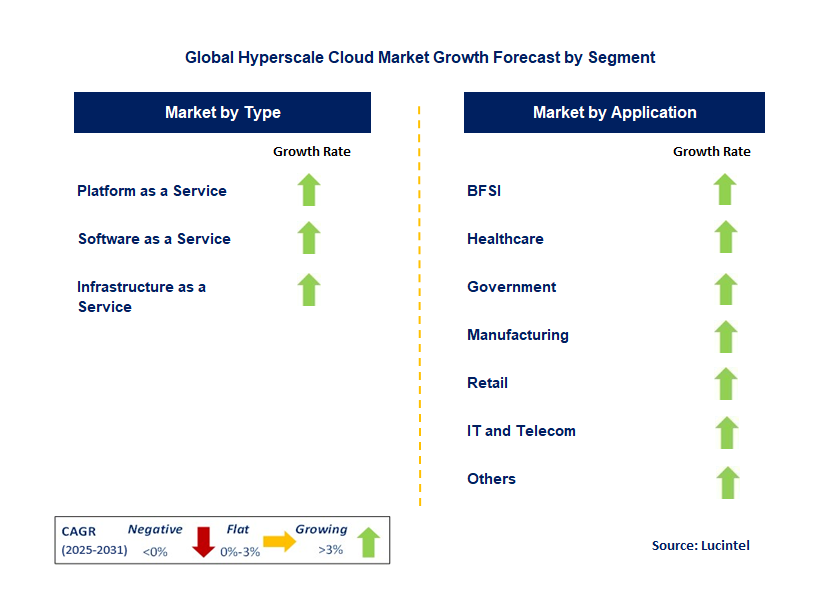
• Apple Q5. Which hyperscale cloud market segment will be the largest in future? Answer: Lucintel forecasts that infrastructure as a service is expected to witness the highest growth over the forecast period. Q6. In hyperscale cloud market, which region is expected to be the largest in next 5 years? Answer: APAC is expected to witness the highest growth over the forecast period. Q7. Do we receive customization in this report? Answer: Yes, Lucintel provides 10% customization without any additional cost.


Choose a license that fits your team. Instant PDF delivery.
Prices exclude taxes. Instant delivery. Custom licensing available on request.
Market Report · July 16, 2026
Market Report · May 18, 2026
Market Report · May 18, 2026
Trusted partner for strategic intelligence and business growth


Receive a complimentary market analysis tailored to your industry. Our analysts will identify key growth opportunities and competitive dynamics specific to your business.

Market size, growth rate, and key trend analysis for your specific sector.

Top competitor positioning and market share analysis.

Strategic recommendations backed by data-driven insights.
Get curated market intelligence and competitive moves straight to your inbox.
By subscribing, you agree to receive our monthly insights. Unsubscribe anytime.
Receive a complimentary market analysis tailored to your industry. Our analysts will identify key growth opportunities and competitive dynamics specific to your business.
Market size, growth rate, and key trend analysis for your specific sector.
Top competitor positioning and market share analysis.
Strategic recommendations backed by data-driven insights.
Get curated market intelligence, emerging trends, and competitive moves straight to your inbox each month.
By subscribing, you agree to receive our monthly insights. Unsubscribe anytime.
We'll send your sample report shortly.