
Market Report · July 22, 2026

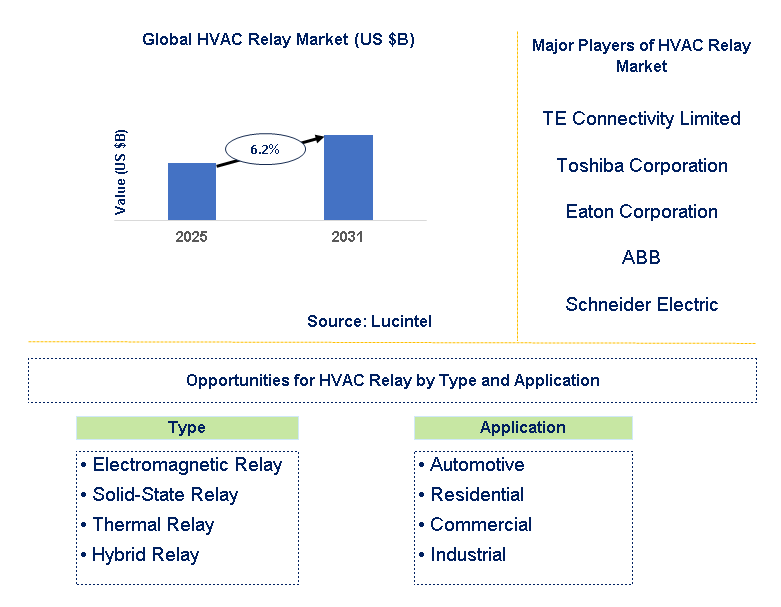
Key data points: The growth forecast = 6.2% annually for the next 7 years. Scroll below to get more insights. This market report covers trends, opportunities and forecasts in HVAC relay market to 2031 by type (electromagnetic relay, solid-state relay, thermal relay, and hybrid relay), application (automotive, residential, commercial, and industrial), and region (North America, Europe, Asia Pacific, and the Rest of the World)
We'll send your sample report shortly.
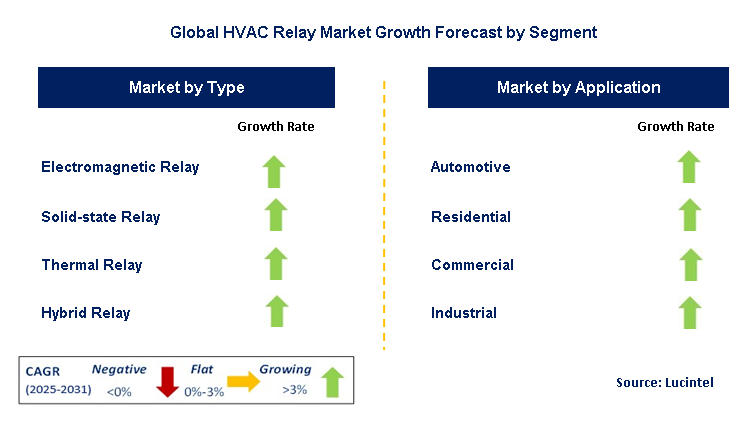
• Lucintel forecasts that, within the type category, electromagnetic relay is expected to witness the highest growth over the forecast period.
• Within the application category, industrial is expected to witness the highest growth.
• In terms of region, APAC is expected to witness the highest growth over the forecast period. Gain valuable insights for your business decisions with our comprehensive 150+ page report. Sample figures with some insights are shown below.
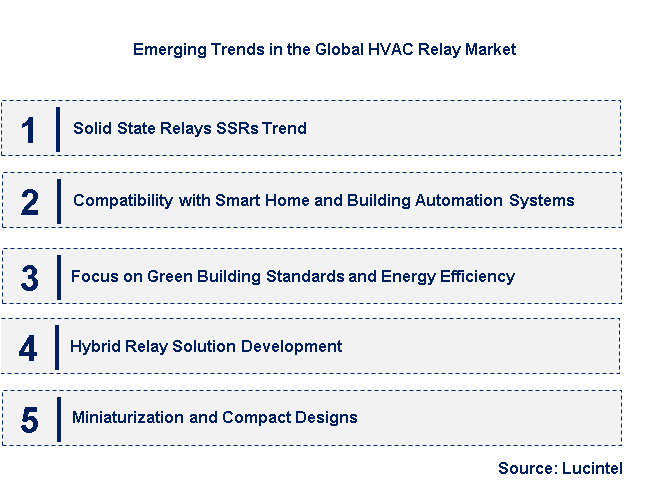
• Solid State Relays SSRs Trend: One trend that is unfolding is the dramatic move away from conventional electromagnetic relays towards Solid State Relays SSRs in HVAC usage. SSRs have several benefits such as increased lifespan with no moving parts, quicker switching speed, quiet operation, and higher durability against shock and vibration. This is necessitated by growing demands for greater reliability, lower maintenance, and accurate control in the latest HVAC systems, which results in better energy efficiency and quiet performance, especially in commercial and residential applications.
• Compatibility with Smart Home and Building Automation Systems: The market is seeing a new trend towards greater integration of HVAC relays into smart home and building automation systems. This includes relays with communication features, allowing remote monitoring, control, and diagnostics using IoT platforms. This trend enables optimized energy management, predictive maintenance, and customized climate control settings, improving user convenience and lower operational costs. It is essential for smart city and energy efficient building programs.
• Focus on Green Building Standards and Energy Efficiency: One of the dominant emerging trends is the increased focus on energy efficiency and adherence to green building protocols. This creates demand for HVAC relays that will result in lower power usage and lower carbon emissions. The development of more efficient relay designs and use of new materials with lower energy loss is underway. This trend supports worldwide environmental targets and government drives for sustainable construction initiatives, influencing product innovation and market uptake.
• Hybrid Relay Solution Development: A breakthrough new trend is the innovation of hybrid relay solutions that unite the best of electromagnetic and solid state relays. Such hybrid relays seek to provide a combination of high current handling, cost efficiency, and increased reliability. This trend addresses the needs in certain applications where a complete SSR may be too expensive, yet standard electromagnetic relays are not desired lifespan or switching speed, offering a convenient solution for HVAC system designers.
• Miniaturization and Compact Designs: The industry is seeing a growing trend of miniaturization and smaller designs for HVAC relays. With more advanced HVAC units and tighter space constraints, there is demand for smaller but more powerful relay components. The trend allows manufacturers to produce smaller HVAC systems, decrease system size overall, and possibly decrease material costs, while at least maintaining and in some cases enhancing performance and reliability. It is essential to contemporary appliance design and optimal space use. These new trends are deeply transforming the HVAC relay market by promoting innovation, improving product performance, and meeting wider industry objectives. Migration to solid state relays and hybrid offerings is enhancing reliability and efficiency. Greater integration with smart systems is permitting sophisticated control and energy management. The focus on miniaturization and energy efficiency is resulting in smaller and more sustainable products. Together, these trends are revolutionizing the HVAC relay market into an intelligent, highly efficient, and integrated segment for future climate control systems.
• Introduction of High-Efficiency Solid State Relays: A key recent innovation is the general introduction and implementation of high efficiency solid state relays SSRs optimized for use in HVAC applications. These relays provide serious improvement over standard electromagnetic relays through longer operating life, quiet switching, and lower power consumption. This innovation addresses directly the industry is move toward more energy efficient HVAC systems and aids overall cost savings in operation for consumers and businesses.
• Advanced Integration with IoT and Smart HVAC Systems: Recent advancements point to improved integration capabilities of HVAC relays with Internet of Things IoT and intelligent HVAC systems. New relays are being created with in-built communication protocols that ensure easy integration with building management systems BMS and intelligent home platforms. This supports high-level functionalities like remote monitoring, predictive maintenance, and optimized energy scheduling, making HVAC systems more intelligent and user-friendly.
• Hybrid Relay Technology Development: Another notable recent trend is the appearance and coming of age of hybrid relay technologies. These pair the rugged switching strengths of electromagnetic relays with the longer term reliability and fine control of solid state devices. Hybrid relays provide an optimal balance solution, meeting the requirement for high current capability and long term reliability in a wide range of HVAC applications and presenting a universally adaptable choice for manufacturers and system integrators.
• Emphasis on Miniaturization and Space Saving Designs: The industry has witnessed a recent trend in the industry is concerted effort toward miniaturization and development of more compact relay designs. With HVAC equipment becoming more advanced and integrated, there is an increasing need for smaller components that can be fitted into limited spaces without affecting performance. This trend supports the design of smaller, more attractive, and more efficient HVAC units.
• Use of Advanced Materials for Enhanced Durability: Recent improvements also involve the use of advanced materials in the making of relays to enhance durability and performance in harsh HVAC conditions. This entails the employment of materials that provide greater resistance to thermal changes, humidity, and electrical stresses. These developments increase the lifespan of relays, lower failure rates, and enhance the overall reliability of HVAC equipment across different climatic conditions. These recent developments are affecting the HVAC relay market significantly by boosting product performance, system integration, and efficiency. The emergence of high efficiency solid state and hybrid relays is resulting in more energy efficient and reliable HVAC systems. Improved IoT integration is rendering climate control more intelligent, and miniaturization and smarter materials are allowing for more diminutive and resilient designs. All these together are driving the HVAC relay market towards more advanced, sustainable, and networked solutions for future heating, ventilation, and air conditioning.
• Residential HVAC Systems: One key strategic growth area is in the growing residential HVAC systems market. As urbanization increases, disposable incomes rise, and home comfort and energy efficiency become increasingly important, demand for residential air conditioners, furnaces, and heat pumps is exploding. Growth opportunities include creating cost effective, dependable, and smart compatible relays that accommodate a broad spectrum of residential HVAC configurations, both for new installations and the huge replacement market.
• Commercial Building Automation and Management Systems: Another key strategic growth prospect is in commercial building automation and management systems BMS. With corporations focusing on saving energy and optimizing facility efficiency, the market for combined HVAC systems managed by sophisticated relays is gaining traction. Prospects are to create high current, highly reliable, and network compatible relays that can easily interface with sophisticated BMS, providing centralized control, optimized scheduling, and predictive maintenance for large commercial facilities.
• Industrial Process Control and HVAC: Strategic opportunities for growth lie in industrial HVAC and process control applications. Industrial facilities like manufacturing plants, data centers, and cleanrooms need sensitive temperature and humidity control for optimal functioning and machine protection. Opportunities include creating rugged, high durability relays that can withstand heavy loads and operate under harsh industrial environments, usually with special features for mission-critical process control and safety systems, for uninterrupted operations.
• Automotive HVAC Systems: The automotive HVAC systems market is a key strategic opportunity for growth. Advanced climate control systems for passenger comfort and protection are part of advanced vehicles. Some opportunities are to create compact, highly reliable, and vibration resistant relays that can serve well within the compact and dynamic climate of cars. The advancement in vehicle electronics and growing electric vehicles demand will further propel the demand for advanced, compact, and energy efficient relays in this industry.
• Retrofit and Upgrade Market: A major growth strategic opportunity lies in the retrofit and upgrade market for current HVAC systems. With older HVAC units losing efficiency and not meeting current energy standards, building owners are preferring upgrades over replacements. Opportunities lie in offering compatible and easy-to-install relays that can improve the efficiency and performance of older systems, providing a cost effective solution for better climate control and energy efficiency. These strategic opportunities for growth are deeply affecting the HVAC relay market through driving specialization, growing its consumer base, and propelling technological development. The attention on residential, commercial, and industrial applications covers significant demand segments. The increasing requirements of automotive HVAC systems and the massive retrofit market present varied channels for growth. Together, these opportunities are driving the market for HVAC relays to create increasingly specialized, efficient, and technologically integrated solutions, essential to addressing the changing needs of worldwide climate control systems.
• TE Connectivity Limited
• Toshiba Corporation
• Eaton Corporation
• ABB
• Schneider Electric
• Hitachi
• Rockwell Automation
• Mitsubishi Electric Corporation
• General Electric
• Littlefuse
• Electromagnetic Relay
• Solid-State Relay
• Thermal Relay
• Hybrid Relay
• Automotive
• Residential
• Commercial
• Industrial
• North America
• Europe
• Asia Pacific
• The Rest of the World
• United States: In the United States, the recent trends in the U.S. HVAC relay market are driven by a strong focus on energy efficiency and smart home connectivity. There is an increasing need for SSRs because of their longer lifespan and better control quality, essential for sophisticated building management systems. Energy conservation regulations are compelling the installation of more energy-efficient HVAC units, which in turn creates additional demand for compatible relays. The market also experiences ongoing investment to upgrade older buildings with new HVAC units, which helps ensure steady demand for relay upgrades and replacement.
• China: China is a fast-growing market for HVAC relays, fueled by huge urbanization, infrastructure growth, and a rapidly expanding construction industry. New trends are a growing demand for relays in residential and commercial HVAC applications. Chinese manufacturers are quickly improving their manufacturing capacities and concentrating on creating smart relays with connectivity to Internet of Things IoT and building automation systems. Government policies encouraging green buildings and energy efficient technologies are also contributing immensely to market growth, enhancing the uptake of more advanced HVAC relay solutions throughout the country.
• Germany: Germany‘s developed engineering capabilities and high emphasis on energy efficiency demonstrate latest trends in its HVAC relay market dominated by demand for high precision and effective components. There is a strong preference for hybrid and solid state relays which are capable of supporting complex commercial and industrial HVAC systems, providing maximum performance and energy efficiency. German firms are leaders in innovation and design and produce relays that meet rigorous European Union energy efficiency standards. Durability and long term stability are also key expectations in the market, indicating dedication to quality and sustainable building.
• India: The India HVAC relay market is witnessing strong recent growth, driven by rapid urbanization, rising disposable incomes, and enhanced demand for air conditioning systems in residential, commercial, and industrial applications. With India emphasizing infrastructure development and smart city projects, there is an increased requirement for energy-efficient and digitally controlled HVAC systems, driving demand for advanced relays. Local producers are diversifying their product lines, and consumers are increasingly aware of the advantages of up-to-date HVAC solutions, so there is increased adoption of relays.
• Japan: Japan‘s market for HVAC relays is driven by a high focus on technological advancement and energy efficiency. Recent growth involves a call for compact and high-reliability relays for sophisticated HVAC equipment, specifically heat pumps, which are in extensive use as a result of government carbon neutral goals. Japanese companies are engaging in research and development efforts to create small and highly efficient relays that facilitate precision temperature control and integration with smart home systems. The market is also fueled by an ongoing requirement for upgrading and replacing components in current buildings, which continues to sustain stable demand for superior quality components.


• TE Connectivity Limited
• Toshiba Corporation
• Eaton Corporation
• ABB
• Schneider Electric
• Hitachi
• Rockwell Automation
• Mitsubishi Electric Corporation
• General Electric
• Littlefuse Q5. Which HVAC relay market segment will be the largest in future? Answer: Lucintel forecasts that, within the type category, electromagnetic relay is expected to witness the highest growth over the forecast period. Q6. In HVAC relay market, which region is expected to be the largest in next 5 years? Answer: In terms of region, APAC is expected to witness the highest growth over the forecast period. Q7. Do we receive customization in this report? Answer: Yes, Lucintel provides 10% customization without any additional cost.


Choose a license that fits your team. Instant PDF delivery.
Prices exclude taxes. Instant delivery. Custom licensing available on request.
Market Report · July 22, 2026
Market Report · July 22, 2026
Market Report · July 17, 2026
Trusted partner for strategic intelligence and business growth


Receive a complimentary market analysis tailored to your industry. Our analysts will identify key growth opportunities and competitive dynamics specific to your business.

Market size, growth rate, and key trend analysis for your specific sector.

Top competitor positioning and market share analysis.

Strategic recommendations backed by data-driven insights.
Get curated market intelligence and competitive moves straight to your inbox.
By subscribing, you agree to receive our monthly insights. Unsubscribe anytime.
Receive a complimentary market analysis tailored to your industry. Our analysts will identify key growth opportunities and competitive dynamics specific to your business.
Market size, growth rate, and key trend analysis for your specific sector.
Top competitor positioning and market share analysis.
Strategic recommendations backed by data-driven insights.
Get curated market intelligence, emerging trends, and competitive moves straight to your inbox each month.
By subscribing, you agree to receive our monthly insights. Unsubscribe anytime.
We'll send your sample report shortly.