
Market Report · July 13, 2026

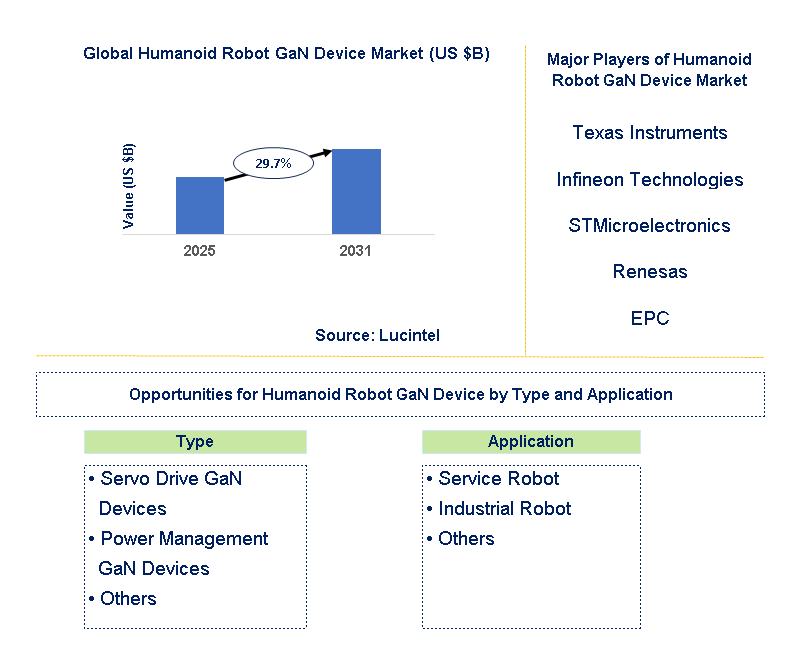
Key data points: The growth forecast = 29.7% annually for the next 7 years. Scroll below to get more insights. This market report covers trends, opportunities and forecasts in humanoid robot GaN device market to 2031 by type (servo drive GaN devices, power management GaN devices, and others), application (service robot, industrial robot, and others), and region (North America, Europe, Asia Pacific, and the Rest of the World)
We'll send your sample report shortly.
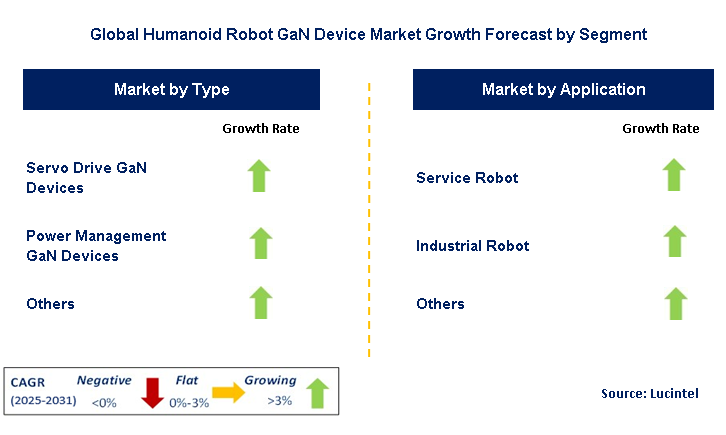
• Lucintel forecasts that, within the type category, power management GaN device is expected to witness higher growth over the forecast period.
• Within the application category, industrial robot is expected to witness higher growth.
• In terms of region, APAC is expected to witness the highest growth over the forecast period. Gain valuable insights for your business decisions with our comprehensive 150+ page report. Sample figures with some insights are shown below.
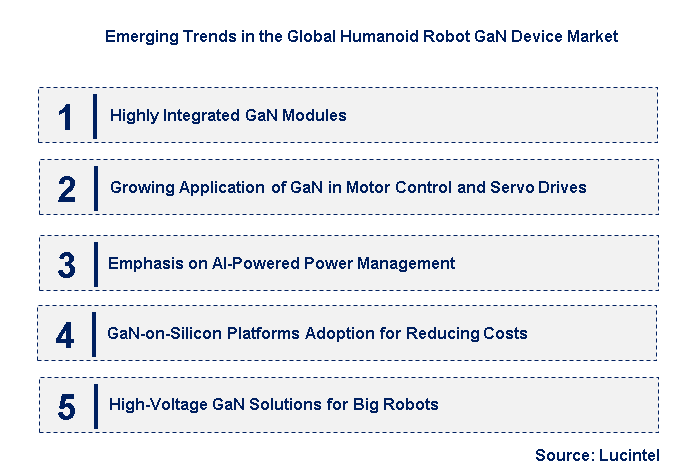
• Highly Integrated GaN Modules: A growing trend is the creation of highly integrated GaN modules which integrate the power transistor, gate driver, and other passives in one package. This integration and miniaturization are essential for humanoid robots, where both weight and space are maximized in each limb and joint. The result is high power density that enables greater, more responsive motors in a reduced space. This provides the ability to move more agilely and in a more lifelike manner, which is essential for mass adoption of humanoid robots.
• Growing Application of GaN in Motor Control and Servo Drives: The market is witnessing a robust trend towards the growing application of GaN in motor control and servo drives. Humanoid robots contain multiple motors that need to be controlled accurately and efficiently. GaN’s high-frequency switching capability with low loss makes it perfect for these applications, enabling more precise and responsive motor control. The effect is a major enhancement of the dexterity of the robot and capacity for intricate tasks. It also results in decreased heat generation, which is a principal hurdle in a highly populated body of robots.
• Emphasis on AI-Powered Power Management: An important upcoming trend is emphasizing AI-powered power management systems that utilize GaN devices. Artificial intelligence-based algorithms are being designed to maximize the power delivery to a robot’s motors in real time, depending on what task it is executing. This means that the robot will always be running at its most efficient level. The effect is a considerable prolongation of the battery life of the robot and a more stable and consistent operation. This trend is essential for allowing humanoid robots to run independently for extended time periods, which is critical for their commercial success.
• GaN-on-Silicon Platforms Adoption for Reducing Costs: The market is shifting towards a trend of embracing GaN-on-silicon platforms for the production of GaN devices. It is an economical method that utilizes existing silicon fabrication facilities. The effect is a substantial drop in the cost of producing GaN devices, which becomes more affordable for a broader set of humanoid robot projects and producers. This tendency is pivotal in taking humanoid robots out of the R&D phase and into mass production since it tackles one of the significant hurdles to adoption, which is costly components.
• High-Voltage GaN Solutions for Big Robots: The industry is witnessing an increasing movement towards the creation of high-voltage GaN solutions for bigger, more powerful humanoid robots. Although initial GaN devices were mostly applied in low-voltage systems, emerging devices are being designed to support the higher voltage and current necessary for the prime actuators and power supply of a full-scale humanoid. The effect is a more powerful and capable robot. This trend is essential for use cases that involve heavy lifting and hard physical interaction, for example, logistics and manufacturing. These new trends are collectively transforming the humanoid robot GaN device market by integrating the technology more, making it more efficient, and making it more accessible. Emphasis on high-frequency motor control and integrated modules is improving performance and dexterity, and AI-based power management is improving battery life. GaN-on-silicon adoption is reducing prices, and high-voltage solution development is broadening the market’s range of applications. All these are revolutionizing the market by establishing GaN devices as a base technology for the next wave of humanoid robots.
• Commercialization of Integrated GaN Power Modules: One such significant recent development is the commercialization of integrated GaN power modules that integrate the GaN transistor and its driver into one package. The development by companies such as Texas Instruments and Infineon makes the robot manufacturer’s job easier in terms of design and brings down the overall size of the power electronics. The effect is a tremendous boost in power density and efficiency, which are essential for the many servo motors in a humanoid robot. This enables more powerful and compact joint actuators, resulting in a more agile and humanlike robot
• Advancements in High-Frequency Motor Control: The industry witnessed a recent emergence of substantial advances in high-frequency motor control algorithms well-optimized specifically for GaN devices. The capability of GaN to switch so much faster than silicon-based devices is being used to make a robot’s movements more precise and responsive. The result is more natural and smoother motion, which is critical for applications involving delicate manipulation. This is fueling the need for GaN devices as a key part of next-generation servo control systems.
• Strategic Partnerships Among Chipmakers and Robot Makers: The industry is witnessing a significant evolution in strategic partnerships among GaN chipmakers and robot makers. Such alliances are aimed at co-developing application-specific GaN solutions that will be designed with respect to the particular requirements of a robot’s architecture. The outcome is an accelerated development cycle and the development of fully optimized GaN devices capable of meeting the specific challenges of power density and thermal management in a humanoid robot. This progress is essential in driving the commercialization of humanoid robots.
• GaN-on-Silicon for Manufacturing Scalability: The most important advancement is the market increasing interest in GaN-on-silicon manufacturing platforms. This method makes it possible to manufacture GaN devices in the same, large-scale silicon manufacturing facilities already in place, a cost factor that lowers dramatically and that makes the technology more scalable. The effect is a huge leap toward achieving humanoid robots’ affordability for mass production. This technology is pivotal in shifting the market from a niche R&D community to a high-volume commercial market.
• GaN Solutions for Battery Management Systems (BMS) Development: The market is witnessing a new trend in the application of GaN devices for battery management systems (BMS) for humanoid robots. GaN’s high efficiency is well suited for controlling the power flow to and from the battery of the robot, minimizing energy losses in charging and discharging. The result is longer battery life and an overall efficient power system. This advancement is essential for increasing the operating duration of humanoid robots, which is one of the biggest issues in their practical implementation. These advancements are dramatically influencing the humanoid robot GaN device industry by driving it toward more efficiency, integration, and cost-effectiveness. The emphasis on integrated modules and high-frequency motor control is enhancing performance, while the strategic partnerships are speeding up innovation. The push towards GaN-on-silicon and GaN-based BMS is confronting the biggest challenges of cost and battery life. Put together, these advances are making sure that GaN devices are not only a part but a building block technology for the future generation of humanoid robots.
• Robot Actuators and Joints Custom GaN Solutions: One of the biggest growth areas is in the development of custom GaN solutions for robot actuators and joints. Humanoid robots contain numerous joints that need to be served by compact, high-power, and highly efficient motor drives. Robot manufacturers can collaborate with companies to produce custom integrated GaN power modules that match the specific form factor and performance needs of each joint. This enables them to address a high-value, high-growth market segment and offer vital equipment that is vital to the robot’s agility and natural motion.
• Growth in AI and Edge Computing Hardware: Another major opportunity is in creating GaN-based power solutions for the AI and edge computing hardware of humanoid robots. The brain of the robot needs an efficient power delivery system in order to power its sophisticated processors and sensors. Companies can provide GaN-based DC-DC converters and power management ICs that feature high power density and low losses. This enables them to access a high-growth market and deliver essential components that are vital to the robot’s intelligence and autonomy.
• Focusing on Logistics and Manufacturing Industry: The market offers a prime growth opportunity in the logistics and manufacturing industries. Humanoid robots are being used more and more in factories and warehouses to do tasks that need dexterity and human motion. Businesses can create high-power, rugged GaN devices capable of meeting the heavy loads and duty cycles associated with these industrial uses. They are able to access a large and expanding market that is concerned with maximizing productivity and labor shortages.
• GaN Innovation for Healthcare and Personal Assistance Robots: The healthcare and personal assistance markets present an exciting space for development. Humanoid robots are being created to serve the elderly, be companions, and do tasks within medical facilities. The ultra-low-power, extremely reliable GaN solutions can be created by companies that are well suited for these applications, where battery life is a concern and safety is important. This enables them to target a substantial and expanding market interested in enhancing quality of life and care, as well as meeting healthcare regulations.
• Strategic Sensor and Perception Systems Partnerships: Strategic opportunity for growth exists in partnerships for sensor and perception systems. Humanoid robots depend on a broad range of sensors like LiDAR and vision systems that need highly efficient power management. Partnership with sensor companies that are experts in these sensors can help develop combined power solutions that are tailored to their unique requirements. This helps GaN device manufacturers to increase their product offerings and provide a complete solution to their customers. All these strategic growth prospects are transforming the humanoid robot GaN device industry by directing it toward specialization, integration, and innovation. The emphasis on bespoke solutions for actuators and AI hardware is meeting high-value, high-performance applications. The growth into the logistics and healthcare industries is widening the scope of the market, and the establishment of partnerships for sensor systems is guaranteeing its future technological leadership. These opportunities are aligning the market for sustained and profitable growth.
• Texas Instruments
• Infineon Technologies
• STMicroelectronics
• Renesas
• EPC
• NXP
• Zhongke Wireless Semiconductor
• InnoScience Technology
• Navitas Semiconductor
• Jiangsu Corenergy Semiconductor
• Servo Drive GaN Devices
• Power Management GaN Devices
• Others
• Service Robot
• Industrial Robot
• Others
• North America
• Europe
• Asia Pacific
• The Rest of the World
• United States: The United States market is dominated by a solid emphasis on cutting-edge robotics R&D as well as commercialization activities. Firms are already working to create GaN-based servo drive modules that are efficient and small in size, meeting the stringent needs of humanoid robots such as Tesla Optimus and Boston Dynamics Atlas. Much focus is on equipping these GaN devices with sophisticated control software and artificial intelligence (AI) to enhance the robot’s dexterity and energy efficiency. The market is also witnessing greater investment in the development of GaN-on-silicon platforms to minimize costs.
• China: China’s market is marked by industrialization at high growth rates and strong government support for the robotics market. Recent trends include a concerted drive for local production of GaN devices for humanoid robots. Businesses are creating GaN-based motor drivers for numerous humanoid robot models, including Unitree and UBTECH Robotics models, to enhance their agility and load-carrying capacities. There is also a strong demand in the market for GaN devices for applications in the country’s thriving manufacturing industry, where humanoid robots are being used more for complex, repetitive jobs.
• Germany: Germany, the world leader in industrial automation and precision engineering, is concentrating on the use of GaN devices in high-performance servo systems for humanoid robots. Current advances are directed towards the utilization of GaN to produce highly power-dense and dependable motor controllers needed for the smooth and accurate motion of robot joints. Industry 4.0, however, is given high priority in the country, and GaN devices are being created as a central piece of integrated and smart robot systems. There is even an effort to create GaN solutions that would comply with high quality and reliability expectations of the country.
• India: The Indian market is growing, fueled by an expanding industrial base and emphasis on automation for productivity. Recent trends involve a considerable boost in R&D work on robotics, with companies developing more interest in the incorporation of GaN devices for their size and efficiency benefits. While the market for humanoid robots is nascent in India, there are needs for GaN devices across other areas of robotics. The market is witnessing an emphasis on creating low-cost GaN solutions that can be scaled for large-scale industrial and commercial application.
• Japan: Japan, the robotics pioneer, continues to be at the forefront of the humanoid robot market with a strong emphasis on innovation and high-precision applications. Some recent developments are the application of GaN devices to enhance the performance of humanoid robots for applications such as bioprocessing and healthcare, where precision and reliability are crucial. Japanese firms are leading the way in the design of highly integrated GaN power modules that are optimized for the special needs of humanoid robot joints. Miniaturization and GaN solutions for enabling new dexterity and motion levels are also trending in the market.


• Texas Instruments
• Infineon Technologies
• STMicroelectronics
• Renesas
• EPC
• NXP
• Zhongke Wireless Semiconductor
• InnoScience Technology
• Navitas Semiconductor
• Jiangsu Corenergy Semiconductor Q5. Which humanoid robot GaN device market segment will be the largest in future? Answer: Lucintel forecasts that, within the type category, power management GaN device is expected to witness higher growth over the forecast period. Q6. In humanoid robot GaN device market, which region is expected to be the largest in next 5 years? Answer: In terms of region, APAC is expected to witness the highest growth over the forecast period. Q7. Do we receive customization in this report? Answer: Yes, Lucintel provides 10% customization without any additional cost.


Choose a license that fits your team. Instant PDF delivery.
Prices exclude taxes. Instant delivery. Custom licensing available on request.
Market Report · July 13, 2026
Market Report · July 13, 2026
Market Report · July 2, 2026
Trusted partner for strategic intelligence and business growth


Receive a complimentary market analysis tailored to your industry. Our analysts will identify key growth opportunities and competitive dynamics specific to your business.

Market size, growth rate, and key trend analysis for your specific sector.

Top competitor positioning and market share analysis.

Strategic recommendations backed by data-driven insights.
Get curated market intelligence and competitive moves straight to your inbox.
By subscribing, you agree to receive our monthly insights. Unsubscribe anytime.
Receive a complimentary market analysis tailored to your industry. Our analysts will identify key growth opportunities and competitive dynamics specific to your business.
Market size, growth rate, and key trend analysis for your specific sector.
Top competitor positioning and market share analysis.
Strategic recommendations backed by data-driven insights.
Get curated market intelligence, emerging trends, and competitive moves straight to your inbox each month.
By subscribing, you agree to receive our monthly insights. Unsubscribe anytime.
We'll send your sample report shortly.