
Market Report · July 13, 2026

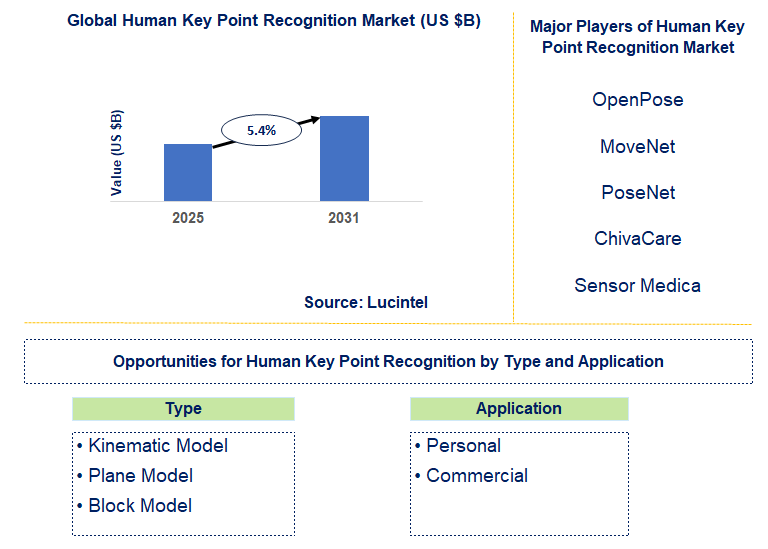
Key data points: The growth forecast = 5.4% annually for the next 7 years. Scroll below to get more insights. This market report covers trends, opportunities and forecasts in human key point recognition market to 2031 by type (kinematic model, plane model, and block model), application (personal and commercial), and region (North America, Europe, Asia Pacific, and the Rest of the World)
We'll send your sample report shortly.
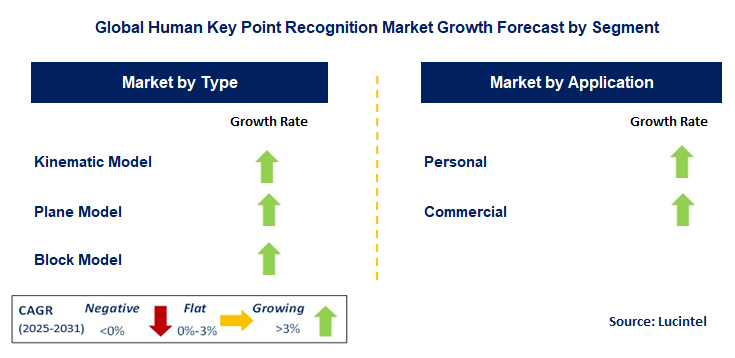
• Lucintel forecasts that, within the type category, kinematic model is expected to witness the highest growth over the forecast period.
• Within the application category, commercial is expected to witness higher growth.
• In terms of region, APAC is expected to witness the highest growth over the forecast period. Gain valuable insights for your business decisions with our comprehensive 150+ page report. Sample figures with some insights are shown below.
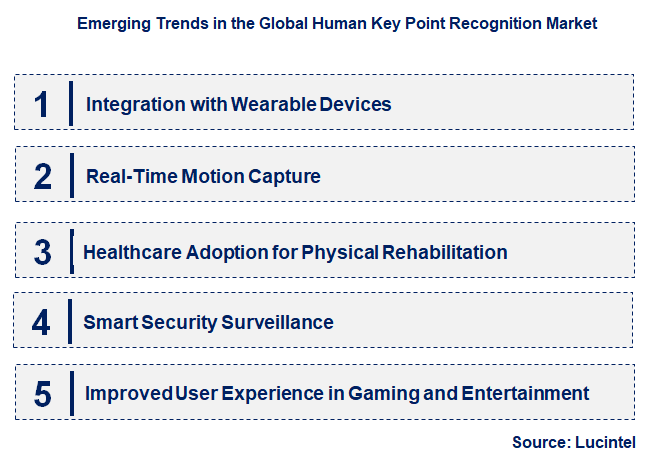
• Integration with Wearable Devices: The technology of key point recognition has started integrating with wearable devices like fitness trackers, smartwatches, and AR glasses. Wearable devices enable users to monitor human movements in real-time, making them enhance the health, performance, and safety of their users. The integration has also raised the usability of wearables as they become more responsive and worth it for healthcare monitoring, preventing injuries, and even rehab. This trend is likely to grow as fresh wearable devices are created to harness HKPR technologies for more personalized fitness monitoring.
• Real-Time Motion Capture: Perhaps the most prominent trend in the HKPR industry is moving towards real-time motion capture. This trend is being driven by advancements in AI and deep learning algorithms, allowing the identification of human poses and movements in real-time. Real-time motion capture is increasingly important across industries such as sports for performance analysis, healthcare for injury detection, and entertainment for interactive experiences in gaming and virtual reality. The capability to record and analyze movements in real time creates a variety of opportunities for companies to enhance user engagement and service delivery.
• Healthcare Adoption for Physical Rehabilitation: Human key point recognition technology is gaining tremendous usage in healthcare, especially physical therapy and rehabilitation. Through the monitoring of patients' movements, HKPR can assist therapists in monitoring progress, posture correction, and detecting issues like improper movement or injury risk. With healthcare systems shifting towards telemedicine and remote care, key point recognition is a major contributor to making virtual rehabilitation sessions possible. The trend is set to increase as the need for remote healthcare services rises across the world.
• Smart Security Surveillance: Key point recognition in security surveillance systems is an emerging trend. This technology allows systems to monitor and analyze human movement in real-time, enhancing the identification of abnormal or suspicious activity. In public areas, airports, and large buildings, HKPR is applied to improve safety measures by recognizing possible security risks, allowing prompt responses. This is also spreading to smart cities where real-time monitoring can give instant feedback on crowd dynamics and possible threats.
• Improved User Experience in Gaming and Entertainment: Technology of key point recognition is increasingly being incorporated in the gaming and entertainment sectors to improve user experience by sensing movement and controlling objects through gestures. The practice is especially common with virtual reality (VR) and augmented reality (AR) interfaces, where players or users use their bodies to interact with digital worlds. Using HKPR, businesses are able to create more interactive experiences, providing new opportunities in gaming, live entertainment, and virtual events. The technology will revolutionize the way consumers interact with entertainment media. The new trends in the human key point recognition market are revolutionizing industries by improving the ways businesses and consumers engage with technology. The merging of HKPR with wearables, AI systems, AR/VR, and real-time monitoring in sports and healthcare is driving more personalized, immersive, and efficient uses. These trends are making HKPR technology increasingly accessible and effective across industries, stimulating innovation and increasing its applications across fields of fitness, healthcare, entertainment, and security. The market is anticipated to keep expanding as the trends intensify and the technology improves.
• Enhanced Precision and Speed of Key Point Detection: Current developments in machine learning and AI have enhanced the precision and speed of human key point detection systems. It is now possible for such systems to detect key points with high precision and at high speeds, enabling real-time applications in fields like sports, medicine, and security. With greater precision, these technologies can be implemented for more complex applications such as injury prevention in sports or real-time posture analysis in rehabilitation.
• Implementation of Real-Time Tracking in Sports: In sports, human key point recognition is being used more and more to monitor the movement of athletes and analyze their performance. This involves monitoring posture, motion, and gestures to optimize training protocols and prevent injuries. Sports teams and coaches are using this technology to learn more about their athletes' biomechanics and optimize training protocols. The capability of analyzing and correcting movements real-time is revolutionizing the way athletes train and compete.
• Integration with Augmented Reality (AR) and Virtual Reality (VR): Merging human key point recognition with AR and VR technologies is transforming sectors such as gaming, entertainment, and education. This blend makes it possible for rich, interactive experiences in which users can interact with virtual worlds using their body movements. Through the support of gesture-based controls, this technology is enabling more natural and interactive methods for users to interact with virtual worlds, dramatically improving user experiences in these sectors.
• AI-Powered Health Apps: In medicine, AI-driven key point recognition algorithms are in development for uses including remote care, physical therapy, and rehabilitation. The algorithms can monitor a patient's movement while exercising or undergoing rehabilitation, so that they stay on the right track and get instant feedback. This is particularly useful in telemedicine, where patients receive virtual treatment but get their movements tracked and analyzed remotely.
• Improved Security in Smart Cities: In the security and surveillance industry, key point recognition is being incorporated into smart city technologies to enhance public safety. Real-time monitoring of human activity allows security agents to identify unusual patterns, recognize threats, and track crowds. This incorporation is critical for the increasing number of smart city projects worldwide, where sophisticated surveillance systems assist in ensuring safety in cities by offering real-time information about public activity. The market for human key point recognition is changing fast with the help of advancements in machine learning, AI, and real-time tracking. Major innovations across industries like sports, entertainment, security, and healthcare are changing the way business and consumers are engaging with technology. With faster and more accurate results, the technology is finding application across numerous applications, including performance analysis as well as interactive experiences in entertainment and gaming. With the technology developing and picking up speed, it is anticipated that it will change industries and catalyze additional innovation in the next few years.
• Healthcare and Rehabilitation: Perhaps the greatest growth opportunity for HKPR is in healthcare uses, specifically rehabilitation and physiotherapy. With the capacity to monitor body movement and analyze posture, HKPR technology can be used to monitor patient recovery in real-time. By detecting improper movements or incorrect posture, medical professionals can provide individualized treatment plans and monitor progress in recovery more accurately. This technology also makes remote monitoring possible for patients, improving the quality and accessibility of care. The increasing need for non-invasive and tailored rehabilitation solutions will continue to promote the adoption of HKPR in medicine.
• Sports and Fitness Performance Analysis: In the fitness and sports industry, HKPR is revolutionizing how athletes and fitness enthusiasts monitor and enhance their performance. With accurate motion tracking, sportsmen can study their movements, identify form weaknesses, and make adjustments in their techniques to achieve better performance. This potential is increasing, especially among professional sports, where real-time analysis can give a competitive advantage. In addition, health and fitness apps and wearables are incorporating HKPR technology to enable individuals to access customized exercise routines through real-time data, which is compelling the consumer market to adopt this technology.
• Security and Surveillance: Security and surveillance is a key market opportunity for HKPR technology. Through its ability to trace and analyze human movements, HKPR can improve threat recognition and enhance crowd control in population areas. It is becoming more integrated into surveillance systems to make them even better at detecting suspicious behavior or out-of-place movements. HKPR technologies are especially worth it in big event environments, airports, and urban security networks. With the call for more intelligent, efficient security solutions, this market segment is growing, with room for innovation in public as well as private sectors.
• Entertainment and Virtual Reality: The entertainment sector, particularly virtual reality (VR) and gaming, is another important use of HKPR technology. By enabling users to engage with virtual worlds through their movements, HKPR increases the realism and immersion of VR experiences. This potential is growing in gaming, training simulations, and interactive media. With continued advancements in VR technology, HKPR will become increasingly vital to facilitate even more realistic and interactive user experience, which is generating growing demand within both professional and consumer spaces.
• Human-Computer Interaction: With development of user interfaces, the presence of HKPR within human-computer interaction (HCI) systems is generating opportunity for growth. Through the use of human movement as an input, HKPR makes it possible to have more natural and intuitive interactions with devices, especially in AR and robotics. Having the potential to control systems and communicate with virtual spaces through physical movements opens doors for users in both personal and work-related contexts. As more people want to engage hands-free, applications that include HKPR will just grow larger as time goes by, particularly where the emphasis in the industry lies in accessibility, usability, and innovation. The human key point recognition market's opportunities for strategic expansion are immense with its applications increasing in healthcare, sports, security, entertainment, and human computer interaction. With the continued development of technology and increasing industries acknowledging the benefits of accurate motion tracking and analysis, the market for HKPR solutions will continue to grow. These opportunities are transforming the market, positioning HKPR technology as a key driver in the creation of smarter, more interactive, and personalized systems across industries. The incorporation of HKPR in these applications will be a driving force in taking the market forward.
• OpenPose
• MoveNet
• PoseNet
• ChivaCare
• Sensor Medica
• APECS
• DCpose
• Yugamiru Cloud
• Egoscue
• ErgoMaster
• Kinematic Model
• Plane Model
• Block Model
• Personal
• Commercial
• North America
• Europe
• Asia Pacific
• The Rest of the World
• United States: In the US, the human key point recognition market is witnessing growth at a rapid pace, driven mainly by the need for AI and machine learning solutions. Google and Microsoft are investing heavily in developing AI-based pose recognition technology to be applied in the healthcare, fitness, and entertainment segments. For instance, innovations in real-time motion capture systems have enabled better tracking of human movements and analysis of human motions. Moreover, the development of smart fitness wearables and virtual reality (VR) apps is driving the market as companies look to incorporate key point recognition for enhanced user experiences.
• China: China is quickly progressing in human key point recognition, driven by the government's significant investments in AI and smart technologies. Domestic players like Baidu and Huawei are working on applying key point recognition to fields like security surveillance, sports, and healthcare. In security, the technology is utilized for real-time surveillance and crowd monitoring to guarantee public safety. In sports, key point recognition is being applied to player tracking and performance analysis. The aggressive thrust from both the government and private segments places China in a leadership position in the world HKPR market.
• Germany: Germany's human key point recognition market is expanding in its established automotive and robotics sectors. Bosch and Siemens, German companies, are engaged in incorporating human key point recognition technology for improved human-robot interaction and automobile safety systems. This encompasses uses like gesture control for car interfaces and self-driving cars. Moreover, the nation's high focus on research and development in AI is driving advancements in real-time motion analysis, with key point recognition being a key component in innovations in robotics, manufacturing, and medical care.
• India: India is witnessing exponential growth in the market for human key point recognition, especially in areas like healthcare, education, and sports analytics. With the increasing number of AI startups, India is seeing innovations that incorporate key point recognition technology into virtual healthcare solutions to support remote patient monitoring and physical therapy. Key point recognition is also increasingly being used for sports analysis, especially in cricket and football, where players' movements and strategies are studied. Moreover, the government's promotion of a digital economy is driving the adoption of AI technologies, further propelling market growth in India.
• Japan: Japan is leading the deployment of human key point recognition in robotics, healthcare, and entertainment. Sony and Toyota are among Japanese firms leveraging the technology for sophisticated motion sensing in robotics, allowing robots to interact more naturally with humans. In healthcare, the technology is being used to monitor elderly patients' movement for fall detection and rehabilitation. Further, Japan's keen interest in smart home technologies is fueling the demand for HKPR in domains such as gesture control for smart devices. The application of human key point recognition along with augmented reality (AR) and VR technologies is also increasing in entertainment and gaming industries.


• OpenPose
• MoveNet
• PoseNet
• ChivaCare
• Sensor Medica
• APECS
• DCpose
• Yugamiru Cloud
• Egoscue
• ErgoMaster Q5. Which human key point recognition market segment will be the largest in future? Answer: Lucintel forecasts that, within the type category, kinematic model is expected to witness the highest growth over the forecast period. Q6. In human key point recognition market, which region is expected to be the largest in next 5 years? Answer: In terms of region, APAC is expected to witness the highest growth over the forecast period. Q7. Do we receive customization in this report? Answer: Yes, Lucintel provides 10% customization without any additional cost.


Choose a license that fits your team. Instant PDF delivery.
Prices exclude taxes. Instant delivery. Custom licensing available on request.
Market Report · July 13, 2026
Market Report · July 13, 2026
Market Report · July 2, 2026
Trusted partner for strategic intelligence and business growth


Receive a complimentary market analysis tailored to your industry. Our analysts will identify key growth opportunities and competitive dynamics specific to your business.

Market size, growth rate, and key trend analysis for your specific sector.

Top competitor positioning and market share analysis.

Strategic recommendations backed by data-driven insights.
Get curated market intelligence and competitive moves straight to your inbox.
By subscribing, you agree to receive our monthly insights. Unsubscribe anytime.
Receive a complimentary market analysis tailored to your industry. Our analysts will identify key growth opportunities and competitive dynamics specific to your business.
Market size, growth rate, and key trend analysis for your specific sector.
Top competitor positioning and market share analysis.
Strategic recommendations backed by data-driven insights.
Get curated market intelligence, emerging trends, and competitive moves straight to your inbox each month.
By subscribing, you agree to receive our monthly insights. Unsubscribe anytime.
We'll send your sample report shortly.