
Market Report · July 15, 2026

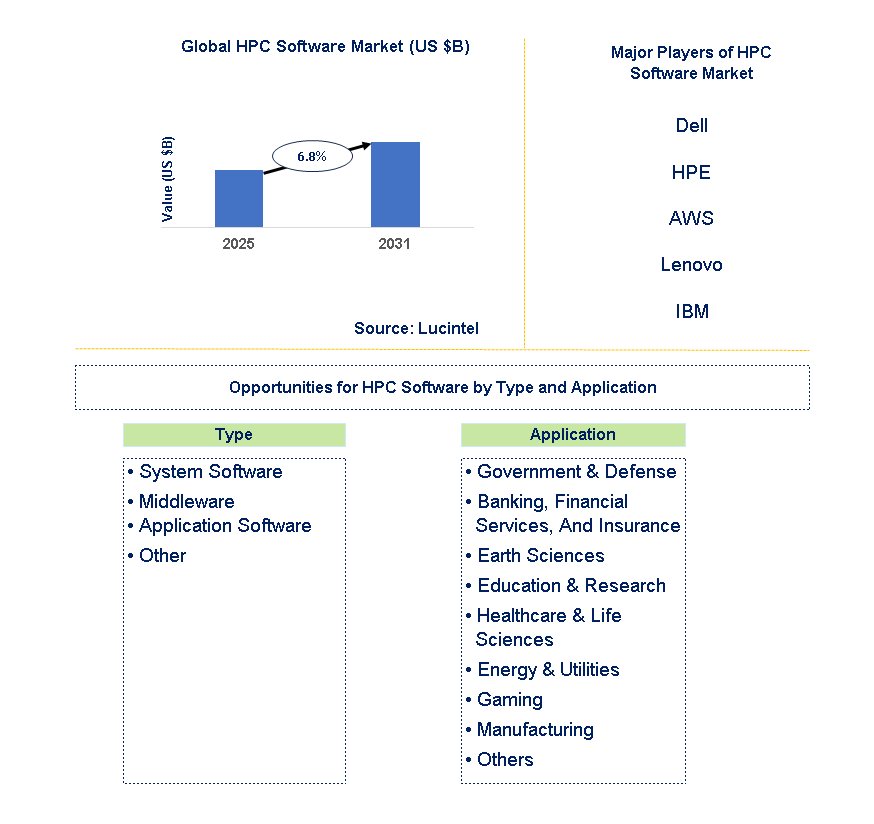
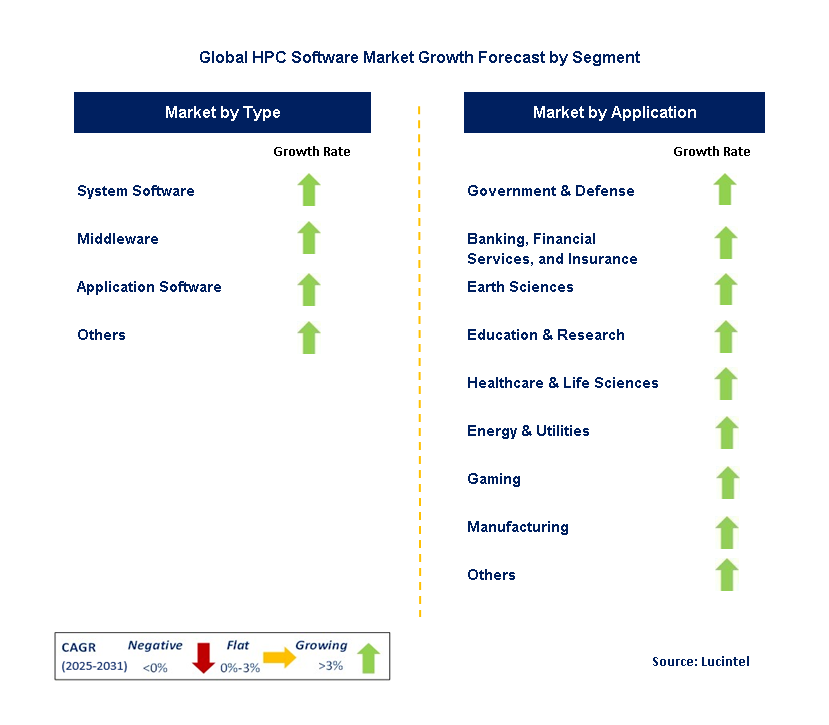
Key data points: The growth forecast = 6.8% annually for the next 7 years. Scroll below to get more insights. This market report covers Trends, opportunity and forecast in HPC software market to 2031 by type (system software, middleware, application software, and other), application (government & defense, banking, financial services, and insurance, earth sciences, education & research, healthcare & life sciences, energy & utilities, gaming, manufacturing, and others), and region (North America, Europe, Asia Pacific, and the Rest of the World)
We'll send your sample report shortly.
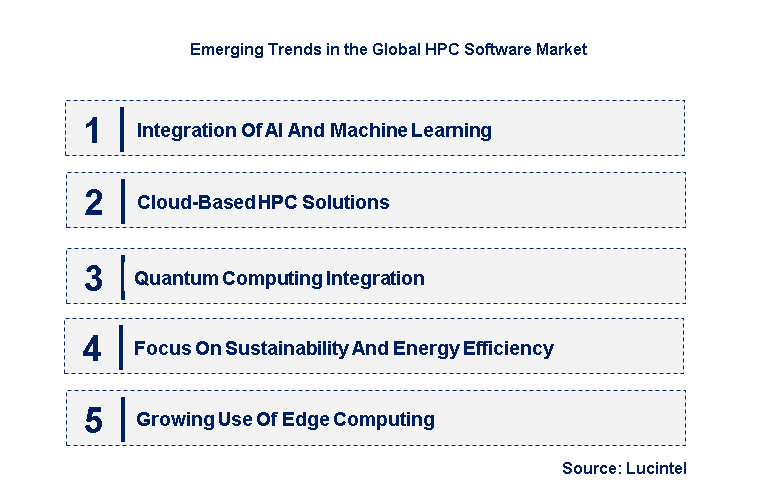
• Integration Of AI And Machine Learning: Integration of AI and ML with HPC software transforms the way data is processed and analyzed. Some of the trends that are being availed through AI and ML algorithms include optimization of simulations, reduction of computational time, and increased predictive capabilities. This leads to more efficient utilization of HPC systems to yield faster and accurate results. The sectors that are being significantly improved are healthcare, automotive, and energy, wherein AI-powered HPC software can handle complex challenges, such as drug discovery, designing an autonomous vehicle, and optimization of energy grids.
• Cloud-Based HPC Solutions: Cloud-based HPC solutions are reshaping the landscape of high-performance computing, offering businesses greater flexibility and scalability. With the rise of cloud computing, organizations no longer need to invest in expensive on-premise infrastructure to access HPC capabilities. Cloud-based HPC solutions enable companies to run large-scale simulations and process massive datasets remotely, reducing the upfront costs and maintenance associated with traditional supercomputing systems. The adoption of cloud HPC is enabling smaller enterprises and startups to access high-performance resources and compete with larger organizations in various industries.
• Quantum Computing Integration: Quantum computing is poised to have a profound impact on the HPC software market. While still in the early stages of development, quantum computers promise to solve complex problems that classical supercomputers cannot efficiently handle. Integration of quantum computing with HPC software makes it possible to process data at a faster pace, especially in fields such as cryptography, materials science, and drug development. Companies and research institutions are already exploring hybrid systems that combine the strengths of traditional supercomputing and quantum computing to tackle problems that have never been solved before.
• Focus On Sustainability And Energy Efficiency: Sustainability has become a critical concern in the HPC software market, with organizations striving to reduce energy consumption and carbon footprints. The development of energy-efficient HPC systems and software is gaining momentum, with companies seeking solutions that optimize the power usage of high-performance computing systems without compromising on performance. This is especially important for large-scale data centers and supercomputing facilities, where energy consumption is one of the highest operational costs. In this respect, the HPC software market is in step with global efforts to reduce the impact on the environment.
• Growing Use Of Edge Computing: Edge computing is increasingly used in the HPC software market as more organizations look to process data closer to its source rather than relying on centralized data centers. By utilizing edge computing, companies achieve faster processing speed and lower latency, which becomes important in the applications of real-time data analytics, IoT, and autonomous systems. The use of HPC software with edge computing is further assisting organizations to optimize their workflow and make better decisions based on data in many manufacturing, logistics, and smart city industries. These emerging trends in the HPC software market are revolutionizing how organizations leverage computational resources to solve complex problems and drive innovation. The integration of AI, cloud computing, quantum computing, energy efficiency, and edge computing is enhancing the capabilities of HPC systems, enabling industries to tackle challenges that were previously unimaginable. As these trends keep evolving, the HPC software market will continue to play an increasingly important role in shaping the future of technology across various sectors.
• Rise in AI and Data Analytics: With increasing penetration of AI and data analytics into all kinds of industries, it offers the best growth opportunities to HPC software vendors. Through the incorporation of AI and machine learning in HPC systems, companies will speed up the data analysis, predictive modeling, and optimization of the decision-making process. In such areas as health care, automobiles, and energy, innovation and efficiency are most likely to be triggered through the application of AI-based simulations and analysis.
• Healthcare and Life Sciences: Healthcare and life sciences are using HPC software for applications that include drug discovery, medical imaging, and personalized medicine. With HPC, processes such as massive data processing and simulating complex biological processes are possible, allowing breakthroughs in treatments and therapies. The growing need for precision medicine, as well as the capability of modeling complex biological systems, create a high-growth opportunity for HPC software providers in this space.
• Growth of Cloud-Based HPC Services: The migration towards cloud computing offers significant growth opportunities for HPC software providers providing cloud-based HPC services. Organizations can scale resources on an as-needed basis and minimize costs by shifting their HPC workloads to the cloud. This is particularly helpful for SMEs that may not have the necessary capital to invest in expensive on-premise systems. The ongoing growth of cloud-based HPC is expanding the market and making it possible for more businesses to take advantage of high-performance computing resources.
• Quantum Computing Solutions Development: Quantum computing is an emerging technology that can transform the HPC software market. With maturing technology, HPC software providers get a chance to design solutions with integration of both classical supercomputing and quantum computing. Quantum computing is in its early phases and is highly expected to unlock some of the world's biggest mysteries in such areas as cryptography, material science, and new drug development. Therefore, going forward, innovating in capitalizing on that growth opportunity in quantum computing becomes essential for the HPC software provider.
• Sustainability and Energy Efficiency: The HPC software market is gaining focus on sustainability and energy efficiency, as organizations look to reduce their energy consumption and carbon footprint. Developing energy-efficient HPC systems and software that optimize performance while minimizing power usage is a significant growth opportunity. Companies that can deliver sustainable HPC solutions will be well-positioned to meet the growing demand for green technologies and help organizations achieve their sustainability goals. HPC software growth opportunities are shaped by AI and quantum computing developments, cloud-based services, and sustainability. Opportunities in these areas can help the HPC software vendors expand into different industries, meet the increasingly demanding needs of powerful, efficient, and sustainable computing solutions. The future of high-performance computing will be molded and innovation fueled across sectors with these opportunities.
• Rise in AI and Data Analytics: With increasing penetration of AI and data analytics into all kinds of industries, it offers the best growth opportunities to HPC software vendors. Through the incorporation of AI and machine learning in HPC systems, companies will speed up the data analysis, predictive modeling, and optimization of the decision-making process. In such areas as health care, automobiles, and energy, innovation and efficiency are most likely to be triggered through the application of AI-based simulations and analysis.
• Healthcare and Life Sciences: Healthcare and life sciences are using HPC software for applications that include drug discovery, medical imaging, and personalized medicine. With HPC, processes such as massive data processing and simulating complex biological processes are possible, allowing breakthroughs in treatments and therapies. The growing need for precision medicine, as well as the capability of modeling complex biological systems, create a high-growth opportunity for HPC software providers in this space.
• Growth of Cloud-Based HPC Services: The migration towards cloud computing offers significant growth opportunities for HPC software providers providing cloud-based HPC services. Organizations can scale resources on an as-needed basis and minimize costs by shifting their HPC workloads to the cloud. This is particularly helpful for SMEs that may not have the necessary capital to invest in expensive on-premise systems. The ongoing growth of cloud-based HPC is expanding the market and making it possible for more businesses to take advantage of high-performance computing resources.
• Quantum Computing Solutions Development: Quantum computing is an emerging technology that can transform the HPC software market. With maturing technology, HPC software providers get a chance to design solutions with integration of both classical supercomputing and quantum computing. Quantum computing is in its early phases and is highly expected to unlock some of the world's biggest mysteries in such areas as cryptography, material science, and new drug development. Therefore, going forward, innovating in capitalizing on that growth opportunity in quantum computing becomes essential for the HPC software provider.
• Sustainability and Energy Efficiency: The HPC software market is gaining focus on sustainability and energy efficiency, as organizations look to reduce their energy consumption and carbon footprint. Developing energy-efficient HPC systems and software that optimize performance while minimizing power usage is a significant growth opportunity. Companies that can deliver sustainable HPC solutions will be well-positioned to meet the growing demand for green technologies and help organizations achieve their sustainability goals. HPC software growth opportunities are shaped by AI and quantum computing developments, cloud-based services, and sustainability. Opportunities in these areas can help the HPC software vendors expand into different industries, meet the increasingly demanding needs of powerful, efficient, and sustainable computing solutions. The future of high-performance computing will be molded and innovation fueled across sectors with these opportunities.
• Dell
• Hpe
• Aws
• Lenovo
• Ibm
• Sugon
• Inspur
• Atos
• Huawei
• Fujitsu
• System Software
• Middleware
• Application Software
• Other
• Government & Defense
• Banking, Financial Services, And Insurance
• Earth Sciences
• Education & Research
• Healthcare & Life Sciences
• Energy & Utilities
• Gaming
• Manufacturing
• Others
• North America
• Europe
• Asia Pacific
• The Rest of the World
• United States: HPC software in the United States is growing significantly, as huge investments in research and development have been made, especially in aerospace, automotive, and scientific research. Advanced HPC software solutions in the U.S. involve artificial intelligence (AI), machine learning (ML), and quantum computing. Large corporations like NVIDIA, Intel, and IBM develop the software to boost the efficiency and effectiveness of supercomputers at a lesser cost. Furthermore, the shift to cloud-based HPC services is changing how organizations access and consume these high-power computing capabilities. This trend is improving the competitiveness of U.S. businesses around the world.
• China: China is emerging as a global leader in the HPC software market, fueled by major government investments in high-performance computing infrastructure. The country has produced significant advancements in both hardware and software customized to facilitate advanced research in computing. Chinese companies such as Huawei and Lenovo are leading the way in HPC software for scientific research, weather forecasting, and big data analysis. The country's "Made in China 2025" initiative is accelerating efforts toward self-sufficiency in HPC software and reducing dependence on foreign solutions. Additionally, China's rapid adoption of cloud-based HPC platforms is further propelling growth in the sector.
• Germany: Germany is a high-profile player within the European market for HPC software, not only in investing in research, but also by its industrial usage. German automotive and energy-related industries are finding new ways with HPC-driven innovations in terms of design and simulation and subsequently in manufacturing itself. Companies such as Siemens and SAP are currently developing powerful integrated software solutions aligned with high performance computing systems. The German government is also concentrating on the further development of digitalization, with the European High-Performance Computing Joint Undertaking being one of the initiatives that will help in improving the HPC capabilities of the country. The increasing importance of AI and data analytics in Germany is also driving the demand for advanced HPC software.
• India: India's HPC software market is growing as the country continues to progress in the field of high-performance computing. Indian research institutes, universities, and government institutions are increasingly using HPC software for simulations, scientific research, and big data analytics. Healthcare, finance, and energy sectors are using HPC to draw insights from big data and streamline processes. Also, cloud-based HPC services are now providing Indian firms-including small and medium-sized enterprises-access to high-end computing. India is increasingly focusing on AI and data-driven solutions, which will fuel the HPC software demand even more in the years to come.
• Japan: Japan has been a leader in the HPC software market for many decades. The country has significantly contributed to global progress in automotive, robotics, and electronics sectors. The state-of-the-art technological infrastructure and strides towards innovation will help fuel the growth of HPC software solutions. It develops high-performance software in cutting-edge technology for use in healthcare, manufacturing, and energy sectors among others. Other commitments by the Japanese government for AI and big data analytics propel the adoption of HPC software. The investments in supercomputing, as with the Fugaku, have opened a new market frontier for the country.


• Dell
• HPE
• AWS
• Lenovo
• IBM
• Sugon
• Inspur
• Atos
• Huawei
• Fujitsu Q5. Which HPC software market segment will be the largest in future? Answer: Lucintel forecasts that, within the type category, application software is expected to witness higher growth over the forecast period. Q6. In HPC software market, which region is expected to be the largest in next 5 years? Answer: In terms of region, APAC is expected to witness the highest growth over the forecast period. Q7. Do we receive customization in this report? Answer: Yes, Lucintel provides 10% customization without any additional cost.


Choose a license that fits your team. Instant PDF delivery.
Prices exclude taxes. Instant delivery. Custom licensing available on request.
Market Report · July 15, 2026
Market Report · June 26, 2026
Market Report · June 24, 2026
Trusted partner for strategic intelligence and business growth


Receive a complimentary market analysis tailored to your industry. Our analysts will identify key growth opportunities and competitive dynamics specific to your business.

Market size, growth rate, and key trend analysis for your specific sector.

Top competitor positioning and market share analysis.

Strategic recommendations backed by data-driven insights.
Get curated market intelligence and competitive moves straight to your inbox.
By subscribing, you agree to receive our monthly insights. Unsubscribe anytime.
Receive a complimentary market analysis tailored to your industry. Our analysts will identify key growth opportunities and competitive dynamics specific to your business.
Market size, growth rate, and key trend analysis for your specific sector.
Top competitor positioning and market share analysis.
Strategic recommendations backed by data-driven insights.
Get curated market intelligence, emerging trends, and competitive moves straight to your inbox each month.
By subscribing, you agree to receive our monthly insights. Unsubscribe anytime.
We'll send your sample report shortly.