
Market Report · July 15, 2026

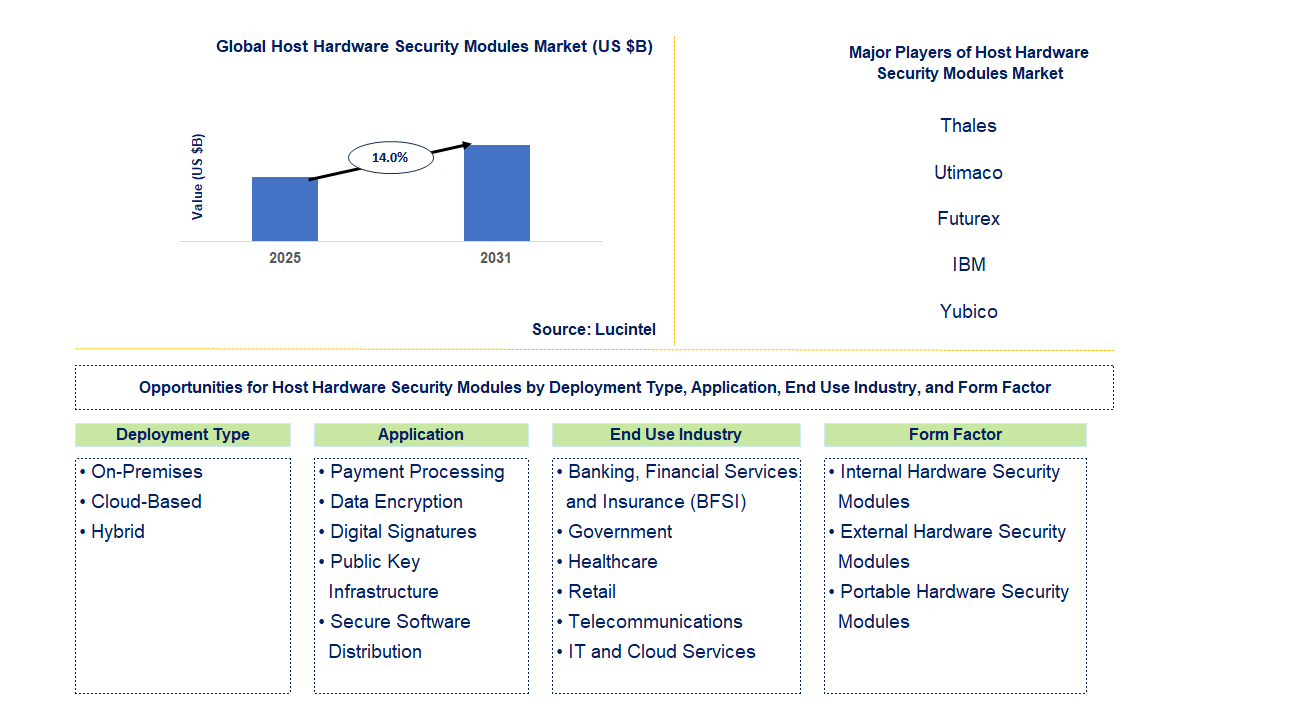
Key data points: The growth forecast = 14.0% annually for the next 7 years. Scroll below to get more insights. This market report covers trends, opportunities and forecasts in host hardware security modules market to 2031 by deployment type (on-premises, cloud-based, and hybrid), application (payment processing, data encryption, digital signatures, public key infrastructure, and secure software distribution), end use industry (banking, financial services, and insurance (BFSI), government, healthcare, retail, telecommunications, and it and cloud services), form factor (internal hardware security modules, external hardware security modules, and portable hardware security modules), and region (North America, Europe, Asia Pacific, and the Rest of the World)
We'll send your sample report shortly.
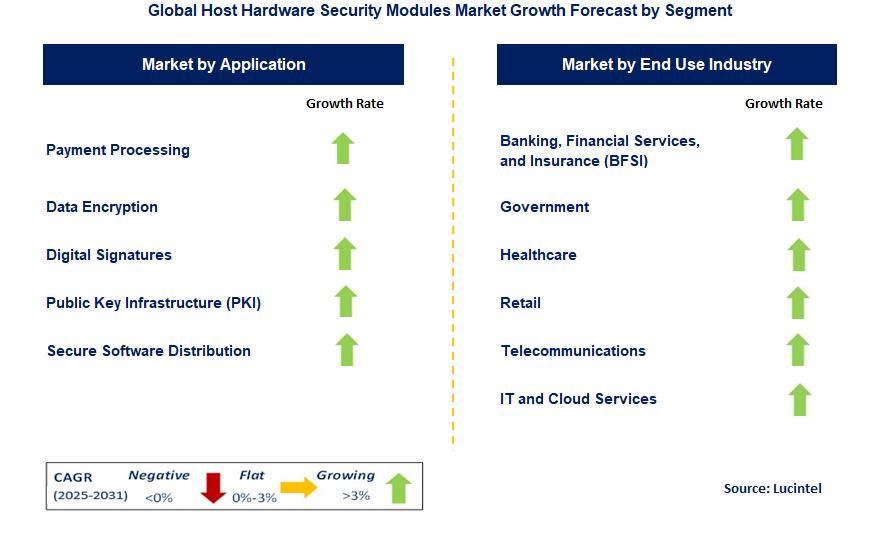
• Lucintel forecasts that, within the application category, payment processing is expected to witness the highest growth over the forecast period.
• Within the application category, banking, financial services, and insurance (BFSI) is expected to witness the highest growth.
• In terms of region, APAC is expected to witness the highest growth over the forecast period. Gain valuable insights for your business decisions with our comprehensive 150+ page report. Sample figures with some insights are shown below.
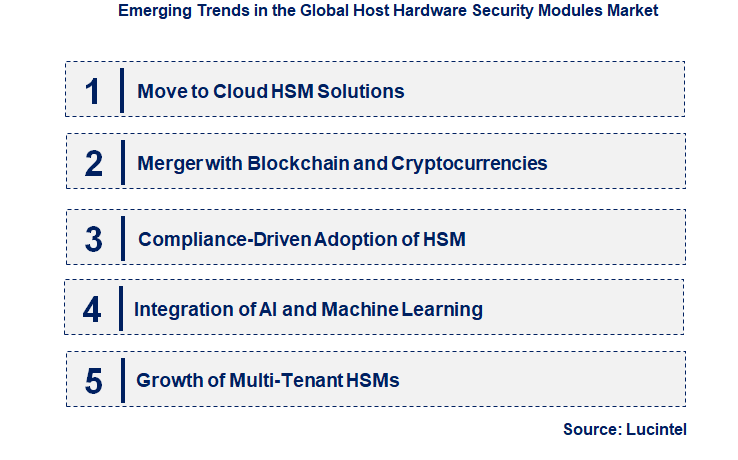
• Move to Cloud HSM Solutions: The adoption of HSMs that integrate directly into the cloud boosts an organization’s ability to use remote cryptographic functions. It also adds flexibility and scalability. Cost-effective measures strengthen the business’s data security infrastructure without compromising compliance. As such, businesses increasingly prefer Cloud HSMs.
• Merger with Blockchain and Cryptocurrencies: The emergence of cryptocurrencies and blockchain technology has created a need for HSMs. These technologies enable secure storage of cryptographic keys and support crucial functions of the blockchain. HSMs ensure secure key management and uphold the decentralized nature of blockchain.
• Compliance-Driven Adoption of HSM: Global regulations like GDPR have fueled the deployment of HSMs to ensure compliance with legal requirements. This is especially notable in banking, government, and healthcare services, where data security is under close scrutiny.
• Integration of AI and Machine Learning: Integrating AI and machine learning into HSMs improves response times for detecting and addressing threats. Machine learning systems focus on suspicious data derived from the system’s cryptography. This architecture helps breach perimeter security and detect anomalies in hybrid security systems more quickly.
• Growth of Multi-Tenant HSMs: Multi-tenant HSMs are becoming increasingly popular as organizations seek to streamline the management of cryptographic workloads on a departmental or client basis. This model enables several groups or organizations to share a single physical HSM, reducing operational costs while maintaining required security standards. This illustrates how the HSM market is adapting to cope with multifaceted issues brought about by technological advancements, compliance requirements, and industrial demands. The market is moving toward more sophisticated HSM systems with greater flexibility, scalability, and stronger protective measures to keep critical data secure.
• Remote-access HSM: Cloud-based HSMs are particularly appealing to companies seeking flexible and affordable security solutions. These allow businesses to safely manage cryptographic keys without needing to store hardware on their premises or IT infrastructure, making them attractive to both startups and large corporations.
• Latest Innovations in Cryptographic Algorithms: The growing use of quantum-resistant encryption techniques is significantly increasing the potential of HSMs. The development of such algorithms ensures protection against future risks, especially when considering quantum computing capabilities.
• Effects of Government Regulations: The increase in government regulations worldwide is further driving the need for more advanced HSM solutions. Regulations such as GDPR in Europe and CCPA in California are heightening the demand for HSMs in sensitive customer data sectors like finance, healthcare, and e-commerce.
• HSM-as-a-Service (HaaS): The creation of HSM-as-a-Service platforms allows users to benefit from hardware encryption without the hassle of physical devices. There is growing demand for this service in fields requiring strict compliance with high standards for cloud security.
• Mergers and Acquisitions: Larger companies in the cybersecurity domain are acquiring smaller HSM technology firms to expand their portfolios. These acquisitions enable the integration of hardware encryption with advanced software security features, providing a range of industries with access to improved solutions. The HSM market is being reshaped by these innovations, making it easier for businesses to protect sensitive data, comply with laws, and counteract sophisticated attacks in the evolving cybersecurity landscape.
• Banking and Financial Services: The banking sector is one of the fastest-growing in terms of adopting HSM technology because of the need for secure financial transactions, digital payments, adherence to PCI DSS, and other regulations. HSMs have become a critical aspect of data security and trust with the growth in mobile banking and fintech services.
• Cloud Security: With the growth of cloud computing, service providers are incorporating HSMs into their offerings to secure client data stored in the cloud. There is a growing demand for strong solutions for cryptographic key management, increasing the importance of cloud-based HSMs.
• Healthcare: As patient data becomes a prime target for cybercriminals, the healthcare sector is facing growing cybersecurity concerns. To prevent unauthorized access to electronic health records (EHRs) and adhere to HIPAA guidelines, HSMs are recommended.
• Government and Defense: Government agencies are adopting HSMs to safeguard sensitive information related to national security and ensure compliance with data protection legislation. HSMs are essential in protecting digital and voice communications, digital identification, military assets, and other critical national resources.
• E-Commerce and Retail: The demand for convenient and efficient online shopping is growing, as is the need for secure payment processing. HSMs are used to protect payment gateways, prevent fraud, and secure all financial transactions carried out on computer networks. These opportunities reflect a growing recognition across industries of the gaps in their data protection infrastructure and the need for cryptographic security, resulting in increased demand for HSM solutions.
• Thales
• Utimaco
• Futurex
• IBM
• Yubico
• Synopsys
• Swift
• On-Premises
• Cloud-Based
• Hybrid
• Payment Processing
• Data Encryption
• Digital Signatures
• Public Key Infrastructure
• Secure Software Distribution
• North America
• Europe
• Asia Pacific
• The Rest of the World
• USA: There is a fast adoption of HSMs in the financial services and government sectors due to the heightened risk of cyberattacks in the US market. The country is focusing on compliance with standards such as FIPS and NIST. There is also a growing demand for cloud-based HSM services due to the adoption of hybrid and cloud computing models.
• China: The Chinese government has implemented effective cybersecurity policies that have made the use of HSMs a requirement. The primary focus is on securing data at rest and critical information infrastructures. Local suppliers are expanding their HSM products to meet the domestic market’s demand for data security.
• Germany: Germany continues to intensify the need for HSMs in its financial services sector due to GDPR legislation and the country’s data protection regulations. There is a continued focus on mitigating cyber risks associated with HSMs, as well as ensuring data privacy standards in both on-premise and cloud-hosted solutions.
• India: In India, the adoption of HSMs is growing in the banking and finance sectors, driven by digitization and mobile payment applications. Initiatives like Digital India are supporting secure transactions, which, along with regulatory policies, are promoting the use of digital HSMs.
• Japan: In response to the increase in cyber threats and data privacy concerns, Japan is expanding the scope of HSM usage. Considerable spending is directed toward securing cloud infrastructure, and many Japan-based companies are now adopting HSM technology as part of their cybersecurity policies to protect sensitive data.


• Thales
• Utimaco
• Futurex
• IBM
• Yubico
• Synopsys
• Swift Q5. Which host hardware security modules market segment will be the largest in future? Answer: Lucintel forecasts that, within the application category, payment processing is expected to witness the highest growth over the forecast period. Q6. In host hardware security modules market, which region is expected to be the largest in next 5 years? Answer: In terms of region, APAC is expected to witness the highest growth over the forecast period. Q7. Do we receive customization in this report? Answer: Yes, Lucintel provides 10% customization without any additional cost.


Choose a license that fits your team. Instant PDF delivery.
Prices exclude taxes. Instant delivery. Custom licensing available on request.
Market Report · July 15, 2026
Market Report · June 26, 2026
Market Report · June 24, 2026
Trusted partner for strategic intelligence and business growth


Receive a complimentary market analysis tailored to your industry. Our analysts will identify key growth opportunities and competitive dynamics specific to your business.

Market size, growth rate, and key trend analysis for your specific sector.

Top competitor positioning and market share analysis.

Strategic recommendations backed by data-driven insights.
Get curated market intelligence and competitive moves straight to your inbox.
By subscribing, you agree to receive our monthly insights. Unsubscribe anytime.
Receive a complimentary market analysis tailored to your industry. Our analysts will identify key growth opportunities and competitive dynamics specific to your business.
Market size, growth rate, and key trend analysis for your specific sector.
Top competitor positioning and market share analysis.
Strategic recommendations backed by data-driven insights.
Get curated market intelligence, emerging trends, and competitive moves straight to your inbox each month.
By subscribing, you agree to receive our monthly insights. Unsubscribe anytime.
We'll send your sample report shortly.