
Market Report · July 22, 2026

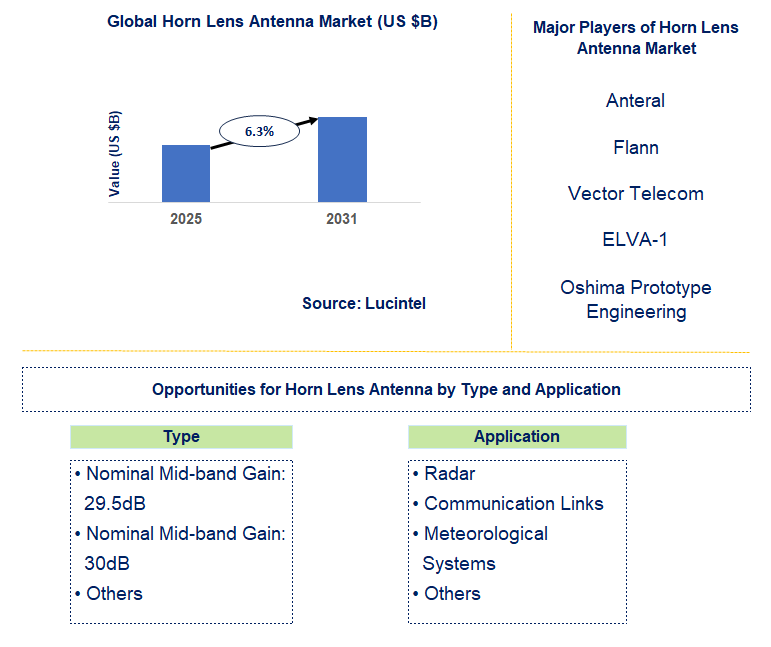
Key data points: The growth forecast = 6.3% annually for the next 7 years. Scroll below to get more insights. This market report covers trends, opportunities and forecasts in horn lens antenna market to 2031 by type (nominal mid-band gain: 29.5db, nominal mid-band gain: 30db, and others), application (radar, communication links, meteorological systems, and others), and region (North America, Europe, Asia Pacific, and the Rest of the World)
We'll send your sample report shortly.
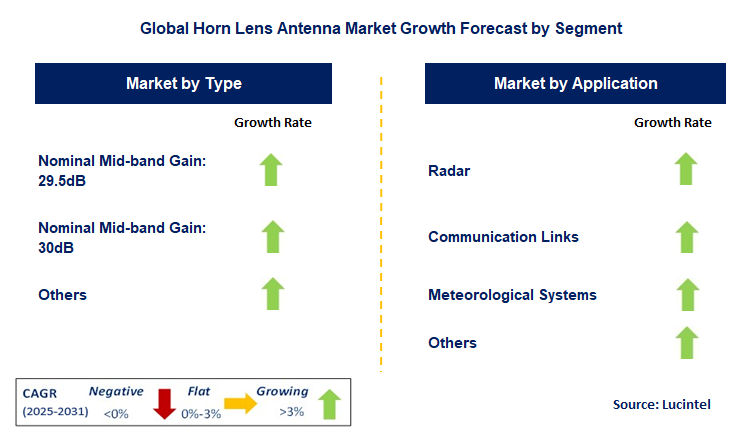
• Lucintel forecasts that, within the type category, nominal mid-band gain: 30dB is expected to witness higher growth over the forecast period.
• Within the application category, radar is expected to witness the highest growth.
• In terms of region, APAC is expected to witness the highest growth over the forecast period. Gain valuable insights for your business decisions with our comprehensive 150+ page report. Sample figures with some insights are shown below.
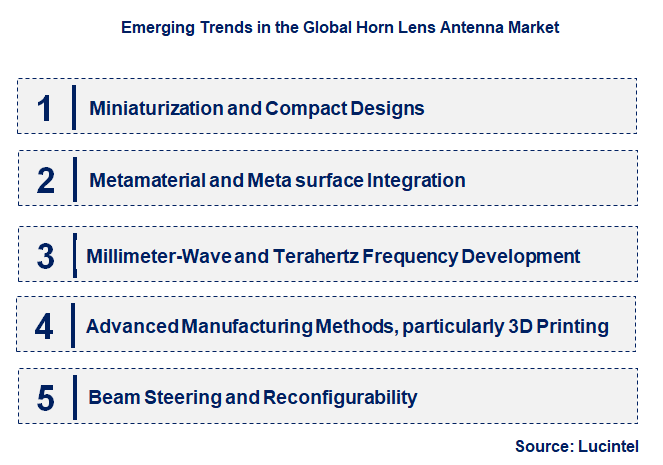
• Miniaturization and Compact Designs: Strong miniaturization of horn lens antennas to facilitate integration into compact, handheld devices and space-restricted platforms, e.g., drones, small satellites, and compact auto radar systems. The trend is fueled by advances in materials technology and manufacturing methods, such as the application of high-dielectric materials and 3D printing. The effect is a wider use of these high-performance antennas in consumer electronics and embedded systems where weight and size are of paramount importance, extending the market beyond the conventional large installations.
• Metamaterial and Meta surface Integration: The application of metamaterials and meta surfaces for horn lens antenna design is a new trend. These artificially created materials possess electromagnetic characteristics not available naturally and enable control over electromagnetic waves to unprecedented levels. By incorporating them into lenses, their makers can realize better beamforming, broader bandwidths, reduced losses, and greater miniaturization. This trend is affecting the market by making it possible for the development of very efficient, flexible, and customizable antennas that are capable of surpassing traditional designs, enabling new applications in many high-frequency communications systems.
• Millimeter-Wave and Terahertz Frequency Development: The demand for higher bandwidths in 5G, 6G, and future wireless communications is stimulating the development of horn lens antennas tuned for millimeter-wave (mm Wave) and even terahertz (THz) frequencies. At such higher frequencies, path loss becomes significant, so highly directional and high-gain antennas become essential. This trend is influencing the market by channeling research and development on designs and materials to be able to work efficiently at very high frequencies, allowing for ultra-high-speed data transmission and new sensing abilities for uses such as automotive radar and medical imaging.
• Advanced Manufacturing Methods, particularly 3D Printing: The use of advanced manufacturing methods, most notably 3D printing (additive manufacturing), is a prominent emerging trend. 3D printing enables the manufacture of intricate, high-end custom geometries that are hard or impossible to produce with conventional manufacturing processes. This promotes rapid prototyping, reduced costs for bespoke designs, and the manufacture of integrated antenna structures with optimized internal waveguide and lens shapes. This technology is democratizing antenna design and fabrication, promoting faster innovation cycles and allowing highly customized, high-performance antennas for low-volume applications to be produced.
• Beam Steering and Reconfigurability: Another trend is adding beam steering and reconfigurability functionalities in horn lens antennas. This means that antennas are designed electronically or mechanically to change beam direction and shape without relocating the antenna physically. This is essential for dynamic scenarios such as autonomous cars, satellite tracking, and 5G urban networks. This trend is influencing the market by offering more dynamic and flexible antenna solutions, allowing for quicker network adaptation, better signal reception in dynamic environments, and more effective use of spectrum assets. These developments are significantly transforming the horn lens antenna market by fueling innovation towards more intelligent, compact, and variable antenna technologies. They are facilitating greater performance at higher frequencies, simplifying manufacturing processes, and making antennas that can evolve in response to dynamic operating conditions, all of which is driving the evolution of next-generation communication and sensing applications.
• High Performance at Millimeter-Wave Frequencies: One of the most significant recent advancements is the dramatic enhancement of horn lens antenna performance at mm Wave frequency bands (e.g., 28 GHz, 77 GHz). This involves the delivery of higher gain, broader bandwidths, and lower sidelobe levels important for 5G backhaul, automotive radar, and satellite communications. This advancement is influencing the market by providing horn lens antennas as feasible solutions for high-capacity short-range communication systems and highly accurate sensing uses where accuracy and performance at high frequencies are the utmost priority.
• Additive Manufacturing Integration: The use of 3D printing as a manufacturing method for horn lens antennas is an emerging recent development. 3D printing makes it possible to fabricate complex, shaped lens geometries and horn structures that are hard to achieve through conventional means. This innovation influences the market by allowing prototyping at high speeds, lowering custom design manufacturing costs, and enabling optimal performance by means of new antenna structures with better impedance matching and radiation patterns.
• Hybrid Lens Designs Development: The recent advances involve the research and adoption of hybrid lens design, where multiple dielectric or metallic lens concepts are merged into a single horn antenna. Some instances involve hybrid lenses integrating slow-wave dielectric lenses with fast-wave metal lenses. This advancement affects the market by enabling more compact antenna design, thinner lens, and higher aperture efficiency, which makes horn lens antennas viable for size-restricted applications without trading gain or beam characteristics.
• Emphasize Dual Polarization and Multi-Beam Capabilities: There is an emerging recent trend of developing horn lens antennas with dual polarization and multi-beam functionality. Dual polarization enables higher data rates and improved signal reception, while multi-beam capability is essential for applications such as cellular base stations and satellite communications systems requiring simultaneous coverage of multiple users or directions. This trend influences the market by enabling more flexible and effective antenna solutions capable of handling advanced communication scenarios and maximizing spectrum usage.
• Application-Specific Miniaturization and Integration: Current advances indicate a marked trend towards miniaturization and integration with an emphasis on particular applications. In automotive radar, for instance, there's concentration on miniaturized horn and lens antennas with integrability into vehicle bodies with no loss in high gain and wide field of view. The advance influences the market by making pervasive deployment of high-performance antennas in previously difficult environments, such as embedded sensors in autonomous vehicles and miniature communication modules in drones. These advances are deeply affecting the horn lens antenna market by making it possible to achieve higher performance, more design flexibility, and wider applicability across an increasing scope of high-frequency communication and sensing systems. They are pushing the market towards smaller, more efficient, and smarter antenna solutions that are necessary for the next generation wireless technology.
• 5G and Beyond 5G Communication Infrastructure: The worldwide 5G network rollout, particularly in millimeter-wave (mm Wave) bands, and the continued research into beyond 5G (6G) technologies offer a vast growth opportunity. Horn lens antennas best serve 5G base stations and backhaul links because they can realize high gain and narrow, steerable beams, which are needed for dense urban deployments and high-capacity data transfers. This use case creates demand for antennas that operate effectively in high frequencies with good performance and beamforming.
• Automotive Radar Systems: The high-speed developments in Advanced Driver-Assistance Systems (ADAS) and the advancement towards highly autonomous driving vehicles present a strong opportunity for growth. Horn lens antennas, especially at 77 GHz, are essential building blocks for high-resolution automotive radar systems, providing accurate object detection, ranging, and speed measurement. The requirement for small, highly precise, and reliable antennas for collision avoidance, adaptive cruise control, and autonomous navigation will spur large market growth in this category.
• Satellite Communications and Ground Stations: The lucrative satellite communications market, both low Earth orbit (LEO) constellations for world broadband and conventional geostationary satellites, presents a compelling growth opportunity. Horn lens antennas play a critical role in satellite ground stations, airborne terminals, and possibly satellite-borne uses because of their high gain, directivity, and tracking capability for moving satellites. The requirement covers both conventional large ground stations and small, high-performance terminals for mobile and remote connections.
• Test and Measurement Equipment: With the increased use of higher frequency communication and sensing technologies, there will be a growing need for accurate test and measurement tools that operate at mm Wave and sub-THz frequencies. Horn lens antennas are commonly applied in calibration, antenna pattern measurement, EMC testing, and research labs because they have well-determined radiation patterns and high gain. This is a stable growth opportunity since there will be a growing demand for characterizing new wireless devices and systems accurately.
• High-Resolution Imaging and Sensing: New uses in high-resolution sensing and imaging, including security screening, industrial inspection, and medical diagnostics, are creating new opportunities for growth. Horn lens antennas can deliver the very focused beams and high gain required by these applications, especially at millimeter-wave and terahertz frequencies where there is greater attainable resolution. This market opportunity is one of creating customized antennas specific to selected sensing modalities and environments based on their accuracy and beam management abilities. These strategic opportunities for growth are having a far-reaching influence on the horn lens antenna market by fueling specialization, miniaturization, and improved performance in a wide range of high-frequency applications. They are forcing manufacturers to push boundaries in design and materials, making horn lens antennas essential building blocks in the next generation of wireless communication, sensing, and autonomous technologies.
• Anteral
• Flann
• Vector Telecom
• ELVA-1
• Oshima Prototype Engineering
• Keycom
• Xi'an Hengda
• Shanghai Juanji
• CHENGDU CHUANGYIJIA SCIENCE & TECHNOLOGY
• Beijing Tianlang
• Nominal Mid-band Gain: 29.5dB
• Nominal Mid-band Gain: 30dB
• Others
• Radar
• Communication Links
• Meteorological Systems
• Others
• North America
• Europe
• Asia Pacific
• The Rest of the World
• United States: The United States is a strong market for horn lens antennas, driven by heavy investments in 5G infrastructure, defense, aerospace, and satellite communications. Recent trends target high-frequency applications, notably millimeter-wave (mm Wave) bands, to deliver improved data rates and accuracy. R&D is robust, with organizations and institutions targeting advanced materials such as metamaterials and enhanced manufacturing techniques to deliver higher efficiency, miniaturization, and reconfigurability for a wide range of applications, including automotive radar and scientific exploration.
• China: The Chinese horn lens antenna market is seeing urgent innovation, spurred by its enormous 5G rollout, satellite communications goals, and automotive radar technology advancements. New developments involve applying 3D printing to miniaturized, high-gain, dual-polarized horn antennas with hybrid lenses to decrease thickness and enhance performance. Chinese producers are emphasizing low-cost production techniques along with high efficiency, wideband operation, and miniaturization to satisfy growing domestic demand and export prospects.
• Germany: The horn lens antenna market in Germany is being driven by its strong automobile industry, especially in advanced driver-assistance systems (ADAS) and autonomous driving, and 5G and satellite communication contribution. Recent trends in Germany highlight design of efficient and small-sized lens antennas, frequently utilizing 3D printing methods for millimeter-wave and 5G purposes. Beam steering performance and design optimization of lens topologies for high gain and wide steering angles are areas of research for various communication and radar systems.
• India: India's horn lens antenna industry is growing swiftly, driven by deepening internet penetration, aggressive deployment of 5G networks, and expanding defense and aerospace industries. Current trends point towards the development of high-frequency horn antennas for microwave applications such as corrugated feed horn antennas and diagonal low sidelobe horn antennas. The market is also witnessing heightened research on dielectric-loaded horn antenna structures for broader bandwidth, aiding the country's initiative towards greater connectivity and advanced communications infrastructure.
• Japan: Japan's horn lens antenna industry is dominated by a high focus on precision engineering and high-performance uses, such as in automotive radar, satellite communications, and autonomous technologies. Recent applications involve the utilization of special glass lens antennas for stable transmission in autonomous bus convoys, overcoming communication disruptions when turning. Japanese research is also placing emphasis on miniaturized lens and horn antenna designs for 77 GHz automotive long-range radar applications to achieve high-density implementation and better efficiency for next-generation advanced autonomous driving systems.


• Anteral
• Flann
• Vector Telecom
• ELVA-1
• Oshima Prototype Engineering
• Keycom
• Xi'an Hengda
• Shanghai Juanji
• CHENGDU CHUANGYIJIA SCIENCE & TECHNOLOGY
• Beijing Tianlang Q5. Which horn lens antenna market segment will be the largest in future? Answer: Lucintel forecasts that, within the type category, nominal mid-band gain: 30dB is expected to witness higher growth over the forecast period. Q6. In horn lens antenna market, which region is expected to be the largest in next 5 years? Answer: In terms of region, APAC is expected to witness the highest growth over the forecast period. Q7. Do we receive customization in this report? Answer: Yes, Lucintel provides 10% customization without any additional cost.


Choose a license that fits your team. Instant PDF delivery.
Prices exclude taxes. Instant delivery. Custom licensing available on request.
Market Report · July 22, 2026
Market Report · July 17, 2026
Market Report · July 17, 2026
Trusted partner for strategic intelligence and business growth


Receive a complimentary market analysis tailored to your industry. Our analysts will identify key growth opportunities and competitive dynamics specific to your business.

Market size, growth rate, and key trend analysis for your specific sector.

Top competitor positioning and market share analysis.

Strategic recommendations backed by data-driven insights.
Get curated market intelligence and competitive moves straight to your inbox.
By subscribing, you agree to receive our monthly insights. Unsubscribe anytime.
Receive a complimentary market analysis tailored to your industry. Our analysts will identify key growth opportunities and competitive dynamics specific to your business.
Market size, growth rate, and key trend analysis for your specific sector.
Top competitor positioning and market share analysis.
Strategic recommendations backed by data-driven insights.
Get curated market intelligence, emerging trends, and competitive moves straight to your inbox each month.
By subscribing, you agree to receive our monthly insights. Unsubscribe anytime.
We'll send your sample report shortly.