
Market Report · July 15, 2026

Key data points: The growth forecast = 5.8% annually for the next 7 years. Scroll below to get more insights. This market report covers trends, opportunities and forecasts in homeland security market to 2031 by type (border security, aviation security, maritime security, critical infrastructure security, cyber security, mass transport security, law enforcement, CBRN security, and others), technology (security platforms, recognition & surveillance systems, AI-based solutions, and others), end use (public sector and private sector), and region (North America, Europe, Asia Pacific, and the Rest of the World)
We'll send your sample report shortly.
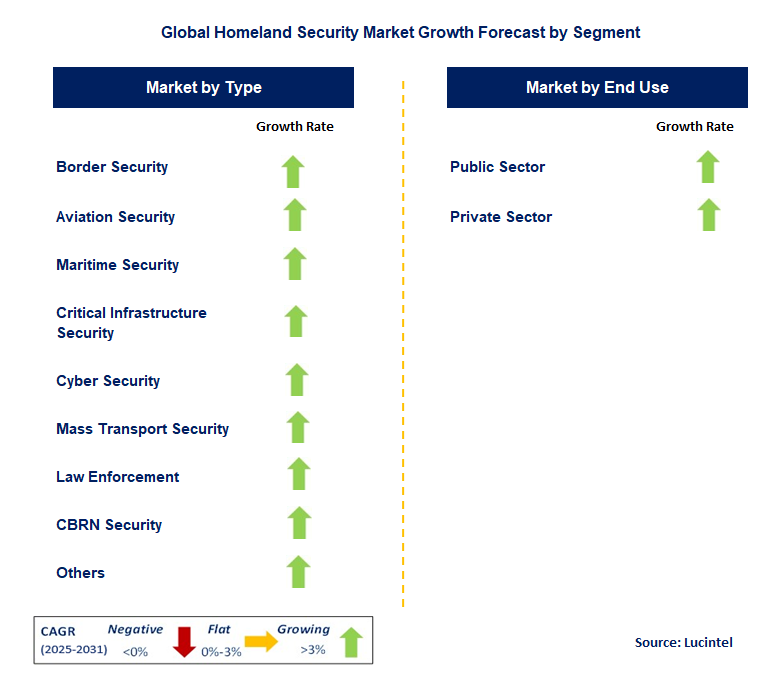
• Lucintel forecasts that, within the type category, border security will remain the largest segment over the forecast period.
• Within the end use category, public sector will remain a larger segment.
• In terms of region, North America will remain the largest region over the forecast period.
Gain valuable insights for your business decisions with our comprehensive 150+ page report. Sample figures with some insights are shown below.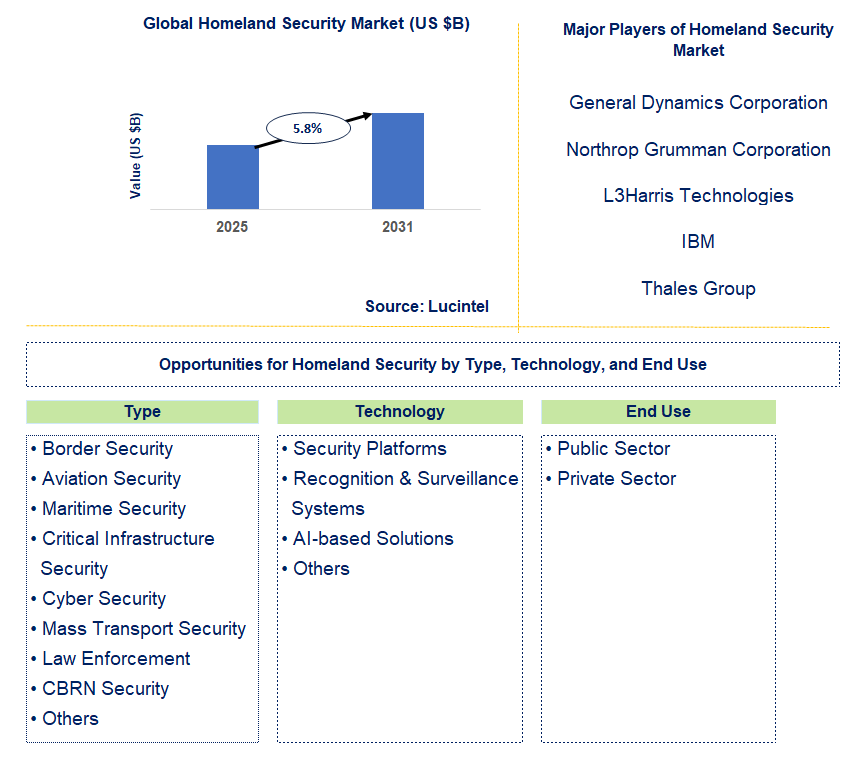
• Artificial Intelligence and Analytics: Merging of Artificial Intelligence (AI) and big data analytics is growing more essential to homeland security. AI-based systems are able to process large quantities of information from a wide range of sources in order to detect patterns, forecast threats, and increase situational awareness. Some of the applications include those in facial recognition, detection of anomalies within surveillance videos, and predictive policing, resulting in more proactive and effective security strategies.
• Cybersecurity Integration with Physical Security: There is a convergence between cybersecurity and physical security in the homeland security space. As infrastructure becomes more interconnected, protecting the cyber and physical assets from convergent threats is becoming more important. This trend includes integrated security platforms that can scan and react to threats in both areas, delivering an integrated security posture.
• Biometric Identification and Authentication: Biometric technologies like facial recognition, iris scanning, and fingerprinting are increasingly being used in identification and authentication for homeland security. These technologies improve border management, law enforcement, and access management to sensitive installations, providing enhanced precise and secure ways of authenticating identities.
• Robotics and Unmanned Systems: The use of unmanned aerial systems (UAS or drones) and ground robots is increasing in homeland security missions. These unmanned systems are employed for surveillance, border surveillance, bomb disposal, search and rescue, and other purposes, providing improved capabilities with lower risks to human assets. Improvements in autonomous capabilities continue to stimulate this trend.
• Resilience and Disaster Preparedness: As natural disasters and other crises become more frequent, there is a greater focus on national resilience building and disaster preparedness. This trend entails investments in early warning systems, emergency communications networks, and technologies that enable first responders and assist in recovery, with a view to limiting the disruption caused by high-impact events.
Collectively, these trends are redefining the homeland security market by fueling the need for increasingly technological, integrated, and forward-looking solutions. The emphasis has shifted to taking advantage of data, automation, and advanced analytics to mitigate a more extensive range of threats and build greater national security and resilience overall.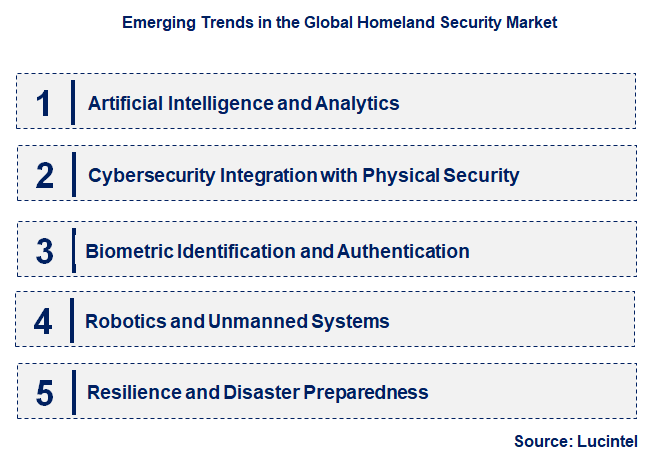
• Growth of Cybersecurity Initiatives: One major development is the sweeping growth in cybersecurity efforts to safeguard infrastructure, government networks, and vital services against cyber-attacks. This involves spending on threat detection, incident response capacity, and formulation of national cybersecurity strategies.
• Border Security Technology Advancements: There have been significant developments in border security technologies, such as the use of advanced surveillance systems, biometric identifiers, and aerial drone technologies for monitoring and control. These are designed to strengthen border security efficiency while facilitating legitimate travel.
• Greater Emphasis on Domestic Extremism: Most countries are now more concerned with combating domestic extremism, and as a result, new technologies and methods of monitoring and preventing such activities have been created. This involves greater intelligence collection and analysis and community outreach programs.
• Improving Public Safety Communication Systems: An ongoing effort to advance and connect public safety communication systems for interoperability among agencies in cases of emergency is being pursued. This includes deploying broadband networks and enhanced communications equipment for first responders.
• Enhancement of Biosecurity Capabilities: Recent worldwide occurrences have emphasized the significance of biosecurity. Advances here are in terms of improved surveillance for infectious disease, improvement of public health infrastructure, and research into countermeasures to biological threats.
These innovations are affecting the homeland security market by compelling innovation in certain areas of technology and by changing priorities to counter threats better. The market is witnessing enhanced investment in digital security, next-generation surveillance, and resilience-building methods to protect national interests and public safety.• Smart City Security: Smart city development is a major growth potential for homeland security solutions. This involves incorporating security technologies in urban infrastructure for public safety, traffic management, and emergency response using sensors, artificial intelligence, and networked systems.
• Critical Infrastructure Protection: Security of critical infrastructure such as electric grids, water supply systems, and transportation networks against physical and cyber threats is an important area of growth. This includes the deployment of sophisticated monitoring systems, intrusion detection systems, and fault-tolerant network architectures.
• Disaster Response and Emergency Management: Upgrading disaster response and emergency management capabilities has huge growth prospects. These involve early warning technologies, crisis communication technologies, drone and robotics-based search and rescue technologies, and analytics technologies for efficient resource deployment.
• Transportation and Aviation Security: Securing the safety and security of aviation and other transport systems remains a high-growth sector. This includes advances in passenger and cargo screening, perimeter security, and technologies to counter evolving threats such as drone attacks.
• Public Safety and Law Enforcement Technology: The use of technology to facilitate public safety and law enforcement offers tremendous growth potential. This encompasses body-worn cameras, digital forensics equipment, AI-driven crime analysis, and less-lethal weapons.
These opportunities for growth are affecting the homeland security market by funneling investment and innovation into areas of specific applications that meet essential security requirements and take advantage of technological advances. This emphasis is creating customized solutions that better respond to each sector's changing challenges.• General Dynamics Corporation
• Northrop Grumman Corporation
• L3Harris Technologies
• IBM
• Thales Group
• ELBIT SYSTEMS
• Lockheed Martin Corporation
• Leonardo
• Unisys Corporation
• Science Applications International Corporation
• Border Security
• Aviation Security
• Maritime Security
• Critical Infrastructure Security
• Cyber Security
• Mass Transport Security
• Law Enforcement
• CBRN Security
• Others
• Security Platforms
• Recognition & Surveillance Systems
• AI-based Solutions
• Others
• North America
• Europe
• Asia Pacific
• The Rest of the World
• United States: The US homeland security market remains focused on counter-terrorism, border security, and cybersecurity. Recent trends involve greater investment in next-generation surveillance technologies, AI-based threat detection, and protection of critical infrastructure against cyber and physical threats. Domestic extremism is increasingly becoming a focus for attention, alongside strengthening resilience to natural disasters and their security consequences. Public safety communication networks and advanced screening technologies at transport sites continue to be areas of priority investment.
• China: China's homeland security landscape is dominated by high stress on internal security, public order, and technological monitoring. Recent trends are the large-scale adoption of sophisticated facial recognition and AI-based surveillance systems. Cybersecurity is also very prominent with attempts to lock down key digital infrastructure and control online content. Control of the border and population movements are central features, aided by technological tools and a powerful state-led response.
• Germany: Germany's strategy for homeland security combines security requirements with civil rights. Current developments involve prioritizing the fight against right-wing extremism and terrorism, in addition to improving cybersecurity capacity. There is a growing focus on digital forensics, border control technology, and protecting the resilience of critical infrastructure against physical and cyber-attacks. Public safety and disaster readiness, including responses to climate change effects, are also rising in prominence.
• India: India's homeland security sector deals with an intricate spectrum of challenges such as counter-terrorism, border security, and internal security matters. Current developments include the upgrading of police forces with sophisticated arms and surveillance tech, and enhanced border management infrastructure. Cybersecurity is also an expanding area of interest, specifically as it relates to critical national infrastructure and finance systems. Disaster management and emergency response capacities are being upgraded country-wide.
• Japan: Japanese homeland security initiatives emphasize disaster preparedness, counter-terrorism, and cyber-security. Recent trends include large investments in early warning systems to prepare for natural disasters, and intensified surveillance and security for major public events and key infrastructure. Cyber-security is also a priority area, with efforts to defend government networks and critical services. Border security and the management of potential threats through international terrorism continue to be focal areas.


• General Dynamics Corporation
• Northrop Grumman Corporation
• L3Harris Technologies
• IBM
• Thales Group
• ELBIT SYSTEMS
• Lockheed Martin Corporation
• Leonardo
• Unisys Corporation
• Science Applications International Corporation
Q5. Which homeland security market segment will be the largest in future?

Choose a license that fits your team. Instant PDF delivery.
Prices exclude taxes. Instant delivery. Custom licensing available on request.
Market Report · July 15, 2026
Market Report · June 26, 2026
Market Report · June 24, 2026
Trusted partner for strategic intelligence and business growth


Receive a complimentary market analysis tailored to your industry. Our analysts will identify key growth opportunities and competitive dynamics specific to your business.

Market size, growth rate, and key trend analysis for your specific sector.

Top competitor positioning and market share analysis.

Strategic recommendations backed by data-driven insights.
Get curated market intelligence and competitive moves straight to your inbox.
By subscribing, you agree to receive our monthly insights. Unsubscribe anytime.
Receive a complimentary market analysis tailored to your industry. Our analysts will identify key growth opportunities and competitive dynamics specific to your business.
Market size, growth rate, and key trend analysis for your specific sector.
Top competitor positioning and market share analysis.
Strategic recommendations backed by data-driven insights.
Get curated market intelligence, emerging trends, and competitive moves straight to your inbox each month.
By subscribing, you agree to receive our monthly insights. Unsubscribe anytime.
We'll send your sample report shortly.