
Market Report · July 15, 2026

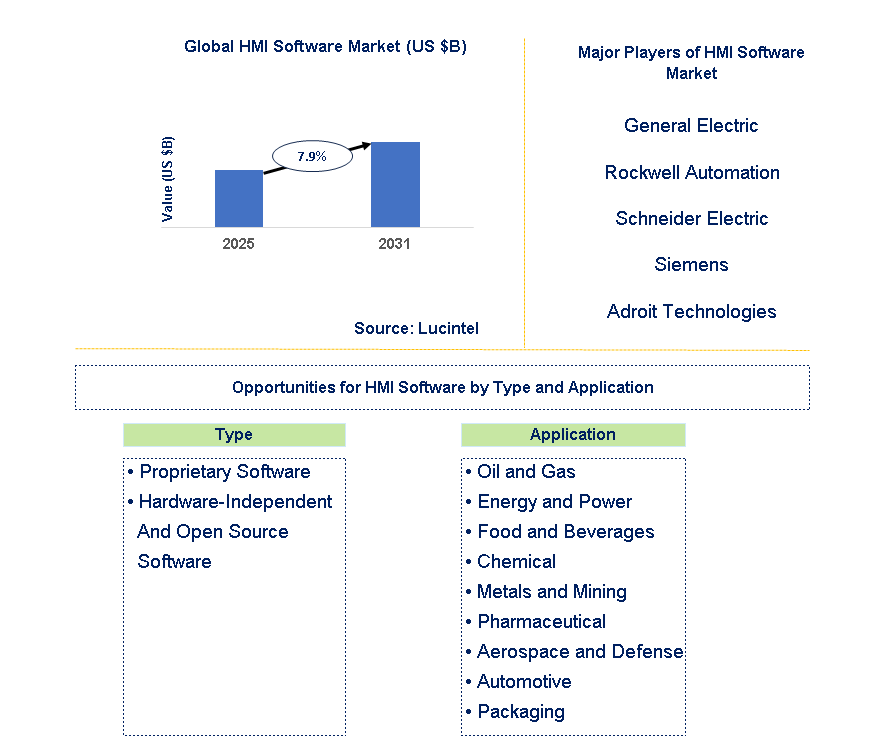
Key data points: The growth forecast = 7.9% annually for the next 7 years. Scroll below to get more insights. This market report covers Trends, opportunity and forecast in HMI software market to 2031 by type (proprietary software and hardware-independent and open source software), application (oil and gas, energy and power, food and beverages, chemical, metals and mining, pharmaceutical, aerospace and defense, automotive, and packaging), and region (North America, Europe, Asia Pacific, and the Rest of the World)
We'll send your sample report shortly.
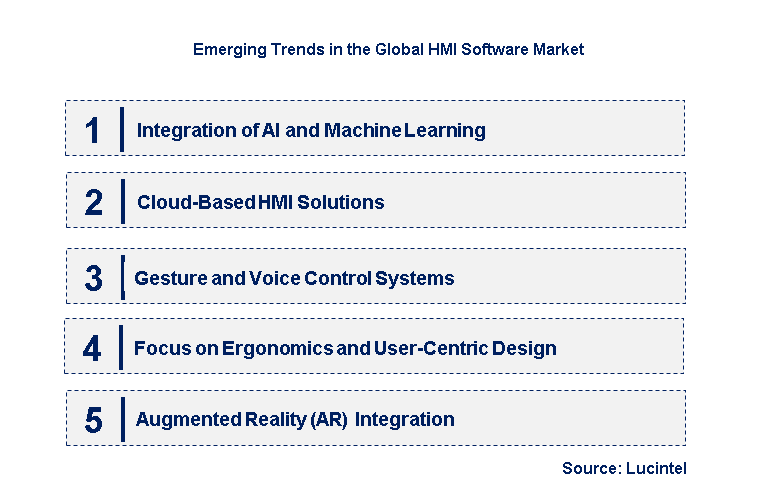
• Integration of AI and Machine Learning: AI and machine learning are increasingly being integrated into HMI software to make it more user-friendly and predictive. The application of AI allows HMI systems to provide users with more personalized experiences, predictive maintenance, and real-time performance analytics. This is making industries like automotive, manufacturing, and healthcare operate at peak efficiency through the use of real-time data and predictive insights.
• Cloud-Based HMI Solutions: The cloud-based HMI solutions have gained popularity over the years; it allows the manufacturers and various industries to view and manage their HMI system from a distance. This provides real-time monitoring, remote debugging, and information sharing across many locations. Thus, using a cloud-based platform, organizations cut down on the infrastructure costs while improving the system scalability and ensure smooth integration with IoT devices for the growth of smart factories and connected vehicles.
• Gesture and Voice Control Systems: HMI software is increasingly being integrated with gesture and voice recognition technologies to provide more intuitive and hands-free user interfaces. This trend is more evident in automotive applications, where touch-based control systems are supplemented by gesture and voice controls to enhance safety and user experience. Gesture and voice controls are also being used in industrial applications to enable operators to control machines and equipment more efficiently, even in challenging environments.
• Focus on Ergonomics and User-Centric Design: As the importance of user experience is now recognized by the industries, focus on ergonomically designed HMI software has been growing, with the intention of making the interfaces more intuitive and thus reduce the cognitive load on the user while improving the overall operational efficiency. This is causing the development of customized interfaces that are tailored to the needs of workers and drivers for ease of use and reduction in human error during manufacturing and other automobile industries.
• Augmented Reality (AR) Integration: Augmented reality (AR) integration in HMI systems is on the rise, especially for automotive and industrial applications. AR-enabled HMI software overlays digital information onto the real world, making it easier for users to visualize data and interact with systems. In the automotive sector, AR displays are used to provide navigation and vehicle data directly on the windshield. In manufacturing, AR is being used for real-time equipment monitoring and operator assistance, enhancing productivity and reducing downtime. These trends are changing the HMI software market by enhancing interactivity, improving user experience, and creating more efficient control systems. As AI, machine learning, cloud technologies, and augmented reality continue to be integrated into HMI systems, these systems are becoming smarter, more flexible, and more user-friendly, which in turn is fueling adoption across industries.
• Advanced Touch-Based Interfaces: HMI software has evolved to support more advanced touch interfaces, which provide smoother, more responsive user experiences. In automotive applications, touchscreens are now being paired with advanced haptic feedback and multi-touch capabilities, enhancing driver interaction. The development of capacitive touch technology allows for more precise and intuitive controls, which has improved the overall usability of HMI systems.
• Integration with IoT and Smart Devices: The integration of HMI systems with the Internet of Things (IoT) and other smart devices is one of the emerging trends in the market. The IoT-enabled HMI software gives access to real-time data, which can further enhance decision-making and operational efficiency. In a smart factory, connected systems can communicate with HMI software, providing real-time insights into machine performance, production schedules, and maintenance needs, thereby driving efficiency in industrial operations.
• Real-Time Data Analytics: Real-time data analytics continues to become more integrated in HMI software for instant decision-making. In the manufacturing industry, and especially within automotive, this has allowed operators to view system performance and identify defects before potentially developing into expensive problems. This has led HMI software to include predictive analytics, through which organizations can forecast maintenance requirements, reinforce safety practices, and fine-tune production processes.
• Cloud-Based HMI Platforms: Cloud-based HMI platforms have gained much attention due to their flexibility, cost-effectiveness, and support for remote access. Cloud technology enables manufacturers and industries to manage and monitor HMI systems across various locations, improving overall management efficiency. Cloud-based platforms also support the integration of advanced data analytics and AI, enabling smarter, more adaptive HMI systems.
• Cyber Security focus: Due to the highly dependent nature of more interconnected HMI systems with greater reliance on the cloud computing world and the 'Internet of things', there lies a focus and emphasis on a higher priority security aspect-cybersecurity for HMI development. More dependency on internet- and networked-based services can make them much more susceptible and vulnerable, putting them under intense scrutiny to take adequate precautions toward cybersecurity. All these key developments show how HMI software is evolving to cater to the requirements of more sophisticated, connected, and data-centric industries. Integration of new technologies such as IoT, AI, and cloud computing is driving the market toward more intelligent, agile HMI solutions that enhance user experience and operational efficiency.
• Automotive Application: In the automotive domain, there is a growing opportunity to develop advanced HMI systems that can improve the safety of interaction with the driver. For example, as vehicles are becoming increasingly autonomous, the demand for intuitive interfaces that enable better communication between drivers and vehicles will rise. Integration of voice control, touchless gestures, and augmented reality will enhance user experience and safety.
• Industrial Manufacturing: Smart manufacturing is one of the biggest growth opportunities for HMI software. Industry 4.0 technologies are being adopted, and HMI systems that can integrate with IoT devices, sensors, and real-time data analytics are in demand. These solutions help operators monitor and control production processes more efficiently, reducing downtime and improving overall productivity.
• Healthcare Industry: HMI software has the greatest opportunities in the healthcare industry, especially in patient monitoring and control of medical devices. HMI solutions used for easy patient data monitoring, setting adjustment of the medical equipment, and interacting with patient care systems are in demand. This market is increasing as healthcare systems focus on the digitalization and remote management of patients.
• Consumer Electronics: With the rise of connected devices, the consumer electronics sector presents a promising opportunity for HMI software development. HMI systems that facilitate seamless interaction with smart devices, wearables, and home automation systems are becoming increasingly popular. These systems provide users with more intuitive control over their personal devices and home environments.
• Robotics and Automation: Robotics and automation industries employ advanced HMI software for improved human-robot interaction. Opportunities in this sector include developing even more intuitive interfaces related to the control of robotic arms, drones, and other forms of automated systems. Interfaces must be highly responsive, as well as easy to use, and able to give operators real-time feedback. Strategic growth opportunities are visible in the HMI software market across all application areas as a result of an increasing need for more intelligent, interconnected, and user-friendly systems. In view of increasing industries' dependence on automation and digitization, control and improved user experience are in demand and would continue to fuel growth for HMI software solutions.
• General Electric
• Rockwell Automation
• Schneider Electric
• Siemens
• Adroit Technologies
• Beijer Electronics
• Brainchild Electronic
• B-Scada
• Copa-Data
• Elipse Software
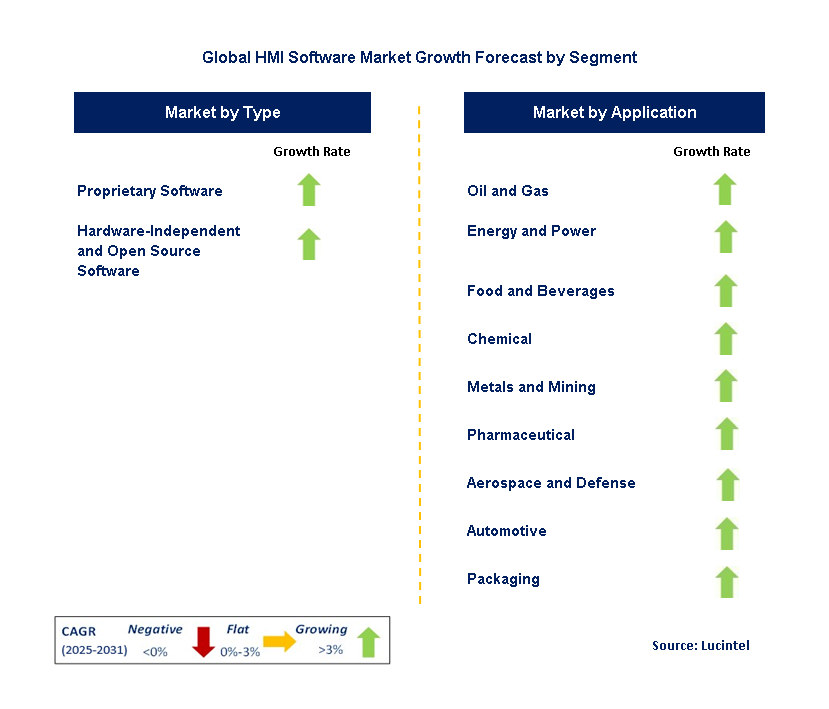
• Proprietary Software
• Hardware-Independent And Open Source Software
• Oil And Gas
• Energy And Power
• Food And Beverages
• Chemical
• Metals And Mining
• Pharmaceutical
• Aerospace And Defense
• Automotive
• Packaging
• North America
• Europe
• Asia Pacific
• The Rest of the World
• United States: The HMI software market in the United States is experiencing robust growth, driven by technological innovations and widespread adoption across industries. One notable development is the increased integration of AI and machine learning with HMI software, allowing for predictive maintenance and advanced analytics in industrial applications. In the automotive sector, HMI software is evolving to incorporate more advanced touch, voice, and gesture-based control systems, improving the user experience. Additionally, cloud-based HMI solutions are becoming more prevalent, enabling real-time data monitoring and remote management, particularly in smart factories and connected vehicles.
• China: In China, the HMI software market is advancing rapidly, particularly in industries such as manufacturing, automotive, and consumer electronics. Industry 4.0 and smart manufacturing by the government is the demand for advanced HMI systems. The need for sophisticated HMI systems to improve human-vehicle interaction in the case of automotive applications is growing due to autonomous vehicles. Additionally, HMI software in China is using AI for facial recognition and voice commands to improve the user interface. The Chinese market is also witnessing the development of localized HMI software that caters to the specific needs of local industries and consumers.
• Germany: Germany, which is known for its industrial and automotive prowess, remains a leader in the HMI software market. Recent developments include the development of more ergonomic and intuitive HMI systems in manufacturing environments to enhance worker safety and productivity. In automotive applications, German manufacturers are adding advanced HMI technologies, such as gesture controls and augmented reality displays, to their vehicles. Moreover, the focus on Industry 4.0 and smart factory solutions is driving the uptake of HMI software that enables seamless integration with other digital systems, thereby enhancing operational efficiency and minimizing downtime.
• India: The HMI software market in India is experiencing rapid growth, fueled by the country’s expanding manufacturing and automotive sectors. Indian companies are adopting more advanced HMI solutions to streamline operations and improve the user experience in both industrial and consumer applications. The government’s push towards automation and digitization in manufacturing is driving the demand for HMI systems that provide real-time data and enhanced control. Indian HMI software developers are also incorporating AI and machine learning into their products, allowing for predictive analytics and advanced process automation. The growth of smart manufacturing in India is expected to further fuel the HMI software market.
• Japan: Japan continues to be a significant player in the HMI software market, particularly in the automotive and robotics industries. Latest developments include the integration of advanced HMI in modern automobiles, including touch-free control, voice recognition, and augmented reality interfaces. All of these point to improved road use efficiency between drivers and passengers. Robotics innovations originating from Japan have also driven innovations in HMI software for human-robot interaction. In addition, with the growth in smart factories and industrial automation in Japan, real-time data visualization and interactive control panels are significantly improving operational efficiency.


• General Electric
• Rockwell Automation
• Schneider Electric
• Siemens
• Adroit Technologies
• Beijer Electronics
• Brainchild Electronic
• B-Scada
• Copa-Data
• Elipse Software Q5. Which HMI software market segment will be the largest in future? Answer: Lucintel forecasts that, within the type category, proprietary software is expected to witness higher growth over the forecast period. Q6. In HMI software market, which region is expected to be the largest in next 5 years? Answer: In terms of regions, APAC is expected to witness the highest growth over the forecast period. Q7. Do we receive customization in this report? Answer: Yes, Lucintel provides 10% customization without any additional cost.


Choose a license that fits your team. Instant PDF delivery.
Prices exclude taxes. Instant delivery. Custom licensing available on request.
Market Report · July 15, 2026
Market Report · June 26, 2026
Market Report · June 24, 2026
Trusted partner for strategic intelligence and business growth


Receive a complimentary market analysis tailored to your industry. Our analysts will identify key growth opportunities and competitive dynamics specific to your business.

Market size, growth rate, and key trend analysis for your specific sector.

Top competitor positioning and market share analysis.

Strategic recommendations backed by data-driven insights.
Get curated market intelligence and competitive moves straight to your inbox.
By subscribing, you agree to receive our monthly insights. Unsubscribe anytime.
Receive a complimentary market analysis tailored to your industry. Our analysts will identify key growth opportunities and competitive dynamics specific to your business.
Market size, growth rate, and key trend analysis for your specific sector.
Top competitor positioning and market share analysis.
Strategic recommendations backed by data-driven insights.
Get curated market intelligence, emerging trends, and competitive moves straight to your inbox each month.
By subscribing, you agree to receive our monthly insights. Unsubscribe anytime.
We'll send your sample report shortly.