
Market Report · July 22, 2026

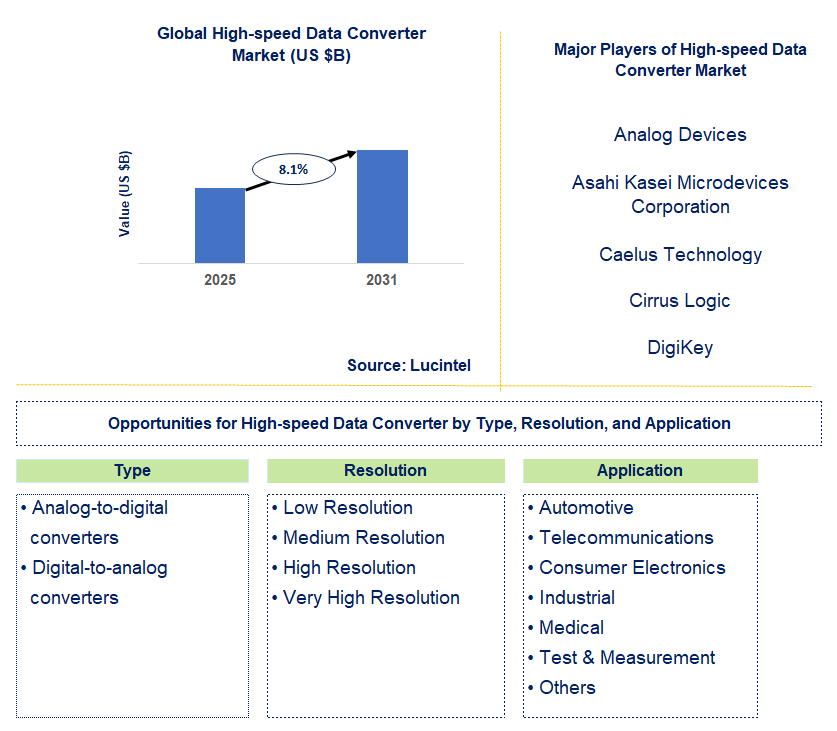
Key data points: The growth forecast = 8.1% annually for the next 7 years. Scroll below to get more insights. This market report covers trends, opportunities and forecasts in high-speed data converter market to 2031 by type (analog-to-digital converters and digital-to-analog converters), resolution (low resolution, medium resolution, high resolution, and very high resolution), application (automotive, telecommunications, consumer electronics, industrial, medical, test & measurement, and others), and region (North America, Europe, Asia Pacific, and the Rest of the World)
We'll send your sample report shortly.
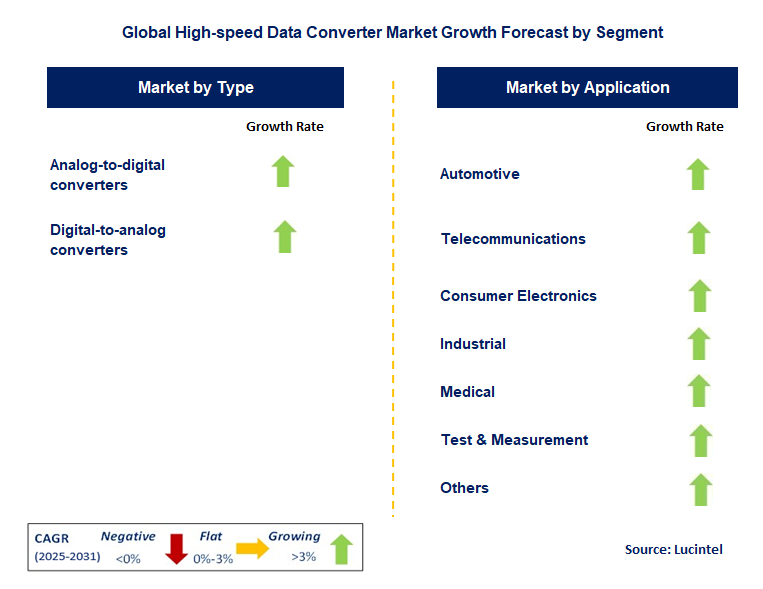
• Lucintel forecasts that, within the type category, analog-to-digital converter will remain a larger segment over the forecast period.
• Within the application category, consumer electronic will remain the largest segment.
• In terms of region, North America is expected to witness the highest growth over the forecast period. Gain valuable insights for your business decisions with our comprehensive 150+ page report. Sample figures with some insights are shown below.
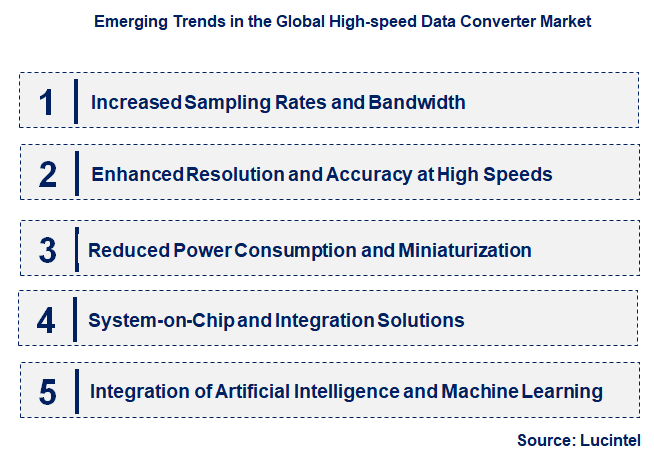
• Increased Sampling Rates and Bandwidth: The leading trend is the ongoing drive toward higher sampling rates and bandwidth in data converters. This is important for applications requiring the handling of very high-speed signals, including 5G and future 6G wireless communications, broadband satellite systems, and state-of-the-art radar. Companies are making converters that can sample tens of giga samples per second (GSPS) to acquire and process higher signal bandwidths with higher fidelity. The effect is improved performance in real-time sensing and communication systems, facilitating new generations of high-data-rate applications.
• Enhanced Resolution and Accuracy at High Speeds: The industry is also seeing a strong trend toward achieving greater resolution and accuracy even at extremely high sampling rates. Though traditionally there has been a compromise between speed and resolution, circuit design and process technology advancements are allowing converters to maintain high accuracy (e.g., 16-bit and higher) while running at gigahertz data rates. This is necessary for applications such as high-fidelity medical imaging, high-precision test and measurement equipment, and scientific instrumentation, where both speed and minute detail are important to data integrity.
• Reduced Power Consumption and Miniaturization: There is a growing emphasis on creating high-speed data converters with much reduced power consumption and compact form factors. The trend is fueled by the wide adoption of portable and battery-powered equipment, as well as the requirement for energy efficiency in large-scale data centers and telecommunication equipment. Manufacturers are leveraging advanced semiconductor processes and innovative design architectures to minimize power dissipation without sacrificing performance. The effect is extended battery life for consumer devices and lower operational expenses and cooling needs for large systems.
• System-on-Chip and Integration Solutions: One dominant trend is growing incorporation of high-speed data converters into high-level System-on-Chip (SoC) solutions or highly integrated mixed-signal ICs. Rather than in discrete form, designers are looking for integrated solutions where ADCs/DACs are integrated with other functions such as digital signal processors (DSPs), RF front-ends, and microcontrollers. It makes board design simpler, lowers component counts, and improves system performance. The effect is shorter time-to-market, lower system cost, and higher reliability for sophisticated electronic systems.
• Integration of Artificial Intelligence and Machine Learning: One of the emerging trends is the embedding of artificial intelligence (AI) and machine learning (ML) functionality directly into data converter design or their related digital processing units. This enables features of intelligent calibration, adaptive signal processing, and predictive maintenance. AI can dynamically optimize converter performance, correct for deficiencies, and further process data at the edge. The result is smarter, more resilient, and self-optimizing data conversion solutions, essential for future-generation AI-based applications and edge computing. These new trends are basically transforming the high-speed data converter market by expanding performance limits, efficiency, and integration. They are empowering new uses and evolving existing ones to guarantee that the digital universe remains fueled by more advanced and powerful analog-to-digital and digital-to-analog conversion technologies.
• Advances in Sampling Rate and Bandwidth: One major recent advancement is the advent of data converters with higher sampling rates and broader analog bandwidths than ever before. Companies are continually introducing new ADCs and DACs that can sample tens of giga samples per second (GSPS), sometimes even double-digit GSPS. This innovation is a must to capture and produce high-frequency signals with high-fidelity directly because of the enormous bandwidth demands of 5G mm Wave, satellite communications, and advanced radar systems. The effect is an enabling cornerstone for real-time high-bandwidth data processing.
• Higher Resolution at High Frequencies: Another important innovation is the capability to attain higher resolution (e.g., 16-bit or better) at the same time as extremely high sampling rates. In the past, there was a trade-off, but leading process technologies and creative architectures such as successive approximation register (SAR) and pipeline converters are shattering this barrier. This allows high-fidelity signal capture and creation for demanding medical imaging (MRI, CT scanner) applications, precision instrumentation, and defense and aerospace systems. The result is more precise data, with the effect being better diagnostics and more accurate control systems.
• Power Efficiency and Miniaturization: Current developments highlight major power efficiency gains and miniaturization of high-speed data converters. With devices shrinking and becoming increasingly integrated, and with energy efficiency becoming a major consideration in data centers and mobile electronics, converter designers are creating lower power footprints. That means taking advanced Fin FET processes (such as 16nm, 7nm) and new power management strategies. The result is less heat dissipation, extended battery life for smartphones, and smaller, more energy-efficient system designs.
• Higher Integration and Mixed-Signal SoCs: There is increasing emphasis on increased integration, with high-speed data converters integrated into sophisticated mixed-signal SoCs. Rather than discrete components, solutions now integrate ADCs/DACs with RF transceivers, DSP blocks, and embedded processors onto a single die. Complexity is minimized, board space is conserved, and system performance overall is enhanced. The result is a less complex design cycle for engineers, reduced bill of materials (BOM) expense, and increased reliability for high-performance applications.
• Use of Advanced Interfaces: Recent trends reflect the widespread use of high-speed serial interfaces such as JESD204B and the more recent JESD204C. These interfaces allow for data converters to talk to FPGAs and processors at extremely high speeds using fewer data lanes, making board routing easier and taking up less pin space. This becomes important when dealing with the sheer data throughput created by high-speed converters. The effect is reduced system complexity, enhanced signal integrity, and the capacity to design more miniaturized and high-performance data and measurement systems. These major advancements are revolutionizing the high-speed data converter market by setting new limits in performance and integration. They are creating a new era of high-bandwidth, high-accuracy, and power-efficient electronic systems that are critical to continued digital transformation throughout industries.
• 5G and Beyond Communications Infrastructure: One key strategic growth area is the ongoing installation of 5G and subsequent 6G communications infrastructure. Base stations, massive MIMO antennas, and active antenna systems cannot do without high-speed data converters to convert analog RF signals to digital for processing purposes and vice versa. As 5G deployment gains momentum worldwide and new spectrum bands (such as millimeter wave) are being used, the need for ultra-high-speed, high-linearity ADCs and DACs will increase rapidly. This application ensures reliable and efficient transmission of large volumes of data.
• State-of-the-Art Test and Measurement Equipment: The growing complexity of electronic systems, especially in RF, microwave, and high-speed digital applications, presents a huge opportunity for growth for FPGAs in state-of-the-art test and measurement equipment. Oscilloscopes, spectrum analyzers, signal sources, and arbitrary waveform generators are dependent on high-speed data converters for signal acquisition and generation with precision. With increasing test requirements driven by new technologies such as 5G, IoT, and autonomous vehicles, the need for converters with increased sampling rates, improved resolution, and larger bandwidth will also increase, allowing for accurate characterization and verification.
• Automotive Electronics: The automotive industry, especially advanced driver-assistance systems (ADAS) and autonomous driving, is a fast-growing opportunity. High-speed data converters play a pivotal role in radar, lidar, and camera systems for sensing the environment, allowing real-time capture and processing of data for collision avoidance, adaptive cruise control, and navigation. As cars become more autonomous and have more features, there will be a growing need for small, reliable, and high-performance ADCs and DACs to enable the advanced sensing and control functions necessary for safe and efficient operation.
• Medical Imaging and Healthcare Devices: The medical imaging and healthcare industry presents a growth opportunity of strategic significance as more advanced diagnostic devices are increasingly being adopted. Modalities like MRI, CT scanners, ultrasound machines, and digital X-rays rely considerably on high-speed data converters to record high-fidelity signals from the human body. These converters provide better image quality, quicker scanning times, and more precise diagnoses. With increasing demands on healthcare and advancing technology, converters with higher resolution, dynamic range, and speed will have an ever-growing requirement, improving patient care.
• Aerospace and Defense Applications: Aerospace and defense markets, such as radar, electronic warfare (EW), and satellite communication systems, are a strong growth segment. These applications need high-speed data converters for real-time signal intelligence, target detection, and secure communication. The stringent performance requirements of high sampling rates, wide bandwidths, and high linearity under harsh conditions make these areas an ideal market for advanced data converters. The continuing modernization and rising defense expenditures across the globe will continue to fuel demand in this strategic segment. These strategic growth opportunities are shaping the high-speed data converter market by inducing innovation, broadening the addressable market, and requiring the evolution of ever more advanced and specialized converter solutions. They highlight the paramount importance these components have for making next-generation technologies in a variety of demanding industries.
• Analog Devices
• Asahi Kasei Microdevices Corporation
• Caelus Technology
• Cirrus Logic
• DigiKey
• Faraday Technology Corporation
• GlobalSpec
• Infineon Technologies
• Microchip Technology
• Omni Design Technologies
• Analog-to-digital converters
• Digital-to-analog converters
• Low Resolution
• Medium Resolution
• High Resolution
• Very High Resolution
• North America
• Europe
• Asia Pacific
• The Rest of the World
• United States: The United States is a leading power in the high-speed data converter market, supported by robust demand from telecommunications, automotive, and consumer electronics industries. Recent trends involve increased investment in data centers for AI growth, fueling demand for high-efficiency converters. US-based companies such as Analog Devices and Texas Instruments remain at the forefront, with innovations involving greater sampling rates, reduced power consumption, and increased integration. The market sees substantial growth in applications requiring real-time signal processing and high-resolution imaging.
• China: China's market for high-speed data converters is witnessing healthy growth, fueled by huge investments in 5G infrastructure and a booming domestic electronics manufacturing sector. Strong focus is laid on the development of mixed-signal integrated circuits, many of which include high-speed data converters. Though large volumes of semiconductors continue to be imported, local players are rapidly improving their design and manufacturing capabilities. The communication segment, with growing consumer electronics and industrial automation, drives demand for high-speed, low-power ADCs and DACs.
• Germany: The high-speed data converter market in Germany is dominated by the growth of 5G networks and the growing use of AI-based solutions. Major German players include Infineon Technologies, with a focus on industrial and automotive data converters. The need is especially high for high-resolution (13-bit to 16-bit) and very high-resolution (17-bit and more) converters for next-generation radar and advanced medical imaging applications, allied to Germany's robust industrial and technological foundation.
• India: India's high-speed data converter market is expected to witness strong growth with a high compound annual growth rate, driven primarily by the fast growth in 5G network deployments and the increasing use of IoT devices. The need for high-performance converters is also driven by the thriving consumer electronics industry and government initiatives to encourage local semiconductor production. India is surfacing as a prominent market for analog-to-digital converters (ADCs) and digital-to-analog converters (DACs) in different applications.
• Japan: Japan's data converter market for high-speed data converters is growing steadily, with emphasis on high-resolution and high-performance converters for telecommunications, automotive, and industrial applications. Firms such as Asahi Kasei Microdevices and Renesas Electronics are leading innovators in Japan, providing cutting-edge analog and mixed-signal ICs. The market is fueled by the nation's need for advanced electronic systems within consumer electronics and industrial automation, as well as huge investments in next-generation communication infrastructure.


• Analog Devices
• Asahi Kasei Microdevices Corporation
• Caelus Technology
• Cirrus Logic
• DigiKey
• Faraday Technology Corporation
• GlobalSpec
• Infineon Technologies
• Microchip Technology
• Omni Design Technologies Q5. Which high-speed data converter market segment will be the largest in future? Answer: Lucintel forecasts that, within the type category, analog-to-digital converter will remain a larger segment over the forecast period. Q6. In high-speed data converter market, which region is expected to be the largest in next 5 years? Answer: In terms of region, North America is expected to witness the highest growth over the forecast period. Q7. Do we receive customization in this report? Answer: Yes, Lucintel provides 10% customization without any additional cost.


Choose a license that fits your team. Instant PDF delivery.
Prices exclude taxes. Instant delivery. Custom licensing available on request.
Market Report · July 22, 2026
Market Report · July 17, 2026
Market Report · July 17, 2026
Trusted partner for strategic intelligence and business growth


Receive a complimentary market analysis tailored to your industry. Our analysts will identify key growth opportunities and competitive dynamics specific to your business.

Market size, growth rate, and key trend analysis for your specific sector.

Top competitor positioning and market share analysis.

Strategic recommendations backed by data-driven insights.
Get curated market intelligence and competitive moves straight to your inbox.
By subscribing, you agree to receive our monthly insights. Unsubscribe anytime.
Receive a complimentary market analysis tailored to your industry. Our analysts will identify key growth opportunities and competitive dynamics specific to your business.
Market size, growth rate, and key trend analysis for your specific sector.
Top competitor positioning and market share analysis.
Strategic recommendations backed by data-driven insights.
Get curated market intelligence, emerging trends, and competitive moves straight to your inbox each month.
By subscribing, you agree to receive our monthly insights. Unsubscribe anytime.
We'll send your sample report shortly.