
Heliport Market
The future of the global heliport market looks promising with opportunities in the commercial, private, public and ambulance markets. The global heliport market is expected to reach an estimated $1197 million by 2035 with a CAGR of 3.2% from 2026 to 2035. The major drivers for this market are the increasing urban air mobility adoption, the rising emergency medical transport demand and the growing offshore energy logistics expansion.
• Lucintel forecasts that, within the type category, land based heliport will remain the largest segment over the forecast period as the increasing urban air mobility demand.
• Within the end use category, commercial will remain the largest segment due to the the rising tourism and business travel demand.
• In terms of regions, North America will remain the largest region over the forecast period due to the the growing emergency medical air transport services.
Gain valuable insights for your business decisions with our comprehensive 150+ page report.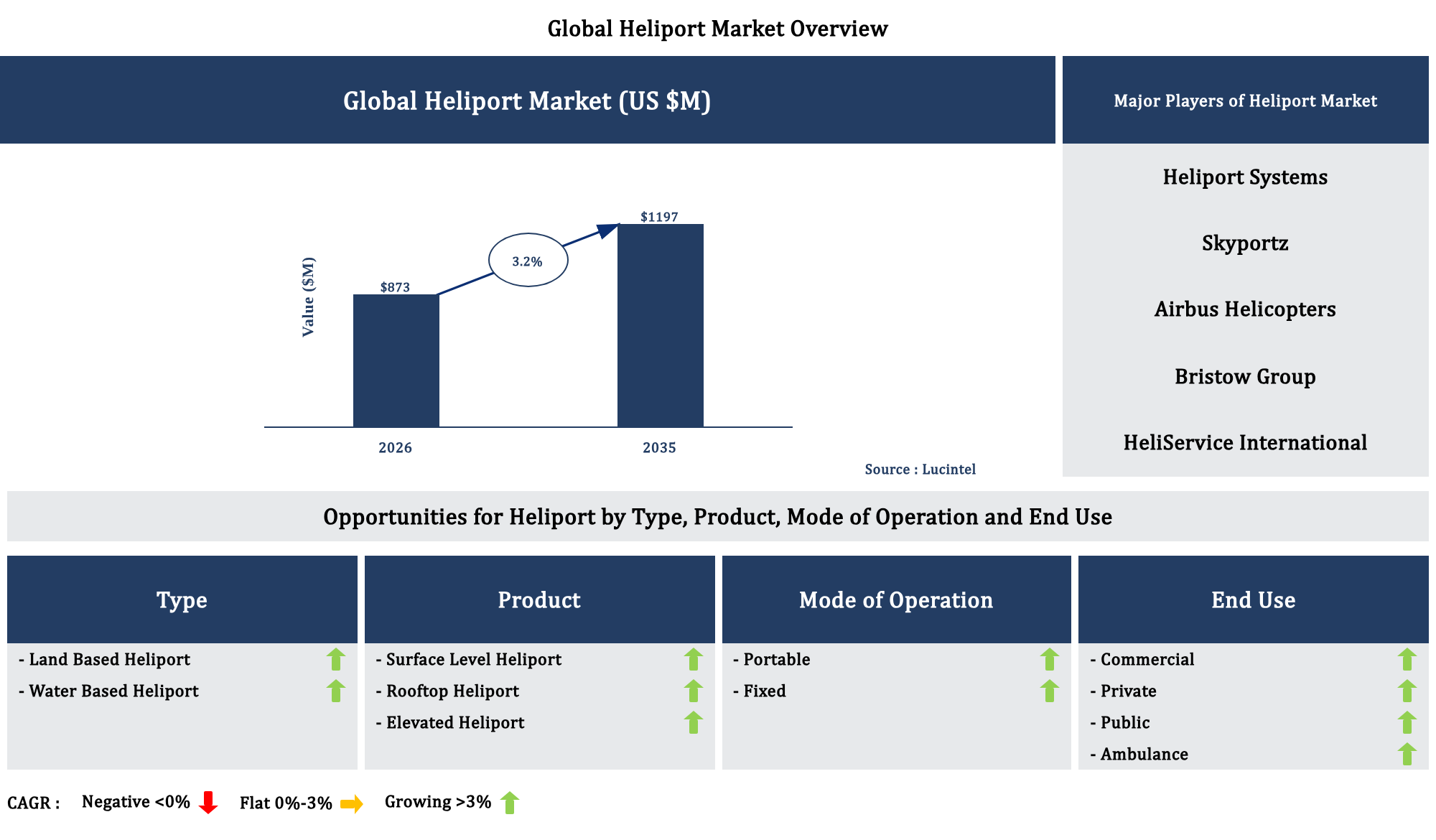
Emerging Trends in the Heliport Market
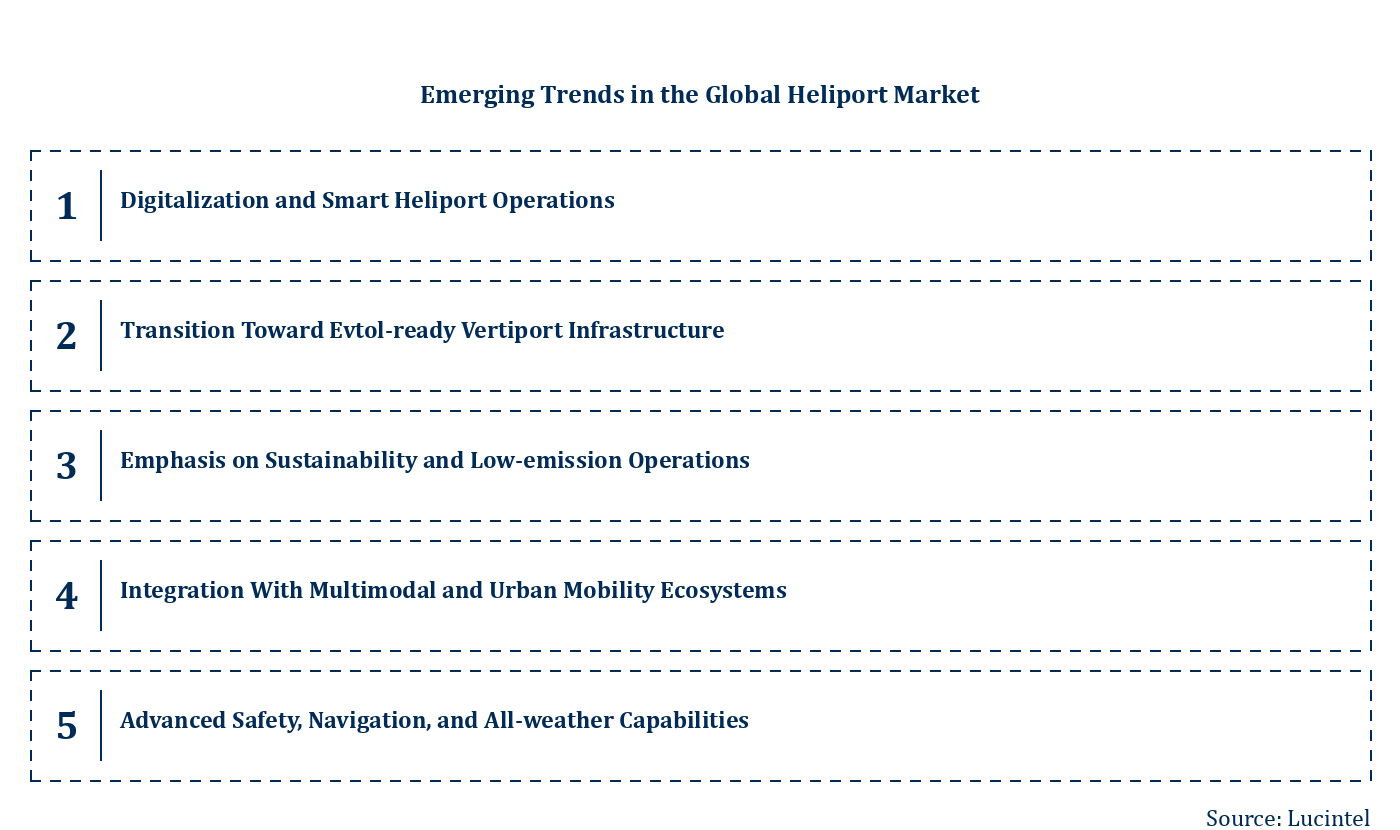
The heliport market is undergoing a significant transformation as operators, regulators, and technology providers respond to rising demand for aerial mobility, emergency response, and business aviation. Digitalization is reshaping how heliports are planned, operated, and integrated with broader transportation networks, while sustainability pressures are driving investments in cleaner infrastructure and energy systems. At the same time, the emergence of electric vertical takeoff and landing aircraft is pushing heliports to evolve into future-ready vertiports. These changes are redefining safety, capacity, and user experience, and they are creating new business models and partnerships across aviation, infrastructure, and technology ecosystems.
Recent Developments in the Heliport Market
The heliport market is undergoing notable transformation as urban air mobility, emergency medical services, and offshore energy operations evolve. Recent developments are driven by the need for safer, more efficient, and greener vertical take‑off and landing infrastructure. Investors, regulators, and technology providers are collaborating to modernize existing heliports while enabling new rooftop and floating facilities. Digitalization, automation, and integration with air traffic management are central themes influencing design and operations. Collectively, these changes are redefining service standards, cost structures, and regulatory expectations, positioning the heliport market as a critical enabler of next‑generation air transport and logistics solutions worldwide.
Strategic Growth Opportunities in the Heliport Market
The heliport market is entering a strategic growth phase as demand accelerates for faster, more flexible point-to-point mobility. Urban congestion, remote industrial activity, rising medical evacuation needs, and the emergence of electric vertical take-off and landing (eVTOL) aircraft are reshaping development priorities. Operators and investors are focusing on application-specific infrastructure, digitalization, and safety enhancements to unlock new revenue streams. Across emergency medical services, corporate transport, tourism, offshore logistics, and public safety, tailored heliport solutions can improve accessibility and response times while meeting stringent regulatory standards. Targeted investment in these high-impact applications will define the next wave of competitive advantage.
Heliport Market Drivers and Challenges
The global heliport market is shaped by a combination of technological innovation, evolving aviation demand, and stringent safety and environmental regulations. Growth is supported by expanding helicopter fleets, the rise of advanced air mobility concepts, and increasing use of rotary-wing services in emergency, offshore, and urban applications. At the same time, the market faces challenges such as high development costs, complex planning and permitting processes, and community resistance to noise and emissions. A clear understanding of these drivers and challenges enables investors, operators, and policymakers to design sustainable heliport networks and align infrastructure development with long-term mobility trends.
The factors responsible for driving the heliport market include:
The challenges facing this heliport market include:
The global heliport market reflects a dynamic balance between expanding demand for rotary and vertical lift services and the structural hurdles of infrastructure development. Technological progress, emergency and urban mobility needs, and infrastructure modernization initiatives are widening the market opportunity. However, high project costs, community and environmental constraints, and fragmented regulations temper the pace of new heliport deployments. Stakeholders that proactively address noise, safety, and sustainability concerns while designing flexible, standards-ready facilities are best positioned to benefit. Overall, these interacting drivers and challenges will shape how quickly and efficiently heliport and future vertiport networks evolve worldwide.
List of Heliport Market Companies
Companies in the market compete on the basis of product quality offered. Major players in this market focus on expanding their manufacturing facilities, R&D investments, infrastructural development, and leverage integration opportunities across the value chain. Through these strategies heliport market companies cater increasing demand, ensure competitive effectiveness, develop innovative products & technologies, reduce production costs, and expand their customer base. Some of the heliport market companies profiled in this report include-
Heliport Market by Segment
The study includes a forecast for the global heliport market by type, product, mode of operation, end use, and region.
Country Wise Outlook for the Heliport Market
The global heliport market is evolving rapidly as countries upgrade aviation infrastructure to support emergency medical services, business aviation, offshore operations, and the emerging advanced air mobility ecosystem. Technological improvements in lighting, navigation, safety systems, and digital air traffic management are reshaping how heliports are planned and operated. Urbanization and congestion in major cities are prompting renewed interest in rooftop and vertiport-ready facilities, while defense and disaster-response needs continue to drive specialized installations. Across the United States, China, Germany, India, and Japan, regulatory reforms, public–private partnerships, and integration with future eVTOL operations are defining recent developments.
Features of the Heliport Market
Article
Heliport Market: Which Strategic Trends Are Redefining Urban Airspace?
Dallas, June 5, 2026 – The heliport market is entering a pivotal era as urban congestion, emergency response needs, and emerging advanced air mobility concepts reshape how cities think about vertical infrastructure. Once treated as niche assets for corporate and medical aviation, heliports are rapidly evolving into critical nodes in multimodal transport networks and testbeds for future electric vertical takeoff and landing operations. This article examines major trends in the heliport market, the sectors poised to benefit most from these shifts, and the challenges and opportunities now confronting operators, technology providers, and investors.
How Is Urbanization Accelerating the Strategic Role of Heliports?
Rising urban density and persistent road congestion are pushing city planners and private developers to reassess the value of rooftop and near-city heliports. Instead of serving only high-net-worth travelers or sporadic emergency flights, heliports are being reframed as high-value connectivity infrastructure that can bridge critical gaps in urban and regional mobility. Metropolitan regions with constrained ground capacity, such as coastal megacities and tourism hubs, are increasingly studying heliport networks as a strategic complement to rail and road corridors.
This shift is encouraging more integrated planning between aviation authorities, transportation departments, and property developers. Mixed-use buildings, hospitals, logistics hubs, and even large retail complexes are evaluating the business case for adding or upgrading heliports to support corporate shuttles, air ambulance operations, and time-critical cargo. As a result, demand is rising for standardized design guidelines, digital traffic management tools, and performance-based regulations that can safely support higher sortie volumes in dense airspace.
Why Are Advanced Air Mobility and Electric VTOL Designs Transforming Heliport Concepts?
A key trend reshaping the heliport market is the emergence of advanced air mobility and electric vertical takeoff and landing aircraft. While many eVTOL platforms are still in certification or pilot phases, their requirements are already influencing heliport planning and investment decisions. Electric propulsion, distributed rotors, shorter takeoff profiles, and tighter noise envelopes mean heliports must adapt from fuel-based, rotorcraft-centric layouts toward more flexible, multimodal vertiport configurations.
Existing heliports are being assessed for retrofit potential to accommodate eVTOL operations by integrating charging infrastructure, higher-throughput passenger processing, and upgraded safety and fire systems. New greenfield facilities are being designed as “verti-ready” from inception, with modular pads, scalable power systems, and digital integration into air traffic management and ground mobility platforms. Technology suppliers in power electronics, battery management, and smart grid interfaces are increasingly partnering with heliport operators to design energy-resilient facilities that can handle peak loads from electric fleets.
Which Markets Stand to Gain Most from Heliport Innovation and How Will They Be Disrupted?
Several markets are poised to see significant impact from innovation in heliports as operations become more frequent, digitalized, and integrated with new aircraft technologies. The disruption will not only alter aviation value chains but also reshape expectations around access, speed, and resilience in urban mobility.
The most visible disruption is likely to occur in metropolitan corridors where air shuttles begin to divert high-value, time-sensitive trips away from ground networks. As reliability and safety records strengthen, more corporate and institutional users may reallocate premium ground transport budgets toward heliport-enabled services, pressuring traditional chauffeured and high-speed rail offerings in specific corridors.
How Is Digitalization Changing the Economics and Operations of Heliports?
Another major shift is the application of digital technologies to improve safety, capacity, and economics. Historically, many heliports operated with limited automation, localized traffic management, and manual scheduling, leading to underutilization and higher operating risks. New software platforms and sensor technologies are enabling a transition toward data-driven heliport management.
These digital capabilities are expected to improve yield management, support higher utilization, and reduce operating costs per movement, which may in turn broaden the addressable customer base beyond ultra-premium segments.
What Challenges Could Slow the Expansion and Modernization of Heliports?
Despite the apparent momentum, the heliport market faces several strategic challenges that could temper growth or delay modernization initiatives. Regulatory frameworks in many jurisdictions were developed for traditional rotorcraft operations and may not yet accommodate high-density or electric operations at scale. Certification timelines, safety case development for mixed traffic, and harmonization across borders create uncertainty for investors and technology vendors.
Community acceptance is another constraint, driven mainly by concerns over noise, perceived safety risks, and visual intrusion. Even with quieter aircraft, new or expanded heliport projects may encounter opposition if public engagement and transparent impact assessments are not prioritized. Land-use competition in dense urban areas also poses hurdles, as rooftops and waterfront parcels must balance aviation needs against residential, commercial, and green-space priorities.
Capital intensity remains a barrier, especially where return-on-investment depends on unproven demand or on the subsequent certification of eVTOL fleets. Integrating robust firefighting, structural reinforcement, charging systems, and digital control centers can require substantial upfront spending, which may deter smaller operators or municipalities with constrained budgets.
Where Do the Biggest Opportunities Lie for Stakeholders in the heliport market?
Alongside these constraints, multiple opportunity vectors are emerging for ecosystem players capable of aligning infrastructure, technology, and regulatory engagement. Infrastructure investors have an opportunity to develop standardized heliport and vertiport platforms that can be replicated across cities, capturing network effects and operational synergies. Engineering and construction firms can differentiate by offering turnkey design-build-operate models that bundle regulatory approvals, digital systems, and future-proofing for eVTOL integration.
For aviation and mobility service providers, value lies in integrating heliport networks into broader multimodal offerings. Seamless connectivity with ride-hailing, rail hubs, car-sharing, and micro-mobility can enhance customer value and justify premium pricing. Technology companies specializing in air traffic management, cybersecurity, energy management, and data analytics can supply critical components that transform heliports into smart, resilient nodes.
Public authorities also stand to benefit by leveraging heliports for resilience strategies. During disasters, pandemics, or infrastructure failures, well-distributed heliports can support rapid evacuation, supply delivery, and medical transfers. This resilience function can justify public co-funding, zoning flexibility, and supportive policies that otherwise might be hard to secure.
What Are the Key Use Cases in the Technology Industry Surrounding Heliports?
The technology industry is deeply embedded in the heliport market across hardware, software, connectivity, and analytics. Several concrete use cases are gaining traction among aerospace, telecommunications, and digital infrastructure players.
Collectively, these technology-driven use cases are shifting heliports from passive landing sites into intelligent infrastructure nodes tightly integrated with digital ecosystems.
Which Recent Developments Signal the Next Phase of heliport market Evolution?
Recent activity across regulation, partnerships, and pilot deployments offers important signals about where the heliport market is heading. Aviation regulators in multiple regions are issuing draft frameworks for vertiports and updating performance-based rules for rooftop and elevated heliports, clarifying design standards, separation minima, and emergency access criteria. These regulatory moves are giving developers and investors more confidence to commit capital to new or upgraded facilities.
Partnerships between helicopter operators, eVTOL manufacturers, and heliport developers are emerging to co-design future operational concepts and revenue-sharing models. Joint ventures are experimenting with hybrid networks where conventional helicopters and prototype electric aircraft share heliport infrastructure under coordinated scheduling and safety protocols. In parallel, major airport operators are announcing plans to integrate heliport or vertiport facilities into airport master plans to create rapid airside-to-city connections.
On the technology front, several companies are conducting trials of digital tower services and remote monitoring for smaller heliports, enabling centralized operations oversight across multiple sites. Energy providers are collaborating with heliport operators to model peak load scenarios for electric fleets and to pilot on-site energy storage that can reduce grid strain and enhance resilience. These developments suggest the heliport market is moving beyond isolated upgrades toward networked, data-rich, and energy-aware infrastructures.
Why Is Now a Strategic Moment to Reassess Heliport Portfolios and Policies?
The convergence of urbanization pressures, technological innovation, and new aircraft concepts means heliports are transitioning from peripheral assets to strategically important components of the mobility and infrastructure landscape. Stakeholders that proactively reassess their heliport portfolios, regulatory approaches, and technology partnerships stand to shape the emerging market structure rather than react to it. Across corporate aviation, emergency services, logistics, tourism, and smart city programs, the capability to integrate safe, efficient, and digitally enabled heliports may differentiate regions and companies competing for talent, investment, and resilience in the coming decade.
Top 5 Companies
1. Airbus Helicopters
Airbus Helicopters is a leading global manufacturer of civil and military rotorcraft and an important stakeholder in the heliport market through its integrated infrastructure, support, and services ecosystem. Headquartered in Marignane, France, and established in 1992 as Eurocopter before becoming Airbus Helicopters in 2014, the company employs tens of thousands of people worldwide within the broader Airbus Group. Its helicopters operate in more than 150 countries, giving it a uniquely broad geographic footprint that directly shapes requirements for heliports, vertiports, and associated ground infrastructure. Airbus Helicopters supports a wide portfolio of platforms such as the H125, H145, H160, H175, and H225, each with specific performance and ground-handling needs that influence heliport design standards, landing systems, safety zones, and passenger handling facilities. The company provides consulting and technical guidance for heliport layout, obstacle clearance, approach procedures, and integration with air traffic management systems, particularly for demanding applications such as offshore energy, emergency medical services, and urban air mobility trials. In recent years, Airbus Helicopters has been closely involved in advanced air mobility initiatives, including demonstration projects that require new rooftop and urban heliport concepts which can later transition to electric vertical take-off and landing operations. It also pursues strategic partnerships with infrastructure providers and operators to facilitate network expansion in regions such as the Middle East, Asia-Pacific, and Latin America. While Airbus Group’s recent mergers and acquisitions are not exclusively heliport-focused, the company’s integration of digital services, navigation solutions, and maintenance platforms strengthens its influence over standards and best practices within the global heliport market.
2. Sikorsky Aircraft
Sikorsky Aircraft, a Lockheed Martin company, is one of the most established names in the helicopter industry and exerts significant influence on the heliport market through its fleet requirements, mission profiles, and support solutions. Founded in 1923 and headquartered in Stratford, Connecticut, USA, Sikorsky designs and manufactures rotorcraft for military, search and rescue, offshore transport, and VIP missions. The company, together with other Lockheed Martin business areas, employs tens of thousands of people and maintains operations and customer support centers in North America, Europe, the Middle East, and the Asia-Pacific region. Its core platforms, including the S-76, S-92, UH-60 Black Hawk family, and newer variants for maritime and utility roles, drive demand for heliports and specialized landing facilities in offshore oil and gas, government, and commercial sectors. Sikorsky provides customers with technical input for heliport siting, load-bearing requirements, firefighting systems, and approach paths, especially for operations in harsh environments such as offshore rigs or remote Arctic locations. The company’s aftermarket services, digital flight support tools, and condition-based maintenance offerings help operators optimize heliport turnaround times, safety procedures, and throughput. Sikorsky has participated in modernization programs and collaborations for upgrading existing heliports to handle heavier aircraft and more intensive search-and-rescue operations. Within Lockheed Martin, acquisitions in advanced avionics, mission systems, and unmanned technologies indirectly impact heliport infrastructure by introducing new requirements for communication, navigation, and surveillance equipment at ground facilities. Collectively, Sikorsky’s global installed base and mission diversity make it a central reference point for heliport design standards and future infrastructure planning.
3. Bristow Group
Bristow Group is a leading global provider of offshore helicopter services and a major operator influencing the heliport market through its extensive network of bases, terminals, and offshore platforms. Founded in 1955 and headquartered in Houston, Texas, Bristow employs several thousand people and operates a mixed fleet of helicopters and fixed-wing aircraft serving the offshore energy, search and rescue, and government services sectors. The company maintains a broad geographic presence with operations across the Americas, Europe, Africa, and the Asia-Pacific region, including significant activity in the North Sea, Gulf of Mexico, West Africa, and Australia. Bristow’s business model is tightly connected to heliport infrastructure, as it operates and uses numerous onshore heliports, offshore helidecks, and passenger terminals that support crew change flights, medevac missions, and logistics. Its operational standards for safety, passenger handling, refueling, and helicopter maintenance heavily influence design and modernization requirements for heliports and helidecks used by energy companies and government agencies. Bristow’s fleet includes aircraft from Airbus Helicopters, Sikorsky, and Leonardo, each with distinct performance profiles that must be accommodated through appropriate deck sizing, obstacle clearance, and load-bearing capacities at heliports. The company has invested in upgrading bases and terminal facilities in key regions to enhance passenger experience and operational efficiency, often partnering with local airport authorities and oil and gas operators. Bristow has also pursued strategic combinations in the past, including its merger with Era Group, which expanded its global footprint and heliport access portfolio. As Bristow explores emerging advanced air mobility concepts and hybrid-electric platforms, it is evaluating how existing heliport infrastructure can be adapted or expanded, helping to shape future heliport market development.
4. HeliService International
HeliService International is a specialized helicopter operator focused primarily on offshore wind, offshore oil and gas, and maritime services, giving it a direct and practical role in the heliport market. Established in 1987 and headquartered in Emden, Germany, HeliService employs a few hundred highly skilled professionals, including pilots, engineers, and operations staff. The company operates a modern fleet of helicopters, including models from Airbus Helicopters, that support crew transfers, hoisting operations, cargo missions, and search-and-rescue activities across the North Sea, Baltic Sea, and other growing offshore renewable energy regions. To support these missions, HeliService relies on and collaborates with a network of heliports, offshore helidecks, and shore-based bases in Germany, other parts of Europe, and select international locations. The company’s operational experience in offshore wind farms has made it an important source of best practices for heliport and helideck design specific to wind turbine platforms, substations, and service operation vessels. HeliService often provides input on deck layouts, obstacle avoidance, approach designs, and safety systems that meet both aviation and maritime regulations. Its expansion into new offshore wind clusters and contracts in regions such as the United Kingdom and the broader North Sea corridor has required the development and upgrading of heliports and helidecks to handle increased traffic volumes and all-weather operations. While HeliService has not been associated with very large, high-profile mergers within the heliport market, it engages in strategic partnerships with turbine manufacturers, energy companies, and port authorities to co-develop infrastructure. This collaboration ensures that heliport capabilities keep pace with the rapid build-out of offshore wind capacity in Europe, reinforcing HeliService International’s role as a niche yet influential player in the heliport ecosystem.
5. Skyportz
Skyportz is an Australian-based infrastructure developer focused on next-generation vertiports and heliports, positioning itself at the intersection of today’s helicopter operations and tomorrow’s advanced air mobility ecosystem. Headquartered in Melbourne, Australia, and established in the late 2010s, Skyportz operates with a lean team but leverages a large network of partners in real estate, aviation, architecture, and urban planning. Its geographic focus is anchored in Australia, but the company pursues projects and partnerships that have global relevance, including concept designs and framework agreements that can be replicated in other regions. Skyportz’s core portfolio centers on planning, designing, and securing sites for heliports and future vertiports, ranging from retrofitted rooftop facilities to purpose-built suburban and regional hubs. The company works with municipalities, property owners, and regulators to address zoning, noise, and safety considerations, and to future-proof facilities for electric vertical take-off and landing aircraft while supporting conventional helicopter operations in the near term. Skyportz has announced collaborations with aircraft manufacturers and urban air mobility platform providers to create standardized vertiport designs and operating concepts that integrate seamlessly with city infrastructure, ground transportation, and digital booking systems. These activities directly contribute to expanding the heliport and vertiport network, particularly in and around major Australian cities and tourist destinations. While Skyportz has not executed large-scale mergers or acquisitions, it actively forms joint development agreements and strategic alliances that function similarly to M&A in terms of market impact, giving it access to capital, technology, and premium real estate. Through these initiatives, Skyportz is helping shape regulatory frameworks and investment strategies for the heliport market as it evolves into a broader, multimodal, and highly connected urban air mobility infrastructure landscape.
Table of Contents
List of Figures
List of Tables
Methodology
Lucintel has been in the business of market research and management consulting since 2000 and has published over 1000 market intelligence reports in various markets / applications and served over 1,000 clients worldwide. This study is a culmination of four months of full-time effort performed by Lucintel's analyst team. The analysts used the following sources for the creation and completion of this valuable report:
- In-depth interviews of the major players in this market
- Detailed secondary research from competitors' financial statements and published data
- Extensive searches of published works, market, and database information pertaining to industry news, company press releases, and customer intentions
- A compilation of the experiences, judgments, and insights of Lucintel's professionals, who have analyzed and tracked this market over the years.
Extensive research and interviews are conducted across the supply chain of this market to estimate market share, market size, trends, drivers, challenges, and forecasts. Below is a brief summary of the primary interviews that were conducted by job function for this report.

Thus, Lucintel compiles vast amounts of data from numerous sources, validates the integrity of that data, and performs a comprehensive analysis. Lucintel then organizes the data, its findings, and insights into a concise report designed to support the strategic decision-making process. The figure below is a graphical representation of Lucintel's research process.

Buy Now
Choose a license that fits your team. Instant PDF delivery.
Prices exclude taxes. Instant delivery. Custom licensing available on request.
Frequently Asked Questions
What is the Heliport Market size?
What is the growth forecast for Heliport Market?
What are the major drivers influencing the growth of the Heliport Market?
What are the major segments for Heliport Market?
Who are the key Heliport Market companies?
Which Heliport Market segment will be the largest in future?
In Heliport Market, which region is expected to be the largest in next 9 years?
Do we receive customization in this report?
Key Questions
- • What are some of the most promising, high-growth opportunities for the Heliport Market by Type (Land Based Heliport and Water Based Heliport), Product (Surface Level Heliport, Rooftop Heliport, and Elevated Heliport), Mode of Operation (Portable and Fixed), End Use (Commercial, Private, Public, and Ambulance), and region (North America, Europe, Asia Pacific, and the Rest of the World)?
- • Which segments will grow at a faster pace and why?
- • Which region will grow at a faster pace and why?
- • What are the key factors affecting market dynamics? What are the key challenges and business risks in this market?
- • What are the business risks and competitive threats in this market?
- • What are the emerging trends in this market and the reasons behind them?
- • What are some of the changing demands of customers in the market?
- • What are the new developments in the market? Which companies are leading these developments?
- • Who are the major players in this market? What strategic initiatives are key players pursuing for business growth?
- • What are some of the competing products in this market and how big of a threat do they pose for loss of market share by material or product substitution?
- • What M&A activity has occurred in the last 9 years, and what has its impact been on the industry?


