
Market Report · July 29, 2026

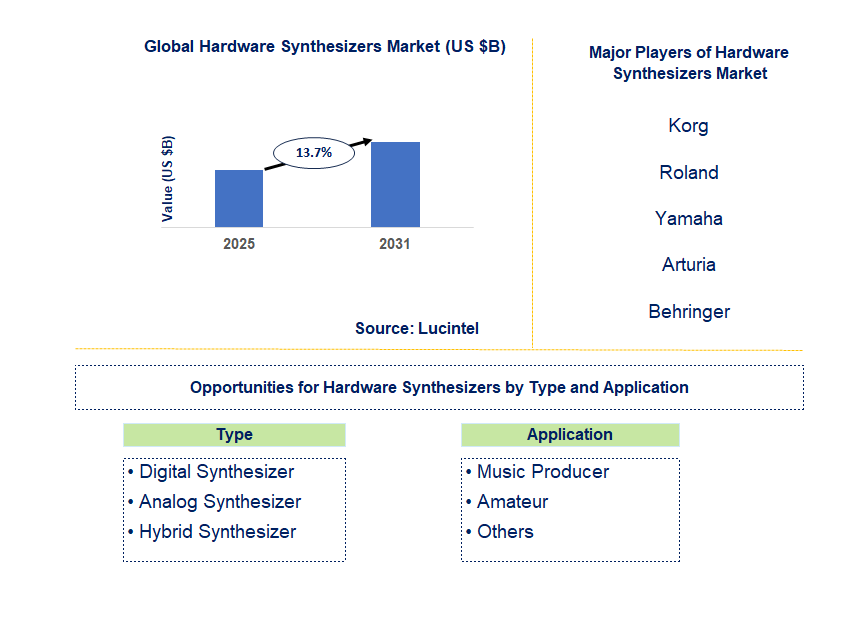
Key data points: The growth forecast = 13.7% annually for the next 7 years. Scroll below to get more insights. This market report covers Trends, opportunity and forecast in hardware synthesizers market to 2031 by type (digital synthesizer, analog synthesizer, and hybrid synthesizer), application (music producer, amateur, and others), and region (North America, Europe, Asia Pacific, and the Rest of the World)
We'll send your sample report shortly.
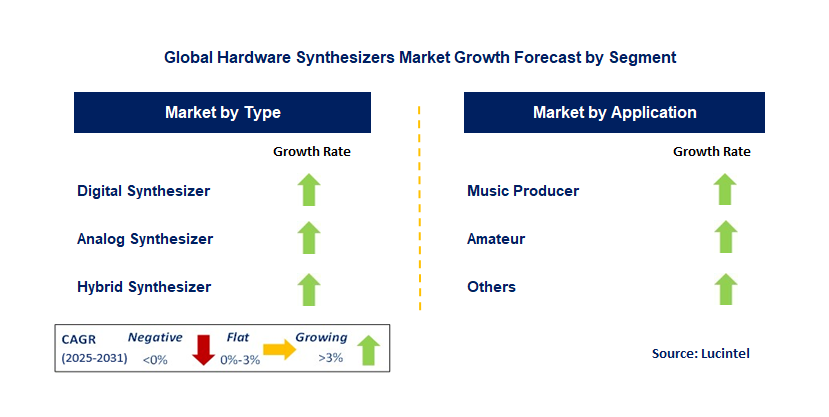
• Lucintel forecasts that, within the type category, digital synthesizers is expected to witness the highest growth over the forecast period due to growing demand for versatile sound design capabilities is driving the adoption of digital synthesizers.
• Within the application category, music producers is expected to witness the higher growth due to increasing demand for unique and customizable audio in music production is boosting hardware synthesizer usage.
• In terms of region, North America is expected to witness the highest growth over the forecast period. Gain valuable insights for your business decisions with our comprehensive 150+ page report. Sample figures with some insights are shown below.
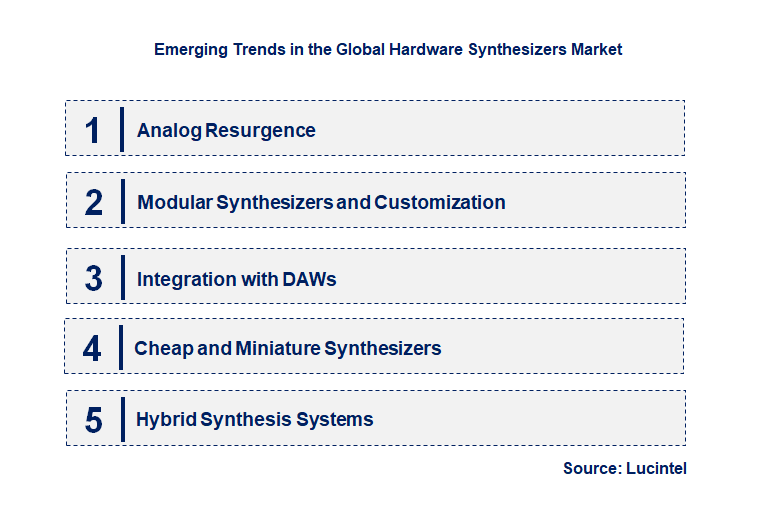
• Analog Resurgence: The greatest trend characterizing the market is the resurgence of analog synthesizers. Many musicians and producers prefer the warm, rich sound of analog synthesizers, which has a unique character that cannot be achieved by digital models. Thus, many hardware manufacturers are focusing on developing new analog synthesizers or revisiting classic designs. The trend is also very apparent in the growing boutique analog synthesizers, which bring modern features into the traditional analog sound production. Analog synthesizers are also being combined with digital features to make them more versatile.
• Modular Synthesizers and Customization: Modular synthesizers have become popular, especially among advanced users who want full control over their sound design. These synthesizers allow for more customization since musicians can mix and match various modules to create unique setups. This trend is being driven by the personal music production tool demand, along with the personalization of sounds towards extremely specialized sounds. Modular systems also tend to give synthesis through a sort of hands-on, tactile approach, so perfect for those users who want to try to create new sonics out of pure experimentation and exploration.
• Integration with DAWs: As the production of music becomes further immersed in digital environments, hardware synthesizers are being created to integrate seamlessly with DAWs. It marks the requirement for greater versatility and convenience in producing music. Generally, hardware synthesizers equipped with built-in MIDI and USB connections are making it easier for musicians to incorporate their synths into their digital workflow more efficiently. This can be accompanied by integration that involves hardware synthesizers and DAWs, which means further editing, more effects processing, and control over the production process.
• Cheap and Miniature Synthesizers: There is increasing demand for miniaturized and low-cost hardware synthesizers, particularly from beginners and for amateur musicians. Manufacturers are catering to that demand through portable synthesizers that not only sound great but are also more budget-friendly and affordable. Such synthesizers commonly integrate digital technology, so even though they are smaller, they don't lose performance. The compact models especially attract producers with restricted budgets or who need them for gigs and mobile production setups.
• Hybrid Synthesis Systems: Hybrid synthesizers are those that include analog and digital parts. Such synthesizers bring the best from both, so they offer warmth and character like in analog synthesis and versatility and precision as in digital synthesis. This trend is particularly appealing to producers wanting to produce a wide array of sounds while retaining the authentic feel of analog instruments. Hybrid systems are also in vogue as they have the capability to deliver more complex options of modulation and can also have an integrated digital effects. Emerging trends within the hardware synthesizer market-the resurgence of analog models, rise of modular systems, and increasing integration with DAWs-are remodeling the landscape of music production. These trends indicate the need for more personal, affordable, and flexible tools as well as a trend toward combining analog and digital technologies in the creation of innovative new products. All these trends are bound to impact consumer preferences as well as fuel further new product development as the market evolves.
• Boutique Synthesizer Brands: There is growing interest in boutique synthesizer brands, where professional musicians want specific, customized sounds. This kind of synthesizer makes the product valuable and pushes sales. Brands offering boutique models and high-quality synthesizers handcrafted to sound and look differently and uniquely than all others, giving birth to some established giants in this marketplace. This development is now motivating the giants, too, to become boutique for the higher-quality, exclusive demands of musicians who always look for the niche.
• Analog-Digital Hybrid Synths Innovation: A hybrid synthesizer is the integration of both analog and digital components into one product. It has allowed musicians to combine the warmth of analog sound with the precision and flexibility of digital features. Hybrid synthesizers open up more possibilities in modulation and sound design complexity without losing the feel of the analog synthesis. This has been widely welcomed by professional producers as well as hobbyists who need high-performance versatile tools for music production.
• Development of Affordable Entry-level Synths: Affordable entry-level synthesizers have expanded the market by allowing a wider population to access music production tools. The high-quality synthesizers that manufacturers produce at lower price points have made it possible for more people to explore music production. These affordable models are usually designed with streamlined concepts, which concentrate on the most essential features but ensure solid sound quality. This trend has allowed new musicians to enter the market without making heavy financial investments.
• MIDI and USB connectivity integration: The integration of MIDI and USB connectivity into hardware synthesizers has greatly improved their functionality and usability. It allows synthesizers to connect easily with digital audio workstations (DAWs) and other devices, making it easier to integrate hardware into modern music production workflows. MIDI and USB compatibility make live performances and studio productions much more flexible. Musicians can easily control their synthesizers with higher precision.
• Focus on Live Performance Features: Many hardware synthesizers are now designed with live performances in mind. These instruments are constructed to survive the testing of a touring and live show. Features range from sound-manipulation controls performed in real time to easy handling in fast-moving environments. Such development can trace its evolution to the electronic music festivals and performances, thereby seeking more spontaneous and flexible tools for the performer. These current developments-introduction of boutique brands, innovation in hybrid synths, and access for entry-level users-are steering the future of the hardware synthesizer market. Firms are answering the rising hunger among the users toward the new-age, commercially viable, and user-friendly synthesizers to evolve and change constantly for musicians and producers.
• Live Performance Synthesizers: The demand in synthesizers dedicated to live shows is a new area of growing opportunity. Together with the popularization of electronic music festivals and live shows, there is currently a growing need for synthesizers that meet the demands placed on them with live performance needs. Manufacturers would do well to capitalize on these trends by devising synthesizers with features specifically set up for live players, such as real-time control over sound as well as customizable patch sets and maximum portability.
• Growth of Synthesizers for Film and TV Scoring: Synthesizers are increasingly used in film and TV scoring. This application, therefore, holds much growth potential. With increased demand for high-quality sound design in media production, hardware synthesizers become the most essential tools for composers and sound designers. Manufacturers who focus on creating unique sound qualities with cinematic capabilities in synthesizers will be able to tap into this growing market and provide valuable tools for the entertainment industry.
• Increasing Demand for Synthesizers in Educational Campuses: The number of educational campuses offering courses in music production has increased. Institutions of learning, especially music production institutes, are a booming market for hardware synthesizers. Synthesizers' demand will increase as more programs in music production are developed and students require hands-on experimentation with synthesizers. Affordable, robust educational models would cater to the needs of both educators and students and would be a perfect potential target market for manufacturers.
• Development of Portable Synthesizers for On-the-Go Production: Portable synthesizers have been gaining popularity in the hands of musicians who need flexibility in producing music on the go. Compact, battery-powered synthesizers appeal to mobile musicians and producers traveling frequently or who prefer to create outside the studio. This trend holds a significant opportunity for manufacturers to develop lightweight, feature-packed synthesizers designed for portability and ease of use in a variety of environments.
• Focus on Synthesizers for the Indie Music Scene: The uprising indie music genre opens the door to hardware synthesizers that would serve independent artists with specific requirements. This type of synthesizer is usually sought after by indie artists who wish to creatively produce popular and innovative sounds. If companies can fabricate models to suit this market, a huge part of the music industry, now growing rapidly, can be captured by them. There are ample strategic growth opportunities in the hardware synthesizer market, especially in applications that involve live performances, film scoring, education, portability, and the indie music scene. Manufacturers must penetrate these applications to achieve growth and introduce solutions that better suit the evolving needs of musicians and producers.
• Korg
• Roland
• Yamaha
• Arturia
• Behringer
• Elektron
• Sequential
• Teenage Engineer
• M-Audio
• Akai
• Digital Synthesizer
• Analog Synthesizer
• Hybrid Synthesizer
• Music Producer
• Amateur
• Others
• North America
• Europe
• Asia Pacific
• The Rest of the World
• United States: The hardware synthesizer market in the United States has been experiencing a resurgence, particularly among musicians and producers who appreciate analog warmth and hands-on control. Moog and Roland, among other companies, keep innovating in synthesizer models that blend the old with new features. There is also an increasing trend in live performances involving hardware synthesizers and modular systems, which is giving birth to more specialized and customizable equipment. The U.S. market also benefits from the partnerships of companies dealing in hardware synthesizers with software firms, which involves them in more versatile, integrated systems for music production.
• China: The developing hardware synthesizer market in China is based upon the growing demand of new consumers- primarily the younger generations of people who now want to make music on their own. The rising electronic music and production culture are becoming a good market for hardware synthesizer companies in the country. Since the growth of electronic music, Chinese companies have been offering affordable synthesizer models both to beginners and professionals. In this case, China has emerged as a hub of electronic musicians and producers, becoming an important market for international brands as well as local synthesizer companies. The availability of cheaper manufacturing options in China also benefits global synthesizer brands.
• Germany: Germany has long been a hub for electronic music, and its hardware synthesizer market continues to thrive as a result. The country is home to some of the most renowned synthesizer brands, such as Doepfer and Waldorf, which have been pushing the boundaries of modular synthesizer design and sound innovation. The country's music scene, particularly in techno and experimental electronic music, drives a very strong demand for high-quality, versatile hardware synthesizers. Germany also has a very educated consumer base, and industry support is also excellent, as is evident with the Super booth, which exhibits new developments in hardware synthesizer technology.
• India: In India, the hardware synthesizer market is slowly growing due to independent music production and interest in electronic music. Due to the country's young, technology-savvy population, adoption of electronic music production tools is increasing. However, the market remains relatively new and demand for budget synthesizers is building with the emerging potential of aspiring music producers and DJs. Indian consumers also increasingly adopt hybrid systems that pair hardware synthesizers with DAWs. With local music festivals and electronic music scenes developing, the hardware synthesizer market is expected to grow further.
• Japan: For decades, Japan has been the leader in the hardware synthesizer market. Yamaha, Roland, and Korg continue to innovate and lead the industry. The long history of synthesizer development in Japan, especially in the context of electronic music and popular culture, continues to contribute to the country's success in the market. The Japanese are also famous for producing some of the most innovative products in the world, including Korg Minilogue and Yamaha's digital synthesizers. In terms of competition, Japan has a highly competitive market where there is an even demand for both analog and digital hardware synthesizers. Its export capabilities also put it in a strategic position to be one of the world's top synthesizer industries.


• Korg
• Roland
• Yamaha
• Arturia
• Behringer
• Elektron
• Sequential
• Teenage Engineer
• M-Audio
• Akai Q5. Which hardware synthesizers market segment will be the largest in future? Answer: Lucintel forecasts that digital synthesizers is expected to witness the highest growth over the forecast period due to growing demand for versatile sound design capabilities is driving the adoption of digital synthesizers. Q6. In hardware synthesizers market, which region is expected to be the largest in next 5 years? Answer: North America is expected to witness the highest growth over the forecast period. Q7. Do we receive customization in this report? Answer: Yes, Lucintel provides 10% customization without any additional cost.


Choose a license that fits your team. Instant PDF delivery.
Prices exclude taxes. Instant delivery. Custom licensing available on request.
Market Report · July 29, 2026
Market Report · July 20, 2026
Market Report · July 20, 2026
Trusted partner for strategic intelligence and business growth


Receive a complimentary market analysis tailored to your industry. Our analysts will identify key growth opportunities and competitive dynamics specific to your business.

Market size, growth rate, and key trend analysis for your specific sector.

Top competitor positioning and market share analysis.

Strategic recommendations backed by data-driven insights.
Get curated market intelligence and competitive moves straight to your inbox.
By subscribing, you agree to receive our monthly insights. Unsubscribe anytime.
Receive a complimentary market analysis tailored to your industry. Our analysts will identify key growth opportunities and competitive dynamics specific to your business.
Market size, growth rate, and key trend analysis for your specific sector.
Top competitor positioning and market share analysis.
Strategic recommendations backed by data-driven insights.
Get curated market intelligence, emerging trends, and competitive moves straight to your inbox each month.
By subscribing, you agree to receive our monthly insights. Unsubscribe anytime.
We'll send your sample report shortly.