
Market Report · July 29, 2026

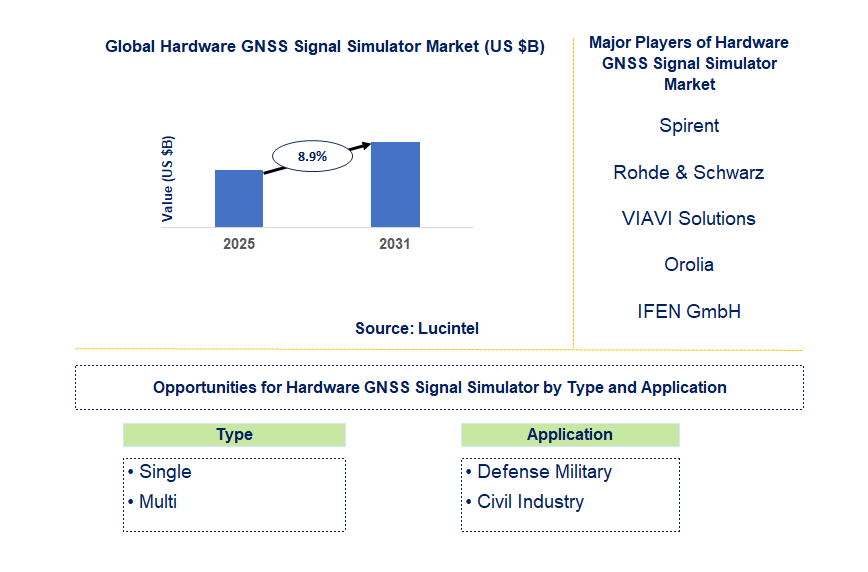
Key data points: The growth forecast = 8.9% annually for the next 7 years. Scroll below to get more insights. This market report covers Trends, opportunity and forecast in hardware GNSS signal simulator market to 2031 by type (single and multi), application (defense military and civil industry), and region (North America, Europe, Asia Pacific, and the Rest of the World)
We'll send your sample report shortly.
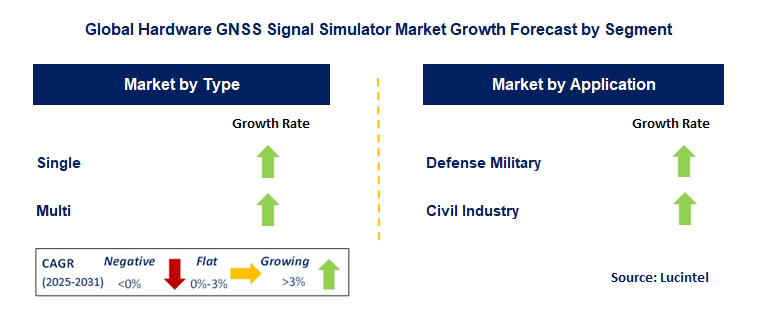
• Lucintel forecasts that, within the type category, single is expected to witness higher growth over the forecast period.
• Within the application category, the defense military is expected to witness higher growth.
• In terms of region, APAC is expected to witness the highest growth over the forecast period. Gain valuable insights for your business decisions with our comprehensive 150+ page report. Sample figures with some insights are shown below.
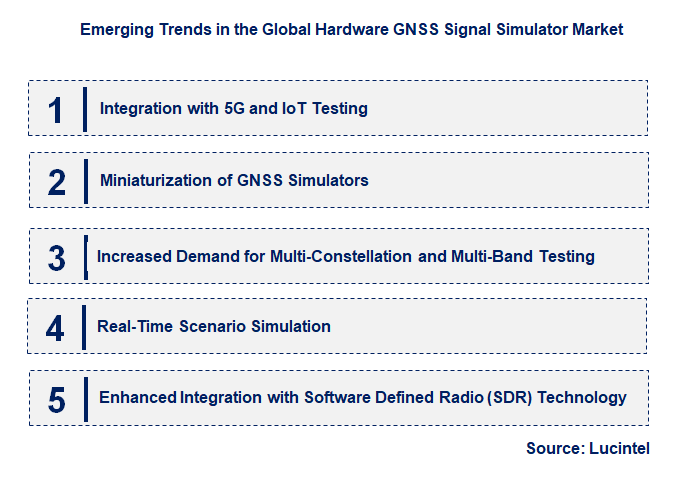
• Integration with 5G and IoT Testing: Hardware GNSS signal simulators are increasingly integrated with 5G and IoT testing environments. As 5G networks expand and IoT applications proliferate, the need to simulate GNSS signals in 5G and IoT devices has surged. Simulators help ensure that GNSS-based location services, such as those used in autonomous vehicles, smart cities, and logistics, perform accurately within the 5G infrastructure. This trend is significant for industries requiring seamless GNSS integration with high-speed, low-latency 5G networks to enable real-time positioning and tracking.
• Miniaturization of GNSS Simulators: Miniaturization is a prominent trend in the GNSS signal simulator market. As the demand for portable and compact testing solutions grows, manufacturers are designing smaller and more portable simulators without compromising performance. These miniaturized simulators are ideal for field testing, providing flexibility for engineers working in remote locations or confined spaces. Miniaturization also reduces costs, making high-quality GNSS testing tools more accessible to a wider range of industries, from automotive to handheld consumer electronics, driving innovation in product design and functionality.
• Increased Demand for Multi-Constellation and Multi-Band Testing: As GNSS technology evolves, there is a growing need for simulators capable of handling multiple constellations (e.g., GPS, GLONASS, Galileo, Beidou) and multiple frequency bands. Multi-constellation testing is crucial for ensuring that GNSS receivers can operate effectively in diverse global environments. Hardware GNSS simulators are increasingly offering support for these complex testing requirements, enabling more comprehensive testing and validation of GNSS-based devices. This trend is driven by the increasing use of multi-constellation GNSS systems for applications requiring higher precision and resilience, such as aviation and military navigation.
• Real-Time Scenario Simulation: Hardware GNSS signal simulators are evolving to support real-time scenario simulation, where the device replicates dynamic, real-world environments. This allows for the simulation of complex GNSS signal scenarios, such as high-speed motion, urban canyons, and multi-path effects, providing more realistic testing conditions. This trend is particularly important for industries like automotive (especially autonomous driving) and aerospace, where accurate, real-time simulation of navigation conditions is essential for testing safety-critical systems. Real-time scenario simulation enables thorough validation and ensures that GNSS systems function correctly under varying environmental factors.
• Enhanced Integration with Software Defined Radio (SDR) Technology: Software Defined Radio (SDR) technology is being increasingly integrated into hardware GNSS signal simulators to provide greater flexibility and adaptability. SDR allows users to reconfigure the signal generation and processing through software, enhancing the versatility of GNSS simulators. This trend is particularly valuable for developers who need to rapidly adapt the simulator for various testing scenarios or modify signal parameters on the fly. The combination of SDR with GNSS simulators enables customized signal testing, allowing for a broader range of testing in dynamic and evolving environments such as defense, aerospace, and telecommunications. Emerging trends such as integrating 5G and IoT, miniaturization, multi-constellation and multi-band testing, real-time scenario simulation, and enhanced SDR integration are reshaping the hardware GNSS signal simulator market. These developments enable more advanced, flexible, and accurate testing capabilities, expanding the range of applications for GNSS technology. As industries continue to innovate in autonomous systems, telecommunications, and precision navigation, these trends will drive the adoption of GNSS simulators, ensuring that the next generation of GNSS-enabled devices operates seamlessly in increasingly complex and demanding environments.
• Integration of Multi-Constellation Support: Recent advancements in GNSS signal simulators now support multi-constellation systems, including GPS, GLONASS, Galileo, and BeiDou. This capability enables simulators to replicate a wider range of satellite signals, enhancing the testing of navigation systems that rely on multiple GNSS constellations for improved accuracy and reliability. This is particularly beneficial for industries such as automotive, where precise and redundant navigation is crucial for autonomous driving systems. By supporting these diverse systems, simulators help ensure that navigation devices can operate effectively in global environments, providing more comprehensive testing across different geographic regions and operational scenarios.
• Increased Frequency Bandwidth and Multi-Frequency Simulation: Another important development is the increase in frequency bandwidth and the ability to simulate multiple frequency bands. Multi-frequency simulators are capable of replicating signals from L1, L2, L5, and other frequency bands used by modern GNSS systems. This improvement enables more accurate testing of GNSS receivers that are designed to use multiple frequencies to mitigate signal degradation and improve positioning precision, especially in challenging environments such as urban canyons or mountainous areas. The ability to simulate these complex signal conditions is critical for sectors that require high-precision navigation, including aerospace and defense.
• Real-Time and Cloud-Based Simulation: The shift towards real-time and cloud-based GNSS signal simulators is reshaping the market by offering greater flexibility and scalability. Cloud-based simulators enable users to conduct simulations remotely, eliminating the need for expensive on-site hardware setups and reducing operational costs. Additionally, real-time simulators allow for instant updates, providing more dynamic and responsive testing environments. This development is particularly advantageous for organizations that require constant testing and calibration of navigation systems, such as the automotive and aerospace industries, which need to ensure the ongoing reliability of their GNSS-based technologies.
• Compact and Portable Simulators: The demand for compact and portable GNSS simulators has increased, especially in the defense and field-testing sectors. Smaller, lightweight simulators can be easily transported and deployed in remote locations, making them ideal for mobile applications and on-the-go testing. These portable systems are particularly useful in military and emergency response operations, where testing and validation of navigation systems must be conducted in varied environments. The ability to simulate GNSS signals on-site enhances operational readiness and ensures that equipment remains fully functional, even in remote or rugged conditions, expanding the usability of simulators in various industries.
• Enhanced Interference Simulation: Advances in simulating interference and jamming signals have become a key feature of modern GNSS simulators. The ability to replicate both natural and artificial interference allows for more comprehensive testing of GNSS receivers' robustness and resilience. This development is essential for industries like defense, where GNSS systems must be tested against potential threats such as jamming or spoofing attacks. Enhanced interference simulation helps ensure that critical navigation systems can maintain accurate positioning even in the presence of external disruptions, safeguarding the reliability of GNSS-based applications in security-sensitive environments. These recent developments in the hardware GNSS signal simulator market reflect the growing demand for advanced testing capabilities across industries relying on satellite navigation systems. The integration of multi-constellation support, increased frequency bandwidth, real-time and cloud-based simulation, compact and portable designs, and enhanced interference simulation are enhancing the accuracy, reliability, and flexibility of GNSS signal testing. These innovations are crucial for industries such as aerospace, automotive, defense, and telecommunications, ensuring that GNSS receivers perform optimally in real-world conditions. As these developments continue, the market for GNSS signal simulators will expand, offering new solutions to meet the evolving needs of the global navigation ecosystem.
• Autonomous Vehicles: The rise of autonomous vehicles presents a significant growth opportunity for GNSS signal simulators. These vehicles rely heavily on precise navigation and positioning, making advanced testing essential to ensure safety and performance. GNSS simulators enable manufacturers to replicate real-world conditions, such as urban canyons and tunnels, to evaluate the robustness of navigation systems. Additionally, they allow testing of multi-frequency and multi-constellation capabilities, which are critical for redundancy and accuracy. This application is set to grow as the adoption of autonomous driving technology expands, particularly in industries such as logistics, public transportation, and personal vehicles.
• Aerospace and Defense: In aerospace and defense, GNSS signal simulators are vital for testing navigation systems under extreme and challenging conditions. This includes simulating high-altitude environments, interference, jamming, and spoofing scenarios. With increasing reliance on GNSS for aircraft navigation, missile guidance, and military operations, the demand for precise and robust testing solutions is rising. Advanced simulators help ensure the reliability and resilience of systems in mission-critical applications, contributing to strategic defense capabilities and aviation safety. As global aerospace and defense investments continue to grow, this segment offers substantial potential for market expansion.
• Telecommunications: Telecommunications infrastructure depends on accurate GNSS timing for network synchronization. GNSS simulators are used to test and validate timing systems to prevent disruptions in communications. The rollout of 5G networks has further amplified the need for precision timing, as these networks require stringent synchronization to deliver high-speed data services. GNSS signal simulators enable telecom providers to ensure system reliability and identify vulnerabilities in timing mechanisms. This application is poised for growth as 5G adoption accelerates globally, with additional opportunities arising from the future development of 6G networks.
• Agriculture and Precision Farming: The use of GNSS technology in agriculture has revolutionized precision farming by enabling applications such as autonomous tractors, yield mapping, and variable rate technology. GNSS signal simulators support the development and testing of these systems by replicating diverse field conditions, such as signal interference caused by dense foliage or rural terrain. As the agricultural industry increasingly adopts smart farming technologies to improve efficiency and sustainability, the demand for reliable GNSS testing solutions is expected to grow. This application provides a significant growth avenue for simulator manufacturers targeting the agri-tech sector.
• Consumer Electronics and Wearables: The integration of GNSS in consumer electronics, including smartphones, smartwatches, and fitness trackers, has created a growing need for accurate positioning. GNSS signal simulators are used by manufacturers to test devices under various signal conditions, ensuring reliable performance in different environments. Features such as multi-frequency GNSS and enhanced location accuracy in urban areas are key testing focus areas. With the increasing popularity of wearables and IoT devices, this application represents a lucrative growth opportunity. Simulators help developers deliver high-quality products, meeting consumer demands for precision and reliability. Strategic growth opportunities in the hardware GNSS signal simulator market are being driven by advancements across key applications such as autonomous vehicles, aerospace and defense, telecommunications, agriculture, and consumer electronics. Each sector presents unique challenges and requirements that simulators address through advanced testing and validation capabilities. By focusing on these applications, manufacturers can align their solutions with market demands, fostering innovation and expanding their reach. These opportunities are reshaping the GNSS Signal Simulator market, enabling industries to develop more reliable and efficient navigation technologies that meet the evolving needs of a highly interconnected world.
• Spirent
• Rohde & Schwarz
• VIAVI Solutions
• Orolia
• IFEN GmbH
• CAST Navigation
• RACELOGIC
• Jackson Labs Technologies
• Syntony GNSS
• WORK Microwave
• Single
• Multi
• Defense Military
• Civil Industry
• North America
• Europe
• Asia Pacific
• The Rest of the World
• United States: In the United States, the hardware GNSS signal simulator market is being driven by technological advancements and increasing demand for more accurate and versatile simulation tools. The U.S. aerospace and defense sectors are major consumers, with simulators being crucial for testing navigation systems in spacecraft, military equipment, and autonomous vehicles. Leading companies are integrating multi-constellation GNSS signals, allowing simulators to replicate signals from GPS, GLONASS, Galileo, and BeiDou systems. Furthermore, advancements in software and cloud-based simulation platforms are enhancing testing flexibility, enabling real-time updates and remote access. These innovations are supporting the rapid development of advanced GNSS-enabled systems.
• China: China is witnessing significant growth in the hardware GNSS signal simulator market, fueled by the expansion of its space exploration programs and a strong push towards technological self-sufficiency. The Chinese government’s investment in satellite infrastructure, particularly its BeiDou Navigation Satellite System, has spurred the demand for high-performance GNSS simulators. Local manufacturers are improving their simulation technology to support both civilian and military applications. Additionally, China’s automotive and drone sectors are increasingly adopting GNSS simulators to enhance autonomous navigation capabilities. These developments are contributing to the country’s overall push to become a global leader in satellite and GNSS technologies.
• Germany: Germany is a key player in the European market for Hardware GNSS Signal Simulators, especially in the automotive and aerospace industries. German companies are adopting GNSS simulators to support the development of autonomous driving technologies and advanced aviation navigation systems. The country’s automotive sector is particularly focused on testing navigation systems for self-driving cars and connected vehicles. Germany is also home to several leading research institutions that are developing next-generation simulators capable of replicating complex signal environments and testing multi-frequency, multi-constellation GNSS systems. This enables enhanced precision and reliability in navigation and positioning technologies across various sectors.
• India: The Indian hardware GNSS signal simulator market is evolving with increasing applications in defense, aerospace, and agriculture. The Indian Space Research Organisation (ISRO) has been a driving force in developing and testing satellite systems, creating demand for advanced GNSS simulators to support their programs. The defense sector, including the Indian Army and Air Force, is increasingly utilizing GNSS simulators for training and developing navigation systems for missile guidance and drones. Additionally, the rising interest in agricultural applications of GNSS technology for precision farming is also contributing to the growth of the simulator market, as accurate positioning data is critical for these technologies.
• Japan: The Japanese market for Hardware GNSS Signal Simulators is growing, particularly in the automotive, robotics, and telecommunications sectors. Japanese companies are integrating GNSS simulators to enhance the development of autonomous vehicles and smart transportation systems. The country’s robotics industry is also adopting these simulators to test navigation and positioning systems in industrial robots, drones, and autonomous delivery systems. Japan’s emphasis on smart city initiatives and advanced infrastructure also drives the demand for accurate GNSS testing. Innovations such as multi-frequency and multi-constellation simulators are helping Japan stay at the forefront of GNSS-related technology development, ensuring its positioning solutions are globally competitive.


• Spirent
• Rohde & Schwarz
• VIAVI Solutions
• Orolia
• IFEN GmbH
• CAST Navigation
• RACELOGIC
• Jackson Labs Technologies
• Syntony GNSS
• WORK Microwave Q5. Which hardware GNSS signal simulator market segment will be the largest in future? Answer: Lucintel forecasts that single is expected to witness higher growth over the forecast period. Q6. In hardware GNSS signal simulator market, which region is expected to be the largest in next 5 years? Answer: APAC is expected to witness the highest growth over the forecast period. Q7. Do we receive customization in this report? Answer: Yes, Lucintel provides 10% customization without any additional cost.


Choose a license that fits your team. Instant PDF delivery.
Prices exclude taxes. Instant delivery. Custom licensing available on request.
Market Report · July 29, 2026
Market Report · July 20, 2026
Market Report · July 20, 2026
Trusted partner for strategic intelligence and business growth


Receive a complimentary market analysis tailored to your industry. Our analysts will identify key growth opportunities and competitive dynamics specific to your business.

Market size, growth rate, and key trend analysis for your specific sector.

Top competitor positioning and market share analysis.

Strategic recommendations backed by data-driven insights.
Get curated market intelligence and competitive moves straight to your inbox.
By subscribing, you agree to receive our monthly insights. Unsubscribe anytime.
Receive a complimentary market analysis tailored to your industry. Our analysts will identify key growth opportunities and competitive dynamics specific to your business.
Market size, growth rate, and key trend analysis for your specific sector.
Top competitor positioning and market share analysis.
Strategic recommendations backed by data-driven insights.
Get curated market intelligence, emerging trends, and competitive moves straight to your inbox each month.
By subscribing, you agree to receive our monthly insights. Unsubscribe anytime.
We'll send your sample report shortly.