
Market Report · July 16, 2026

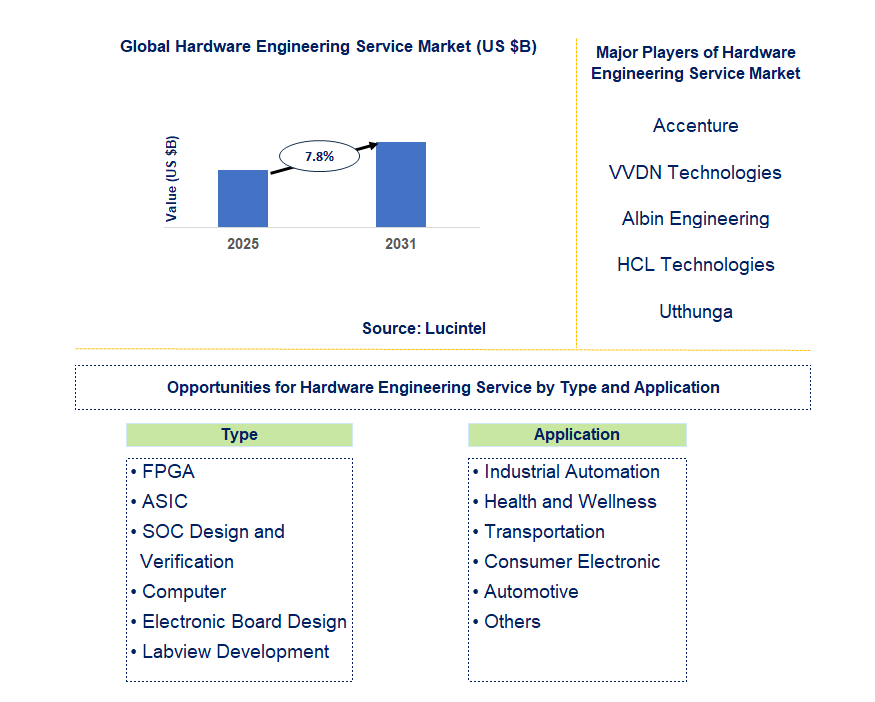
Key data points: The growth forecast = 7.8% annually for the next 7 years. Scroll below to get more insights. This market report covers Trends, opportunity and forecast in hardware engineering service market to 2031 by type (FPGA, ASIC, SOC design and verification, computer, electronic board design, and labview development), application (industrial automation, health and wellness, transportation, consumer electronic, automotive, and others), and region (North America, Europe, Asia Pacific, and the Rest of the World)
We'll send your sample report shortly.
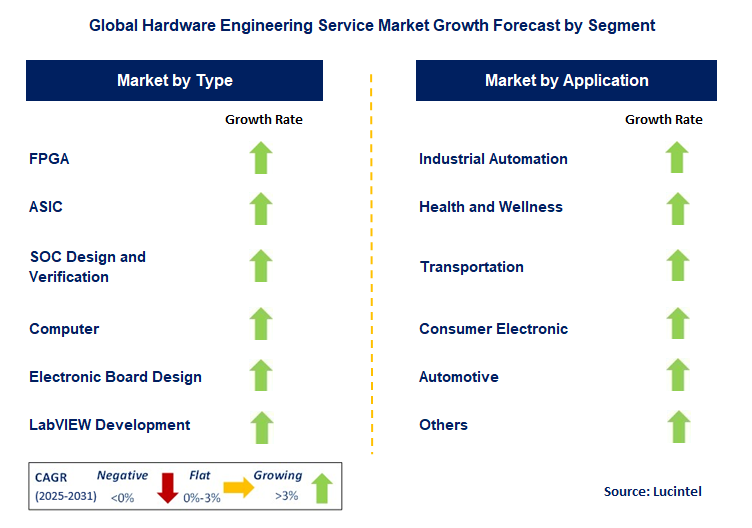
• Lucintel forecasts that, within the type category, FPGA is expected to witness the highest growth over the forecast period.
• Within the application category, industrial automation is expected to witness the highest growth.
• In terms of region, APAC is expected to witness the highest growth over the forecast period. Gain valuable insights for your business decisions with our comprehensive 150+ page report. Sample figures with some insights are shown below.
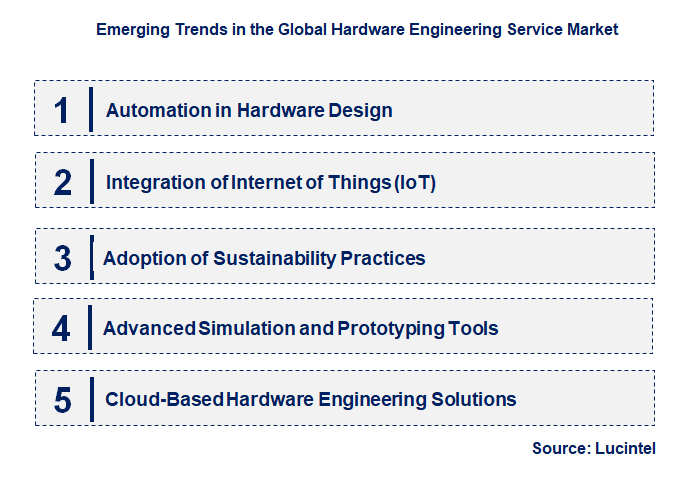
• Automation in Hardware Design: Automation is revolutionizing hardware design and development processes. By leveraging advanced software tools and algorithms, engineers can automate tasks such as schematic generation, component placement, and routing, reducing human error and accelerating development cycles. Automation also allows for faster iterations and prototyping, ultimately speeding up time-to-market. The increased use of artificial intelligence (AI) in design processes optimizes hardware layouts and improves overall efficiency, making hardware systems more adaptable and scalable. As automation becomes more integrated into hardware engineering, it enables companies to meet the growing demand for more complex and customized solutions.
• Integration of Internet of Things (IoT): The integration of IoT technologies into hardware engineering services is transforming product development. With IoT, engineers can design smarter and more interconnected systems that enhance functionality and performance. This trend is particularly prominent in industries such as automotive, healthcare, and consumer electronics. Hardware engineers are increasingly tasked with creating devices that not only operate individually but communicate with each other in a network, providing real-time data collection and analysis. IoT integration enables predictive maintenance, remote monitoring, and enhanced product experiences, thereby boosting the demand for hardware solutions that support IoT connectivity and functionality.
• Adoption of Sustainability Practices: Sustainability has become a critical focus for hardware engineering services, driven by regulatory pressures and consumer demand for eco-friendly products. This trend involves designing energy-efficient hardware, using sustainable materials, and focusing on the recyclability of components. Hardware engineering firms are also incorporating lifecycle management strategies to reduce waste and promote circular economies. As companies become more environmentally conscious, hardware engineers are working to develop energy-efficient products with lower carbon footprints, aligning with global sustainability goals. This trend not only meets market demands but also helps companies comply with increasingly stringent environmental regulations.
• Advanced Simulation and Prototyping Tools: Advanced simulation and prototyping tools are used to reshape the hardware engineering landscape by enabling more accurate and efficient product testing. Virtual prototypes and simulations allow engineers to test hardware performance in various scenarios without physical prototypes, reducing both time and costs. Tools such as finite element analysis (FEA) and computational fluid dynamics (CFD) simulations enable designers to optimize the design process, ensuring better-quality products with fewer errors. As these tools become more advanced and accessible, they empower engineers to refine hardware designs early in the development phase, thus improving overall product quality and reliability.
• Cloud-Based Hardware Engineering Solutions: Cloud-based platforms are increasingly becoming a critical tool in hardware engineering, allowing teams to collaborate, access design tools, and manage resources remotely. These solutions facilitate real-time communication between global teams, enabling faster decision-making and more flexible workflows. Cloud computing also supports the use of powerful design tools and massive data storage without the need for expensive on-premise infrastructure. This trend is particularly important for hardware engineers working on complex, multi-component systems where collaboration and data sharing are essential. By adopting cloud-based platforms, companies can streamline their hardware design and manufacturing processes, leading to greater efficiency and innovation. The emerging trends in the hardware engineering service market reflect the sector's response to evolving technology, market demands, and sustainability imperatives. Automation, IoT integration, sustainability practices, advanced simulation tools, and cloud-based solutions are transforming the way hardware products are designed, developed, and brought to market. These trends enable faster, more efficient, and cost-effective hardware development while also enhancing product performance and meeting consumer expectations. As these trends continue to evolve, hardware engineering services will become more agile, innovative, and aligned with the needs of modern industries, driving the market toward more advanced and sustainable solutions.
• Integration of AI and IoT in Hardware Development: The increasing integration of artificial intelligence (AI) and the Internet of Things (IoT) into hardware systems is one of the most significant developments in the hardware engineering services market. Companies are looking for hardware solutions that seamlessly integrate these technologies to create smarter, more connected devices. This development allows for the creation of advanced products, such as intelligent home devices, wearable technology, and autonomous vehicles. The ability to develop hardware capable of supporting AI and IoT applications increases the demand for specialized engineering services, positioning companies to address the growing market for smart devices and interconnected systems.
• Focus on Customization and Tailored Solutions: Another major development is the rising demand for customized and tailored hardware solutions across industries. As businesses seek to optimize their operations and differentiate themselves in the marketplace, customized hardware is increasingly being seen as a key factor in gaining a competitive edge. Hardware engineering service providers are investing in creating bespoke hardware systems to meet specific client requirements, particularly in industries like automotive, healthcare, and telecommunications. This trend emphasizes the importance of flexibility in hardware design, allowing companies to address unique use cases and achieve superior performance that off-the-shelf hardware cannot deliver.
• Advancements in 5G Hardware Engineering: The global rollout of 5G networks is driving major developments in hardware engineering services, with a focus on designing and developing specialized 5G infrastructure hardware. This includes antennas, routers, small cells, and other equipment necessary to support faster and more efficient wireless communication. As 5G networks expand, hardware engineering service providers are crucial in creating the necessary infrastructure that can handle the high bandwidth and low latency requirements of 5G technology. This demand is prompting innovations in hardware design and new testing and manufacturing standards, significantly expanding the scope of services offered by hardware engineering firms.
• Sustainability in Hardware Design and Manufacturing: Sustainability has become a focal point in hardware engineering services, as companies are increasingly seeking eco-friendly and energy-efficient solutions. The push for green technology has led to the development of hardware components that minimize energy consumption and reduce environmental impact. This includes designing more efficient chips, utilizing sustainable materials, and improving the recyclability of hardware products. With regulatory pressures and growing consumer demand for sustainable products, hardware engineering services are prioritizing environmental considerations in their development processes. This trend not only helps companies comply with regulations but also aligns them with market demands for environmentally responsible products.
• Automation and Robotics in Hardware Manufacturing: The integration of automation and robotics into hardware manufacturing processes is transforming the hardware engineering services market. Automated systems are being deployed to streamline production, reduce human error, and increase the scalability of hardware production. Robotics is being used in assembly lines, testing, and packaging, enhancing overall efficiency and reducing costs. These technological advancements allow manufacturers to produce higher-quality products in less time while also supporting mass customization of hardware. As automation continues to evolve, hardware engineering service providers are adapting their operations to incorporate these advanced manufacturing techniques, leading to improved product quality and faster time-to-market. These recent developments—AI and IoT integration, demand for customized solutions, advancements in 5G, sustainability initiatives, and the automation of manufacturing processes—are significantly impacting the hardware engineering services market. As these trends continue, the market is expected to evolve toward more specialized, efficient, and sustainable hardware solutions. Companies are increasingly investing in research and development to address the growing demand for smarter, customized, and eco-friendly products. In this dynamic environment, hardware engineering service providers will need to stay at the forefront of these developments to remain competitive and meet the changing needs of industries worldwide.
• Consumer Electronics Design and Development: The consumer electronics industry is one of the key growth drivers for the hardware engineering services market. With the rapid pace of innovation, there is an ever-growing demand for advanced designs, better performance, and user-centric features in products like smartphones, wearables, and home appliances. Hardware engineers play a critical role in creating systems that optimize performance, reduce power consumption, and improve form factor. The growth opportunity lies in leveraging automation, miniaturization techniques, and high-performance components to meet these demands. Companies can also focus on developing integrated solutions that connect seamlessly with IoT devices to stay ahead of consumer expectations.
• Automotive Hardware Solutions: The automotive sector presents a significant growth opportunity for hardware engineering services, especially with the rise of electric vehicles (EVs), autonomous driving, and smart connected cars. Automotive hardware requires highly specialized components, from battery management systems to advanced driver-assistance systems (ADAS). Engineers have the opportunity to design components that address the challenges of power efficiency, safety, and seamless connectivity. The growing adoption of electric and autonomous vehicles requires hardware engineers to focus on high-performance components and integrate complex systems that support advanced functionality and connectivity, fostering growth in the automotive hardware engineering space.
• Healthcare and Medical Devices: In the healthcare industry, there is increasing demand for innovative, reliable, and regulatory-compliant medical devices. Hardware engineering services can capitalize on this demand by developing devices that support the Internet of Medical Things (IoMT), wearable health monitors, and diagnostic systems. Engineers can design systems that integrate wireless technologies, sensors, and data analytics capabilities for real-time monitoring and decision-making. The growing focus on personalized medicine, preventive healthcare, and remote patient monitoring offers opportunities to create cutting-edge solutions that improve patient outcomes while adhering to regulatory standards, presenting substantial growth potential in the healthcare sector.
• Industrial Automation and Robotics: The rise of Industry 4.0 has significantly increased demand for hardware solutions in industrial automation, including robotics, sensor systems, and control units. Hardware engineering services are essential for developing precise, reliable, and scalable solutions for automated manufacturing processes, material handling, and predictive maintenance. Growth opportunities in this sector include designing advanced robotics that enhances manufacturing flexibility and reduces downtime. Additionally, with the increasing use of artificial intelligence (AI) and machine learning in automation, engineers can focus on creating hardware systems that facilitate smarter decision-making and real-time monitoring, boosting productivity and performance in industrial environments.
• Telecommunications Infrastructure: Telecommunications is another sector witnessing growth opportunities for hardware engineering services, driven by the expansion of 5G networks and the increasing demand for high-speed internet connectivity. Engineers are tasked with developing hardware systems such as signal processors, routers, and antennas that support advanced telecommunications infrastructure. As 5G technology continues to roll out, there is a need for hardware that can handle higher frequencies, greater data throughput, and lower latency. Engineering services that focus on creating solutions that enhance network reliability, speed, and capacity will have significant growth potential as the global demand for faster connectivity increases. Strategic growth opportunities in the hardware engineering service market are emerging across various applications such as consumer electronics, automotive solutions, healthcare, industrial automation, and telecommunications. By focusing on innovative designs, enhanced performance, and regulatory compliance, hardware engineers can address the evolving demands of these sectors. As industries increasingly rely on advanced hardware to enable next-generation technologies, the market for hardware engineering services continues to expand. By capitalizing on these opportunities, service providers can strengthen their position in the market, driving growth and contributing to the development of cutting-edge solutions across diverse industries.
• Accenture
• VVDN Technologies
• Albin Engineering
• HCL Technologies
• Utthunga
• ACL Digital
• Velvetech
• Excellent Webworld
• Softeq Development
• Arrow
• FPGA
• ASIC
• Soc Design and Verification
• Computer
• Electronic Board Design
• Labview Development
• Industrial Automation
• Health and Wellness
• Transportation
• Consumer Electronic
• Automotive
• Others
• North America
• Europe
• Asia Pacific
• The Rest of the World
• United States: In the United States, the hardware engineering services market is being driven by rapid advancements in IoT, automation, and artificial intelligence. There is a growing demand for integrated hardware solutions that can support smart technologies across industries like automotive, healthcare, and consumer electronics. The U.S. is also seeing an increase in the development of custom hardware solutions to support emerging technologies such as 5G, AI, and autonomous systems. Moreover, the focus on automation and robotics within manufacturing has increased the need for specialized hardware engineering services, helping U.S. companies maintain a competitive edge in global markets.
• China: The Chinese hardware engineering services market continues to expand rapidly, supported by the country’s position as a global manufacturing hub. The emphasis is on upgrading infrastructure to support the latest technologies, particularly in sectors such as telecommunications, consumer electronics, and automotive. Chinese companies are focusing on creating high-performance hardware systems that integrate AI and IoT functionalities. Additionally, with a strong push from the government to innovate and boost domestic manufacturing capabilities, China is investing heavily in developing advanced hardware engineering services to maintain its leadership in the production of electronic components and systems, particularly for emerging technologies like 5G.
• Germany: The German hardware engineering services market is characterized by its focus on precision engineering and the growing importance of Industry 4.0. The adoption of smart manufacturing systems, automation, and AI integration has been driving demand for advanced hardware solutions. The country is investing in next-generation hardware to support its automotive, industrial automation, and renewable energy sectors. Germany's strong engineering expertise, especially in automotive and machinery, positions it as a leader in providing customized hardware engineering solutions. Furthermore, there is increasing attention on sustainable hardware design to align with environmental regulations and energy efficiency goals in manufacturing.
• India: In India, the hardware engineering services market is expanding due to increased demand for high-tech solutions in sectors like telecommunications, consumer electronics, and IT infrastructure. The country is emerging as a hub for cost-effective, high-quality hardware engineering services, with many global companies outsourcing design and development to Indian firms. India’s growing startup ecosystem is also driving innovation in hardware engineering, particularly in IoT and wearable devices. Additionally, government initiatives such as "Make in India" are encouraging local manufacturing and hardware innovation, creating new opportunities for hardware engineering services to support the growing industrial and technological needs of the country.
• Japan: Japan remains a global leader in hardware engineering, with advancements focusing on robotics, automation, and precision manufacturing. The country is increasingly integrating AI and machine learning into hardware design and development, particularly in robotics, automotive, and consumer electronics. Japan's strong research and development focus has enabled it to create cutting-edge hardware systems, particularly for industrial applications. The country also continues to emphasize the development of sustainable hardware solutions, with a strong push towards energy-efficient components and eco-friendly manufacturing practices. Japan’s hardware engineering services market is supported by its highly skilled workforce and innovative technological environment.


• Accenture
• VVDN Technologies
• Albin Engineering
• HCL Technologies
• Utthunga
• ACL Digital
• Velvetech
• Excellent Webworld
• Softeq Development
• Arrow Q5. Which hardware engineering service market segment will be the largest in future? Answer: Lucintel forecasts that FPGA is expected to witness the highest growth over the forecast period. Q6. In hardware engineering service market, which region is expected to be the largest in next 5 years? Answer: APAC is expected to witness the highest growth over the forecast period. Q7. Do we receive customization in this report? Answer: Yes, Lucintel provides 10% customization without any additional cost.


Choose a license that fits your team. Instant PDF delivery.
Prices exclude taxes. Instant delivery. Custom licensing available on request.
Market Report · July 16, 2026
Market Report · May 18, 2026
Market Report · May 18, 2026
Trusted partner for strategic intelligence and business growth


Receive a complimentary market analysis tailored to your industry. Our analysts will identify key growth opportunities and competitive dynamics specific to your business.

Market size, growth rate, and key trend analysis for your specific sector.

Top competitor positioning and market share analysis.

Strategic recommendations backed by data-driven insights.
Get curated market intelligence and competitive moves straight to your inbox.
By subscribing, you agree to receive our monthly insights. Unsubscribe anytime.
Receive a complimentary market analysis tailored to your industry. Our analysts will identify key growth opportunities and competitive dynamics specific to your business.
Market size, growth rate, and key trend analysis for your specific sector.
Top competitor positioning and market share analysis.
Strategic recommendations backed by data-driven insights.
Get curated market intelligence, emerging trends, and competitive moves straight to your inbox each month.
By subscribing, you agree to receive our monthly insights. Unsubscribe anytime.
We'll send your sample report shortly.