
Market Report · July 29, 2026

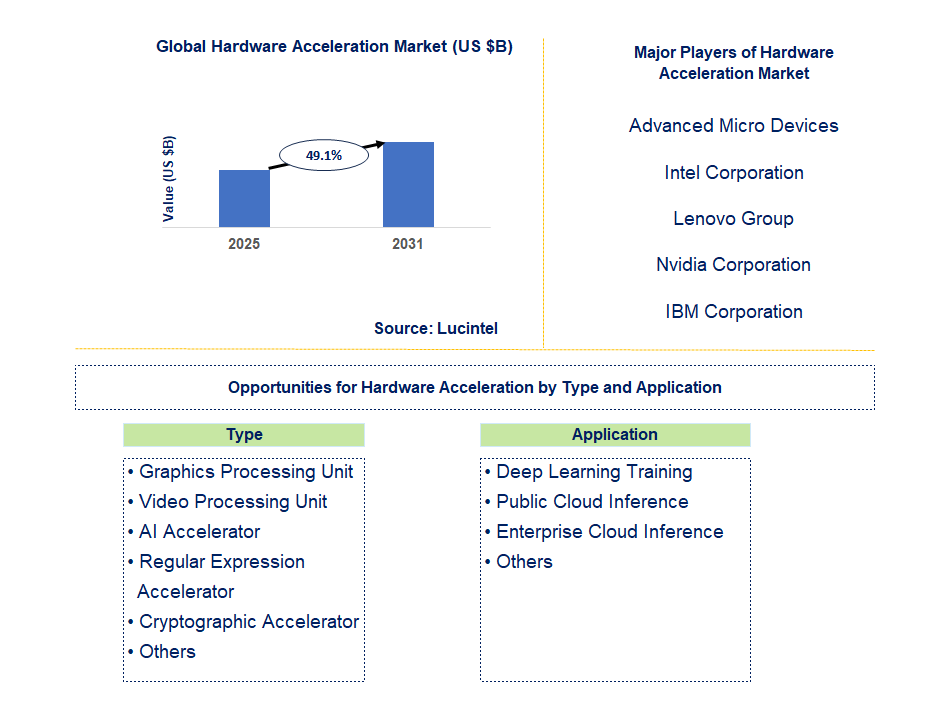
Key data points: The growth forecast = 49.1% annually for the next 7 years. Scroll below to get more insights. This market report covers Trends, opportunity and forecast in hardware acceleration market to 2031 by type (graphics processing unit, video processing unit, AI accelerator, regular expression accelerator, cryptographic accelerator, and others), application (deep learning training, public cloud inference, enterprise cloud inference, and others), and region (North America, Europe, Asia Pacific, and the Rest of the World)
We'll send your sample report shortly.
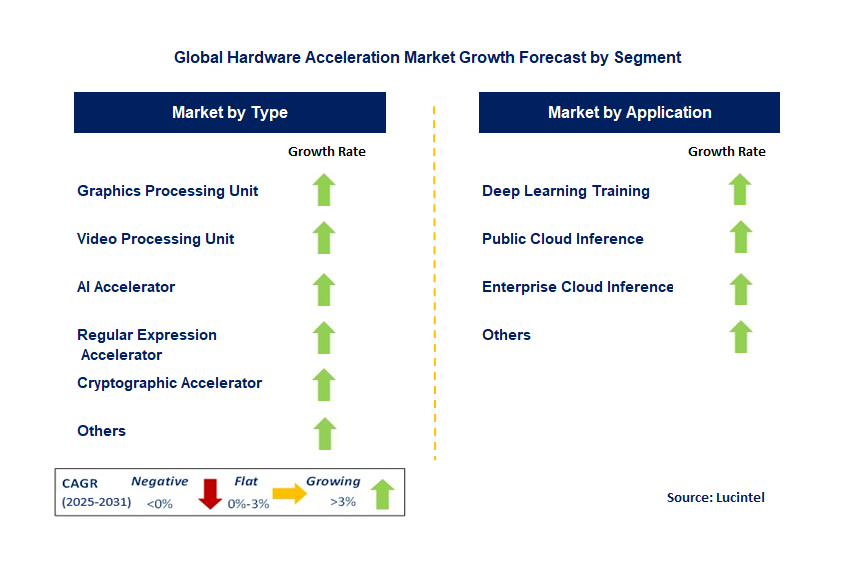
• Lucintel forecasts that, within the type category, graphics processing unit is expected to witness the highest growth over the forecast period due to increasing demand for high-performance computing in gaming, simulations, and data centers is boosting GPU utilization.
• Within the application category, deep learning training is expected to witness the highest growth due to growing demand for faster and more efficient model training in ai applications is accelerating the use of hardware accelerators in deep learning.
• In terms of region, North America is expected to witness the highest growth over the forecast period. Gain valuable insights for your business decisions with our comprehensive 150+ page report. Sample figures with some insights are shown below.
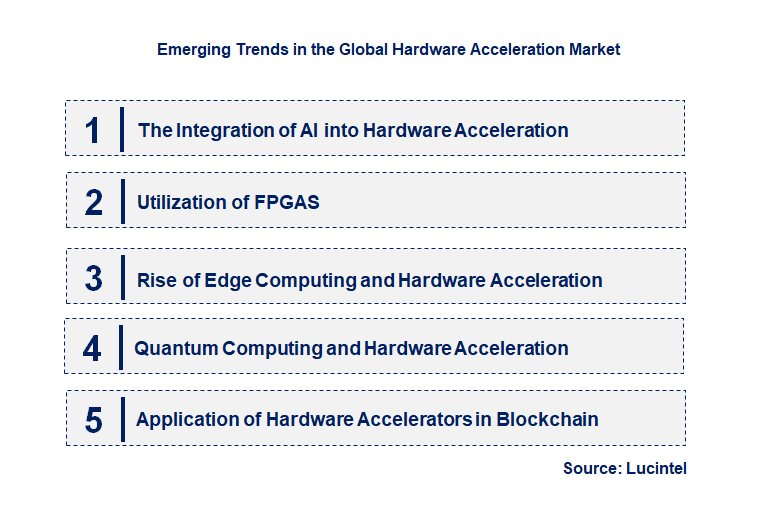
• The Integration of AI into Hardware Acceleration: AI workloads often require massive processing power, and hardware accelerators like GPUs and custom ASICs are designed to handle these tasks more efficiently than general-purpose processors. AI-driven hardware accelerators are becoming crucial in applications such as machine learning, deep learning, and data analytics. This integration improves performance in industries such as healthcare, automotive, and finance, allowing for faster decision-making and real-time insights.
• Utilization of FPGAS: With the usage of FPGAs that are highly adaptable, they are utilized in the hardware acceleration market. FPGAs can be reprogrammed according to specific applications. FPGAs are highly customizable and are suitable for applications like telecommunications, data centers, and automotive with respect to achieving low latency and high throughput. FPGAs are of great importance to those industries that have specific tasks, such as image processing or video encoding, for dedicated hardware acceleration. Their flexibility and ability to optimize tasks are driving their increasing use in high-performance computing environments.
• Rise of Edge Computing and Hardware Acceleration: Edge computing has given rise to a strong demand for hardware acceleration in the network's edge. Edge devices often need to process data locally and in real-time to avoid latency, so hardware accelerators such as GPUs and AI chips are essential. The adoption of edge computing is taking place in industries such as autonomous driving, smart cities, and IoT, where real-time processing of data is critical. The growth in this trend is being driven by the need for hardware acceleration to support AI and machine learning models at the edge.
• Quantum Computing and Hardware Acceleration: The new paradigm is the rise of quantum computing. No doubt quantum computing is one of the new trends that emerged in hardware acceleration. In its infancy, quantum computing promises to change the landscape of processing data- traditional binary bit versus the quantum bit, or qubits. The best hardware accelerators aim for optimization to leverage enhanced calculations speed into quantum computing. This technology is likely to be applied in areas such as cryptography, material science, and complex simulations. As quantum computing advances, hardware accelerators are going to become an important enabler of this technology to bring it closer to being used in practice.
• Application of Hardware Accelerators in Blockchain Technology: The blockchain technology has started using hardware acceleration for accelerating the processing and verification of transactions. As the cryptocurrency and decentralized finance (DeFi) trend rises, there is a great demand for efficient blockchain solutions. ASICs and FPGAs are applied in hardware accelerators to boost the performance of blockchain networks, increase throughput, and decrease latency. With this, the efficiency and scalability of blockchain applications will be increased due to miners' ability to process more transactions per second. This trend is particularly important in the finance and supply chain management industries. Emerging trends in hardware acceleration market, like AI integration, edge computing, FPGA adoption, quantum computing, and blockchain applications, all of which are changing the face of industries and are impacting demand for faster and more efficient processing solutions. As these new applications continue to develop, hardware accelerators will remain at the epicenter of the action.
• Advancements in GPU Technology: GPUs are the cutting edge of hardware acceleration, and the latest developments have dramatically improved the performance and efficiency of these processors. Companies such as NVIDIA and AMD have produced newer generations of GPUs with faster processing, improved memory, and greater energy efficiency. All this is critical for applications in gaming, AI, and big data analytics, where the high computational power is required to process and analyze in real-time.
• AI-Specific Hardware Accelerators : They have grown in leaps and bounds since the increasing growth of machine and deep learning algorithm usage. Here, companies, such as Google with its TPU and Intel with its Nervana chips, build specialized hardware based on AI workload. These accelerators are designed to optimize the performance of tasks like natural language processing, image recognition, and autonomous driving. They improve computation speed and decrease the consumption of energy.
• FPGA Technology in Data Centers: FPGAs are being increasingly included in data centers for dedicated tasks. FPGAs provide flexibility and low latency, which are suitable for applications that need customized processing, such as encryption, real-time analytics, and high-frequency trading. They can be reprogrammed for different workloads, making them a popular choice for data centers, where efficiency and scalability are paramount. Companies are investing heavily in FPGA solutions to improve the performance of data centers and reduce their operating costs.
• Rise of Specialized ASIC Chips: Application Specific Integrated Circuits or ASICs have become more prominent in hardware acceleration, especially in areas such as blockchain and cryptocurrency mining. Custom chips that are made to perform a single task more efficiently than a general-purpose processor are ASICs. Such custom chips are great for applications requiring repetitive computations, such as cryptocurrency mining or video encoding. Their efficiency in power consumption and processing speed will also encourage them to be used in more industries, such as finance and telecommunications.
• Growth of Hardware Accelerators in Automotive Systems: Automotive companies adopt more and more hardware accelerators in autonomous vehicle systems. Hardware accelerators, including GPUs and AI chips, power complex algorithms necessary for the real-time detection of objects, navigation, and decisions inside an autonomous vehicle. With the growing interest of the automotive industry in autonomous driving and driver assistance systems, hardware accelerators are becoming a critical necessity for processing large volumes of data from sensors and cameras. This trend is expected to drive significant growth in the hardware acceleration market in the coming years. New trends in hardware acceleration with advances in GPUs, AI-specific hardware, FPGA, ASIC, and automotive systems will have an innovation potential across different sectors. This is bringing a faster pace to data processing and better performance as well as operational efficiency, and thereby opening the gateways for newer advanced and efficient systems in various applications.
• AI and Machine Learning Applications: The growing demand for AI and machine learning applications presents a significant growth opportunity for hardware accelerators. AI algorithms require significant computational power, and hardware accelerators like GPUs, TPUs, and FPGAs are designed to meet these needs. As AI adoption increases across industries like healthcare, automotive, and finance, the need for more efficient and specialized hardware accelerators will continue to rise.
• Edge Computing and IoT: Edge computing is increasingly becoming a fundamental component of the hardware acceleration market, especially as the Internet of Things or IoT is still growing. Edge devices should process data locally to reduce latency and enhance real-time decision making. Hardware accelerators, such as AI chips and GPUs are really important for allowing faster data processing at the edge. These have made low-latency processing essential to such applications such as autonomous vehicles, smart cities, and industrial IoT.
• Blockchain and Cryptocurrency: Blockchain technology is a major market driver for the hardware acceleration business, especially mining cryptocurrencies. It requires specialized hardware, such as ASICs and FPGAs, to process transactions and mine cryptocurrencies efficiently. As the blockchain technology goes on to conquer other sectors in finance and supply chain management, the demand will grow for these hardware accelerators. This opportunity will allow firms to develop solutions that optimize blockchain performance for marketing.
• High Performance Computing (HPC): Rising applications of HPC is also a key growth opportunity. As industries such as research, simulation, and analytics of complex data require HPC, hardware accelerators like GPUs, TPUs, and FPGAs can have a huge impact in speeding up computations. The increasing necessity for faster, more efficient computational capability is driving hardware accelerators in the data centers of research institutions, as well as academic environments.
• Automotive and Autonomous Vehicles: The automotive sector, especially the autonomous driving sector, presents tremendous growth potential for hardware accelerators. Processing real-time sensor and camera data in self-driving cars requires hardware accelerators of high performance to fuel algorithms for object detection, navigation, and decision-making. As the automotive industry continues innovating in the areas of autonomous driving and ADAS (Advanced Driver Assistance Systems), so will the demand for hardware accelerators. Future opportunities in AI, edge computing, blockchain, HPC, and automotive systems are driving strategic growth in the hardware acceleration market. These areas present a picture where hardware accelerators play an indispensable role in applications in performance improvement, scalability, and efficiency.
• Advanced Micro Devices
• Intel Corporation
• Lenovo Group
• Nvidia Corporation
• IBM Corporation
• Xilinx
• Oracle Corporation
• Graphics Processing Unit
• Video Processing Unit
• AI Accelerator
• Regular Expression Accelerator
• Cryptographic Accelerator
• Others
• Deep Learning Training
• Public Cloud Inference
• Enterprise Cloud Inference
• Others
• North America
• Europe
• Asia Pacific
• The Rest of the World
• United States: The hardware acceleration market in the United States is growing rapidly due to advancements in AI and data center technologies. Major players like NVIDIA and Intel are leading the market with GPU and FPGA solutions that improve processing efficiency and speed. The growing use of cloud computing and the rise in the demand of AI-based applications have dramatically increased the demand for hardware acceleration. Another reason is that U.S. companies are highly investing in the research and development in hardware accelerators to increase their performance to efficiently support big data analytics and real-time decision-making systems.
• China: The hardware acceleration market in China is booming with the pace of technological advancements and increasing focus on artificial intelligence (AI) and 5G networks. Among those companies engaged in the development of customized hardware accelerators, such as AI chips designed for deep learning applications, Baidu and Huawei are at the forefront in China. The Chinese government has also been prompting advancements in high-performance computing (HPC) and AI-driven technologies; thus, growing the demand for hardware acceleration solutions in industries such as autonomous vehicles, healthcare, and manufacturing. This country is likely to expand this market since it aims to be a world leader in AI.
• Germany: The hardware acceleration market in Germany is expanding because of the growing demand for high-performance computing (HPC) and data analytics solutions. The automotive, healthcare, and manufacturing sectors have been the highest adopters of hardware acceleration technology. Companies such as SAP are developing AI-driven hardware solutions to enable data processing capabilities to speed up and enhance overall operations. There is also growing support from Germany toward Industry 4.0 and further digital transformation processes in manufacturing industries. The use of hardware accelerators, such as GPUs and FPGAs, is upping the ante on efficiency for complex simulations and real-time processing in these industries.
• India: The use of hardware acceleration technology in the country is on an uptrend, with the country's IT and telecommunications markets growing multifold. Improvements in AI, big data, and cloud computing infrastructure being pursued by the Indian government have upped the demand for specialized hardware. Companies in India are integrating AI, machine learning, and high-performance computing solutions into their operations, and the use of hardware accelerators is becoming critical for optimizing these applications. In the semiconductor industry, startups are also contributing to the development of custom hardware accelerators, which enhance performance for domestic and international clients.
• Japan: Hardware acceleration is being adopted across several sectors, including automotive, robotics, and electronics, in Japan. Japanese companies like Sony and Toyota are integrating hardware acceleration solutions into their research and development of AI-powered robotics and autonomous vehicles. The growing demand for real-time data processing in industries like healthcare and manufacturing is driving the expansion of hardware acceleration technologies, including GPUs and FPGAs. Japan’s focus on technological innovation, particularly in AI and robotics, is propelling the demand for hardware accelerators to improve processing efficiency and enable more advanced machine learning algorithms.


• Advanced Micro Devices
• Intel Corporation
• Lenovo Group
• Nvidia Corporation
• IBM Corporation
• Xilinx
• Oracle Corporation Q5. Which hardware acceleration market segment will be the largest in future? Answer: Lucintel forecasts that graphics processing unit is expected to witness the highest growth over the forecast period due to increasing demand for high-performance computing in gaming, simulations, and data centers is boosting GPU utilization. Q6. In hardware acceleration market, which region is expected to be the largest in next 5 years? Answer: North America is expected to witness the highest growth over the forecast period. Q7. Do we receive customization in this report? Answer: Yes, Lucintel provides 10% customization without any additional cost.


Choose a license that fits your team. Instant PDF delivery.
Prices exclude taxes. Instant delivery. Custom licensing available on request.
Market Report · July 29, 2026
Market Report · July 20, 2026
Market Report · July 20, 2026
Trusted partner for strategic intelligence and business growth


Receive a complimentary market analysis tailored to your industry. Our analysts will identify key growth opportunities and competitive dynamics specific to your business.

Market size, growth rate, and key trend analysis for your specific sector.

Top competitor positioning and market share analysis.

Strategic recommendations backed by data-driven insights.
Get curated market intelligence and competitive moves straight to your inbox.
By subscribing, you agree to receive our monthly insights. Unsubscribe anytime.
Receive a complimentary market analysis tailored to your industry. Our analysts will identify key growth opportunities and competitive dynamics specific to your business.
Market size, growth rate, and key trend analysis for your specific sector.
Top competitor positioning and market share analysis.
Strategic recommendations backed by data-driven insights.
Get curated market intelligence, emerging trends, and competitive moves straight to your inbox each month.
By subscribing, you agree to receive our monthly insights. Unsubscribe anytime.
We'll send your sample report shortly.