
Market Report · July 22, 2026

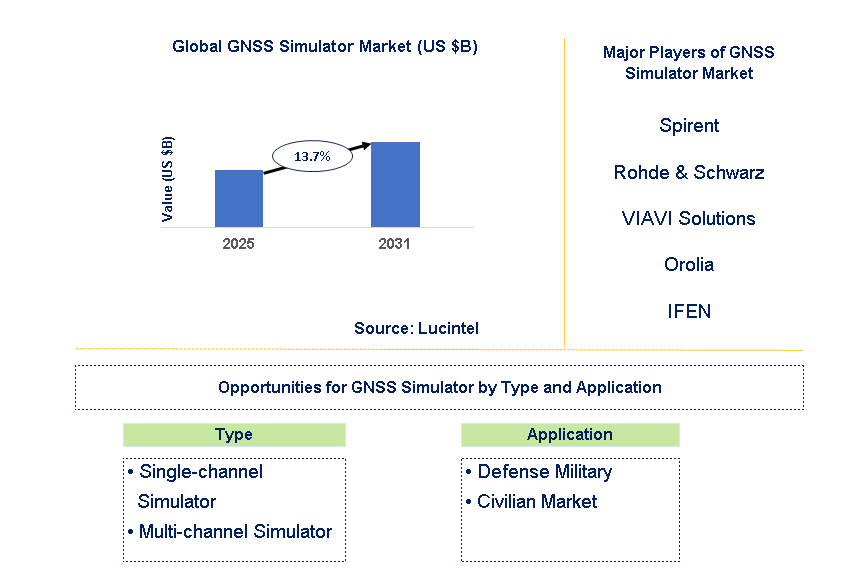
Key data points: The growth forecast = 13.7% annually for the next 7 years. Scroll below to get more insights. This market report covers trends, opportunities and forecasts in GNSS simulator market to 2031 by type (single-channel simulator and multi-channel simulator), application (defense military industry market and civilian market), and region (North America, Europe, Asia Pacific, and the Rest of the World)
We'll send your sample report shortly.
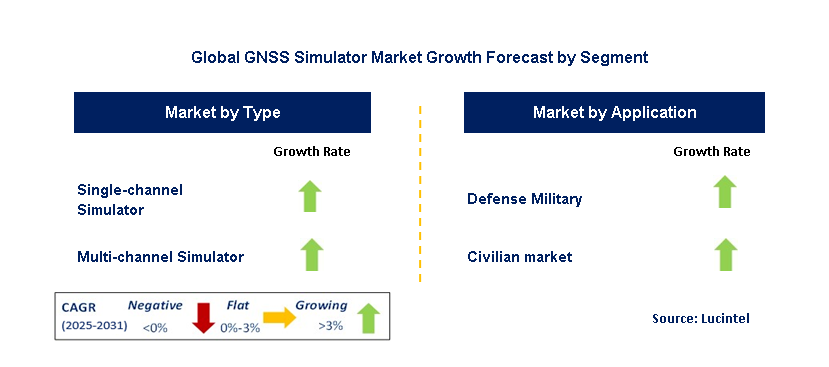
• Lucintel forecasts that, within the type category, multi-channel simulator is expected to witness higher growth over the forecast period.
• Within the application category, defense military industry is expected to witness higher growth.
• In terms of region, APAC is expected to witness the highest growth over the forecast period. Gain valuable insights for your business decisions with our comprehensive 150+ page report. Sample figures with some insights are shown below.
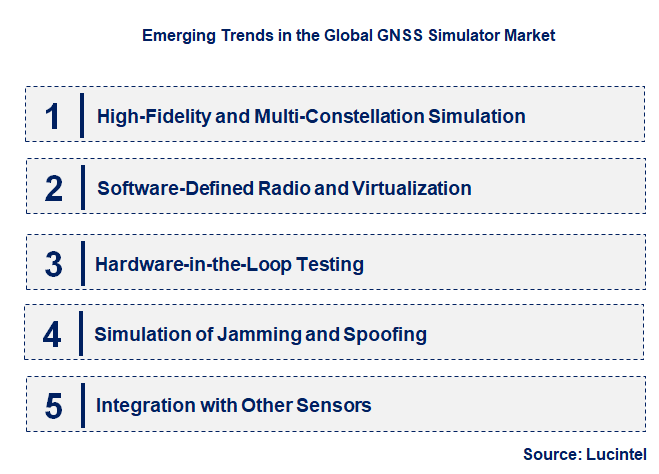
• High-Fidelity and Multi-Constellation Simulation: The trend is toward simulators that can generate high-fidelity signals from multiple constellations (GPS, Galileo, GLONASS, BeiDou, etc.) and regional systems. This enables comprehensive testing of multi-constellation receivers, which are becoming the industry standard. This ensures greater accuracy and reliability of devices in a complex and crowded satellite environment.
• Software-Defined Radio and Virtualization: SDR-based simulators are a key trend, offering a more flexible and cost-effective alternative to traditional hardware-centric systems. The use of virtualization and cloud-based solutions allows for remote access and scenario customization. This reduces the need for expensive hardware, accelerates development cycles, and enables more dynamic and complex test environments.
• Hardware-in-the-Loop Testing: The increasing use of HIL testing is a major trend, particularly in the automotive and aerospace industries. HIL simulators integrate the GNSS signal with real hardware, allowing for a realistic and repeatable test environment. This is crucial for validating the performance and safety of advanced systems like ADAS and autonomous flight controls before physical deployment.
• Simulation of Jamming and Spoofing: There is a growing trend to simulate various threats, including jamming and spoofing, to test the resilience of GNSS receivers. This is driven by security concerns in military, defense, and critical infrastructure applications. The impact is the development of more robust, anti-jamming, and anti-spoofing technologies, which are essential for protecting GNSS-reliant systems from malicious attacks.
• Integration with Other Sensors: The trend toward sensor fusion is seeing GNSS simulators integrated with other sensor models, such as inertial measurement units (IMUs), LiDAR, and radar. This allows for a more holistic testing environment that replicates a real-world multi-sensor system. This is vital for autonomous systems that rely on a combination of sensors to navigate and operate safely. These trends are fundamentally reshaping the GNSS simulator market by driving it toward more sophisticated, software-centric, and integrated solutions. The market is shifting from simply testing a receiver to validating the performance of an entire system in a complex, multi-sensor environment. This is creating a demand for new technologies and collaborative partnerships to develop the next generation of testing tools.
• Advanced Multi-Constellation Support: A key development is the introduction of simulators that can generate signals from all major constellations (GPS, Galileo, GLONASS, BeiDou) and regional systems (QZSS, NAVIC) simultaneously. This enables comprehensive testing of multi-constellation receivers, which are becoming standard. This ensures the best possible accuracy and reliability in a global environment.
• Hardware-in-the-Loop Integration: There has been a significant development in the integration of GNSS simulators with HIL testing platforms. This allows for the GNSS signal to be tested alongside the actual hardware of a system, such as a car's navigation unit or a drone's flight controller. This provides a realistic and repeatable test environment for validating performance.
• Software-Defined Radio Platforms: The shift towards SDR-based GNSS simulators is a notable development. These platforms offer greater flexibility and scalability, allowing users to customize and update signal scenarios through software. The impact is a more cost-effective and adaptable testing solution that can keep pace with evolving GNSS signal standards without requiring a complete hardware overhaul.
• Simulation of Complex Interference: Recent developments include the ability of simulators to generate highly realistic interference scenarios, including jamming and spoofing. This is a critical advancement for military and defense applications, as well as for testing the resilience of autonomous vehicles. The impact is the development of more robust anti-spoofing and anti-jamming receivers.
• Compact and Portable Simulators: The market has seen the development of smaller, more portable GNSS simulators. These compact devices are ideal for field testing, educational purposes, and for smaller R&D labs. The impact is a democratization of GNSS testing, making it more accessible to a wider range of users and accelerating the development of new GNSS-enabled products. These recent developments are profoundly impacting the GNSS simulator market by pushing it toward more comprehensive, flexible, and realistic testing capabilities. The market is moving away from static signal generation to dynamic scenario simulation. This is driving a new wave of innovation and competition to meet the complex and evolving demands of the global market.
• Growth in Autonomous Vehicles: The development of autonomous vehicles is a major growth opportunity. These vehicles rely on highly accurate and reliable GNSS for navigation and positioning. This application is driving demand for advanced simulators that can replicate complex scenarios like urban canyons, signal loss, and multi-path effects to ensure the safety and performance of autonomous driving systems.
• Aerospace and Defense Applications: The aerospace and defense sector presents a significant growth opportunity, with a need for robust simulators for testing missile guidance systems, military UAVs, and other mission-critical applications. This application is driving demand for simulators that can model jamming, spoofing, and other electronic warfare threats to ensure the resilience and security of GNSS receivers.
• Consumer Electronics and IoT: The proliferation of GNSS-enabled consumer electronics, such as smartphones, wearables, and IoT devices, offers a substantial growth opportunity. Manufacturers need to test these devices for accuracy and performance in various conditions. This is driving demand for cost-effective, multi-constellation simulators that can accelerate product development and time to market.
• Precision Agriculture and Surveying: The precision agriculture and surveying sectors are a key growth opportunity. GNSS is used for precision farming, drone-based surveys, and land mapping. This application is driving demand for simulators that can generate RTK (Real-Time Kinematic) and PPP (Precise Point Positioning) signals to test high-accuracy receivers, which are essential for these applications.
• Telecommunications and 5G Network Synchronization: The rollout of 5G networks and other telecommunications infrastructure is creating a new growth opportunity. GNSS is used for network synchronization, which is critical for the reliable operation of these systems. This application is driving demand for simulators that can test the performance of GNSS timing receivers under various conditions to ensure network integrity. These growth opportunities are impacting the GNSS simulator market by driving a strategic shift toward specialization and application-specific solutions. The market is moving from a general-purpose approach to delivering high-value products that address the unique and demanding requirements of each sector. This is fueling innovation and fostering new collaborations to develop next-generation testing technologies.
• Spirent
• Rohde & Schwarz
• VIAVI Solutions
• Orolia
• IFEN
• CAST Navigation
• RACELOGIC
• Jackson Labs Technologies
• Syntony GNSS
• WORK Microwave
• Single-channel Simulator
• Multi-channel Simulator
• Defense Military Industry Market
• Civilian Market
• North America
• Europe
• Asia Pacific
• The Rest of the World
• United States: The U.S. remains a key market leader, with significant developments driven by its dominant aerospace, defense, and automotive sectors. The focus is on creating high-end, multi-channel simulators that can test against jamming and spoofing, and support the modernization of the GPS constellation. This is crucial for national security and the development of next-generation autonomous systems.
• China: China's GNSS simulator market is expanding rapidly, fueled by the widespread adoption of its BeiDou navigation system. Chinese companies are developing domestic simulators to support the testing and validation of BeiDou-enabled devices, particularly in the automotive and consumer electronics sectors. This strategic focus is part of China's effort to achieve technological self-sufficiency.
• Germany: Germany's market is characterized by a strong focus on high-quality engineering and automotive applications. German companies are leading in the development of Hardware-in-the-Loop (HIL) simulators, which are essential for testing advanced driver-assistance systems (ADAS) and autonomous vehicles. The emphasis is on creating realistic and repeatable test scenarios to ensure safety and performance.
• India: India is a growing market, with developments driven by its own navigation system, NAVIC, and increasing investment in the defense and aerospace sectors. The country is focusing on developing indigenous GNSS simulators to reduce reliance on foreign technology and support its domestic space and defense programs. This is a key part of India's strategic push for self-reliance.
• Japan: Japan's contribution to the GNSS simulator market is centered on technological innovation and precision. The country's QZSS regional system and its expertise in consumer electronics are driving the demand for high-performance simulators. Recent developments focus on creating simulators that can replicate urban canyon environments to test the accuracy of GNSS receivers in densely populated areas.


• Spirent
• Rohde & Schwarz
• VIAVI Solutions
• Orolia
• IFEN
• CAST Navigation
• RACELOGIC
• Jackson Labs Technologies
• Syntony GNSS
• WORK Microwave Q5. Which GNSS simulator market segment will be the largest in future? Answer: Lucintel forecasts that, within the type category, multi-channel simulator is expected to witness higher growth over the forecast period. Q6. In GNSS simulator market, which region is expected to be the largest in next 5 years? Answer: In terms of region, APAC is expected to witness the highest growth over the forecast period. Q7. Do we receive customization in this report? Answer: Yes, Lucintel provides 10% customization without any additional cost.


Choose a license that fits your team. Instant PDF delivery.
Prices exclude taxes. Instant delivery. Custom licensing available on request.
Market Report · July 22, 2026
Market Report · July 17, 2026
Market Report · July 17, 2026
Trusted partner for strategic intelligence and business growth


Receive a complimentary market analysis tailored to your industry. Our analysts will identify key growth opportunities and competitive dynamics specific to your business.

Market size, growth rate, and key trend analysis for your specific sector.

Top competitor positioning and market share analysis.

Strategic recommendations backed by data-driven insights.
Get curated market intelligence and competitive moves straight to your inbox.
By subscribing, you agree to receive our monthly insights. Unsubscribe anytime.
Receive a complimentary market analysis tailored to your industry. Our analysts will identify key growth opportunities and competitive dynamics specific to your business.
Market size, growth rate, and key trend analysis for your specific sector.
Top competitor positioning and market share analysis.
Strategic recommendations backed by data-driven insights.
Get curated market intelligence, emerging trends, and competitive moves straight to your inbox each month.
By subscribing, you agree to receive our monthly insights. Unsubscribe anytime.
We'll send your sample report shortly.