
Market Report · July 24, 2026

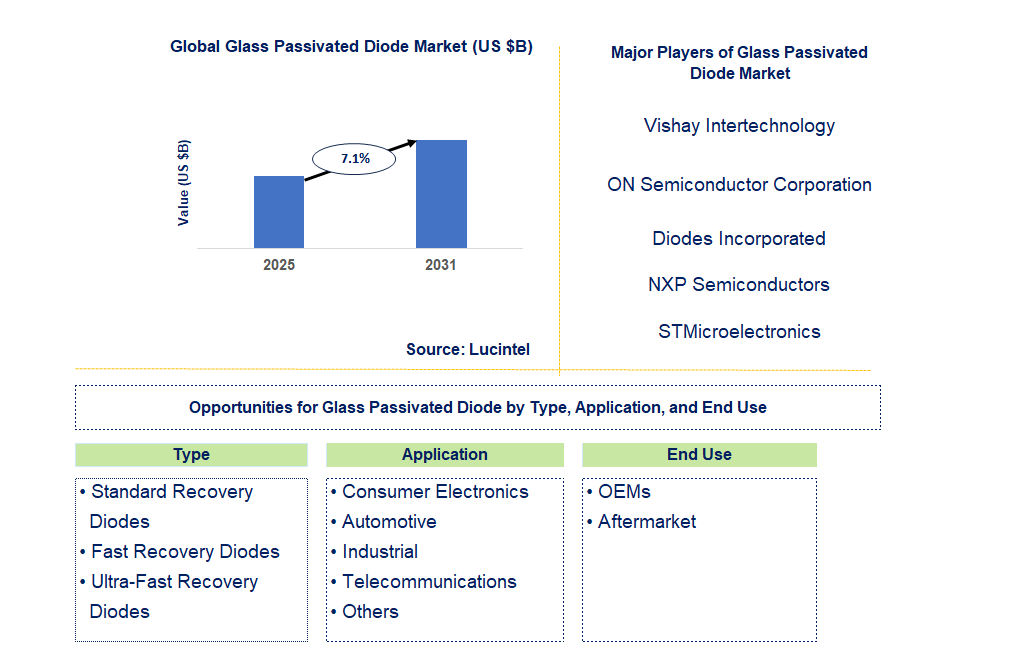
Key data points: The growth forecast = 7.1% annually for the next 7 years. Scroll below to get more insights. This market report covers trends, opportunities and forecasts in glass passivated diode market to 2031 by type (standard recovery diodes, fast recovery diodes, and ultra-fast recovery diodes), application (consumer electronics, automotive, industrial, telecommunications, and others), end use (oems and aftermarket), and region (North America, Europe, Asia Pacific, and the Rest of the World)
We'll send your sample report shortly.
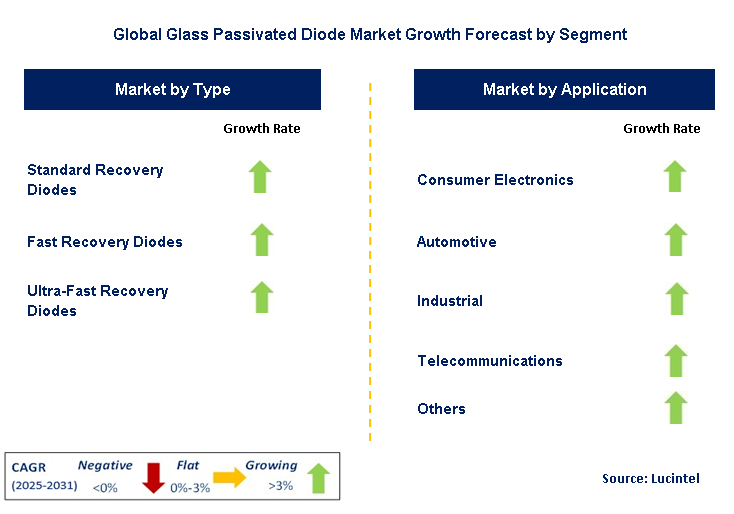
• Lucintel forecasts that, within the type category, ultra-fast recovery diode is expected to witness the highest growth over the forecast period.
• Within the application category, consumer electronics is expected to witness the highest growth.
• In terms of region, APAC is expected to witness the highest growth over the forecast period. Gain valuable insights for your business decisions with our comprehensive 150+ page report. Sample figures with some insights are shown below.
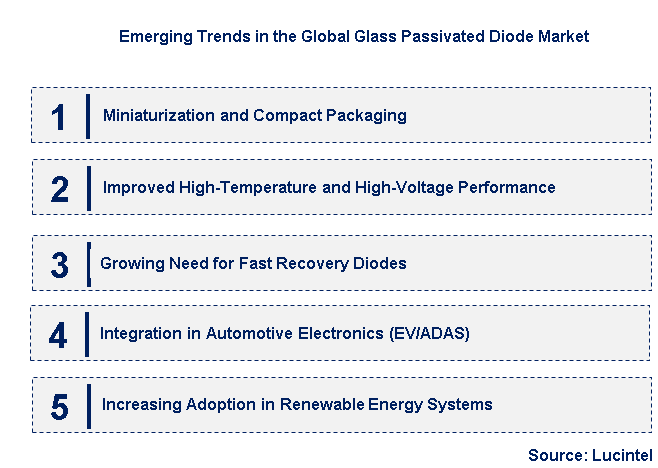
• Miniaturization and Compact Packaging: This trend is about creating glass passivated diodes in progressively smaller sizes and surface-mount device (SMD) packages. With increasingly smaller sizes and levels of integration of electronic devices, there is a high need for miniature parts that conserve board space. The effect is very pronounced in consumer electronics, portable equipment, and automotive markets to allow for higher component packing density on printed circuit boards, decrease the volume and weight of electronic products, and make it easier for automated assembly operations, resulting in cost savings and increased design flexibility.
• Improved High-Temperature and High-Voltage Performance: This is a trend aimed at enhancing the high-temperature and high-voltage capability of glass passivated diodes to perform well under stressful temperature conditions and at elevated voltage levels. This includes technology developments in glass passivation materials and semiconductor manufacturing processes. The effect is important for use in automotive electronics (under-hood applications), industrial power supplies, and renewable energy systems (solar inverters), where components are exposed to hostile environments. This improvement provides more system stability, a longer lifespan, and better protection under harsh operating conditions.
• Growing Need for Fast Recovery Diodes: The trend reflects the growing demand for glass passivated diodes with fast reverse recovery time, particularly in high-frequency switching power supplies, inverters, and motor drives. As electronic circuits become more efficient and operate at higher switching frequencies, rapid recovery is critical in order to reduce power losses and electromagnetic interference (EMI). The result is better energy efficiency, lower heat generation in power conversion stages, and better overall system performance, facilitating the creation of more compact and efficient power management devices.
• Integration in Automotive Electronics (EV/ADAS): This trend highlights the increasing adoption of glass passivated diodes into the fast-growing automotive electronics segment, especially in electric vehicles (EVs) and Advanced Driver-Assistance Systems (ADAS). Such diodes play key roles in numerous applications, ranging from battery management systems to charging infrastructure, infotainment, and sensing modules. The driver behind the effect is the car industry’s quest for electrification and intelligence, demanding high-performance, dependable, and AEC-Q101 qualified diodes that can resist tough automotive environments and provide the reliability and safety of contemporary vehicles.
• Increasing Adoption in Renewable Energy Systems: The trend here is the rising adoption of glass passivated diodes in renewable energy systems, particularly in solar photovoltaic (PV) inverters and wind power conversion systems. These diodes are used as bypass diodes, blocking diodes, and in numerous power conversion stages to maximize energy harvesting and safeguard sensitive components. The demand is fueled by the global drive towards renewable energy, demanding highly efficient and reliable diodes withstanding changing environmental conditions and facilitating efficient conversion and distribution of green energy. These new trends are collectively refashioning the glass passivated diode market by propelling innovation towards increasingly specialist, high-performing, and reliable devices. The emphasis is on addressing the ever-growing demands of various end-use sectors, especially in power efficiency, thermal robustness, and miniaturization, to maintain the applicability and advancement of glass passivated diodes in the contemporary electronics scene.
• Technological Advances in Glass Passivation: The biggest trend is the ongoing optimization of the glass passivation layer itself. This involves creating new glass compositions with enhanced dielectric characteristics, improved adhesion to silicon, and greater thermal stability. Breakthroughs also target improving the deposition process to make layers more uniform and defect-free. The effect is greatly enhanced diode reliability, lower leakage currents, improved surge current handling, and higher resistance to environmental stress such as humidity and thermal changes, resulting in more reliable and longer-lasting electronic devices.
• Miniaturization and Surface Mount Device (SMD) Packaging: Another important breakthrough is the extensive use and on-going miniaturization of glass passivated diodes in surface mount device (SMD) packages. This enables greater component density on printed circuit boards, which is essential in compact electronic products. The effect is to empower the creation of smaller, lighter, and more portable electronic products in consumer electronics, automotive, and telecommunications. It also enables automated manufacturing processes, enhancing production efficiency and lowering assembly costs.
• Development of High-Performance Fast Recovery Diodes: Recent advancements have seen a keen emphasis on improving the switching speed and reverse recovery performance of glass passivated diodes, especially within the fast recovery diode market. This includes the optimization of doping profiles and junction structures. The effect is vital to applications in high-frequency switching power supplies, inverters, and motor drives, where power loss reduction and efficiency improvement are of utmost importance. These developments result in more effective power conversion, less heat dissipation, and overall better system performance.
• Greater Use of Glass Passivated Diodes in Automotive Applications: There has been a tremendous advancement in the special design and qualification of glass passivated diodes for demanding automotive applications. These include AEC-Q101 qualification for reliability in harsh automotive conditions. The demand is fueled by vehicle electrification (EVs), the expansion of Advanced Driver-Assistance Systems (ADAS), and higher electronic content in contemporary vehicles, wherein such diodes are vital for power management, protection of circuits, and other control systems to provide safety and reliability to the vehicle.
• Improved Surge Current and Reverse Voltage Capabilities: One of the most significant advancements is the ongoing upgrade in the surge current capability and maximum reverse voltage ratings of glass passivated diodes. This makes them less susceptible to electrical transients and ideal for higher power applications. The effect is greater reliability and safety in power conversion systems, industrial equipment, and surge protection circuits, enabling these diodes to absorb unforeseen power fluctuations and guard sensitive downstream components better, expanding their application range. These trends are deeply influencing the glass passivated diode market by propelling a wide-ranging transformation towards more dependable, smaller, efficient, and application-oriented solutions. The market is changing to provide superior performance, improved robustness, and better integration capabilities, catering to the increasingly stringent needs of contemporary electronic systems globally.
• Automotive Electrics (EVs, ADAS, Infotainment): The fast expansion of the automotive market, particularly in electric vehicles (EVs), hybrid cars, and Advanced Driver-Assistance Systems (ADAS), presents a significant growth opportunity. Glass passivated diodes are critical for battery management systems, onboard chargers, DC-DC converters, lighting, and sensor applications. Strategic growth is to design AEC-Q101 qualified, high-reliability, and temperature-resistant diodes engineered specifically for the harsh automotive environment in response to the rising electronic content and safety levels in newer vehicles.
• Consumer Electronics (Smartphones, Laptops, Domestic Appliances): Ongoing growth in consumer electronics, with its hallmark of miniaturization, higher functionality, and power efficiency, creates a stable demand for glass passivated diodes. These are employed in power adapters, battery charge circuits, LED lighting, and other internal power management modules. Strategic expansion is in providing miniaturized, affordable, and efficient diodes that allow for reduced device footprints, increased battery life, and enhanced overall performance in a vast array of everyday electronic devices and smart home appliances.
• Renewable Energy Systems (Solar Inverters, Wind Power): With the transition to alternative energy sources, globally, there is a major growth opportunity in the solar photovoltaic (PV) and wind energy sectors. Glass passivated diodes play a crucial role in inverters, charge controllers, and protection circuits in these systems. Strategic expansion entails supplying high-power, high-voltage, and thermally resilient diodes that are able to handle harsh outdoor conditions and play a part in the efficient and reliable conversion and management of renewable energy.
• Industrial Power Supplies and Automation: The growth of industrial automation, robotics, and intelligent manufacturing drives the demand for high-quality power supplies and control systems. Glass passivated diodes are commonly used in rectifiers, power factor correction (PFC) circuits, and motor drives. Strategic opportunities for growth are available through the provision of high-current, high-voltage, and rugged diodes that can be used in industrial applications that demand long operational lifetimes and stable performance under continuous, heavy loads to support the strong operation of industrial machinery.
• Telecommunications and Networking Hardware: Ongoing build-outs of 5G networks, data centers, and other networking hardware necessitate highly efficient and reliable power management devices. Glass passivated diodes are used in power supplies, signal rectification, and surge protection circuits in base stations, servers, and communication modules. Strategic expansion is achieving high-frequency, low-loss diodes that will satisfy the high-power efficiency and reliability needs of today’s telecommunication networks to support the growing data traffic and connectivity requirements. These strategic development opportunities are greatly influencing the glass passivated diode market by fueling innovation toward highly application-specific, performance-optimized, and highly specialized solutions. The market is becoming more diversified to address the unique reliability, efficiency, and environmental requirements of many high-growth markets, and the growth is expected to continue with a strengthening position for glass passivated diodes in the global electronic market.
• Vishay Intertechnology
• ON Semiconductor Corporation
• Diodes Incorporated
• NXP Semiconductors
• STMicroelectronics
• Infineon Technologies
• ROHM Semiconductor
• Toshiba Corporation
• Microsemi Corporation
• Central Semiconductor
• Standard Recovery Diodes
• Fast Recovery Diodes
• Ultra-Fast Recovery Diodes
• Consumer Electronics
• Automotive
• Industrial
• Telecommunications
• Others
• North America
• Europe
• Asia Pacific
• The Rest of the World
• United States: Glass passivated diodes market in the United States is witnessing steady expansion due to growing uptake in sophisticated automotive systems, solar and wind energy systems, and high-reliability industrial electronics. Key trends witnessed in recent times are emphasis on high-performance fast recovery diodes for electric vehicle charging systems and power conversion systems. There is also a focus on integration and miniaturization into complex circuits to suit the need for smaller, more efficient electronic devices and systems that have high quality and reliability.
• China: The market for glass passivated diodes in China is experiencing significant growth, driven by its fast-growing consumer electronics manufacturing industry, heavy investments in electric vehicles, and accelerated industrial automation. Recent developments include a big drive for high-volume manufacturing of inexpensive glass passivated diodes to keep up with the huge domestic and export demand. Chinese companies are also stepping up research and development to enhance performance parameters such as forward voltage drop and reverse recovery time in order to compete with foreign players based on both quantity and quality.
• Germany: The German glass passivated diode market is dominated by a high focus on precision engineering, reliability, and stringent European quality and safety standards. Emerging trends involve the development of glass passivated diode modules for high-power applications in industrial automation, renewable energy inverters, and e-mobility solutions. Thermal management improvement and performance under harsh conditions are a priority for German firms, demonstrating a focus on high-end, reliable components for demanding industrial and automotive applications.
• India: India’s market for glass passivated diodes is witnessing strong growth, fueled by the fast growth of its consumer electronics production, telecommunications infrastructure development, and automotive sector. Recent trends involve a growing need for cost-effective and stable glass passivated diodes across a number of applications, such as power supplies, LED lighting, and automotive electronics. Indian manufacturers and distributors are prioritizing satisfying increasing domestic use and promoting the nation’s efforts at local electronics manufacturing, meeting a growing market with varied requirements.
• Japan: The Japanese glass passivated diode market is characterized by technological sophistication, miniaturization, and premium standards for precision use. Recent innovations involve the development of glass passivated diodes for high-frequency circuits in telecommunications products, advanced consumer electronics, and car sensing systems. Japanese companies are focusing on maximizing performance parameters, including rapid recovery time and low leakage, to enable the creation of next-generation electronic devices that require high reliability and efficiency in small packages.


• Vishay Intertechnology
• ON Semiconductor Corporation
• Diodes Incorporated
• NXP Semiconductors
• STMicroelectronics
• Infineon Technologies
• ROHM Semiconductor
• Toshiba Corporation
• Microsemi Corporation
• Central Semiconductor Q5. Which glass passivated diode market segment will be the largest in future? Answer: Lucintel forecasts that, within the type category, ultra-fast recovery diode is expected to witness the highest growth over the forecast period. Q6. In glass passivated diode market, which region is expected to be the largest in next 5 years? Answer: In terms of region, APAC is expected to witness the highest growth over the forecast period. Q7. Do we receive customization in this report? Answer: Yes, Lucintel provides 10% customization without any additional cost.


Choose a license that fits your team. Instant PDF delivery.
Prices exclude taxes. Instant delivery. Custom licensing available on request.
Market Report · July 24, 2026
Market Report · July 20, 2026
Market Report · July 20, 2026
Trusted partner for strategic intelligence and business growth


Receive a complimentary market analysis tailored to your industry. Our analysts will identify key growth opportunities and competitive dynamics specific to your business.

Market size, growth rate, and key trend analysis for your specific sector.

Top competitor positioning and market share analysis.

Strategic recommendations backed by data-driven insights.
Get curated market intelligence and competitive moves straight to your inbox.
By subscribing, you agree to receive our monthly insights. Unsubscribe anytime.
Receive a complimentary market analysis tailored to your industry. Our analysts will identify key growth opportunities and competitive dynamics specific to your business.
Market size, growth rate, and key trend analysis for your specific sector.
Top competitor positioning and market share analysis.
Strategic recommendations backed by data-driven insights.
Get curated market intelligence, emerging trends, and competitive moves straight to your inbox each month.
By subscribing, you agree to receive our monthly insights. Unsubscribe anytime.
We'll send your sample report shortly.