
Market Report · July 22, 2026

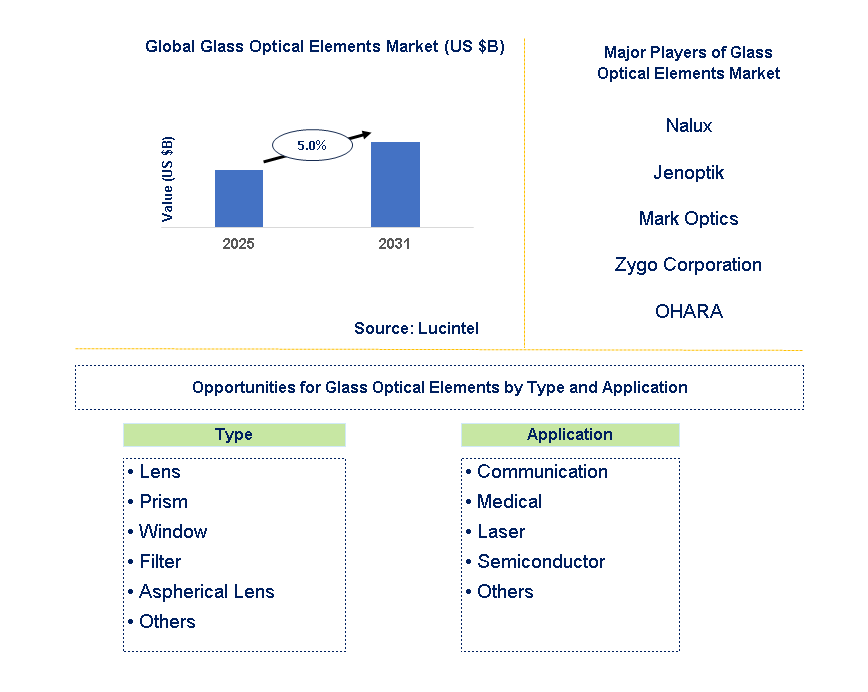
Key data points: The growth forecast = 5.0% annually for the next 7 years. Scroll below to get more insights. This market report covers Trends, opportunity and forecast in glass optical elements market to 2031 by type (lens, prism, window, filter, aspherical lens, and others), application (communication, medical, laser, semiconductor, and others), and region (North America, Europe, Asia Pacific, and the Rest of the World)
We'll send your sample report shortly.
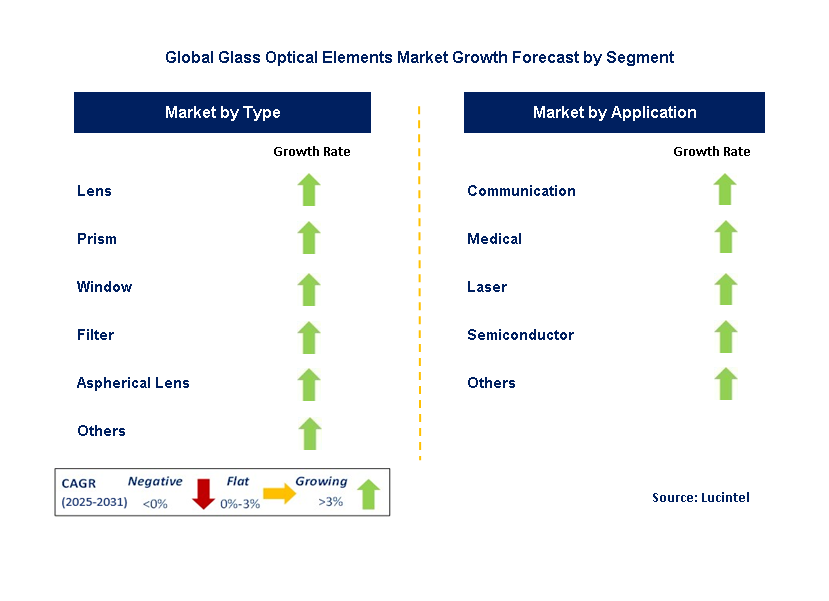
• Lucintel forecasts that, within the type category, lens is expected to witness the highest growth over the forecast period.
• Within the application category, communication is expected to witness the highest growth due to widespread usage of aspherical lenses and filters in automotive, smartphone, and defense applications.
• In terms of region, APAC is expected to witness the highest growth over the forecast period due to existence of leading optical manufacturers and expanding demand from key end-use sectors, such as communication, medical, and electronics in the region. Gain valuable insights for your business decisions with our comprehensive 150+ page report. Sample figures with some insights are shown below.
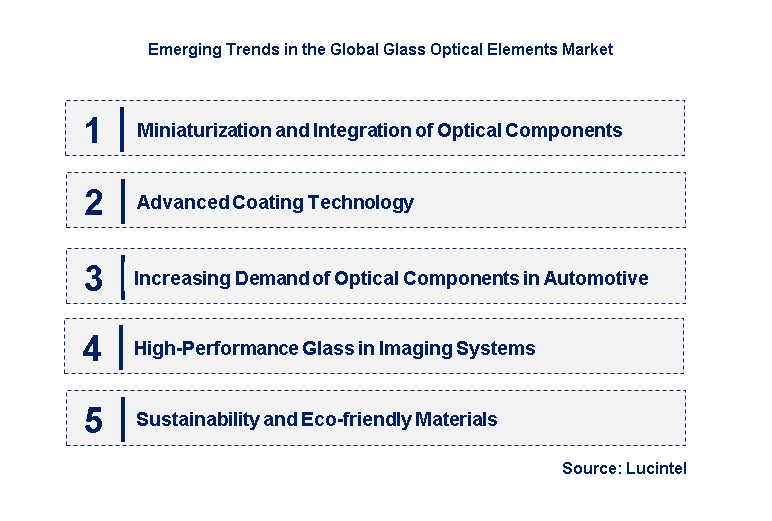
• Miniaturization and Integration of Optical Components: The market for Glass Optical Elements is gaining momentum in the miniaturization trend. Since industries are driving towards more compact devices, miniaturized optical components with high performance without loss of quality are in great demand. This is especially seen in consumer electronics and medical fields where smaller optical components are necessary for devices such as smartphones, wearable technology, and diagnostic equipment. This has also enabled multifunctional designs to be developed in more compact and efficient dimensions.
• Advanced Coating Technology: Coating technologies have emerged as a big leap in Glass Optical Elements Market. Optical coating is now becoming an important constituent for enhancing optical element performance. It improves the transmission of light, reduces reflections, and makes it anti-scratch and anti-glare properties. Coatings are highly valued for uses in cameras, telescopes, and laser systems, where clarity and durability are a high priority. As demand for high-performance optical components in the aerospace, healthcare, and telecommunications industries grows, coating technologies are pivotal in increasing the capabilities of glass optical components.
• Increasing Demand of Optical Components in Automotive Applications: In the automotive sector, the demand for glass optical elements is also rising due to increasing adoption of ADAS and autonomous vehicles. For systems like lidar, radar, and cameras used in self-driving cars, lenses, mirrors, and prisms play a critical role in the application. These optical components are high-precision devices for accurate sensing to improve the safety of a vehicle. As the auto industry shifts more towards automation and connected vehicles, the demand for advanced optical components is expected to grow rapidly.
• High-Performance Glass in Imaging Systems: The development of high-performance glass has been widely used in applications such as in healthcare, aerospace, and security imaging systems. Innovations in optical materials create glass that delivers superior light transmission, reduced chromatic aberration, and much greater clarity. This trend is particularly key in medical imaging devices, such as MRI and endoscopes, and also in high-definition cameras for surveillance and satellite imaging. High-quality optical glass is, therefore, likely to see an increase in demand as the requirement for more accurate and efficient imaging systems increases.
• Sustainability and Eco-friendly Materials: Sustainability is increasingly considered in the design of glass optical elements. Manufacturers are focusing on eco-friendly materials and production processes to meet growing environmental concerns and regulatory requirements. The use of recycled materials and energy-efficient manufacturing methods is helping reduce the environmental footprint of optical element production. Moreover, there is a drive toward creating glass optical components that are more durable and longer-lasting, reducing the need for frequent replacements. This trend is particularly important for industries like automotive and telecommunications, where sustainability is becoming a key consideration. The emerging trends in the Glass Optical Elements Market, including miniaturization, advancements in coatings, increased demand in automotive applications, the development of high-performance imaging glass, and sustainability, are reshaping the industry. These trends are driving innovations that enable more efficient, compact, and high-performance optical systems across various sectors, positioning the market for continued growth and evolution.
• Technological Advancements in Optical Lenses: New technologies in the optical lenses have made them more efficient and precise. These lenses are found in photography, medical imaging, and telecommunications. The improvements in lens design and production techniques enhance the transmission of light, reduce distortion, and increase optical clarity. These developments help in fulfilling an increasingly high demand for high-quality imaging systems from consumer electronics, healthcare, and aerospace industries.
• Automotive Optical Elements Growth: The automotive industry is increasingly adopting optical elements for advanced driver-assistance systems (ADAS) and autonomous vehicles. Developments in lidar, radar, and camera systems rely heavily on high-precision optical components. As self-driving technology progresses, optical elements such as mirrors, prisms, and lenses are becoming critical for ensuring safety and efficiency. One of the main trends shaping the market is this increase in demand for automotive optical elements, emphasizing innovation in sensor technologies and optical clarity.
• Increase in Optical Glass in Medical Applications: In the medical field, there has been a high demand for optical glass, especially in diagnostic imaging systems. Advancements in high-performance optical components have led to more accurate, reliable, and portable medical equipment. Optical elements, such as lenses, mirrors, and prisms, are incorporated into endoscopes, MRI machines, and surgical instruments. As the health care sector accepts advanced imaging technology, there is a further likelihood of the increasing demand for special glass optical elements.
• Focus on Precision Manufacturing: Precision manufacturing has emerged as one of the main areas of interest in the Glass Optical Elements Market. Firms are spending more on developing high-precision production techniques for optical components, ensuring higher precision and fewer defects. This advancement is crucially needed in areas such as aerospace, defense, and telecommunications where the optical performance of the equipment plays a pivotal role. Precision in manufacturing will allow companies to better meet the demanding requirements placed on optical elements used in applications with high precision.
• Integration of Smart Optical Systems: Smart optical systems are being integrated into industries such as telecommunications and consumer electronics. Smart optical systems use sensors and complex algorithms to dynamically adapt optical performance in real time. These systems can be used in applications like AR, VR Systems, and Adaptive Optics in telescopes. As the demand grows for intelligent adaptive optical solutions, manufacturers are making efforts to make optical elements adaptable to such leading-edge systems. Recent developments in the Glass Optical Elements Market, including advancements in optical lenses, automotive applications, medical imaging, precision manufacturing, and smart optical systems, are driving growth in the industry. These developments are contributing to the demand for high-performance optical components across various sectors, positioning the market for continued innovation and expansion.
• Telecommunications and 5G: The telecommunications sector, especially with the advent of 5G networks, offers tremendous growth opportunities for glass optical elements. Optical components are critical in fiber-optic communication systems, where high-performance lenses, prisms, and mirrors are needed to ensure efficient data transmission. The expansion of 5G infrastructure will drive demand for optical elements that can support the increased bandwidth and data speeds associated with 5G technology.
• Consumer Electronics: Consumer electronics such as smartphones, wearables, and cameras have become a large growth opportunity for glass optical elements. As the sophistication of the device increases with higher feature richness, the need for high-quality lenses, displays, and imaging components is growing. Innovations in optical systems to achieve better imaging, augmented reality, and virtual reality have been driving the demand for specialty optical elements in consumer electronics.
• Medical Devices: Medical devices are one of the most promising areas for growth in the Glass Optical Elements Market. Optical parts play a very important role in medical imaging technologies, including endoscopy, MRI, and optical coherence tomography (OCT). Manufacturers of glass optical elements can now expand their range in this sector with the rising demand for non-invasive diagnostic techniques and portable medical devices.
• Automotive Industry: The automotive industry, particularly with the development of autonomous vehicles and advanced driver-assistance systems (ADAS), is a growing market for optical elements. Lenses, mirrors, and sensors are vital components in lidar, radar, and camera systems used for self-driving cars. As the automotive sector moves toward greater automation, the demand for high-precision optical elements will continue to rise, offering substantial growth opportunities for manufacturers.
• Aerospace and Defense: Aerospace and Defense is the growth area in Glass Optical Elements Market. There is a high need for optical elements in all ranges of applications. It can vary from satellite imaging to high sophisticated radar systems. As technology for defense and space continues to move forward, more demand is coming up for optical elements in precise sensing, high-resolution imaging, and high-precision communication, which creates scopes for the glass optical element market. The market for glass optical elements provides strategic growth opportunities across several sectors, such as telecommunications, consumer electronics, medical devices, automotive, and aerospace. As these markets keep changing, the demand for high-quality precision optical components will increase, pushing up the scope of the market.
• Nalux
• Jenoptik
• Mark Optics
• Zygo Corporation
• OHARA
• Esco Optics
• Holo Or
• JML Optical
• Leading Optics
• SCHOTT Glass
• Lens
• Prism
• Window
• Filter
• Aspherical Lens
• Others
• Communication
• Medical
• Laser
• Semiconductor
• Others
• North America
• Europe
• Asia Pacific
• The Rest of the World
• United States: The United States remains a global leader in the Glass Optical Elements Market, particularly in the fields of aerospace, defense, and consumer electronics. Key advancements include the use of advanced coatings to improve the performance of optical elements and the development of lightweight materials for high-end optical devices. Moreover, increased demand for optical components in autonomous vehicles, medical imaging, and communication systems drives the growth of the market. The country's strong R&D capabilities drive innovation in optical technologies, allowing the U.S. manufacturers to manufacture high-precision glass elements for specialized applications.
• China: China is one of the most significant players in the Glass Optical Elements Market, with a focus on the production and export of optical components for consumer electronics, smartphones, and automotive applications. The country has witnessed rapid development in the mass production of optical lenses and glass elements, particularly in the smartphone industry. China's focus on innovation in industrial automation and medical technology has spurred the demand for high-quality optical components. Government spending on R&D and increasing demand for 5G and IoT devices are further driving China as a leader in manufacturing and consuming glass optical elements.
• Germany: Germany has seen significant developments in the Glass Optical Elements Market, with an intense focus on industrial and automotive applications. The country's precision engineering and manufacturing capabilities enable the production of high-accuracy optical elements used in lasers, imaging systems, and inspection equipment. Germany's automotive sector, for instance, has seen increased demand for optical components in the development of advanced driver-assistance systems (ADAS) and autonomous vehicles. Furthermore, the demand for optical glass in medical devices, such as diagnostic instruments, is contributing to Germany's growth in the optical elements market.
• India: India’s Glass Optical Elements Market has seen significant growth driven by increasing demand in sectors like telecommunications, consumer electronics, and medical devices. The country has witnessed developments in both manufacturing and technology, with local production of optical lenses and prisms. India is also expanding its optical infrastructure with the growing demand for telecommunication networks and smart devices. The growth of the healthcare industry, especially in diagnostic imaging, also enhances the demand for quality glass optical elements. Indian manufacturers are increasingly looking towards making cost-effective high performance optical components, which can cater to both local as well as foreign markets.
• Japan: Japanese products are recognized in terms of producing high-quality glass optical elements used in cameras, imaging systems, and other electronic appliances. The country has made significant advancements in its consumer electronics sector, where optical elements play a very important role for high-resolution imaging and display technologies. Japan's expertise in fine glass manufacturing has allowed it to remain a key player in the production of precision optical components for the medical and automotive industries as well. The growth of augmented reality (AR), virtual reality (VR), and autonomous vehicle technologies in Japan is going to increase demand for optical elements in the future years.


• Nalux
• Jenoptik
• Mark Optics
• Zygo Corporation
• OHARA
• Esco Optics
• Holo Or
• JML Optical
• Leading Optics
• SCHOTT Glass Q5. Which glass optical elements market segment will be the largest in future? Answer: Lucintel forecasts that lens is expected to witness the highest growth over the forecast period. Q6. In glass optical elements market, which region is expected to be the largest in next 5 years? Answer: APAC is expected to witness the highest growth over the forecast period due to existence of leading optical manufacturers and expanding demand from key end-use sectors, such as communication, medical, and electronics in the region. Q7. Do we receive customization in this report? Answer: Yes, Lucintel provides 10% customization without any additional cost.


Choose a license that fits your team. Instant PDF delivery.
Prices exclude taxes. Instant delivery. Custom licensing available on request.
Market Report · July 22, 2026
Market Report · July 17, 2026
Market Report · July 17, 2026
Trusted partner for strategic intelligence and business growth


Receive a complimentary market analysis tailored to your industry. Our analysts will identify key growth opportunities and competitive dynamics specific to your business.

Market size, growth rate, and key trend analysis for your specific sector.

Top competitor positioning and market share analysis.

Strategic recommendations backed by data-driven insights.
Get curated market intelligence and competitive moves straight to your inbox.
By subscribing, you agree to receive our monthly insights. Unsubscribe anytime.
Receive a complimentary market analysis tailored to your industry. Our analysts will identify key growth opportunities and competitive dynamics specific to your business.
Market size, growth rate, and key trend analysis for your specific sector.
Top competitor positioning and market share analysis.
Strategic recommendations backed by data-driven insights.
Get curated market intelligence, emerging trends, and competitive moves straight to your inbox each month.
By subscribing, you agree to receive our monthly insights. Unsubscribe anytime.
We'll send your sample report shortly.