
Market Report · July 20, 2026

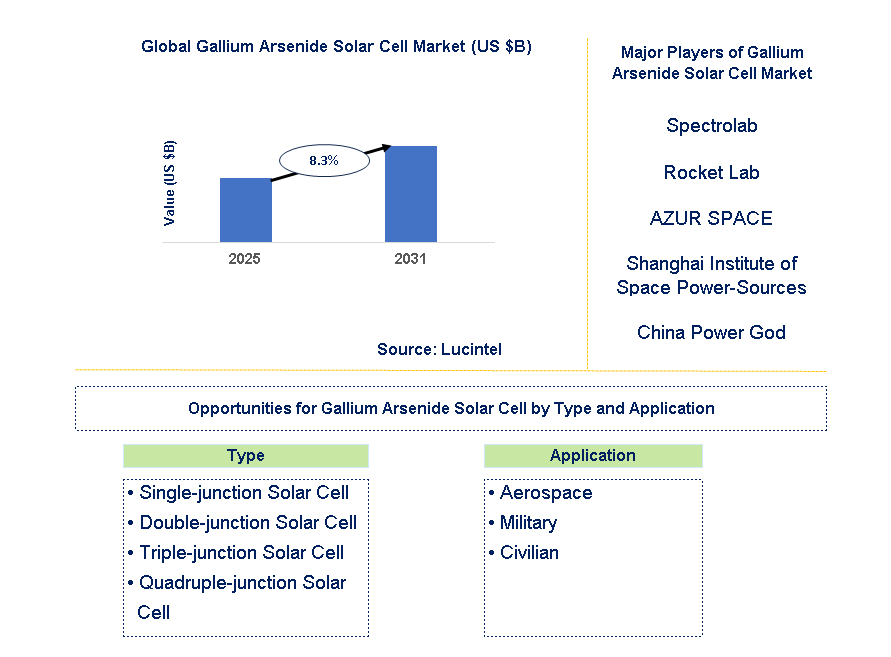
Key data points: The growth forecast = 8.3% annually for the next 7 years. Scroll below to get more insights. This market report covers Trends, opportunities and forecasts in gallium arsenide solar cell market to 2031 by type (single-junction solar cell, double-junction solar cell, triple-junction solar cell, and quadruple-junction solar cell), application (aerospace, military, and civilian), and region (North America, Europe, Asia Pacific, and the Rest of the World)
We'll send your sample report shortly.
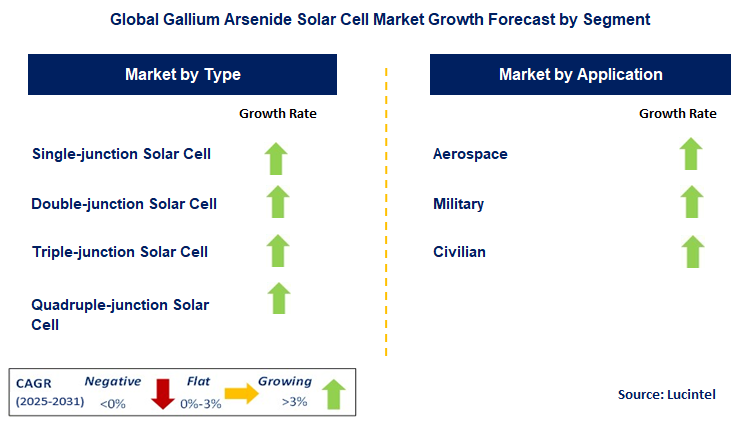
• Lucintel forecasts that, within the type category, triple-junction solar cell is expected to witness the highest growth over the forecast period due to its superior efficiency.
• Within the application category, aerospace is expected to witness the highest growth.
• In terms of region, North America is expected to witness the highest growth over the forecast period due to the region's advanced space exploration programs.
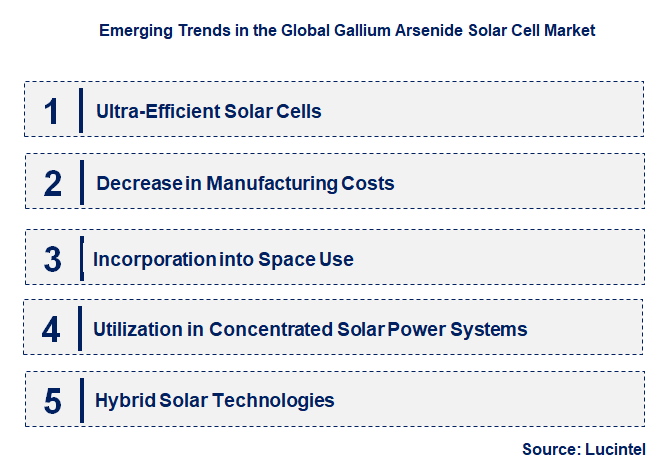
• Ultra-Efficient Solar Cells: The need to manufacture solar cells that are more efficient has always been a major factor in the adoption of Gallagher Arsenide technology. The efficiency of Gallagher Arsenide cells relative to conventional silicon cells is not only better, but it is very efficient for tasks that require high energy input. Researchers are working towards using multi-junction cells to further enhance the efficiency of Gallagher Arsenide solar cells as these types of solar cells can theoretically exceed the efficiency cap of single junction solar cells.
• Decrease in Manufacturing Costs: While the production of gallium arsenide solar cells has historically been costly, there is reason to believe that innovation in manufactory processes will change this. Cheaper GaAs substrates and more advanced deposition methods are making the production of GaAs more economically feasible. This will allow GaAs solar cells to be commercially reasonable for mass usage, which will increase their consumption at the residential and commercial levels.
• Incorporation into Space Use: The gallium arsenide solar cell has undeniable potential in space based power generation. GaAs solar cells are already employed in satellites because solar cells with high efficiency and good performance at extremes is needed. As space exploration continues to expand, there will always be a demand for solar cells to power satellites and space stations. GaAs solar cells are the right choice for these uses because they can work with low light.
• Utilization in Concentrated Solar Power Systems: Concentrated Solar Power systems use lenses or mirrors to focus sunlight onto a small area for efficient solar energy generation. The ability to withstand high intensity light makes gallium arsenide solar cells particularly suitable for CSP applications. As CSP technology evolves, the need for GaAs cell is likely to rise, especially in large solar farms and industrial CPPs.
• Hybrid Solar Technologies: There is growing interest in hybrid solar technologies which combine GaAs with other materials, such as silicon or perovskite. These aim to make more efficient and cost-effective solar cells by combining the benefits of each material. It could be a game changer for the market because hybrid cells will outperform existing options while costing much less, using the best features of GaAs and other materials to create new solar solutions. As solar cell technology continues to advance, the likely future will be one which incorporates high efficiency GaAs technology for both terrestrial and space applications. The use of solar energy is bound to further increase worldwide which in turn would need newer sources of innovation for its sustainable and economical adoption.
• Enhanced Manufacturing Techniques: One of the primary changes that have come into effect in the GaAs solar cell market is GaAs solar cell's manufacturing techniques. The cost of production has greatly declined due to new methods that have been introduced for growing and depositing GaAs films. Innovations in production and equipment also include the use of inexpensive substrates and gas phase epitaxy, and this has enabled the affordable mass production of GaAs cells. This will contribute towards making GaAs solar cells economically viable for residential and commercial use.
• Multi-Junction Cells: The development of multi-junction cells is one of the key milestones of GaAs technology. These cells are capable of capturing a greater portion of the solar spectrum because they incorporate different layers of materials. Multi-junction GaAs cells have achieved remarkable efficiency levels and are expected to play a pivotal role in the next generation of solar technologies. These cells are especially beneficial in concentrated solar power systems and space applications, as these systems require robust efficiency.
• Integration with Other Renewable Technologies: One more notable shift is the integration of GaAs solar cells with other energy technologies like energy storage systems and batteries. This integration results in hybrid solar models that offer uninterrupted solar power generation. Such integrations may enhance the reliability and efficacy of solar energy systems and consequently, the use of GaAs solar cells may increase in homes and industries.
• Advancements in Space Applications: Due to their ability to withstand harsh environments, gallium arsenide solar cells have always been preferred for space applications. Recently however, there seems to be a lot of attention given to GaAs based solar cells in new space initiatives, especially in the Power Si's satellite systems. These developments will increase the use of GaAs solar cells in space applications and also boost their use in satellite and spacecraft power systems.
• Encouraging Research and Investment Support: The recognition of GaAs solar cells’ promise is evident among governments all over the world, notably the United States, China, and Europe. Funding for research and governmental support is propelling the GaAs technology improvements. The public along with the private sector investment is likely to continue dominating the market of GaAs cells which is expected to boost its commercial usage greatly. The changes that occurred lately in the field of solar cells using Gallium Arsenide show a pronounced accentuation toward enhanced commercialization and multilateral utilization. With further progress in support from the government, advances in manufacturing, and integration, the market for GaAs solar cells is anticipated to grow rapidly over the next couple of years.
• Space Applications: GaAs solar cells are used extensively in space applications including powering satellites and propulsion of spacecrafts. For space applications, where energy efficiency is critical, GaAs’s high efficiency makes it a perfect candidate for use in space. Given the higher demand for space missions, further adoption of GaAs technology will be fueled by the need for lightweight, durable, and extremely efficient solar cells. This opportunity for growth is expected to improve with the increasing pace at which space research and satellite deployment is undertaken, particularly with intensifying interest in commercial space activities.
• Concentrated Solar Power Systems: CSP solar systems utilize mirrors and lenses to focus sunlight on a small area, where it can be converted into energy more efficiently. CSP systems benefit from GaAs solar cells because their efficiency is retained even when higher intensity light is used. There will be a higher demand for GaAs cells as CSP technology improves and becomes more feasible for huge scale CSP solar farms. This presents significant growth potential, especially in regions with high solar irradiance which is where CSP systems are most effective.
• Portable and Off-grid Applications: There is a growing market segment for GaAs solar cells in portable and off-grid applications, especially in remote areas or as a solution for emergency power. The efficiency provided by GaAs makes it possible to manufacture more powerful and compact solar panels useable in portable devices, off-grid homes, and backup power systems. This market is growing as consumers and industries are seeking more reliable, efficient, and sustainable energy solutions for off-grid applications. As solar energy becomes cheaper and more accessible, the adoption of renewable energy solutions in remote locations is expected to rise.
• Hybrid Solar Technologies: The market has great prospects for hybrid solar cells that combine gallium arsenide (GaAs) with materials such as silicon or perovskite. These hybrid cells strive to increase the efficiency of solar cells while minimizing costs by integrating the benefits of all materials used, including the low-cost silicone and the highly efficient GaAs. With increased research and development in hybrid technologies, it is expected that GaAs solar cells will play a significant role in the forthcoming solar energy systems. These advancements are bound to change the solar industry for the better by increasing efficiency and lowering costs.
• Building-Integrated Photovoltaics: Building-Integrated photovoltaics (BIPV) refers to solar cells that form an integral part of the structure of the building like windows and roofing materials. GaAs solar cells can be effectively utilized in BIPV applications because windows and roofs do not require additional space unlike solar panels, making them ideal for highly populated cities. BIPV systems with GaAs cells help meet the increasing need for sustainable construction materials along with enhancing the aesthetics of the building. With the continued rise in urbanization and energy efficiency, there is great potential for the growth of this market. Progress in hybrid technologies, photovoltaics, off-grid systems, concentrated solar power, and even space applications are some of the dominant strategic growth opportunities in the gallium arsenide solar energy market. Not only does the application of GaAs solar energy contribute to the growth of the global solar-powered energy market, but it also has great potential in various fields. We can expect GaAs solar cells to have a significant impact on multiple energy domains with the emergence of new innovations.
• Spectrolab
• Rocket Lab
• AZUR SPACE
• Shanghai Institute of Space Power-Sources
• China Power God
• KINGSOON
• Dr Technology
• Xiamen Changelight
• Uniwatt
• CESI
• Single-junction Solar Cell
• Double-junction Solar Cell
• Triple-junction Solar Cell
• Quadruple-junction Solar Cell
• Aerospace
• Military
• Civilian
• North America
• Europe
• Asia Pacific
• The Rest of the World
• United States: There is now increasing adoption of gallium arsenide solar cells both within the commercial and research domains in the United States. Government support and incentives for renewable energy technologies have improved the focus on developing efficiency and cost-effective methods. In the US, there have been partnerships between private industry and national laboratories to enhance GaAs fabrication. It is anticipated that significant advancements in cost reduction and efficiency enhancement will allow GaAs solar cells to be more advantageous in the highly comprehensive solar energy market.
• China: China still retains its position as the world leader of solar cells production and has recently expressed new interest in Gallium Arsenide because of its amazing efficiency potential. There has been strong encouragement from the Chinese government toward R&D activities concerning advanced solar technologies, which include GaAs. In addition, Chinese firms are working on increasing the production of GaAs based solar cells to satisfy both the local and overseas markets. This will reduce the costs of GaAs solar cells and create further chances for mass market acquisition.
• Germany: Germany has always been adopting newly available sources of renewable energy and in that regard, the market of gallium arsenide solar cells has also been growing. Some of the research institutes and manufacturers based in Germany have developed remarkable competencies on GaAs technology, particularly in multi-junction cells with high efficiency. The relentless energy transition googled by Germany has received tremendous attention which together with sustainable investment has stimulated the development of GaAs solar cells both for ground and space applications. All these factors have made Germany emerge as a prominent player in the international market of GaAs solar cells.
• India: Recently, there has been a rise in interest in gallium arsenide solar cells in India due to the increasing demand for renewable energy, particularly for off grid and high-efficiency applications. At the moment, India is focused primarily on large-scale solar projects, but there is growing interest in GaAs solar cells for specialized applications such as space research and remote areas. With international partnerships and government support, there will be innovation in the GaAs technology that will lower production costs, making it more feasible to use these solar cells on a larger scale in the future.
• Japan: Japan is known for being active in the investment of new technologies and solar is no exception when it comes GaAs solar cells. In order to make them more competitive in the market, Japan is putting effort into increasing the efficiency of the solar cells. Japan was also able to lower the production cost of GaAs making it more accessible for terrestrial and space-based applications. There has been an increase in collaborations between Japanese universities and technology companies that has produced GaAs multi-junction solar cells which have high functionality across a range of environmental conditions.


• Spectrolab
• Rocket Lab
• AZUR SPACE
• Shanghai Institute of Space Power-Sources
• China Power God
• KINGSOON
• Dr Technology
• Xiamen Changelight
• Uniwatt
• CESI Q5. Which gallium arsenide solar cell market segment will be the largest in future? Answer: Lucintel forecasts that, within the type category, triple-junction solar cell is expected to witness the highest growth over the forecast period due to its superior efficiency. Q6. In gallium arsenide solar cell market, which region is expected to be the largest in next 5 years? Answer: In terms of region, North America is expected to witness the highest growth over the forecast period due to the region's advanced space exploration programs. Q7. Do we receive customization in this report? Answer: Yes, Lucintel provides 10% customization without any additional cost.


Choose a license that fits your team. Instant PDF delivery.
Prices exclude taxes. Instant delivery. Custom licensing available on request.
Market Report · July 20, 2026
Market Report · July 20, 2026
Market Report · July 20, 2026
Trusted partner for strategic intelligence and business growth


Receive a complimentary market analysis tailored to your industry. Our analysts will identify key growth opportunities and competitive dynamics specific to your business.

Market size, growth rate, and key trend analysis for your specific sector.

Top competitor positioning and market share analysis.

Strategic recommendations backed by data-driven insights.
Get curated market intelligence and competitive moves straight to your inbox.
By subscribing, you agree to receive our monthly insights. Unsubscribe anytime.
Receive a complimentary market analysis tailored to your industry. Our analysts will identify key growth opportunities and competitive dynamics specific to your business.
Market size, growth rate, and key trend analysis for your specific sector.
Top competitor positioning and market share analysis.
Strategic recommendations backed by data-driven insights.
Get curated market intelligence, emerging trends, and competitive moves straight to your inbox each month.
By subscribing, you agree to receive our monthly insights. Unsubscribe anytime.
We'll send your sample report shortly.