
Market Report · July 24, 2026

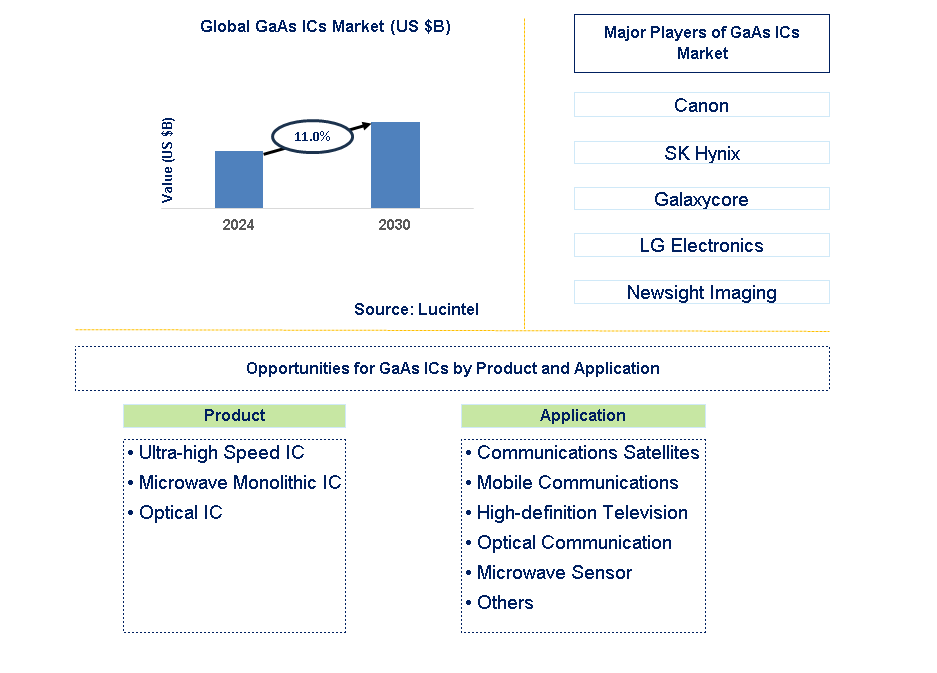
Key data points: The growth forecast = 11.0% annually for the next 7 years. Scroll below to get more insights. This market report covers trends, opportunities, and forecasts in the global GaAs ICs market to 2031 by product (ultra-high speed IC, microwave monolithic IC, and optical IC), application (communications satellites, mobile communications, high-definition television, optical communication, microwave sensor, and others), and region (North America, Europe, Asia Pacific, and the Rest of the World)
We'll send your sample report shortly.
• Lucintel forecasts that within the product category, ultra-high speed IC is expected to witness highest growth over the forecast period due to its higher bandwidth and lower noise.
• Within the application category, communications satellites will remain the largest segment.
• In terms of regions, APAC is expected to witness highest growth over the forecast period due to presence of GaAs ICs manufacturers in the region. Gain valuable insights for your business decisions with our 150+ page report.
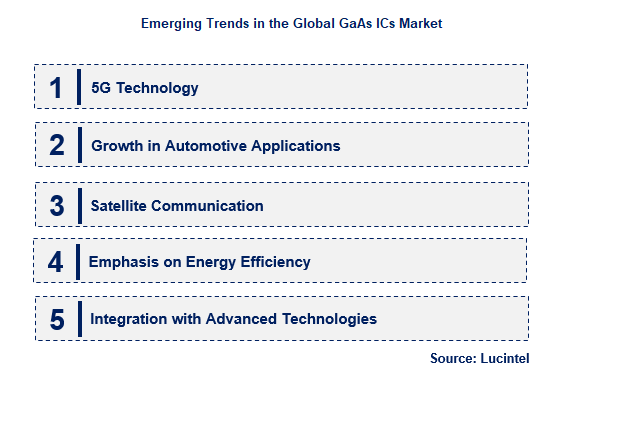
• 5G Technology: 5G technology increases the adoption of GaAs ICs. It is imperative for 5G technology due to its great performance at high frequencies. GaAs ICs provide faster data rates and ensure signal integrity, thereby facilitating the deployment of 5G infrastructure. The trend in 5G is driving the demand for GaAs ICs in base stations and cellular mobile devices.
• Growth in Automotive Applications: The utilization of GaAs in automotive applications is growing, particularly for the implementation of radar and ADAS. The high-speed signal processing required for reliable performance in radar is supported by GaAs ICs, enhancing safety and automation features in vehicles.
• Satellite Communication: High-frequency operable GaAs ICs find increasing applications in satellite communications. This rise in demand for satellite-based services and higher-speed data transmission is improving connectivity and the performance of space communication.
• Emphasis on Energy Efficiency: Energy efficiency is the most sought-after feature in the development of energy-efficient GaAs ICs, as it is expected to reduce power consumption without a loss in performance. This meets global trends toward energy-efficient electronic devices, thus stirring innovation in low-power GaAs technologies.
• Integration with Advanced Technologies: The integration of GaAs ICs into advanced technologies like AI and IoT is ongoing. The increased functionality and performance gained from such integration are applied in important applications ranging from wearable gadgets to industrial systems, as innovation feeds innovation and expands the application fields. These emerging trends are changing the perspective toward the GaAs IC market as they help improve applications and performance. 5G technology, automotive applications, satellite communication, energy efficiency, and integration with other advanced technologies are driving factors contributing to growth and advancement in the field of GaAs ICs.
• Higher 5G Capabilities: Improvements in 5G have become more viable with advancements in GaAs ICs. The new designs of GaAs ICs handle higher frequencies to ensure good signal integrity, facilitating higher data transfer rates and more reliable 5G.
• GaAs IC Integration: GaAs IC integration in automotive radar systems increases the performance of numerous automotive radar systems. Recent developments have enhanced the accuracy and reliability of automotive radar sensors, supporting the latest ADAS and ensuring safety in vehicles.
• Advanced Satellite Communication Systems: Advanced satellite communication systems increasingly use GaAs ICs to enable better data transmission rates with improved signal clarity. Innovations in the field of GaAs support enhanced performance in satellite communications, contributing to global connectivity.
• Energy-Efficient GaAs Designs: New developments focus on energy-efficient GaAs ICs, which lower power consumption without compromising performance. These new designs respond to the global trend toward energy efficiency and sustainability in electronic devices.
• Integration with AI and IoT: The integration of GaAs ICs into AI and IoT technologies opens new avenues for comprehensive functionalities in smart devices and industrial applications. This enhances the capabilities of GaAs ICs, fostering further innovation and expanding their range of applications. These are the major developments occurring in the GaAs IC market, leading to improvements in 5G capability, automotive radar integration, satellite communication systems, energy efficiency, and AI/IoT integration. All these innovations contribute to growth and expansion in the application fields of GaAs ICs across sectors.
• 5G infrastructure: Adoption has become one of the major growth opportunities for the GaAs IC market. These ICs address the necessary high-frequency performance needs among 5G base stations and other network equipment, further proliferating this technology across the world.
• Automotive safety systems: The applications of GaAs ICs in automotive safety systems, including radar and ADAS, are very promising. Their high-speed signal-processing capability leads to better performance and higher reliability for automotive safety features. This, in turn, has driven demand due to growth in the automotive market.
• Satellite communication: The growth of satellite communication systems is where GaAs ICs find their opportunities. Their high-frequency and high-power operation capabilities support the development of high-value, advanced satellite communication technologies, presenting opportunities for improvement in global connectivity and data transmission.
• Consumer electronics: In consumer electronics, the application of GaAs ICs is prominent in high-frequency tasks, both in mobile devices and RF components. Advanced requirements within consumer electronics stimulate more sophisticated performance for GaAs ICs and open up growth opportunities.
• Industrial automation: Industrial automation increasingly utilizes GaAs ICs, especially for sensors and control systems. Their ability to provide highly accurate and reliable data processing enables smart manufacturing and Industry 4.0 initiatives. Strategic growth opportunities in 5G infrastructure, automotive safety systems, satellite communication, consumer electronics, and industrial automation drive the GaAs IC market. These applications highlight the growing use of supporting technical advancements with GaAs ICs and the increasing demand in various industries.
• Technological Advances: Improvements in the fabrication techniques of semiconductor materials, along with an increase in frequency, have bestowed tremendous growth upon the industry. These advances further enhance the performance and efficiency of GaAs ICs, thereby making them more relevant for a wide range of industries.
• 5G Technology: The increasing demand for 5G technology is one of the important factors that heighten the demand for Gallium Arsenide integrated circuits due to high-frequency performance, catering to the requirements of 5G infrastructure. The increasing demand for faster and more reliable data networks encourages an increased demand for GaAs ICs.
• Satellite Communication Expansion: Growth in satellite communication systems fuels the requirement for high-frequency and high-power capable ICs made from GaAs. The advancement of satellite technology and the enhancement in demand for data transmission support the market for GaAs ICs.
• Rising Safety Requirements in the Automotive Sector: The rising safety requirements within the automotive sector drive the adoption of GaAs ICs in radar and ADAS applications. The increasingly sophisticated nature of automotive safety systems depends on high-speed signal processing provided by GaAs ICs.
• Growth in Consumer Electronics: The ever-growing demand for high-performance consumer electronics, including mobile devices and RF components, drives the market for GaAs ICs. Growing technological advances spur the demand for the high-frequency capabilities of GaAs ICs in consumer electronics. Challenges in the GaAs IC market include:
• High Manufacturing Cost: Due to a complicated production process and material costs, the manufacturing cost of GaAs ICs can be very high. This challenge may hinder the reduction of prices for this technology or make it less accessible to a wide range of applications.
• Competition from Silicon Alternatives: Costly GaAs ICs face competition from silicon-based ICs due to cost and wider availability. Competition from silicon-based alternatives challenges the existence of a market for GaAs ICs.
• Regulatory and Environmental Concerns: Despite all these benefits, regulatory and environmental concerns related to the production and disposal of GaAs ICs could hinder the growth of the market. The industry must consider these factors, regulations, and environmental impacts. Technological advancements, demand for 5G technology, satellite communications, automotive safety requirements, and consumer electronics drive the demand for GaAs ICs. High costs associated with manufacturing, competition from alternative silicon-based options, and regulatory scrutiny are the main deterrents to enterprises operating within this market and must be understood to navigate the landscape effectively.
• Canon
• SK Hynix
• Galaxycore
• LG Electronics
• Newsight Imaging
• Hanamatsu
• Pixelplus
• ON Semiconductor
• Samsung Electronics
• Omnivision
• Ultra-high Speed IC
• Microwave Monolithic IC
• Optical IC
• Communications Satellites
• Mobile Communications
• High-definition Television
• Optical Communication
• Microwave Sensor
• Others
• North America
• Europe
• Asia Pacific
• The Rest of the World
• United States: In the US, research into the advancement of GaAs IC technology is focused on improving both 5G communications and aerospace applications. Companies invest in research that will enhance the efficiency and reliability of GaAs-based devices. There is also a movement towards the integration of GaAs ICs into advanced defense systems and satellite communication, driven by increasing demand for high-speed data transmission and signal processing.
• China: The country is rapidly developing its capacity for the production of GaAs ICs, and firms are investing heavily in research and development. Chinese companies primarily focus on producing high-performance GaAs ICs for consumer electronics and telecommunications. Government-backed support for technological innovation, coupled with the growth of indigenous semiconductor industries, is fostering the development of GaAs ICs, mainly for 5G-related infrastructure and cellular devices.
• Germany: The development of the German market focuses on automotive and industrial applications. German companies create GaAs ICs for automotive radar systems and industrial automation with the goal of improving sensor accuracy and the reliability of communication. The key focus is integrating GaAs ICs with advanced technologies to support Industry 4.0 initiatives and smart vehicle systems.
• India: The market for GaAs ICs is slowly gaining momentum and has reached major areas of telecommunications and defense. Indian firms are increasingly adopting GaAs ICs to improve network infrastructure in defense electronics. Developing cost-effective solutions from GaAs to assist the country’s growth in digital and communication needs is also an area of emerging interest.
• Japan: Most Japanese developments in GaAs ICs pertain to applications related to consumer electronics and high-frequency communications. Japanese firms are leading the way in developing innovations in GaAs ICs for use in next-generation mobile communications devices and RF applications. Japanese technology leadership is driving trends in the market regarding the development and deployment of GaAs ICs in satellite systems and ultra-high-speed data transmission systems.


• Canon
• SK Hynix
• Galaxycore
• LG Electronics
• Newsight Imaging
• Hanamatsu
• Pixelplus
• ON Semiconductor
• Samsung Electronics
• Omnivision Q5. Which GaAs ICs market segment will be the largest in future? Answer: Lucintel forecasts that ultra-high speed IC is expected to witness highest growth over the forecast period due to its higher bandwidth and lower noise. Q6. In GaAs ICs market, which region is expected to be the largest in next 5 years? Answer: APAC is expected to witness highest growth over the forecast period due to presence of GaAs ICs manufacturers in the region. Q.7 Do we receive customization in this report? Answer: Yes, Lucintel provides 10% customization without any additional cost.


Choose a license that fits your team. Instant PDF delivery.
Prices exclude taxes. Instant delivery. Custom licensing available on request.
Market Report · July 24, 2026
Market Report · July 20, 2026
Market Report · July 20, 2026
Trusted partner for strategic intelligence and business growth


Receive a complimentary market analysis tailored to your industry. Our analysts will identify key growth opportunities and competitive dynamics specific to your business.

Market size, growth rate, and key trend analysis for your specific sector.

Top competitor positioning and market share analysis.

Strategic recommendations backed by data-driven insights.
Get curated market intelligence and competitive moves straight to your inbox.
By subscribing, you agree to receive our monthly insights. Unsubscribe anytime.
Receive a complimentary market analysis tailored to your industry. Our analysts will identify key growth opportunities and competitive dynamics specific to your business.
Market size, growth rate, and key trend analysis for your specific sector.
Top competitor positioning and market share analysis.
Strategic recommendations backed by data-driven insights.
Get curated market intelligence, emerging trends, and competitive moves straight to your inbox each month.
By subscribing, you agree to receive our monthly insights. Unsubscribe anytime.
We'll send your sample report shortly.