
Market Report · July 16, 2026

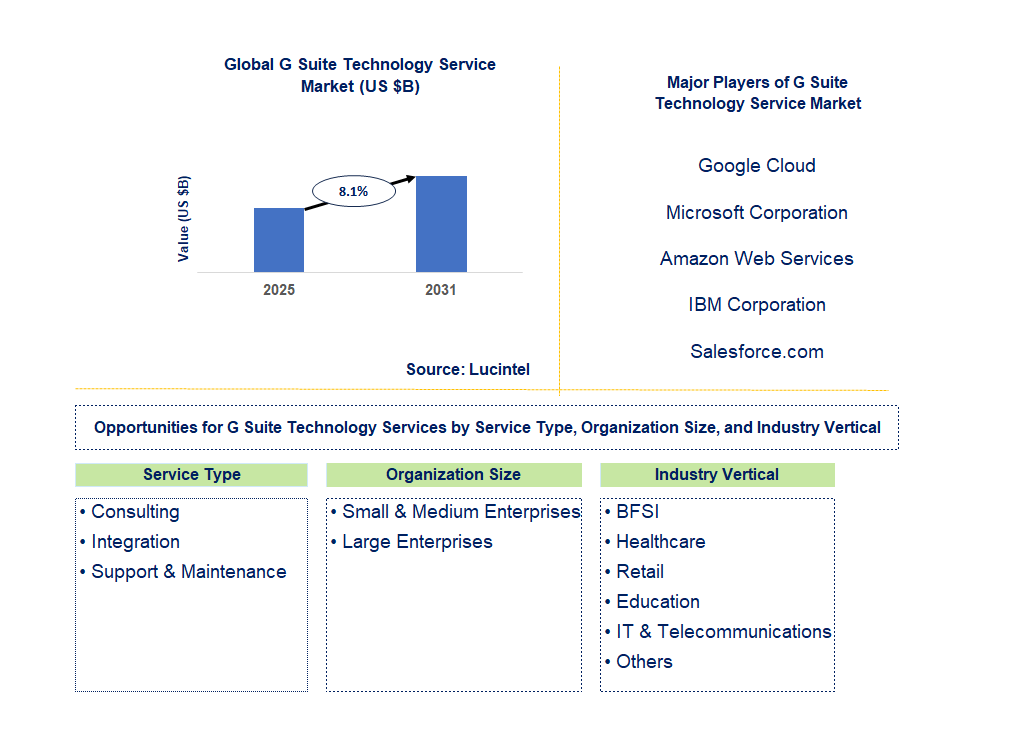
Key data points: The growth forecast = 8.1% annually for the next 7 years. Scroll below to get more insights. This market report covers trends, opportunities and forecasts in G suite technology service market to 2031 by service type (consulting, integration, and support & maintenance), organization size (small & medium enterprises and large enterprises), industry vertical (BFSI, healthcare, retail, education, IT & telecommunications, and others), and region (North America, Europe, Asia Pacific, and the Rest of the World)
We'll send your sample report shortly.
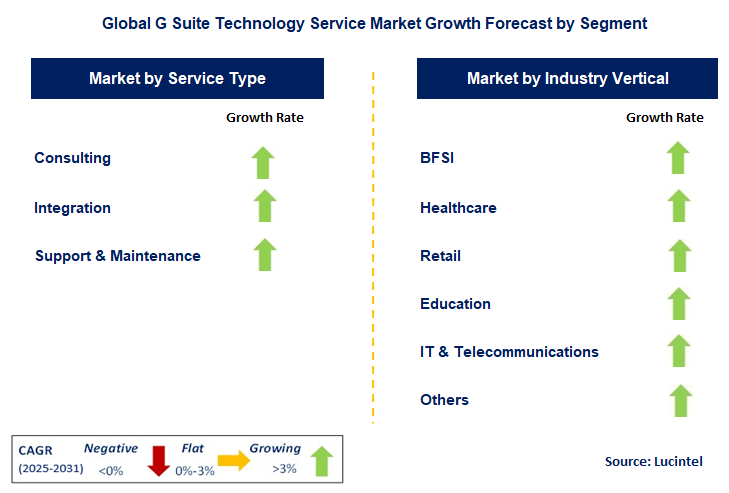
• Lucintel forecasts that, within the service type category, consulting is expected to witness the highest growth over the forecast period.
• Within the industry vertical category, BFSI is expected to witness the highest growth.
• In terms of region, North America is expected to witness the highest growth over the forecast period. Gain valuable insights for your business decisions with our comprehensive 150+ page report. Sample figures with some insights are shown below.
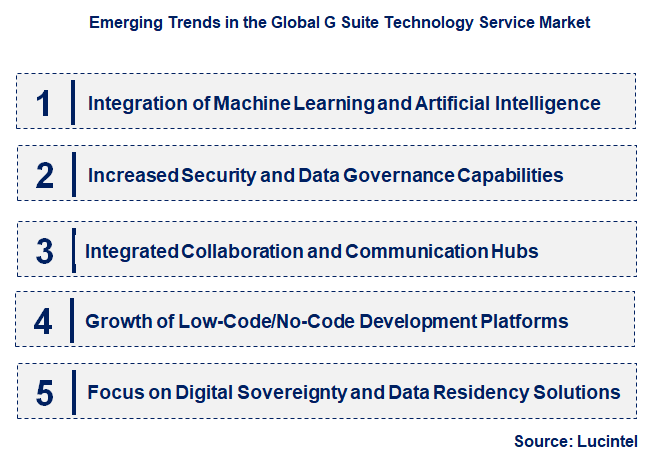
• Integration of Machine Learning and Artificial Intelligence: An overarching trend is the extensive integration of Machine Learning and Artificial Intelligence throughout all Google Workspace tools. AI capabilities such as Gemini now aid in content creation in Docs and Gmail, offer smart insights in Sheets, and improve meeting summaries in Meet. This profound integration is revolutionizing the way users engage with the suite, automating mundane processes, providing proactive recommendations, and dramatically enhancing individual and team productivity by enabling users to concentrate on higher-order work instead of manual tasks.
• Increased Security and Data Governance Capabilities: With expanding cyber-attacks and more stringent data privacy laws, there is a rising shift towards increased security and data governance capabilities in Google Workspace. This encompasses ransomware prevention advancements, Data Loss Prevention (DLP) in cloud and hybrid environments, and AI-based advanced threat detection. The focus is to offer administrators granular control, real-time visibility, and full compliance tools to safeguard sensitive information, ensure regulatory compliance, and ensure business continuity in a dynamic digital world.
• Integrated Collaboration and Communication Hubs: The market is rapidly shifting towards all-inclusive collaboration and communication platforms. Google Workspace is being transformed from independent applications to provide a comprehensive experience where Gmail, Chat, Meet, and Docs work together seamlessly. The trend is to minimize context switching, enhance the efficiency of workflows, and enable real-time collaboration. Spaces, tasks shared among groups, and in-document video calls are examples of such integration that facilitate teams to work more efficiently and smoothly from a single point.
• Growth of Low-Code/No-Code Development Platforms: The growth of low-code/no-code development platforms within the Google Workspace ecosystem, like App Sheet, is another major emerging trend. It enables business users, even without strong coding expertise, to develop custom applications and automate business processes within the Workspace environment itself. This empowerment of application development by democratization allows organizations to develop targeted solutions rapidly that meet specific business requirements, boosting efficiency and innovation without needing significant IT resources, yet adding another layer of versatility to the platform.
• Focus on Digital Sovereignty and Data Residency Solutions: An emerging trend, especially widespread in European markets and other areas with strict data protection regulations, is the focus on digital sovereignty and data residency solutions. Businesses are requesting more control over how their data is processed and stored in order to be in line with national and regional regulations. Google Workspace is reacting with greater data residency features and data-handling transparency so customers can select specific geographic locations for their data, thus meeting sophisticated compliance needs and establishing trust. These new trends are collectively transforming the G suite technology service market, making Google Workspace an even smarter, safer, and more integrated workplace for contemporary work. The deep embedding of AI is powering unprecedented productivity increases, with expanded security and data governance features solving top compliance and threat issues. The emphasis on unified collaboration centers and low-code/no-code programming empowers users and simplifies operations, and the increased focus on digital sovereignty indicates a mature reaction to international regulatory requirements, making Google Workspace a core foundation of future digital workplaces.
• Extensive Integration of AI-Driven Capabilities with Gemini: A game-changing recent advancement is the widespread integration of AI-driven features, most notably through Gemini, throughout the Google Workspace platform. Gemini helps users write emails in Gmail, create content in Docs, summarize meetings in Meet, and analyze data in Sheets. This revolutionizes the user experience by simplifying mundane tasks, providing smart suggestions, and greatly enhancing productivity, enabling employees to concentrate on more strategic and creative work rather than foundational aspects necessary for competitive success.
• Improved Security and Compliance Capabilities: Recent developments span significant improvements to Google Workspace’s security and compliance capabilities. These include more precise data loss prevention (DLP) controls across apps, enhanced phishing and malware protection within Gmail, and stronger identity and access management (IAM) features. These updates are essential for organizations handling more advanced cyber threats and complying with rigorous global data privacy regulations, delivering a more secure and trusted space for sensitive data.
• Integrated User Experience and Collaboration Spaces: Google has also greatly enhanced the user experience with a more coherent and integrated collaboration environment. The evolution involves applications such as Gmail, Chat, Meet, and Spaces being natively linked together so that users can alternate between communication and content creation without ever leaving their main workspace. This brings workflows closer together, minimizes context switching, and encourages real-time collaboration, all aiming to directly meet the demand for distributed teams looking for efficiency and unity.
• Enhancement of Low-Code/No-Code Development Capabilities with App Sheet: One significant development is the increased integration and functionality of low-code/no-code development in Google Workspace, specifically with App Sheet. This enables business users to create personalized applications and automate business processes through natural language descriptions, without needing traditional coding knowledge. This development makes app creation more democratized, allowing organizations to quickly develop customized solutions to address unique operational needs and enhance efficiency in different departments.
• Emphasis on Sustainability and Ecologically Friendly Operations: Google has increasingly foregrounded the sustainability of its cloud infrastructure backing Workspace. The latest developments include publicly reporting carbon neutrality and renewable power procurement for its data centers. This emphasis resonates with environmentally aware businesses and aligns with international corporate social responsibility efforts, enabling organizations that use Google Workspace to add to their own sustainability agendas by using a platform supported by green computing paradigms. These recent advancements are collectively influencing the G suite technology service market to drive it in the direction of a future where productivity is enhanced by AI, security is proactive and complete, and collaboration is integrated and seamless. The ongoing evolution of the user experience, combined with the promotion of low-code development and dedication to sustainability, makes Google Workspace an increasingly attractive and strategic option for organizations looking to streamline their digital activities and stay ahead in a shifting global economy.
• Increased Collaboration for Hybrid Workforces: The ongoing transformation of hybrid workforces is a key strategic growth opportunity. As companies work through a blend of in-office and remote workers, there is a growing requirement for Google Workspace to deliver even more efficient and fair collaboration experiences. These involve the ability for advanced functions within Google Meet for virtual meetings, more robust real-time co-editing within Docs, Sheets, and Slides, and built-in project management within Spaces so everyone can stay productive and engaged no matter where they are.
• AI-Driven Business Intelligence and Analytics: Leveraging Google Workspace for AI-driven business insight and analytics provides a strong growth trajectory. There are opportunities for more extensive integration of AI to extract actionable insights from data in Drive, Sheets, and BigQuery. These can include natural language processing for querying data, the generation of reports automatically, and predictive analytics in the Workspace environment. This enables organizations to make decisions more effectively and efficiently based on data, improving operational performance and strategic planning.
• Industry-Specific Solutions and Customization: Building and providing industry-specific customizations and solutions based on Google Workspace is a significant growth prospect. Customizing the suite for industries such as healthcare (e.g., HIPAA compliance for patient records), education (e.g., learning tools), or finance (e.g., compliance workflows) can open up new market spaces. This includes using App Sheet for creating custom apps, integration with industry software, and compliance with industry regulations to address specific operating requirements.
• Advanced Security and Compliance Services: As cybersecurity threats and regulatory environments become more complex, advanced security and compliance services surrounding Google Workspace represent a significant growth opportunity. This encompasses delivering specialized data governance consulting, deploying strong Data Loss Prevention (DLP) practices, installing high-level threat protection beyond the norm, and offering compliance auditing and reporting capabilities. Companies are open to paying for the expertise to get the most out of Workspace security, as well as work through complicated regulatory obligations.
• Integration with Third-Party Ecosystems and APIs: Strategic expansion can be realized by strong integration with more expansive third-party ecosystems and heavy utilization of APIs. Potential lies in making seamless links between Google Workspace and key enterprise apps such as CRM (for example, Salesforce), ERP (for example, SAP), and project management software. This maximizes the general utility of Workspace so businesses can build complete, integrated digital workflows that take advantage of the strengths of various software packages, enhancing efficiency and minimizing data silos. These strategic expansion opportunities reinforce Google Workspace’s increasingly prominent position as a platform that is not merely a collection of productivity tools. Through the emphasis on reinforcing collaboration in hybrid work, utilizing AI to unlock greater insights, providing industry-specific solutions, delivering advanced security and compliance solutions, and providing solid third-party integrations, the G Suite Technology Service market is strategically positioning itself to become an irreplaceable and highly flexible platform. This move to specialized and integrated applications is essential for continued market dominance and meeting the advanced needs of contemporary businesses.
• Google Cloud
• Microsoft Corporation
• Amazon Web Services
• IBM Corporation
• Salesforce.com
• Oracle Corporation
• Cisco Systems
• Adobe
• Vmware
• ServiceNow
• Consulting
• Integration
• Support & Maintenance
• Small & Medium Enterprises
• Large Enterprises
• North America
• Europe
• Asia Pacific
• The Rest of the World
• United States: The United States market for Google Workspace continues to experience significant growth, driven by the extensive use of remote and hybrid work paradigms. Recent innovation involves deeper embedding of AI-driven features such as Gemini into core products, improving content creation, data analysis, and task automation. There is also a heavy focus on advanced security features such as zero-trust controls and advanced threat prevention to address stringent data privacy laws and new cyber threats, making it an essential tool for businesses of all sizes.
• China: In China, the G suite technology service market is under the influence of special dynamics because of stringent internet regulations and a domestic preference for cloud service providers. Though direct access to the complete suite might be difficult, the recognition of the strength of integrated collaboration tools is growing. Recent trends indicate some strategic alliances aimed at localizing cloud solutions. Yet, the market is increasingly based on local alternatives with comparable functionalities, responding to the high priority on data sovereignty and national security initiatives.
• Germany: The G suite technology service market in Germany is heavily impacted by the strict data privacy of the General Data Protection Regulation (GDPR). Recent trends prioritize improved privacy controls, data localization features, and clear data processing. Firms are especially interested in solutions that not only guarantee compliance but also provide effective collaboration. The adoption of AI capabilities is being scrutinized for its commitment to privacy principles, with particular emphasis on enterprise-class security and data governance in the Workspace environment.
• India: The G suite technology service market in India is witnessing strong growth, driven by swift digital transformation across small, medium, and large businesses, coupled with a flourishing startup ecosystem. Recent trends witnessed include an uptick in the adoption of Google Workspace for remote schooling and business continuity. Increasing demand is being seen for value plans that provide scalable solutions, with specific interest in AI-driven productivity features and added security features to safeguard data in a quickly digitalizing economy in line with the nation’s digital push.
• Japan: The Japanese G suite technology services market values efficiency, reliability, and security based on a robust culture of careful business conduct and an increasing demand for cloud collaboration. Recent trends underscore the use of Google Workspace to ensure easy project management and communications, particularly in industries focusing on innovation and agility. There is ongoing emphasis on bringing Google Workspace together with current Japanese enterprise systems and using its secure design to maintain data integrity and business continuity to support highly digitalized workforces.


• Google Cloud
• Microsoft Corporation
• Amazon Web Services
• IBM Corporation
• Salesforce.com
• Oracle Corporation
• Cisco Systems
• Adobe
• Vmware
• ServiceNow Q5. Which G suite technology service market segment will be the largest in future? Answer: Lucintel forecasts that, within the service type category, consulting is expected to witness the highest growth over the forecast period. Q6. In G suite technology service market, which region is expected to be the largest in next 5 years? Answer: In terms of region, North America is expected to witness the highest growth over the forecast period. Q7. Do we receive customization in this report? Answer: Yes, Lucintel provides 10% customization without any additional cost.


Choose a license that fits your team. Instant PDF delivery.
Prices exclude taxes. Instant delivery. Custom licensing available on request.
Market Report · July 16, 2026
Market Report · May 18, 2026
Market Report · May 18, 2026
Trusted partner for strategic intelligence and business growth


Receive a complimentary market analysis tailored to your industry. Our analysts will identify key growth opportunities and competitive dynamics specific to your business.

Market size, growth rate, and key trend analysis for your specific sector.

Top competitor positioning and market share analysis.

Strategic recommendations backed by data-driven insights.
Get curated market intelligence and competitive moves straight to your inbox.
By subscribing, you agree to receive our monthly insights. Unsubscribe anytime.
Receive a complimentary market analysis tailored to your industry. Our analysts will identify key growth opportunities and competitive dynamics specific to your business.
Market size, growth rate, and key trend analysis for your specific sector.
Top competitor positioning and market share analysis.
Strategic recommendations backed by data-driven insights.
Get curated market intelligence, emerging trends, and competitive moves straight to your inbox each month.
By subscribing, you agree to receive our monthly insights. Unsubscribe anytime.
We'll send your sample report shortly.