
Market Report · July 16, 2026

Key data points: The growth forecast = 10.2% annually for the next 7 years. Scroll below to get more insights. This market report covers Trends, opportunity and forecast in G suite business tool market to 2031 by business size (small businesses, medium enterprises, and large corporations), end use (technology, education, healthcare, finance, retail, manufacturing, and others), and region (North America, Europe, Asia Pacific, and the Rest of the World)
We'll send your sample report shortly.
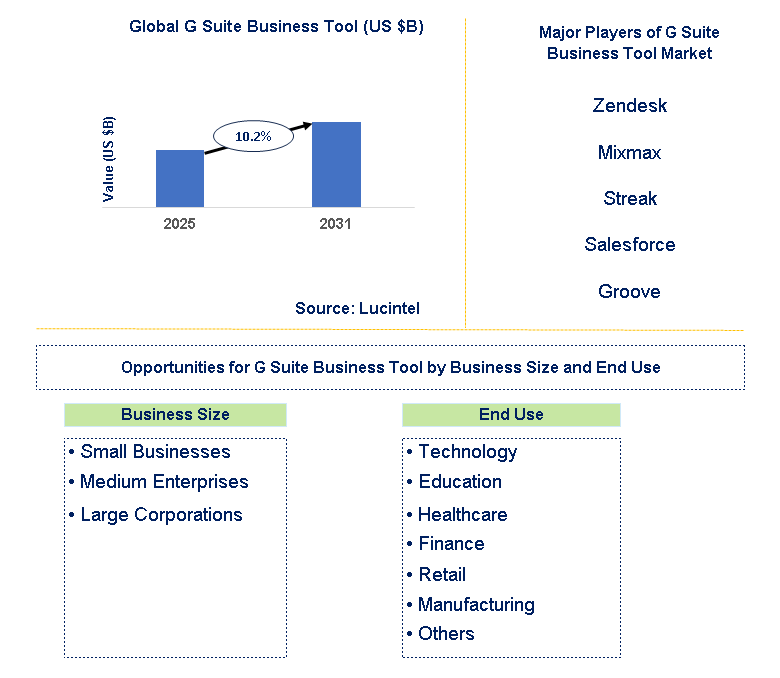
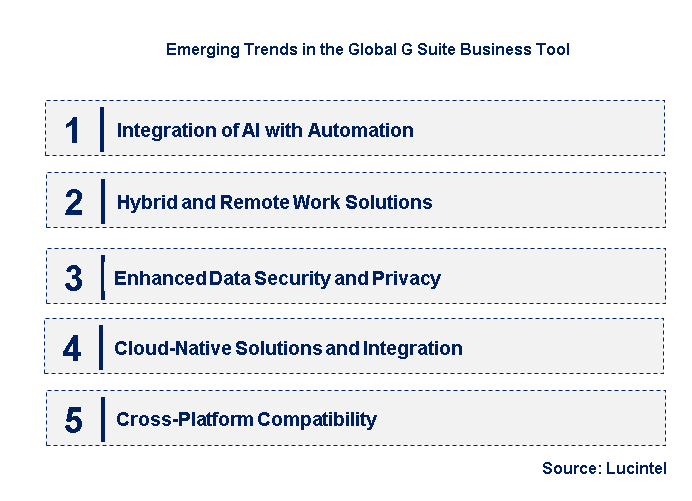
• Integration of AI with Automation: AI features have become an essential part of Google Workspace, automating tasks to increase productivity. These features include smart compose and smart replies in Gmail and Docs, which help users create content faster. Additionally, machine learning-driven insights provide real-time recommendations for enhanced collaboration and decision-making. This makes the platform more responsive to user needs, creating an intelligent and efficient environment for teams.
• Hybrid and Remote Work Solutions: The rise of hybrid work has prompted Google Workspace to enhance real-time collaboration. Teams can now collaborate seamlessly across time zones and locations using Google Meet, Google Drive, and other collaborative tools like Google Docs. This trend is expected to continue as businesses balance in-office and remote work arrangements.
• Enhanced Data Security and Privacy: In response to global data security concerns, Google has significantly strengthened its data protection features. Workspace now includes advanced security management tools, encryption services, and data loss prevention (DLP) mechanisms, in line with strict regulations such as GDPR. These improvements are especially important in sectors like healthcare, finance, and government, where data security is paramount.
• Cloud-Native Solutions and Integration: As more businesses move to cloud-based solutions, Google Workspace positions itself as a central hub for business operations. With deep integration with Google Cloud Platform (GCP), Workspace allows businesses to scale effortlessly while minimizing tool complexity. This integration leads to increased efficiency and reduced operational costs, helping businesses stay competitive.
• Cross-Platform Compatibility: With organizations operating on multiple operating systems and devices, the need for tools that work seamlessly across platforms is growing. Google Workspace’s focus on easy integration with platforms like Windows, macOS, Android, and iOS ensures that organizations can maintain a consistent workflow, regardless of the devices used by their team members. These trends indicate a shift toward AI-enhanced, remote-friendly, and highly secure business environments. Google Workspace’s adaptability and feature expansion are key drivers behind its growing influence in the business tool market.
• AI-Enhanced Functionality: Google has integrated AI more deeply into Workspace, introducing features like predictive text, automatic meeting scheduling, and intelligent collaboration suggestions. This move toward automation enables employees to work more efficiently by reducing repetitive tasks and enhancing decision-making. Additionally, with the introduction of Google Assistant, users can navigate their work environment using voice commands, making the suite even more accessible.
• Better Collaboration Tools: Google has improved collaborative features, including real-time editing in Google Docs, Slides, and Sheets. The upgraded version of Google Meet now supports larger meetings and webinars with improved video quality, seamlessly integrating with other Workspace tools. These updates address the need for more effective remote collaboration solutions for both large enterprises and small businesses.
• Improved Security Features: Google Workspace now provides more control over security management and user access. Multi-factor authentication (MFA), endpoint management, and enhanced encryption offer higher levels of protection. These updates play a crucial role in maintaining trust, especially in industries where data sensitivity is a critical concern.
• Increased Marketplace Integrations: Google Workspace has expanded its third-party application marketplace, allowing businesses to integrate more tools and workflows directly into the platform. These include project management software, CRM tools, and marketing apps, helping create a more interconnected and dynamic team environment.
• Localization of Global Services: As Google Workspace expands into non-English-speaking markets, the platform continues to adapt to regional needs. For example, Google Workspace in Japan includes features tailored to the local business landscape and language, while complying with privacy frameworks like GDPR in Europe and India’s data protection laws in other parts of the world. These recent developments highlight Google’s continuous improvement of Workspace to meet global demands. The ongoing evolution of the platform strengthens its position as a comprehensive business tool worldwide.
• SMB Adoption: Small and medium-sized businesses (SMBs) are increasingly embracing cloud-based productivity tools due to their cost-effectiveness and scalability. Google Workspace provides affordable, integrated tools for collaboration, storage, and productivity, making it an attractive option for SMBs with limited resources. The focus on simplifying the user interface and offering excellent customer support has further increased its appeal to this market.
• Education Sector: Google Workspace for Education has seen explosive growth, especially with the rise of hybrid learning environments. Schools and universities are adopting Google Classroom and other tools for remote learning, collaboration, and administrative management. As global education continues to digitalize, Google has significant opportunities to expand its presence in this sector.
• Healthcare and Life Sciences: The healthcare industry is increasingly adopting cloud-based solutions for secure data management, collaboration, and communication. Google Workspace’s strong security features and its ability to integrate with other healthcare platforms make it well-suited for this sector, particularly as remote consultations and telemedicine become more common.
• Enterprise Market Expansion: Google Workspace continues to expand in large enterprises by improving integrations with other enterprise software tools like CRM, ERP, and financial management systems. As businesses transition to integrated and scalable cloud ecosystems, Google’s comprehensive suite of tools presents ample growth opportunities in the enterprise market.
• Government and Public Sector: Governments worldwide are increasingly adopting cloud-based tools for transparency and collaboration. Google Workspace offers secure and scalable solutions that can streamline operations and enhance communication with citizens. This sector is expected to see growing demand due to the security and compliance features of workspace. These growth opportunities demonstrate how Google Workspace is focusing on specific sectors. Its expansion into SMBs, education, healthcare, enterprise, and government markets creates a vibrant path for development in the business tool market.
• Zendesk
• Mixmax
• Streak
• Salesforce
• Groove
• Expensify
• Mailtrack.io
• Small Businesses
• Medium Enterprises
• Large Corporations
• Technology
• Education
• Healthcare
• Finance
• Retail
• Manufacturing
• Others
• North America
• Europe
• Asia Pacific
• The Rest of the World
• United States: In the US, Google Workspace has been growing its market share with a strong focus on adoption by enterprises. The latest updates focus on AI integration, with machine learning enhancing collaboration and automating workflows. For example, the finance, healthcare, and education sectors are increasingly adopting Google’s suite due to its scalability, security, and competitive pricing. This growth is driven by robust remote work programs and hybrid workforce models, which also necessitate cross-platform compatibility.
• China: Google Workspace is restricted in mainland China; however, there are similar Chinese cloud platforms resembling G Suite that have developed in the local market. This regulatory environment is challenging, particularly regarding privacy laws related to data. Local Chinese businesses are likely to use domestically developed solutions, but multinational companies with operations in China still rely on Google Workspace for its global connectivity.
• Germany: Germany has rapidly adopted Google Workspace, especially following the introduction of the European General Data Protection Regulation (GDPR). This has increased trust among German companies, which now believe Google complies with EU regulations. Additionally, German businesses are incorporating AI-powered tools in their workflows and benefit from Workspace’s seamless integration with other Google Cloud products. Despite some concerns about data privacy, the suite remains dominant in the local market.
• India: The adoption of Google’s productivity suite has increased significantly in India due to its affordability, scalability, and compatibility with the country’s expanding start-up ecosystem. This growth is driven by digital transformation in SMEs, educational institutions, and government organizations. The platform offers collaboration tools and cloud storage solutions that are highly appealing to local businesses, while government initiatives to improve digital infrastructure have further boosted its use.
• Japan: Google Workspace has grown steadily in Japan, attributed to the country’s strong culture of innovation and technology adoption. Organizations are increasingly turning to the suite to modernize their operations and improve cross-functional collaboration. There has been a significant shift toward hybrid work, and Google’s offering of Japanese language support and localized services has contributed to increased adoption rates.


• Zendesk
• Mixmax
• Streak
• Salesforce
• Groove
• Expensify
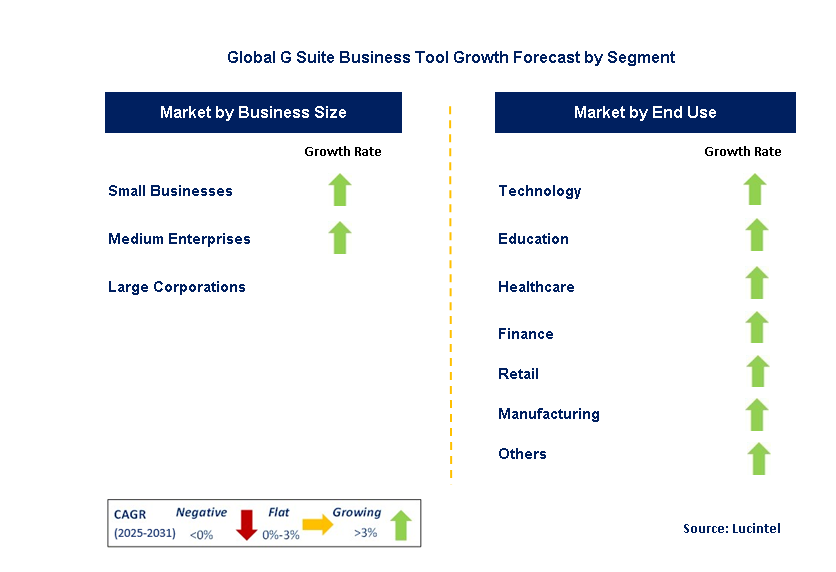
• Mailtrack.io Q5. Which G suite business tool market segment will be the largest in future? Answer: Lucintel forecasts that, within the business size category, large corporation is expected to witness the highest growth over the forecast period. Q6. In G suite business tool market, which region is expected to be the largest in next 5 years? Answer: In terms of region, APAC is expected to witness the highest growth over the forecast period. Q7. Do we receive customization in this report? Answer: Yes, Lucintel provides 10% customization without any additional cost.


Choose a license that fits your team. Instant PDF delivery.
Prices exclude taxes. Instant delivery. Custom licensing available on request.
Market Report · July 16, 2026
Market Report · May 18, 2026
Market Report · May 18, 2026
Trusted partner for strategic intelligence and business growth


Receive a complimentary market analysis tailored to your industry. Our analysts will identify key growth opportunities and competitive dynamics specific to your business.

Market size, growth rate, and key trend analysis for your specific sector.

Top competitor positioning and market share analysis.

Strategic recommendations backed by data-driven insights.
Get curated market intelligence and competitive moves straight to your inbox.
By subscribing, you agree to receive our monthly insights. Unsubscribe anytime.
Receive a complimentary market analysis tailored to your industry. Our analysts will identify key growth opportunities and competitive dynamics specific to your business.
Market size, growth rate, and key trend analysis for your specific sector.
Top competitor positioning and market share analysis.
Strategic recommendations backed by data-driven insights.
Get curated market intelligence, emerging trends, and competitive moves straight to your inbox each month.
By subscribing, you agree to receive our monthly insights. Unsubscribe anytime.
We'll send your sample report shortly.