
Market Report · July 15, 2026

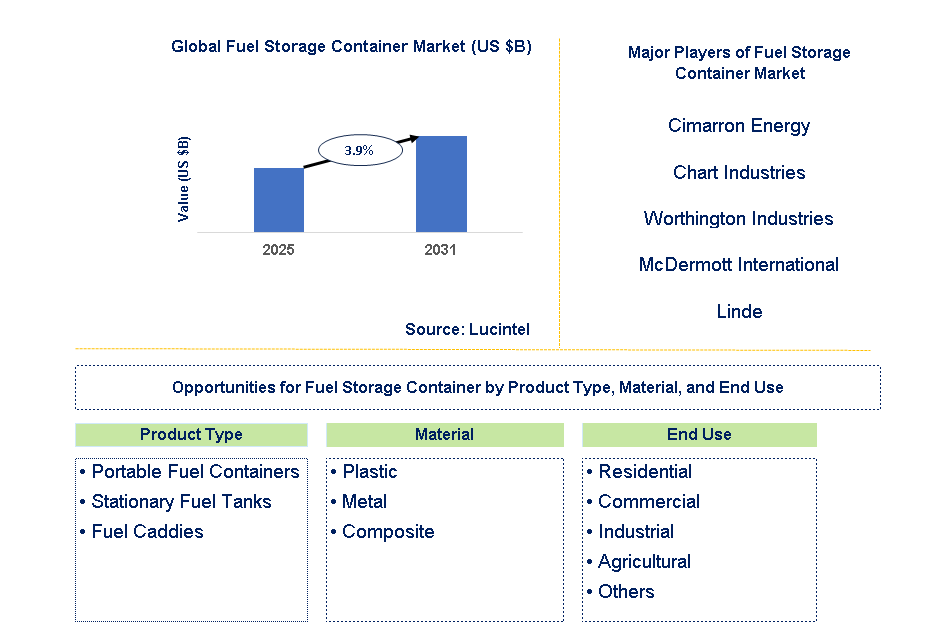
Key data points: The growth forecast = 3.9% annually for the next 7 years. Scroll below to get more insights. This market report covers trends, opportunities and forecasts in fuel storage container market to 2031 by product type (portable fuel containers, stationary fuel tanks, and fuel caddies), material (plastic, metal, and composite), end use (residential, commercial, industrial, agricultural, and others), and region (North America, Europe, Asia Pacific, and the Rest of the World)
We'll send your sample report shortly.
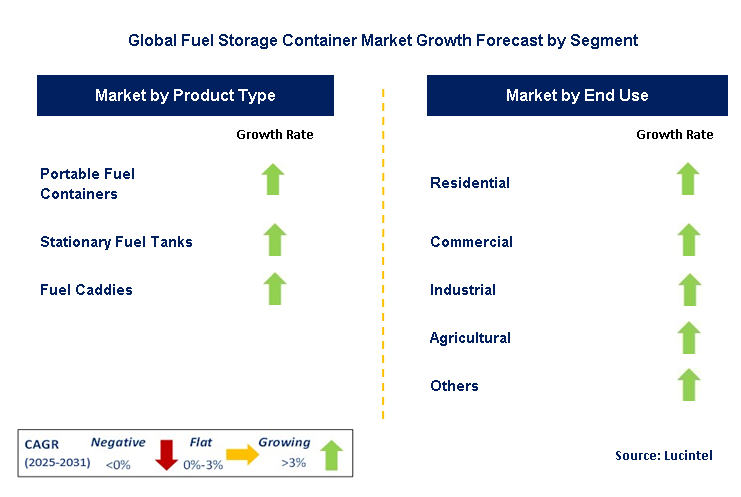
• Lucintel forecasts that, within the product type category, portable fuel container is expected to witness the highest growth over the forecast period.
• Within the end use category, industrial is expected to witness the highest growth.
• In terms of region, APAC is expected to witness the highest growth over the forecast period. Gain valuable insights for your business decisions with our comprehensive 150+ page report. Sample figures with some insights are shown below.
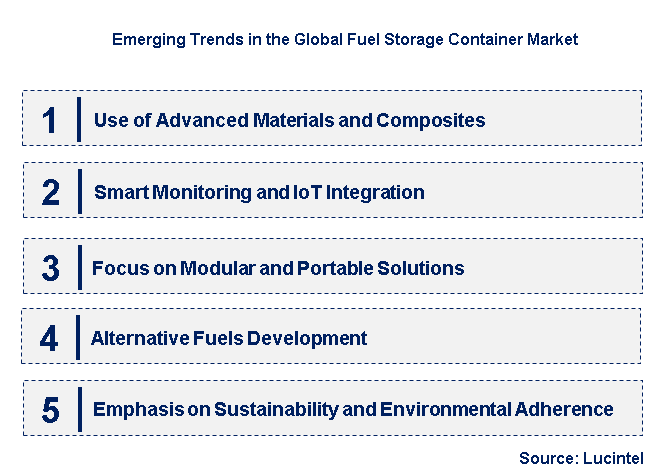
• Use of Advanced Materials and Composites: This trend encompasses greater utilization of light, hard, and corrosion-resistant advanced materials including advanced plastics, fiberglass reinforced polymers (FRP), and custom composites. These products provide advantages compared to conventional steel, such as lower weight, better chemical compatibility, and increased longevity. The use is a major enhancement of the safety and operational effectiveness of fuel storage tanks. Easier-to-move and install lighter tanks, combined with greater corrosion resistance cutting maintenance expenses and prolonging service life, result in long-term cost savings.
• Smart Monitoring and IoT Integration: Fuel storage tanks are being fitted with intelligent sensors, Internet of Things (IoT) devices, and live monitoring devices. The technologies allow fuel level, temperature, pressure, and even leak monitoring remotely. Consumption patterns and predictive maintenance insights are given by data analytics. The effect is improved operational performance, better safety, and environmental risk minimization. Real-time data facilitates better inventory control, avoids spills, and ensures regulatory compliance, resulting in more consistent and secure fuel handling.
• Focus on Modular and Portable Solutions: There is increasing demand for modular, collapsible, and easy-to-deploy fuel storage containers, especially for military, disaster response, building, and off-grid industrial use. Such solutions focus on flexibility, fast deployment, and mobility. The effect is greater operational flexibility and lower logistical complexity. Mobile and modular containers facilitate on-site refueling, reducing downtime and transport expense of machinery and vehicles in locations lacking fixed infrastructure, thereby enhancing efficiency in various operating conditions.
• Alternative Fuels Development: Global energy shift is propelling immense development of storage tanks for alternative fuels such as Liquefied Natural Gas (LNG), hydrogen, and biofuels. This involves specialty cryogenic tanks for LNG and high-pressure composite tanks for hydrogen, maintaining compatibility with biodegradable and corrosive biofuels. The effect is enabling a cleaner energy future, enabling the transition away from conventional fossil fuels. The trend brings new market segments and innovation in material science and safety regulations for alternative sources of energy.
• Emphasis on Sustainability and Environmental Adherence: With more stringent environmental laws and greater corporate social responsibility, the market is witnessing a strong emphasis on green manufacturing processes and environmentally friendly container designs. This comprises double-walled tanks for better leak prevention, vapor recovery equipment, and containers from recycled or recyclable material. The result is a lower environmental impact from fuel storage activities and better regulatory compliance, decreasing the potential for spillage and contamination. This also attracts environmentally friendly businesses and customers. These new trends are essentially redefining the fuel storage container industry by propelling innovation toward increased safety, efficiency, and eco-friendliness. Use of sophisticated materials and intelligent technologies is improving performance and reliability, while the emphasis on modular designs is enhancing flexibility. Most importantly, innovation in the design of specialized containers for alternative fuels and an absolute focus on sustainability are driving the market to the vanguard of the international energy transition. Together, these dynamics are creating a fuel storage container infrastructure that is not only resilient but also responsive to the changing needs of a cleaner, more dynamic energy environment.
• Developments in Double-Walled and Secondary Containment Systems: One important development is the general acceptance and refinement of double-walled fuel storage tanks and secondary containment systems integrated into the tank. These systems have a fuel inner tank and an outer casing to hold any leaks or spills, greatly improving environmental protection and safety. This affects the market of fuel storage containers by significantly eliminating ground and water contamination through leaks, adhering to tight environmental standards, and offering greater peace of mind to operators and the public.
• Integration of Smart Monitoring and IoT for Remote Management: The latest advancements comprise the ubiquitous adoption of intelligent monitoring and Internet of Things (IoT) technologies by fuel storage containers. These technologies offer real-time information regarding fuel levels, temperature, pressure, and leaks, remotely accessed through digital portals. This affects the market for fuel storage containers by facilitating predictive maintenance, maximizing inventory management, enhancing security, and providing instant detection of anomalies, resulting in increased efficiency of operations and anticipatory safety practices.
• Expansion of Portable and Mobile Fuel Storage Solutions: The industry has experienced growth in the production and application of portable and mobile fuel storage tanks. From small, portable tanks used for construction site and farm purposes to large, self-sustaining containerized fueling stations for distant operations and emergency relief efforts, there has been a notable expansion. This affects the fuel storage container industry by providing greater convenience and flexibility, enabling fuel to be taken to the point of use, lowering logistical expenses, and raising operational availability in a number of industries.
• Creation of Specialized Containers for Alternative Fuels: An important area of development is the specialized storage containers for alternate energy resources like Liquefied Natural Gas (LNG), compressed natural gas (CNG), hydrogen, and biofuels (e.g., methanol, ethanol). These need specialized designs, materials, and protective features because of their different characteristics (e.g., cryogenic temperatures in the case of LNG, pressure in the case of hydrogen). This affects the fuel storage container industry by creating new markets altogether and stimulating innovation in engineering and materials science to facilitate the global energy transition.
• Improved Corrosion Resistance and Material Strength: Recent advances highlight improved corrosion resistance and overall material strength in fuel storage containers. This involves the application of advanced coatings, composite materials, and better manufacturing practices for conventional steel tanks. The goal is to extend the duration of containers, especially when used in storage of corrosive biofuels or used in severe environments. This affects the market for fuel storage containers by lowering maintenance needs, decreasing long-term cost replacement, and providing the integrity and safety of fuels stored for long durations. These critical advancements are deeply influencing the fuel storage container industry by stimulating innovation towards more security-oriented features, enhanced operational effectiveness, and more flexibility towards changing energy matrices. Progress in containment technology and intelligent monitoring is reducing eco-hazards, while the emergence of mobile solutions is increasing operating flexibility. Key, in this regard, is the creation of optimized containers for alternative fuels and focus on material durability to be placing the market for long-term growth and its critical position in sustaining a diversified, more sustainable energy future.
• Growth in Industrial and Commercial On-Site Fueling Solutions: One major strategic growth area is offering end-to-end on-site fuel storage solutions to industrial and commercial industries like construction, mining, agriculture, and logistics. These sectors need efficient and reliable fuel supply for their equipment and fleets in sometimes remote or fluid locations. The provision of strong, regulatory-compliant, and simple-to-deploy fuel containers, both mobile and stationary with built-in dispensing, can meet this strong need for operational productivity and less downtime.
• Expansion in Alternative Fuel Infrastructure: The international energy shift presents a significant strategic growth area in developing sophisticated fuel storage tanks for non-traditional fuels such as LNG, hydrogen, and biofuels. As the global economy transitions away from conventional fossil fuels, there will be a growing demand for efficient and safe storage facilities for these new energy carriers. Research and development investments in cryogenic tanks, high-pressure composite tanks, and chemically compatible solutions put firms at the vanguard of this new market segment.
• Intelligent Tank Solutions with IoT and Analytics Data Integration: One of the most critical growth areas is creating and selling "smart" fuel storage tanks with IoT and analytics capabilities built in. These products can track real-time fuel levels, temperature, pressure, leakages, and consumption patterns. These smart systems find value among organizations looking to drive optimization of inventory management, reduce risk, ensure regulatory compliance, and derive actionable insights on their fuel consumption. This provides substantial value-added over traditional storage, leading to a premium market space.
• Existing Storage Facility Retrofit and Modernization: There is a massive strategic growth potential in offering retrofit and modernization solutions to existing, old fuel storage tanks. Most older tanks do not comply with today’s environmental or safety regulations and have lower efficiency. Providing upgrade services, such as secondary containment liners, higher-level monitoring systems, and corrosion protection, can penetrate an immense installed base. This enables asset owners to increase the life of their infrastructure while improving safety and compliance without replacement.
• Emergency Response and Disaster Relief Applications: The growing rate and severity of natural disasters, combined with geopolitical tensions, provide a strategic growth potential in offering quickly deployable fuel storage tanks for emergency response and disaster relief missions. Such solutions must be designed to be ruggedized, easy to move, and simple to deploy in order to enable humanitarian relief efforts, power generation equipment, and emergency response vehicles in the disaster zone. Collaborations with government agencies and NGOs can capture significant contracts in this mission-critical application. These growth opportunities for strategies are deeply influencing the fuel storage container industry by sparking diversification and speeding innovation in different applications. Industry stakeholders are unlocking new sources of income by concentrating on industrial on-site fueling, alternative fuels infrastructure, intelligent tank solutions, modernization projects, and emergency response. This diversified strategy is promoting product development and service improvements, guaranteeing the market’s sustained growth and its vital role in catering to diversified energy demands in a transforming world.
• Cimarron Energy
• Chart Industries
• Worthington Industries
• McDermott International
• Linde
• Royal Vopak
• Emerson Electric
• General Electric Company
• Schneider Electric
• Honeywell International
• Portable Fuel Containers
• Stationary Fuel Tanks
• Fuel Caddies
• Plastic
• Metal
• Composite
• Residential
• Commercial
• Industrial
• Agricultural
• Others
• North America
• Europe
• Asia Pacific
• The Rest of the World
• United States: The fuel storage container market in the United States is witnessing vigorous growth, especially in the automobile and LNG tank container industries. Recent trends involve the use of light-weight materials such as plastics, composites, and aluminum for automobile fuel tanks due to strict emission standards and the fuel efficiency drive. In the case of LNG, improvements revolve around maximization of insulation materials such as vacuum-insulated tanks in an effort to minimize boil-off gas. There is also a growing demand for mobile and modular refueling stations for use in construction, mining, and the military, with a focus on mobility and safety.
• China: China’s market for fuel storage containers is influenced the most by its enormous shipping sector’s green makeover and increasing local energy requirements. Recent news was the maiden delivery of China’s indigenous 16,000 TEU methanol dual-fuel container vessel, which has an 11,000 cubic meter methanol storage tank. This indicates a strong move towards substitute marine fuels and the creation of specialized storage. There is also rising investment in clean fuel refueling services at key ports, suggestive of shifting infrastructure to accommodate varied fuel storage requirements.
• Germany: The market for fuel storage containers in Germany is dominated by a strategic emphasis on the storage of natural gas and the shift to low-carbon fuels. Recent trends include government decrees calling for amending gas storage targets, indicative of attempts to balance energy security with market flexibility. While holding large LPG inventories, the nation is also experiencing rising investment in alternative fuel infrastructure such as bio-marine fuel. The focus is on safe, efficient, and environmentally friendly storage options, responding to shifting energy policies and supply chain dynamics, especially post-Ukraine crisis.
• India: India’s market for fuel storage containers, particularly for ISO tank containers, is witnessing dynamic growth, mainly fueled by mounting investments within the petrochemical and chemical industries. Recent trends have involved large chemical plant developments, requiring substantial demand for safe and effective bulk liquid storage and transport solutions. The market is also witnessing pressure for green and energy-efficient containers, as well as the increased use of ISO tank containers for e-commerce logistics, showcasing diversification from conventional industrial uses.
• Japan: Japan’s fuel storage tank market is driven by energy security and a focus on having stable fuel supplies. Recent trends reflect the government’s intention to uphold considerable LPG stockholding requirements until 2030, even as domestic demand continues to drop, because of geopolitical trade issues. This provides a stable market for large tanks. The bunker fuel market, including very low sulfur fuel oil (VLSFO) and LNG, is also increasing, with demand for efficient and compliant marine fuel storage facilities at ports.


• Cimarron Energy
• Chart Industries
• Worthington Industries
• McDermott International
• Linde
• Royal Vopak
• Emerson Electric
• General Electric Company
• Schneider Electric
• Honeywell International Q5. Which fuel storage container market segment will be the largest in future? Answer: Lucintel forecasts that, within the product type category, portable fuel container is expected to witness the highest growth over the forecast period. Q6. In fuel storage container market, which region is expected to be the largest in next 5 years? Answer: In terms of region, APAC is expected to witness the highest growth over the forecast period. Q7. Do we receive customization in this report? Answer: Yes, Lucintel provides 10% customization without any additional cost.


Choose a license that fits your team. Instant PDF delivery.
Prices exclude taxes. Instant delivery. Custom licensing available on request.
Market Report · July 15, 2026
Market Report · May 18, 2026
Market Report · May 18, 2026
Trusted partner for strategic intelligence and business growth


Receive a complimentary market analysis tailored to your industry. Our analysts will identify key growth opportunities and competitive dynamics specific to your business.

Market size, growth rate, and key trend analysis for your specific sector.

Top competitor positioning and market share analysis.

Strategic recommendations backed by data-driven insights.
Get curated market intelligence and competitive moves straight to your inbox.
By subscribing, you agree to receive our monthly insights. Unsubscribe anytime.
Receive a complimentary market analysis tailored to your industry. Our analysts will identify key growth opportunities and competitive dynamics specific to your business.
Market size, growth rate, and key trend analysis for your specific sector.
Top competitor positioning and market share analysis.
Strategic recommendations backed by data-driven insights.
Get curated market intelligence, emerging trends, and competitive moves straight to your inbox each month.
By subscribing, you agree to receive our monthly insights. Unsubscribe anytime.
We'll send your sample report shortly.