Flavor And Fragrances Market Report: Trends, Forecast and Competitive Analysis to 2035

Key data points: The market size in 2035 = $45 billion, growth forecast = 5.3% annually for the next 8 years. Scroll below to get more insights. This market report covers trends, opportunities and forecasts in flavor and fragrances market to 2035 by product type (nature-identical, artificial, and natural), form (liquid and dry), application (beverages, dairy & frozen desserts, bakery & confectionary products, savories & snacks, and others), and region (North America, Europe, Asia Pacific, and the Rest of the World)

Publisher: Lucintel Last Updated: July 2026
See Pricing

Download Sample Report

| ✨ New Download Sample report — Get instant insights! | ✨ New Download Sample report — Get instant insights!

Flavor And Fragrances Market Report: Trends, Forecast and Competitive Analysis to 2035

Flavor And Fragrances Market

The future of the global flavor and fragrances market looks promising with opportunities in the beverage, dairy & frozen dessert, bakery & confectionary product, and savory & snack markets. The global flavor and fragrances market is expected to reach an estimated $45 billion by 2035 with a CAGR of 5.3% from 2026 to 2035. The major drivers for this market are the increasing demand for natural & organic ingredients, the growing demand for premium & luxury perfumes, and the rising demand for flavors in processed food products.

  • Lucintel forecasts that, within the product type category, natural is expected to witness the highest growth over the forecast period due to rising demand for clean label natural ingredients.
  • Within the application category, beverage is expected to witness the highest growth due to growing beverage industry flavor innovation demand.
  • In terms of regions, North America is expected to witness the highest growth over the forecast period due to strong consumer preference for premium fragrance products.

Gain valuable insights for your business decisions with our comprehensive 150+ page report. Sample figures with some insights are shown below.
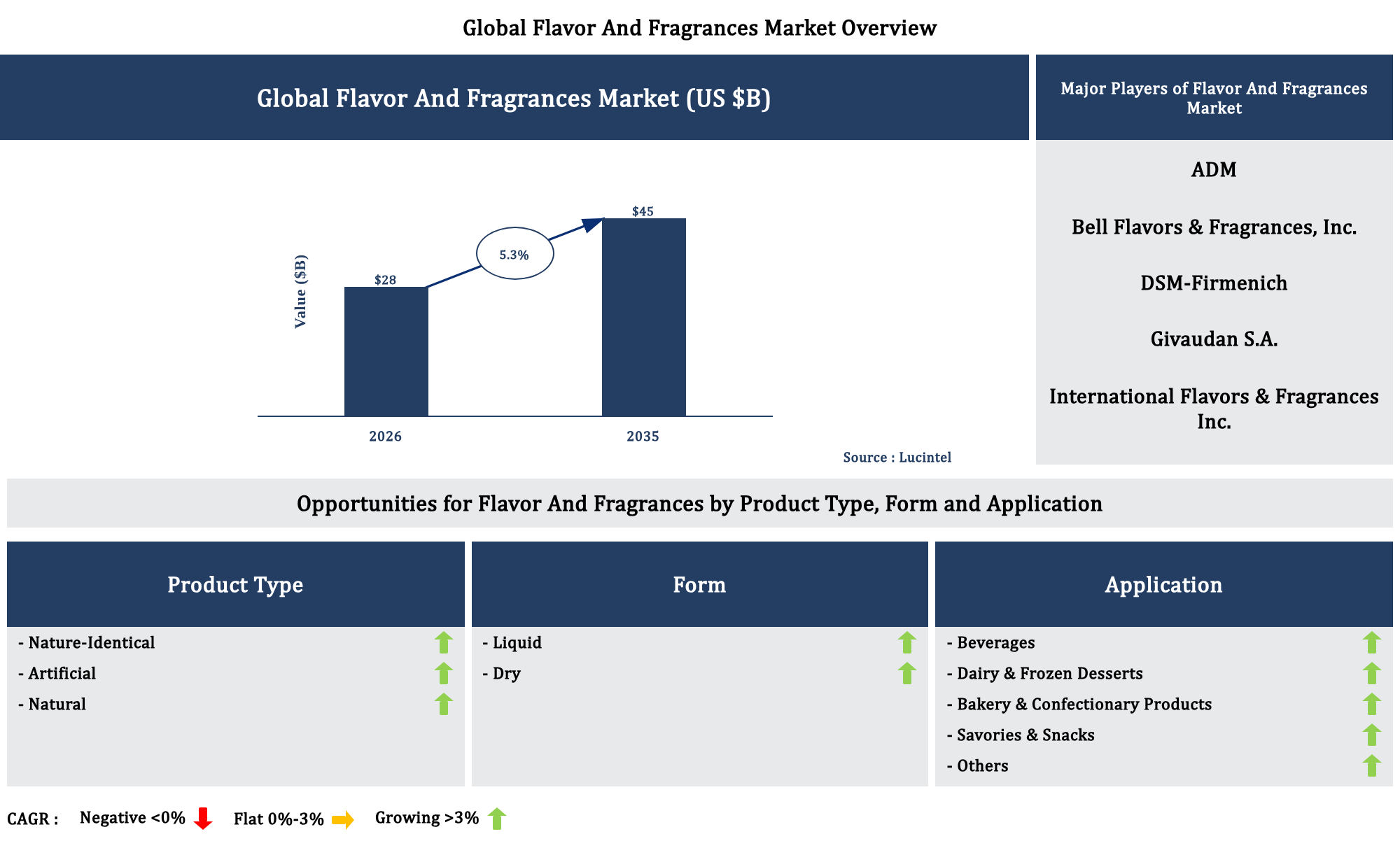
Flavor And Fragrances Market

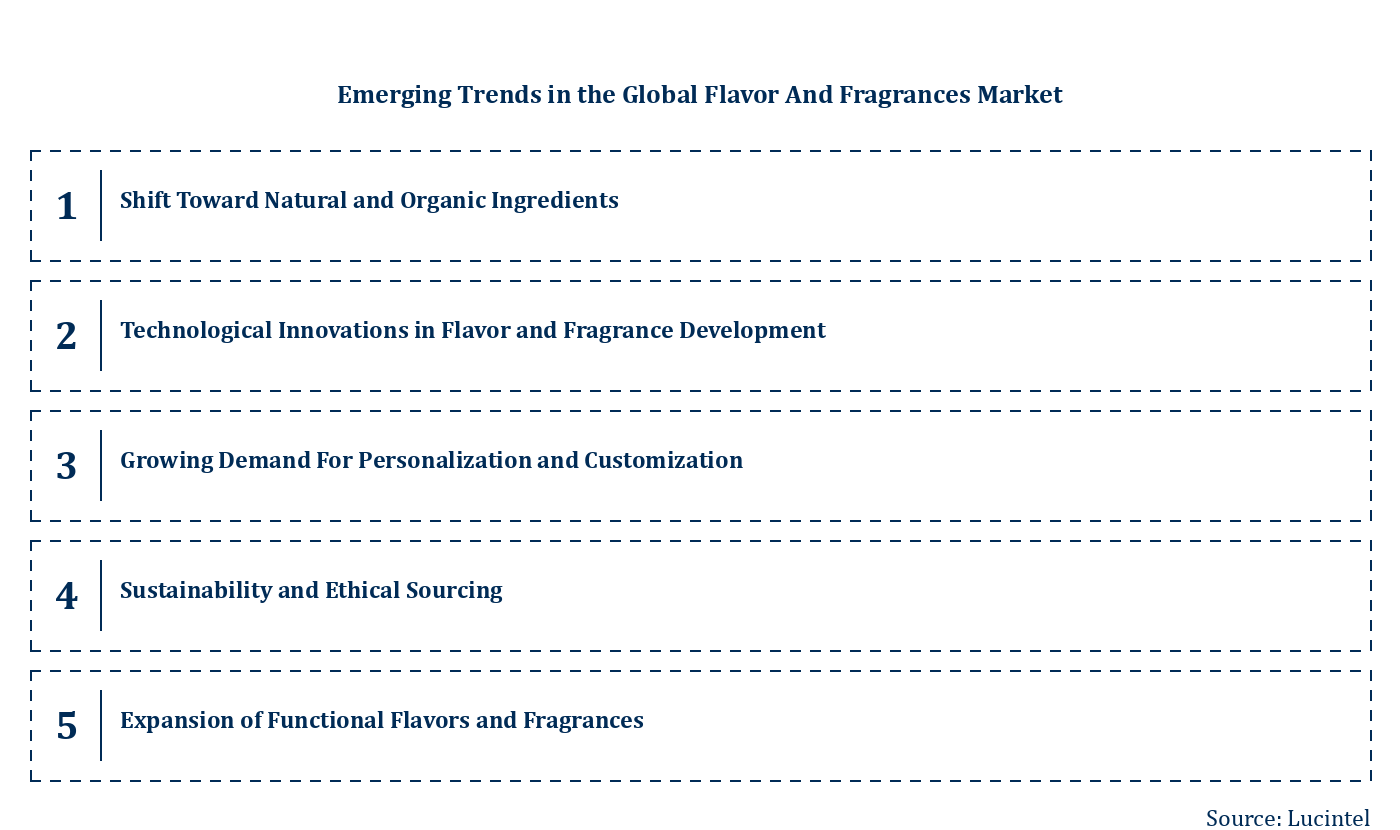
Emerging Trends in the Flavor And Fragrances Market

The flavor and fragrances market is experiencing rapid evolution driven by consumer preferences, technological advancements, and sustainability concerns. As demand for unique, natural, and health-conscious products grows, industry players are innovating to meet these expectations. The market is also influenced by regulatory changes and the increasing importance of personalized experiences. These developments are reshaping how flavors and fragrances are developed, marketed, and consumed, creating new opportunities and challenges. Understanding these emerging trends is crucial for stakeholders aiming to stay competitive and capitalize on future growth prospects in this dynamic industry.

  • Shift Toward Natural and Organic Ingredients: Consumers are increasingly seeking natural and organic flavors and fragrances due to health consciousness and environmental concerns. This trend drives innovation in sourcing sustainable ingredients and developing clean-label products. Companies investing in natural extracts and plant-based components are gaining a competitive edge, responding to regulatory pressures and consumer demand for transparency. The shift encourages industry players to reformulate products, emphasizing purity and authenticity, which enhances brand trust and market share.
  • Technological Innovations in Flavor and Fragrance Development: Advanced technologies such as AI, machine learning, and biotechnology are transforming product development. These tools enable precise formulation, faster innovation cycles, and personalized flavor profiles. For instance, AI-driven algorithms can predict consumer preferences, leading to tailored products. Biotechnology allows for sustainable production of rare ingredients, reducing reliance on traditional agriculture. These innovations improve efficiency, reduce costs, and open new avenues for creating unique sensory experiences, thereby reshaping R&D strategies in the market.
  • Growing Demand for Personalization and Customization: Consumers now seek personalized flavor and fragrance experiences that reflect their individual preferences and lifestyles. This trend prompts companies to develop customizable products and limited-edition offerings. Digital platforms facilitate direct consumer engagement, enabling brands to gather insights and tailor products accordingly. Personalization enhances customer loyalty and allows brands to differentiate themselves in a competitive landscape. As a result, the market is shifting toward more flexible, consumer-centric approaches to product development and marketing.
  • Sustainability and Ethical Sourcing: Environmental concerns and ethical considerations are increasingly influencing purchasing decisions. Companies are adopting sustainable sourcing practices, reducing carbon footprints, and utilizing eco-friendly packaging. Certifications such as Fair Trade and Organic are becoming important for consumer trust. The focus on sustainability not only aligns with regulatory requirements but also appeals to eco-conscious consumers, driving innovation in biodegradable ingredients and sustainable supply chains. This trend is reshaping industry standards and encouraging transparency across the value chain.
  • Expansion of Functional Flavors and Fragrances: There is a rising demand for flavors and fragrances that offer health benefits, such as immunity boosting, stress relief, or digestive support. Functional ingredients are being integrated into products to meet health-conscious consumer needs. This trend is particularly prominent in beverages, snacks, and personal care items. The development of functional flavors and fragrances enhances product differentiation and taps into the wellness movement. It is prompting R&D efforts to combine sensory appeal with functional benefits, thereby expanding market opportunities and consumer engagement.

These emerging trends are fundamentally reshaping the flavor and fragrances market by emphasizing natural ingredients, technological innovation, personalization, sustainability, and health benefits. These developments are driving industry growth, fostering innovation, and aligning products more closely with evolving consumer values and expectations.
Flavor And Fragrances Market by country

Recent Developments in the Flavor And Fragrances Market

The flavor and fragrances market is experiencing rapid innovation driven by consumer preferences, technological advancements, and sustainability initiatives. Companies are investing heavily in R&D to develop unique, natural, and sustainable products. Market dynamics are shifting as demand for clean-label and organic options increases globally. Digital transformation and e-commerce expansion are also reshaping distribution channels. These developments are creating new opportunities for growth, diversification, and competitive advantage, ultimately influencing the markets trajectory and consumer choices worldwide.

  • Growing Demand for Natural and Organic Flavors: Consumers increasingly prefer clean-label products, prompting manufacturers to innovate with natural ingredients. This shift enhances product authenticity and health appeal, driving market growth. Companies investing in plant-based and organic flavor solutions are gaining competitive advantage, expanding their market share. The trend also encourages sustainable sourcing practices, aligning with environmental concerns. Overall, this development boosts innovation and diversification within the flavor segment, meeting evolving consumer expectations.
  • Technological Advancements in Flavor Formulation: Cutting-edge technologies like molecular gastronomy and AI-driven R&D are revolutionizing flavor creation. These innovations enable precise customization, faster development cycles, and enhanced sensory profiles. Companies can now produce complex, novel flavors that cater to niche markets and dietary needs. This technological progress reduces costs and accelerates time-to-market, fostering competitive differentiation. As a result, the market benefits from a broader array of innovative flavors, meeting diverse consumer preferences and expanding product portfolios.
  • Rising Focus on Sustainability and Eco-Friendly Practices: Sustainability initiatives are transforming sourcing, manufacturing, and packaging processes. Companies are adopting biodegradable packaging, reducing carbon footprints, and sourcing ingredients responsibly. These practices appeal to environmentally conscious consumers and comply with stricter regulations. Sustainable development enhances brand reputation and fosters consumer loyalty. The shift encourages industry-wide adoption of eco-friendly standards, driving innovation in sustainable ingredients and processes, and positioning the market as environmentally responsible and future-ready.
  • Expansion of E-Commerce and Digital Marketing Channels: Digital platforms are becoming primary sales channels, enabling direct-to-consumer engagement and personalized marketing. E-commerce growth facilitates wider reach, especially in emerging markets, and offers data-driven insights for product development. Virtual tastings, online promotions, and social media campaigns boost brand visibility and consumer interaction. This shift reduces reliance on traditional retail, lowers distribution costs, and accelerates product launches. Overall, digital expansion enhances market agility, consumer access, and competitive positioning.
  • Increasing Demand for Functional and Health-Oriented Flavors: Consumers seek flavors that offer health benefits, such as probiotics, antioxidants, and adaptogens. This trend drives innovation in functional ingredients and flavor combinations that support wellness. Food and beverage companies are developing products with added health attributes, appealing to health-conscious demographics. The market benefits from diversification into functional segments, creating new revenue streams. This focus on health-oriented flavors aligns with broader wellness trends, fostering growth and differentiation in a competitive landscape.

The overall impact of these developments is a more dynamic, innovative, and sustainable flavor and fragrances market. Consumer preferences for natural, functional, and eco-friendly products are shaping product offerings and corporate strategies. Technological advancements and digital channels are enhancing efficiency and reach. Collectively, these trends are fostering market expansion, diversification, and resilience, positioning the industry for sustained growth and increased consumer engagement.

Strategic Growth Opportunities in the Flavor And Fragrances Market

The flavor and fragrances market is experiencing rapid expansion driven by increasing consumer demand for unique sensory experiences, product innovation, and health-conscious formulations. Emerging markets, technological advancements, and sustainability initiatives are further fueling growth. Companies are focusing on diversifying product portfolios and leveraging natural ingredients to meet evolving preferences. Strategic collaborations and regulatory compliance are also shaping market dynamics. These opportunities present significant potential for industry players to capture new segments and enhance profitability in a competitive landscape.

  • Expansion Into Natural and Organic Flavors and Fragrances: Growing consumer preference for clean-label, natural, and organic products is driving demand for plant-based, non-synthetic flavors and fragrances. Companies investing in sourcing sustainable ingredients and developing natural formulations can tap into premium markets. This shift encourages innovation in extraction and formulation techniques, creating opportunities for differentiation. Emphasizing transparency and authenticity aligns with consumer values, fostering brand loyalty and opening avenues for premium pricing and market share growth.
  • Innovation in Functional and Health-Oriented Flavors and Fragrances: The rising focus on health and wellness is prompting the development of functional flavors and fragrances that offer added benefits such as stress relief, energy boosting, or immune support. Incorporating bioactive ingredients and adaptogens into formulations caters to health-conscious consumers. This trend encourages R&D investments to create novel sensory experiences that also deliver functional benefits, enabling brands to differentiate and command higher margins in a competitive landscape.
  • Expansion in Emerging Markets with Growing Consumer Demand: Rapid economic growth and urbanization in regions like Asia-Pacific, Latin America, and Africa are expanding the consumer base for flavors and fragrances. Local preferences and cultural nuances offer opportunities for tailored product development. Companies investing in regional R&D, local sourcing, and distribution channels can establish a strong foothold. This expansion not only increases volume sales but also diversifies revenue streams and reduces dependency on mature markets.
  • Adoption of Sustainable and Eco-Friendly Practices: Sustainability initiatives are becoming central to market growth, with consumers favoring brands committed to environmental responsibility. Developing biodegradable packaging, reducing carbon footprint, and sourcing sustainable ingredients are key strategies. Companies adopting eco-friendly practices can enhance brand reputation, meet regulatory requirements, and appeal to environmentally conscious consumers. This focus on sustainability fosters innovation and long-term competitiveness, positioning brands as responsible industry leaders.
  • Leveraging Technological Advancements for Customization and Efficiency: Innovations such as AI, machine learning, and advanced extraction techniques enable personalized flavor and fragrance development. These technologies improve formulation accuracy, reduce time-to-market, and lower costs. Customization caters to niche markets and specific consumer preferences, enhancing customer engagement. Additionally, automation and digital tools streamline production processes, increasing efficiency and scalability. Embracing these technological advancements provides a competitive edge and supports sustainable growth in a rapidly evolving market.

The overall impact of these opportunities is a dynamic, innovative, and sustainable flavor and fragrances market poised for substantial growth. Companies that strategically leverage natural ingredients, health benefits, emerging markets, sustainability, and technology will be better positioned to meet consumer demands and outperform competitors. This evolution fosters a more diverse and resilient industry, unlocking new revenue streams and strengthening global market presence.

Flavor And Fragrances Market Drivers and Challenges

The flavor and fragrances market is influenced by a complex interplay of technological advancements, economic shifts, and regulatory frameworks. Innovations in extraction and formulation techniques are enhancing product quality and diversity. Economic factors such as rising consumer disposable income and changing lifestyles are increasing demand for premium flavors and fragrances. Regulatory policies concerning safety, labeling, and environmental impact are shaping product development and marketing strategies. Additionally, globalization and evolving consumer preferences are expanding market reach and product innovation. These drivers and challenges collectively determine the growth trajectory and competitive landscape of the market, requiring stakeholders to adapt swiftly to technological, economic, and regulatory changes to sustain and capitalize on emerging opportunities.

The factors responsible for driving the flavor and fragrances market include:

  • Technological Innovations: The development of advanced extraction, synthesis, and formulation technologies has significantly improved the quality, stability, and variety of flavors and fragrances. These innovations enable manufacturers to create more natural, long-lasting, and customizable products, meeting consumer demand for authenticity and uniqueness. Enhanced R&D capabilities also facilitate the development of novel ingredients, expanding product portfolios and opening new market segments. As technology continues to evolve, it reduces production costs and increases efficiency, further fueling market growth and competitiveness.
  • Rising Consumer Demand for Natural and Organic Products: Increasing awareness about health and wellness has driven consumers to prefer natural, organic, and clean-label flavors and fragrances. This shift is prompting manufacturers to source sustainable ingredients and develop formulations that meet strict regulatory standards. The demand for natural products is also influenced by cultural trends and lifestyle changes, leading to a surge in premium and artisanal offerings. This trend not only boosts sales but also encourages innovation in sourcing and processing, creating opportunities for market differentiation and premium pricing.
  • Economic Growth and Urbanization: Rapid economic development and urbanization in emerging markets are expanding the consumer base with higher disposable incomes. Urban lifestyles foster a preference for convenience foods, beverages, and personal care products, all of which rely heavily on flavors and fragrances. Increased purchasing power enables consumers to indulge in premium and exotic products, driving demand. Moreover, economic stability encourages investment in marketing and product development, further stimulating market expansion. As urban populations grow, so does the scope for innovative product launches tailored to diverse cultural tastes.
  • Expansion of The Food & Beverage and Personal Care Industries: The growth of the food, beverage, and personal care sectors directly impacts the flavor and fragrances market. The rising popularity of functional foods, beverages, and luxury personal care products necessitates innovative flavor and fragrance solutions to differentiate offerings. Manufacturers are investing in customized and region-specific flavors to cater to local preferences, thereby expanding market reach. The integration of flavors and fragrances into new product lines enhances sensory appeal and consumer experience, fostering brand loyalty and market penetration across various segments.
  • Increasing Focus on Sustainability and Ethical Sourcing: Consumers and regulators are increasingly emphasizing sustainability, prompting companies to adopt eco-friendly sourcing and production practices. This includes using renewable ingredients, reducing carbon footprints, and ensuring ethical labor practices. Such initiatives not only meet regulatory requirements but also enhance brand reputation and consumer trust. The shift towards sustainable practices influences ingredient selection, packaging, and supply chain management, which can increase costs but ultimately appeal to environmentally conscious consumers. This focus on sustainability is shaping product development and strategic planning within the market.

The challenges facing the flavor and fragrances market include:

  • Stringent Regulatory Frameworks: The flavor and fragrances industry faces complex regulations concerning safety, labeling, and environmental impact. Compliance with diverse regional standards can be costly and time-consuming, hindering innovation and market entry. Regulatory changes often require reformulation of products, delaying launches and increasing R&D expenses. Navigating these frameworks demands significant expertise and resources, especially for small and medium-sized enterprises. Non-compliance risks legal penalties, product recalls, and damage to brand reputation, making regulatory adherence a critical challenge for sustained growth.
  • Volatility in Raw Material Prices: The market heavily depends on natural ingredients, which are susceptible to price fluctuations due to climate change, geopolitical tensions, and supply chain disruptions. Rising costs of raw materials can squeeze profit margins and force manufacturers to increase product prices, potentially reducing competitiveness. Additionally, scarcity of certain ingredients may limit product innovation and availability. Managing supply chain risks and securing sustainable sourcing are essential but challenging, requiring strategic planning and diversification to mitigate adverse impacts on production and profitability.
  • Consumer Preference Variability and Cultural Differences: Rapidly changing consumer tastes and diverse cultural preferences pose a challenge for standardization and global marketing strategies. What appeals to consumers in one region may not resonate in another, necessitating localized product development and marketing efforts. This variability increases complexity and costs for manufacturers aiming for a broad market reach. Additionally, the demand for novel and exotic flavors requires continuous innovation, which can be resource-intensive. Balancing global brand consistency with regional customization remains a significant challenge in maintaining market relevance and consumer engagement.

The flavor and fragrances market is shaped by technological progress, consumer trends, economic development, and sustainability initiatives, which collectively drive growth. However, regulatory complexities, raw material volatility, and cultural diversity present substantial hurdles. Navigating these drivers and challenges requires strategic agility, innovation, and compliance to sustain competitive advantage. Overall, the markets future hinges on balancing innovation with responsible practices, ensuring resilience amid evolving consumer and regulatory landscapes.

List of Flavor And Fragrances Market Companies

Companies in the market compete on the basis of product quality offered. Major players in this market focus on expanding their manufacturing facilities, R&D investments, infrastructural development, and leverage integration opportunities across the value chain. Through these strategies flavor and fragrances market companies cater increasing demand, ensure competitive effectiveness, develop innovative products & technologies, reduce production costs, and expand their customer base. Some of the flavor and fragrances market companies profiled in this report include-

  • ADM
  • Bell Flavors & Fragrances, Inc.
  • DSM-Firmenich
  • Givaudan S.A.
  • International Flavors & Fragrances Inc.
  • Kerry Group plc
  • Mane SA
  • Robertet Group
  • Sensient Technologies Corporation
  • Symrise AG

Flavor And Fragrances Market by Segment

The study includes a forecast for the global flavor and fragrances market by product type, form, application, and region.

  • Flavor and Fragrances Market by Product Type [Value from 2019 to 2035]:
    • Nature-Identical
    • Artificial
    • Natural
  • Flavor and Fragrances Market by Form [Value from 2019 to 2035]:
    • Liquid
    • Dry
  • Flavor and Fragrances Market by Application [Value from 2019 to 2035]:
    • Beverages
    • Dairy & Frozen Desserts
    • Bakery & Confectionary Products
    • Savories & Snacks
    • Others
  • Flavor and Fragrances Market by Region [Value from 2019 to 2035]:
    • North America
    • Europe
    • Asia Pacific
    • The Rest of the World

Country Wise Outlook for the Flavor And Fragrances Market

The flavor and fragrances market has experienced significant shifts driven by consumer preferences, technological innovations, and regulatory changes across the globe. As demand for natural and sustainable products rises, companies are investing in R&D to develop novel ingredients and formulations. Market dynamics are also influenced by regional economic growth, trade policies, and evolving health trends. In the United States, China, Germany, India, and Japan, these factors manifest uniquely, shaping their respective industry landscapes. Understanding these regional developments is crucial for stakeholders aiming to capitalize on emerging opportunities and navigate challenges effectively.

  • United States: The US market has seen a surge in demand for clean-label and organic flavors and fragrances, driven by health-conscious consumers. Innovation in plant-based and natural ingredients is prominent, with major companies investing in sustainable sourcing. Regulatory agencies are tightening standards, prompting industry players to enhance transparency and traceability. Additionally, the growth of personalized products and functional flavors tailored for wellness trends is notable. The e-commerce sector is expanding rapidly, facilitating direct-to-consumer sales and innovation adoption.
  • China: China’s flavor and fragrances market is experiencing rapid growth fueled by increasing urbanization and rising disposable incomes. There is a strong shift towards natural and traditional ingredients, blending modern formulations with local flavors. Domestic companies are expanding their R&D capabilities to develop innovative products aligned with health and wellness trends. The government’s support for the food and beverage sector and export opportunities is boosting industry expansion. Additionally, e-commerce platforms are playing a vital role in reaching consumers and introducing new products.
  • Germany: Germany remains a key player in the European flavor and fragrances industry, emphasizing sustainability and high-quality standards. The market is witnessing a shift towards bio-based and eco-friendly ingredients, driven by stringent EU regulations and consumer demand. Innovation in functional flavors for health benefits and sensory experiences is prominent. German companies are investing in advanced extraction and formulation technologies to meet sustainability goals. The focus on naturalness and transparency is shaping product development, with a growing interest in organic and vegan options.
  • India: India’s flavor and fragrances market is expanding rapidly, driven by a burgeoning middle class and increasing demand for diverse culinary and personal care products. Traditional Indian ingredients like saffron, cardamom, and rose are gaining popularity globally. The industry is witnessing a rise in local manufacturing and R&D to cater to both domestic and international markets. Consumer preferences are shifting towards natural, herbal, and Ayurvedic formulations. The government’s initiatives to promote the food processing sector and exports are further fueling growth. Evolving consumer lifestyles and urbanization are key drivers.
  • Japan: Japan’s market is characterized by a focus on innovation, health, and wellness. There is a growing preference for natural and functional flavors that promote health benefits. Japanese companies are investing in biotechnology and clean-label ingredients to meet consumer demand for transparency and safety. The market also emphasizes unique, culturally inspired flavors, blending tradition with modernity. Sustainability practices are increasingly integrated into sourcing and production processes. The aging population influences product development, with a focus on functional and health-enhancing fragrances and flavors.

Features of the Flavor And Fragrances Market

  • Market Size Estimates: Flavor and fragrances market size estimation in terms of value ($B).
  • Trend and Forecast Analysis: Market trends (2019 to 2025) and forecast (2026 to 2035) by various segments and regions.
  • Segmentation Analysis: Flavor and fragrances market size by product type, form, application, and region in terms of value ($B).
  • Regional Analysis: Flavor and fragrances market breakdown by North America, Europe, Asia Pacific, and Rest of the World.
  • Growth Opportunities: Analysis of growth opportunities in different product types, forms, applications, and regions for the flavor and fragrances market.
  • Strategic Analysis: This includes M&A, new product development, and competitive landscape of the flavor and fragrances market.
  • Analysis of competitive intensity of the industry based on Porter’s Five Forces model.

Top 5 Companies

  • ADM
  • Bell Flavors & Fragrances, Inc.
  • DSM-Firmenich
  • Givaudan S.A.
  • International Flavors & Fragrances Inc.

Table of Contents

1. Executive Summary
14.1 Competitive Analysis Overview

List of Figures

List of Tables

Methodology

Lucintel has been in the business of market research and management consulting since 2000 and has published over 1000 market intelligence reports in various markets / applications and served over 1,000 clients worldwide. This study is a culmination of four months of full-time effort performed by Lucintel's analyst team. The analysts used the following sources for the creation and completion of this valuable report:

  • In-depth interviews of the major players in this market
  • Detailed secondary research from competitors' financial statements and published data
  • Extensive searches of published works, market, and database information pertaining to industry news, company press releases, and customer intentions
  • A compilation of the experiences, judgments, and insights of Lucintel's professionals, who have analyzed and tracked this market over the years.

Extensive research and interviews are conducted across the supply chain of this market to estimate market share, market size, trends, drivers, challenges, and forecasts. Below is a brief summary of the primary interviews that were conducted by job function for this report.

Lucintel's methodology for market research

Thus, Lucintel compiles vast amounts of data from numerous sources, validates the integrity of that data, and performs a comprehensive analysis. Lucintel then organizes the data, its findings, and insights into a concise report designed to support the strategic decision-making process. The figure below is a graphical representation of Lucintel's research process.

Primary interviews by job function

Buy Now

Choose a license that fits your team. Instant PDF delivery.

Market Report

1 User PDF

$4,850
Buy Now

Market Report

2-5 Users PDF

$6,700
Buy Now

Market Report

Corporate PDF

$8,850
Buy Now

Market Report

Global PDF

$10,000
Buy Now

Prices exclude taxes. Instant delivery. Custom licensing available on request.

Frequently Asked Questions

What is the flavor and fragrances market size?
The global flavor and fragrances market is expected to reach an estimated $45 billion by 2035.
What is the growth forecast for flavor and fragrances market?
The global flavor and fragrances market is expected to grow with a CAGR of 5.3% from 2026 to 2035.
What are the major drivers influencing the growth of the flavor and fragrances market?
The major drivers for this market are the increasing demand for natural & organic ingredients, the growing demand for premium & luxury perfumes, and the rising demand for flavors in processed food products.
What are the major segments for flavor and fragrances market?
The future of the flavor and fragrances market looks promising with opportunities in the beverage, dairy & frozen dessert, bakery & confectionary product, and savory & snack markets.
Who are the key flavor and fragrances market companies?

Some of the key flavor and fragrances companies are as follows:

  • ADM
  • Bell Flavors & Fragrances, Inc.
  • DSM-Firmenich
  • Givaudan S.A.
  • International Flavors & Fragrances Inc.
  • Kerry Group plc
  • Mane SA
  • Robertet Group
  • Sensient Technologies Corporation
  • Symrise AG
Which flavor and fragrances market segment will be the largest in future?
Lucintel forecasts that, within the product type category, natural is expected to witness the highest growth over the forecast period.
In flavor and fragrances market, which region is expected to be the largest in next 5 years?
In terms of region, North America is expected to witness the highest growth over the forecast period.
Do we receive customization in this report?
Yes, Lucintel provides 10% customization without any additional cost.

Key Questions

  • What are some of the most promising, high-growth opportunities for the flavor and fragrances market by product type (nature-identical, artificial, and natural), form (liquid and dry), application (beverages, dairy & frozen desserts, bakery & confectionary products, savories & snacks, and others), and region (North America, Europe, Asia Pacific, and the Rest of the World)?
  • Which segments will grow at a faster pace and why?
  • Which region will grow at a faster pace and why?
  • What are the key factors affecting market dynamics? What are the key challenges and business risks in this market?
  • What are the business risks and competitive threats in this market?
  • What are the emerging trends in this market and the reasons behind them?
  • What are some of the changing demands of customers in the market?
  • What are the new developments in the market? Which companies are leading these developments?
  • Who are the major players in this market? What strategic initiatives are key players pursuing for business growth?
  • What are some of the competing products in this market and how big of a threat do they pose for loss of market share by material or product substitution?
  • What M&A activity has occurred in the last 7 years and what has its impact been on the industry?
Why Choose Us

The Lucintel Advantage

Trusted partner for strategic intelligence and business growth

25+ Years Excellence

25+ Years Excellence

Quarter century of proven expertise in management consulting and market research across global markets.
Game-Changer Ideas

Game-Changer Ideas

Innovative strategies and actionable insights that help clients become the smartest in their industry.
Global Reach

Global Reach

Extensive coverage across 50+ industries and markets worldwide with localized expertise.
Start Your Growth Journey

Get Your Free
Market Intelligence
Briefing

Receive a complimentary market analysis tailored to your industry. Our analysts will identify key growth opportunities and competitive dynamics specific to your business.

Custom Market Snapshot

Market size, growth rate, and key trend analysis for your specific sector.

Competitive Landscape Overview

Top competitor positioning and market share analysis.

Growth Opportunity Identification

Strategic recommendations backed by data-driven insights.

Subscribe

Subscribe to our Newsletter

Get curated market intelligence and competitive moves straight to your inbox.

By subscribing, you agree to receive our monthly insights. Unsubscribe anytime.

Industry Trends Market Signals Opportunities Competitor Moves