
Market Report · July 29, 2026

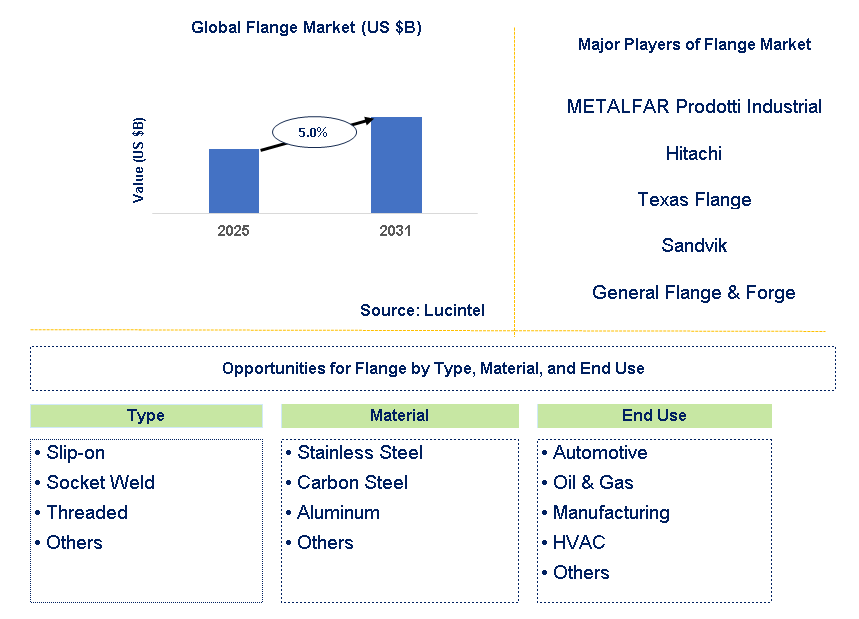
Key data points: The growth forecast = 5% annually for the next 7 years. Scroll below to get more insights. This market report covers trends, opportunities and forecasts in flange market to 2031 by type (slip-on, socket weld, threaded, and others), material (stainless steel, carbon steel, aluminum, and others), end use (automotive, oil & gas, manufacturing, HVAC, and others), and region (North America, Europe, Asia Pacific, and the Rest of the World)
We'll send your sample report shortly.
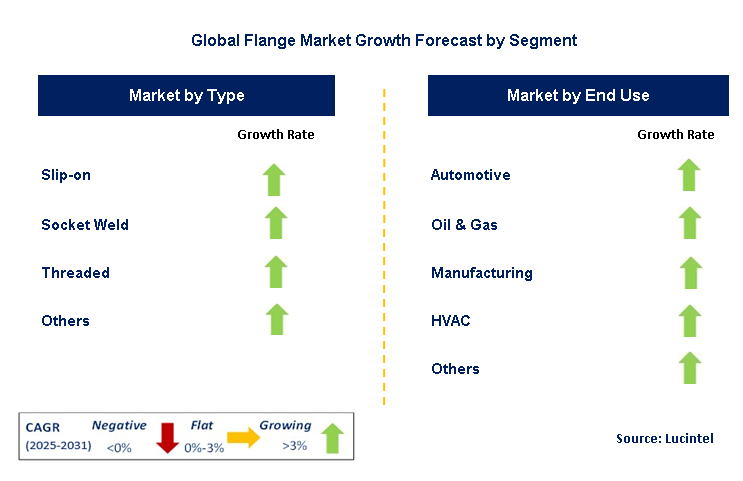
• Lucintel forecasts that, within the type category, slip-on is expected to witness the highest growth over the forecast period.
• Within the application category, oil & gas is expected to witness the highest growth.
• In terms of region, APAC is expected to witness the highest growth over the forecast period. Gain valuable insights for your business decisions with our comprehensive 150+ page report. Sample figures with some insights are shown below.
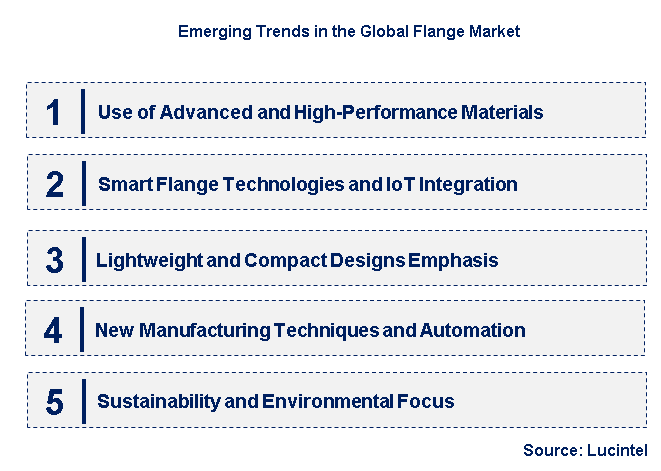
• Use of Advanced and High-Performance Materials: This trend sees an increasing movement away from conventional carbon steel towards the use of advanced materials such as stainless steel (duplex and super duplex grades), nickel alloys, and composite materials such as fiber-reinforced polymers (FRPs). These materials possess superior corrosion resistance, improved strength-to-weight ratios, and enhanced performance in environments involving high temperature and pressure. The effects are increased durability and lifespan of flange connections, lower maintenance needs, and enhanced safety in high-performance applications, especially for challenging industries such as oil and gas, chemical processing, and shipping.
• Smart Flange Technologies and IoT Integration: Smart flange technologies bring with it the integration of sensors in flanges or flange assemblies that measure parameters such as pressure, temperature, vibration, and leakage in real time. These sensors send information through IoT networks for predictive analytics and proactive maintenance. The effect is greatly enhanced operational safety through detection of impending failures, minimized downtime through predictive maintenance, improved asset management, and increased efficiency in industrial processes. All this is powered by the overall Industry 4.0 movement and the need for connected industrial systems.
• Lightweight and Compact Designs Emphasis: There is an increasing emphasis on creating flanges with compact and lightweight designs, which is frequently accomplished through optimized engineering and advanced material selection (e.g., aluminum, composites). This is especially important in applications where weight reduction is paramount, like aerospace, automotive, and some marine uses. The benefit is decreased total system weight, reduced transportation and installation expenses, and smaller footprints for complicated piping systems, leading to enhanced energy efficiency and performance in weight-conscious applications.
• New Manufacturing Techniques and Automation: The flange industry is experiencing dramatic improvements in manufacturing technologies, such as growing use of robotic welding, automated machining, and possibly additive manufacturing (3D printing) for specialized or prototype flanges. These sophisticated processes provide greater accuracy, better consistency, and quicker production cycles. The effect is improved product quality and reliability through tighter tolerance, lower labor expenses, greater manufacturing efficiency, and more flexibility in creating complex or custom flange designs, resulting in more competitive products and faster response to markets.
• Sustainability and Environmental Focus: This trend is characterized by increased attention to sustainable production processes and the implementation of green materials in the manufacture of flanges. It encompasses efforts aimed at minimizing waste material, energy consumption in production, and the development of recyclable or lower-carbon-footprint materials. The effect is a smaller environmental footprint of industrial processes, convergence with international sustainability objectives, and response to growing regulatory pressures and consumer expectations for eco-friendly products. It also involves the creation of flange designs that can be disassembled and recycled more easily at the end of life. All these new trends are cumulatively transforming the flange market by pushing it toward greater performance, intelligence, efficiency, and sustainability. The use of advanced materials and intelligent technologies is enhancing safety and operational dependability. The emphasis on lightweight and compact designs is maximizing system performance, while manufacturing advancements are improving quality and production efficiency. The overall emphasis on sustainability is promoting environmentally friendly practices. This shift is making the market capable of addressing the multifaceted and changing needs of industrial infrastructure in contemporary times.
• Greater Demand for High-Performance Alloys: A key recent trend is the rising demand for flanges of high-performance alloys, such as different grades of stainless steel (e.g., 304, 316, duplex, super duplex), nickel alloys, and some specific carbon steel types. This is triggered by sectors demanding components that will perform under very high pressures, high temperature, and highly corrosive media. The result is improved durability and reliability of piping systems, lower likelihood of leaks and failures, and extended service life, translating into lower maintenance expenses and enhanced operational safety in high-pressure industrial applications.
• Development of Production Processes: Over the last few years, there have been considerable developments in manufacturing processes of flanges. This encompasses greater application of precision forging, advanced machining processes, and robotic welding, mainly in the case of intricate and high-pressure flanges. These technologies provide more precise dimensional tolerances, better material integrity, and greater structural strength. The result is higher quality products, fewer manufacturing faults, increased production consistency, and better cost savings with automation, enabling manufacturers to achieve rigorous industry standards and accommodate customized orders more efficiently.
• Innovation of Smart Flange Solutions: One of the latest developments is the availability of "smart" flanges that have sensors and monitoring features. These systems may return real-time information on parameters like pressure, temperature, vibration, and likely sites of leakage, usually through the application of IoT technology. The result is a shift in maintenance philosophy from reactive to proactive, allowing for the early identification of anomalies, avoiding expensive downtime, and improving overall system safety. This also enables predictive maintenance techniques and enhances asset management through the delivery of continuous insights into operation conditions.
• Emphasis on Lightweight and Compact Designs: With the motivation for greater efficiency and decreased material usage, there is an increasing design of lightweight and smaller flange designs. This is usually realized through enhanced engineering optimization, clever combinations of new materials (e.g., composites), and sophisticated simulation methodologies. The effect is decreased overall system weight, which can result in decreased energy consumption across many applications (e.g., automotive, aerospace), simpler installation, and lower material costs. The trend also helps achieve environmental sustainability by lowering resource utilization.
• Growth into Renewable Energy Sector Applications: A notable recent trend is the growing need for flanges in the fast-growing renewable energy sector, such as wind power, solar thermal, and geothermal energy developments. These opportunities tend to include specialized material needs for corrosion resistance and durability in harsh environments. The effect is a diversification of the flange market's end-user base, opening up new areas of growth outside of conventional oil and gas or chemical sectors. Suppliers are diversifying their product offerings to accommodate the special requirements and pace of renewable energy infrastructure construction. These new advances are all cumulatively influencing the flange market towards higher performance, increased efficiency, and greater incorporation of advanced technology. High-performance alloy and advanced manufacturing direction are improving product quality and reliability. The growth in smart solutions is facilitating anticipatory maintenance and enhanced safety. The trend towards lighter weight is optimizing system performance, and entry into the renewable energy market is broadening opportunities. This change is making the flange industry ready to respond to the advanced and ever-changing needs of contemporary industrial infrastructure around the world.
• Oil and Gas (Upstream, Midstream, Downstream): The oil and gas industry continues to be a prominent use for flanges, with immense growth prospects. Strategic growth exists in supplying extremely long-lived, corrosion-proof, and high-pressure flanges appropriate for exploration, extraction, transportation (pipelines), and refining operations. Opportunities consist of creating specialized flanges for hostile environments (deep-sea, arctic), intelligent flanges for real-time monitoring of pipelines, and customized solutions for liquefied natural gas (LNG) infrastructure. Sustained investment in new schemes and upkeep of existing infrastructure guarantees long-term demand.
• Petrochemical and Chemical Processing: Chemical and petrochemical processing industries provide strong growth prospects because of their ongoing requirement for safe and leak-free connections for the processing of corrosive and toxic chemicals under different temperatures and pressures. Growth strategy is to focus on flanges manufactured from high-cost alloys (e.g., Hastelloy, Inconel) and new-generation stainless steels that provide higher chemical resistance and longer life. Opportunities range from offering specialized flange designs for particular chemical processes, meeting extremely rigorous safety regulations, and extending tailored solutions for plant expansions and upgrades to reduce downtime and enhance security.
• Power Generation (Conventional and Renewable): The power generation industry, including thermal, nuclear, and fast-growing renewable power sources (solar thermal, geothermal, wind), offers varied strategic growth prospects. Strategic expansion comprises the provision of high-temperature and pressure flanges in traditional power plants, and specialized, corrosion-flange products for special needs in geothermal, concentrated solar power, and offshore wind energy. Opportunities come with advancing large-diameter and high-integrity turbine connection and steam line flanges, and lightweight, long-lasting flanges for renewable energy structures.
• Wastewater and Water Treatment: As urbanization continues to rise and environmental standards become more stringent, the wastewater and water treatment industry is another expanding usage of flanges. Strategic expansion involves supplying corrosion-resistant flanges, which are generally stainless steel or ductile iron with coats for protection, for the treatment and untreated water, chemicals, and sludge. Opportunities are in large-diameter flanges for municipal water pipes, heavy-duty flanges for desalination plants, and lightweight solutions for modular treatment plants. Global investment in water infrastructure and sustainable water management creates steady demand.
• Shipbuilding and Marine Uses: Shipbuilding and the marine industry provide specialized but high-growth potential for flanges because of the corrosive marine environment and the requirement for reliable, leak-free connections. Strategic expansion entails focusing on marine-grade flanges, usually produced from specialized stainless steels or bronze alloys, which resist corrosion from saltwater, pressure, and vibrations. Opportunities lie in providing flanges to propulsion systems, ballast water treatment, and offshore platforms. The cyclical nature of the global shipping industry's expansion and maintenance guarantees a steady market for high-performance marine flanges. These growth opportunities on the strategic front are having a deep effect on the flange market through specialization and innovation in various industrial applications. The emphasis on oil and gas, chemical, and power generation markets continues to focus on safety-critical and high-performance solutions. The move into water and wastewater treatment reflects the increased demand for rugged, corrosion-resistant solutions. The shipbuilding and marine applications and niche yet substantial opportunities are creating demand for specialty materials. Collectively, these opportunities are supporting focused product development, refining market response to unique industry requirements, and setting the flange market up for steady expansion across a broad range of key global infrastructure projects.
• METALFAR Prodotti Industrial
• Hitachi
• Texas Flange
• Sandvik
• General Flange & Forge
• Kerkau Manufacturing
• Kohler Corporation
• Coastal Flange
• Qontrol Devices
• AFG Holdings
• Slip-on
• Socket Weld
• Threaded
• Others
• Stainless Steel
• Carbon Steel
• Aluminum
• Others
• Automotive
• Oil & Gas
• Manufacturing
• HVAC
• Others
• North America
• Europe
• Asia Pacific
• The Rest of the World
• United States: The American flange market is growing due to strong infrastructure projects and high demand for quality materials, especially in the oil and gas, chemical processing, and power generation sectors. Current trends involve a strong transition towards new materials such as stainless steel and duplex steel flanges for high-temperature, high-pressure, and corrosive services, weighing greater performance and longer life. Additional emphasis is also being placed on sustainable and energy-efficient production processes, with new entrant companies such as Luda Technology Group going public, reflecting investor optimism in this new industry.
• China: China's flange market is growing very fast, driven by its thriving industrial development, huge infrastructure expansion, and position as the world's largest producer of crude steel. Recent trends indicate a huge rise in demand in the construction, power generation, and oil and gas industries. Improvements in manufacturing processes, such as robotic welding and automated assembly lines for composite flanges, are improving production efficiency and product quality. The market is also experiencing the launch of smart flange monitoring systems with IoT sensors for real-time performance monitoring and leak detection, marking a shift towards intelligent solutions.
• Germany: Germany's flange market is dominated by high focus on precision engineering, quality, and compliance with high industrial standards. Recent trends are driven by investment in key infrastructure, especially for power generation and chemical processing, where strong and secure connections are essential. Though certain flange market trends are associated with general industrial valve and material trends, there is ongoing emphasis on high-performance alloys and advanced fabrication to satisfy the needs of advanced applications, as well as those within emerging technologies and high-temperature, corrosive environments.
• India: India's flange market is witnessing strong growth fueled by fast urbanization, major infrastructure projects, and growing industrial sectors. In the recent past, there has been a shift towards stainless steel and high-specialty alloy flanges over conventional carbon steel, fueled by greater focus on longevity and corrosion resistance in sensitive applications such as oil and gas, water treatment, and power generation. The market is also helped by the implementation of new manufacturing technology and Industry 4.0 concepts, raising accuracy and quality in local production, with government initiatives such as "Make in India" also driving domestic manufacturing capability.
• Japan: Japan's flange market is technologically advanced, with emphasis on high-performance and advanced material solutions, especially for its industry and energy sectors. Recent trends show ongoing demand for higher durability and safety in mission-critical applications. Though particular direct developments are not as often given prominence in overall market summaries, the focus remains on having high-quality manufacturing processes, investigating new material compositions for increased resilience, and having high standards for industry requirements for use in fields such as power generation and petrochemicals. Reliability and long-term performance are top priorities for the market.


• METALFAR Prodotti Industrial
• Hitachi
• Texas Flange
• Sandvik
• General Flange & Forge
• Kerkau Manufacturing
• Kohler Corporation
• Coastal Flange
• Qontrol Devices
• AFG Holdings Q5. Which flange market segment will be the largest in future? Answer: Lucintel forecasts that, within the type category, slip-on is expected to witness the highest growth over the forecast period. Q6. In flange market, which region is expected to be the largest in next 5 years? Answer: In terms of region, APAC is expected to witness the highest growth over the forecast period. Q7. Do we receive customization in this report? Answer: Yes, Lucintel provides 10% customization without any additional cost.


Choose a license that fits your team. Instant PDF delivery.
Prices exclude taxes. Instant delivery. Custom licensing available on request.
Market Report · July 29, 2026
Market Report · July 20, 2026
Market Report · July 20, 2026
Trusted partner for strategic intelligence and business growth


Receive a complimentary market analysis tailored to your industry. Our analysts will identify key growth opportunities and competitive dynamics specific to your business.

Market size, growth rate, and key trend analysis for your specific sector.

Top competitor positioning and market share analysis.

Strategic recommendations backed by data-driven insights.
Get curated market intelligence and competitive moves straight to your inbox.
By subscribing, you agree to receive our monthly insights. Unsubscribe anytime.
Receive a complimentary market analysis tailored to your industry. Our analysts will identify key growth opportunities and competitive dynamics specific to your business.
Market size, growth rate, and key trend analysis for your specific sector.
Top competitor positioning and market share analysis.
Strategic recommendations backed by data-driven insights.
Get curated market intelligence, emerging trends, and competitive moves straight to your inbox each month.
By subscribing, you agree to receive our monthly insights. Unsubscribe anytime.
We'll send your sample report shortly.