
Market Report · July 22, 2026

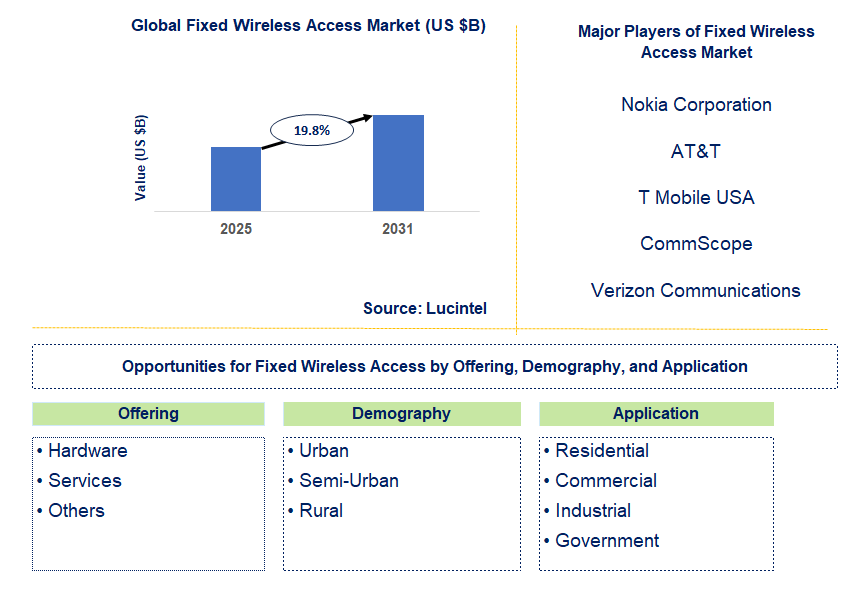
Key data points: The growth forecast = 19.8% annually for the next 7 years. Scroll below to get more insights. This market report covers trends, opportunities and forecasts in fixed wireless access market to 2031 by offering (hardware, services, and others), demography (urban, semi-urban, and rural), application (residential, commercial, industrial, and government), and region (North America, Europe, Asia Pacific, and the Rest of the World)
We'll send your sample report shortly.
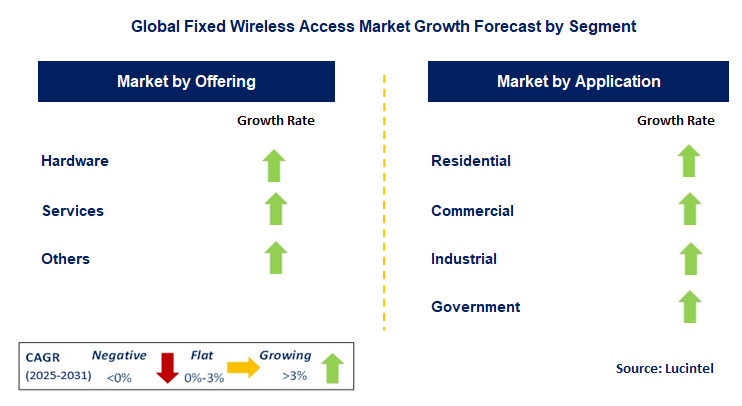
• Lucintel forecasts that, within the offering category, service is expected to witness higher growth over the forecast period.
• Within the application category, residential is expected to witness the highest growth.
• In terms of region, North America is expected to witness the highest growth over the forecast period. Gain valuable insights for your business decisions with our comprehensive 150+ page report. Sample figures with some insights are shown below.
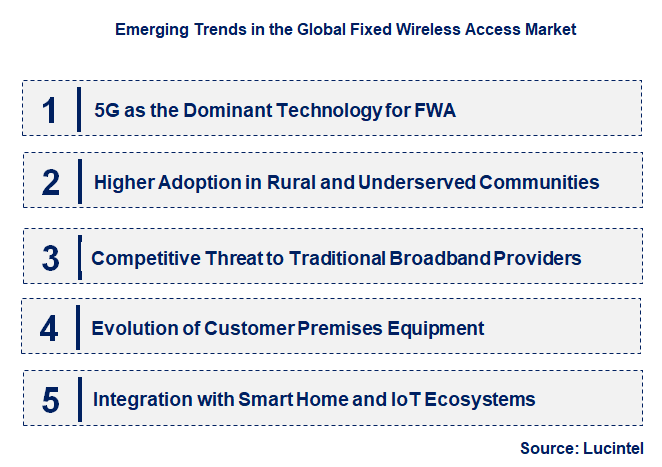
• 5G as the Dominant Technology for FWA: The introduction and large-scale deployment of 5G networks have fundamentally changed the FWA market. 5G provides record-breaking speeds, reduced latency, and much greater capacity than earlier wireless technology generations. This enables FWA to provide fiber-like broadband experiences, offering a true substitute to wired connectivity. With the maturation of 5G standalone networks, 5G will further enhance the FWA features, support more optimized spectrum use, and differentiated services.
• Higher Adoption in Rural and Underserved Communities: FWA is becoming the solution of choice for closing the digital divide in underdeveloped and rural communities where it is economically impossible or technically difficult to roll out fiber-optic infrastructure. With its capability to deliver fast internet rapidly and inexpensively, it is a solution favored to bring fast internet to those homes and offices that earlier did not have fast broadband. This development is motivated by government programs and carrier strategies to expand internet reach to remote areas.
• Competitive Threat to Traditional Broadband Providers: FWA, and especially 5G FWA, is now a serious competitive threat to incumbent fiber and cable broadband operators. With similar speeds and frequently more flexible or competitive pricing, FWA is gaining an increasing number of subscribers in both urban and suburban settings. This is pressuring incumbent providers to innovate and improve the quality of their networks, raising the level of competition and ultimately making customers better off with a greater variety of options and improved service.
• Evolution of Customer Premises Equipment: Advanced and easier-to-use Customer Premises Equipment (CPE) is a fundamental trend. New FWA CPE, such as advanced routers and outdoor units, are optimized for signal reception, improve Wi-Fi inside the home, and make self-installation easier for the customer. This follows from the necessity to optimize FWA performance, provide a flawless customer experience, and lower operating expenses for service providers. More advanced CPE enables higher speeds and increased reliability.
• Integration with Smart Home and IoT Ecosystems: FWA is becoming more viewed as the underlying technology for energizing smart home environments and enabling the spread of Internet of Things (IoT) devices. Its ability to handle high bandwidth and low latency is perfect for linking many smart devices, streaming high-definition video, and delivering real-time applications. This trend broadens FWA's addressable market beyond simple internet access, making it a critical enabler of advanced digital lives and connected surroundings. These new developments are essentially redefining the fixed wireless access market by moving it from a niche solution towards mainstream broadband choice. They are fueling high subscriber growth, increasing competition among internet service providers, and speeding up the deployment of next-generation wireless infrastructure, ultimately leading to a more digitally inclusive and connected world.
• Fast 5G FWA Subscriber Growth and Adoption: A key development is the fast pace of subscriber growth in 5G FWA services in many countries. Telecommunications service providers are actively marketing FWA as a sure and high-speed option to fiber and DSL. This extensive adoption is due to the improved capabilities of 5G, offering fiber-like speeds and minimal latency that satisfy the high requirements of contemporary internet use. The effect is a huge rise in FWA market share, proving its increasing popularity as an initial broadband solution for residential and commercial customers.
• Enhanced Competition with Wired Broadband: Current trends point towards FWA's entry as a major competitive threat to established wired broadband technologies such as fiber and cable. As 5G networks continue to mature and provide more robust and quicker speeds, FWA operators can provide competitive packages that either match or even better the performance of some wired connections at competitive costs. The effect is increased competition within the broadband space, with incumbent wired operators nudging their network improvement and enhancing service plans to maintain customer bases.
• Technology improvements in Customer Premises Equipment: There has been a significant development in the functionality and design of Customer Premises Equipment (CPE) for FWA. New FWA routers and outdoor units feature sophisticated antenna technologies such as Massive MIMO and beamforming, which enhance signal reception and network performance. Most new CPEs are also designed to be easily installed by consumers themselves. The effect is an improved end-user experience, increased perceived value for FWA services, and lower installation costs for service providers, enabling quicker subscriber onboarding.
• Strategic Emphasis on Rural and Under-Served Regions: One of the most important developments is the greater strategic emphasis by FWA providers on rural and under-served regions. Being aware of the high expense and difficulties in laying down wired infrastructure in such areas, FWA provides a fast-to-deploy and cost-effective solution. Government subsidies and digital divide efforts are also driving this emphasis. The result is much enhanced internet connectivity for millions heretofore underserved by legacy broadband, promoting economic growth and advancing the quality of life in these communities.
• Convergence of FWA into Converged Services: Telecom providers are increasingly combining FWA with their larger converged service models, offering it as a package in conjunction with mobile plans, streaming services, and smart home packages. This integrated solution helps deliver a smooth digital experience for the consumer and enhances customer loyalty. The outcome is a more appealing value proposition for consumers, where they can bundle their communication and entertainment services from one operator, resulting in greater ARPU (Average Revenue Per User) for operators and a larger overall FWA market. These recent innovations are together reshaping the fixed wireless access market, propelling it into a new growth and innovation phase. They are expanding FWA's popularity, heightening market competition, and allowing for greater digital inclusion by providing high-quality internet access to an increasing variety of users and places.
• Residential Broadband Expansion, particularly in Rural/Suburban Regions: The greatest growth potential exists in further extending residential broadband services, especially to rural and suburban regions. FWA provides a strong substitute in cases where fiber or cable installation is impracticable or too expensive. The simplicity and rapidity of installment, along with affordability, make FWA a preferred choice for home users requiring dependable internet. This prospect is set to fill the digital divide, with high-speed connectivity reaching millions of unserved or underserved households, thus raising market penetration and subscriber counts for FWA service providers.
• Small and Medium-sized Enterprises Connectivity: FWA is a formidable growth potential for offering connectivity to Small and Medium-sized Enterprises (SMEs). Most SMEs, particularly in rural or developing regions, are faced with subpar or costly wired broadband connectivity. FWA is able to provide secure, high-speed internet needed for cloud-based services, video calls, and digital business, typically with quicker deployment than legacy solutions. This use enables FWA operators to target a profitable business segment, providing customized packages catering to the particular bandwidth and uptime needs of different business sizes.
• Temporary and Pop-Up Network Deployments: There is a specific strategic growth potential in offering temporary and pop-up network deployments for events, building sites, disaster recovery, or seasonal enterprises. FWA's ease of rapid deployment and adaptability make it a perfect solution for applications that necessitate quick and temporary internet connectivity without having to install fixed infrastructure. This specialized use addresses a specific requirement for fast-changing connectivity, potentially creating new revenue streams for FWA vendors and demonstrating the versatility of the technology over fixed residential or business site deployments.
• Industrial Internet of Things and Smart City Applications: The Industrial Internet of Things (IoT) and smart city applications are increasing as a market opportunity for FWA. Low-latency, high-bandwidth FWA connections are important for enabling enormous numbers of sensors, automated equipment, and real-time data transport in smart factories, smart grids, and intelligent transportation systems. FWA can deliver the secure foundation for these essential applications where cabled alternatives would be unworkable on account of scale or environment. This makes FWA an essential digital enabler for industrial and urban spaces.
• Backup and Redundant Connectivity Solutions: FWA presents a strategic growth value as a redundant or backup connectivity option for organizations and mission-critical infrastructure. In cases where the primary wired connections are out of service, FWA can facilitate transparent failover, maintaining business operations and continuity. This use addresses the expanding demand for network reliability and resilience, benefiting organizations where downtime is not only undesirable but costly as well. Through the provision of solid backup services, FWA providers can market to enterprise customers pursuing greater network security and unobstructed access. These application-driven strategic growth opportunities are shaping the fixed wireless access market by expanding its addressable market and broadening its streams of revenue beyond core residential broadband. They are propelling innovation in FWA technology and service models, making it a flexible and essential part of the global connectivity ecosystem, and catalyzing digital transformation in many sectors.
• Nokia Corporation
• AT&T
• T Mobile USA
• CommScope
• Verizon Communications
• Vodafone Group
• Huawei Technologies
• Inseego
• Telstra
• FS.com
• Hardware
• Services
• Others
• Urban
• Semi-Urban
• Rural
• North America
• Europe
• Asia Pacific
• The Rest of the World
• United States: The United States is one of the top FWA markets with rapid subscriber growth fueled mainly by large operators such as T-Mobile and Verizon riding on their large 5G networks. FWA is being especially successful in rural and suburban locations where the deployment of fiber is less economically feasible. Recent trends include more investment in customer premise equipment (CPE) and ongoing competition with incumbent cable and fiber players, resulting in more aggressive pricing and services. The US is looking to continue expanding FWA further to replace aging copper infrastructure and improve service reliability.
• China: China's FWA market is changing, although recent reports indicate a softer overall broadband access equipment market. In spite of this, the country's aggressive 5G deployment and heavy spending on digital infrastructure suggest a sound underlying case for FWA, particularly in serving upcountry areas and powering industrial use cases. The emphasis is still on building out 5G coverage to stimulate wider use of wireless broadband solutions. While data on specific FWA subscriber growth is less prominent compared to other nations, the vast scale of China's network deployments positions it for future FWA expansion.
• Germany: Germany's FWA market is growing as part of a wider resurgence of fixed broadband connectivity, driven particularly by the rollout of 5G. The nation is concentrating on widening high-speed internet coverage, and FWA is a feasible option where fiber deployment is difficult. Recent activity has seen service providers introduce 5G FWA products and a trend toward speed-based tariff plans, demonstrating competition and pressure for greater wireless broadband performance.
• India: India's FWA market is quickly gaining momentum, driven predominantly by Reliance Jio and Bharti Airtel's aggressive 5G rollouts. India has witnessed the tremendous expansion of 5G FWA connections in a very short period with major emphasis on fulfilling the goal of eradicating the digital divide in rural and semi-urban regions. Government programs such as Digital India are also driving demand for broadband connectivity further, making FWA a key enabler in bridging widespread internet penetration across its large and geographically diverse country.
• Japan: Japan is experiencing robust growth in FWA connections, with all leading service providers competitively gaining market share. The nation is utilizing 5G to extend high-speed internet coverage, especially in places where conventional fixed broadband infrastructure is less widespread or presents deployment issues. The emphasis is on providing dependable and quick wireless options to meet growing data needs from both home and enterprise customers, which contributes to the general growth of fixed broadband services.


• Nokia Corporation
• AT&T
• T Mobile USA
• CommScope
• Verizon Communications
• Vodafone Group
• Huawei Technologies
• Inseego
• Telstra
• FS.com Q5. Which fixed wireless access market segment will be the largest in future? Answer: Lucintel forecasts that, within the offering category, service is expected to witness higher growth over the forecast period. Q6. In fixed wireless access market, which region is expected to be the largest in next 5 years? Answer: In terms of region, North America is expected to witness the highest growth over the forecast period. Q7. Do we receive customization in this report? Answer: Yes, Lucintel provides 10% customization without any additional cost.


Choose a license that fits your team. Instant PDF delivery.
Prices exclude taxes. Instant delivery. Custom licensing available on request.
Market Report · July 22, 2026
Market Report · July 17, 2026
Market Report · July 17, 2026
Trusted partner for strategic intelligence and business growth


Receive a complimentary market analysis tailored to your industry. Our analysts will identify key growth opportunities and competitive dynamics specific to your business.

Market size, growth rate, and key trend analysis for your specific sector.

Top competitor positioning and market share analysis.

Strategic recommendations backed by data-driven insights.
Get curated market intelligence and competitive moves straight to your inbox.
By subscribing, you agree to receive our monthly insights. Unsubscribe anytime.
Receive a complimentary market analysis tailored to your industry. Our analysts will identify key growth opportunities and competitive dynamics specific to your business.
Market size, growth rate, and key trend analysis for your specific sector.
Top competitor positioning and market share analysis.
Strategic recommendations backed by data-driven insights.
Get curated market intelligence, emerging trends, and competitive moves straight to your inbox each month.
By subscribing, you agree to receive our monthly insights. Unsubscribe anytime.
We'll send your sample report shortly.