
Market Report · July 22, 2026

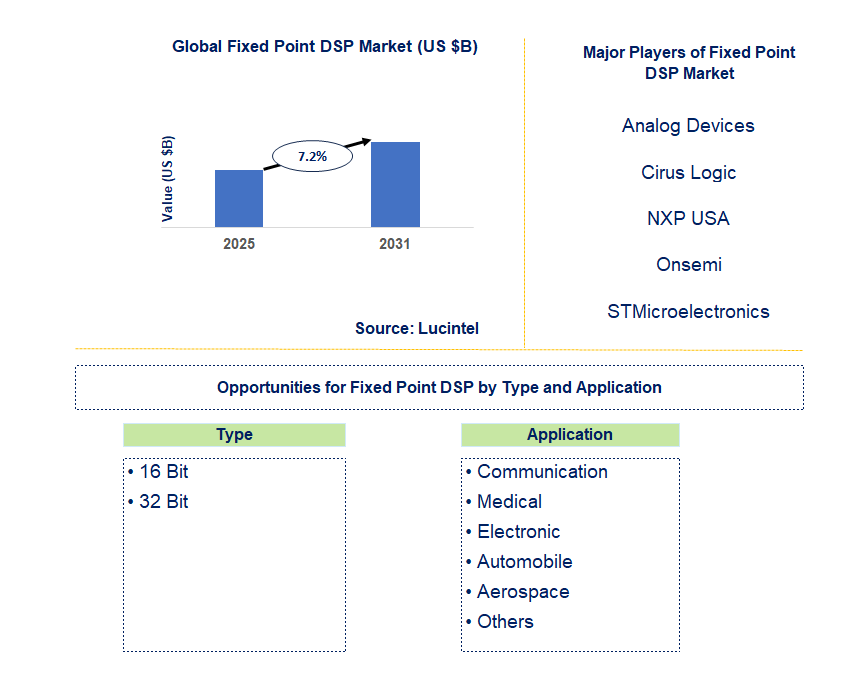
Key data points: The growth forecast = 7.2% annually for the next 7 years. Scroll below to get more insights. This market report covers Trends, opportunity and forecast in fixed point DSP market to 2031 by type (16 bit and 32 bit), application (communication, medical, electronic, automobile, aerospace, and others), and region (North America, Europe, Asia Pacific, and the Rest of the World)
We'll send your sample report shortly.
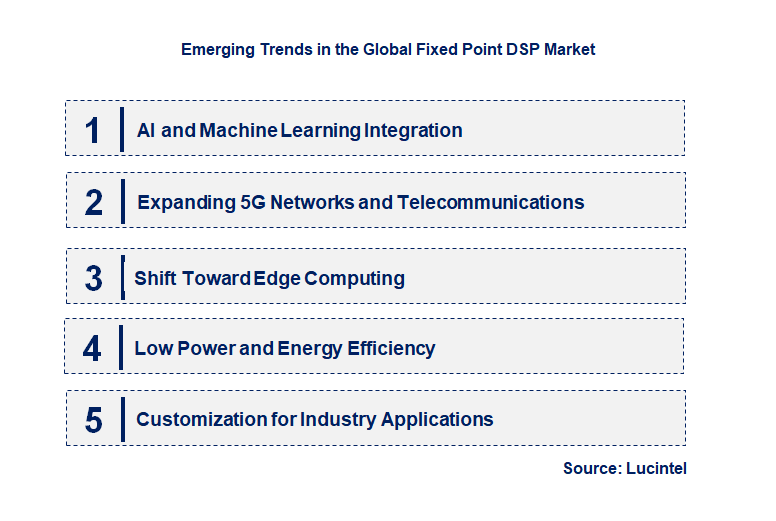
• AI and Machine Learning Integration: Among the largest trends is AI and machine learning algorithm integration with fixed point DSP. AI- enabled DSP is likely to take better advantage of massive datasets; such systems process these data for faster performance and enhanced real-time operations like voice recognition, image processing, and predictive analytics. It's particularly significant in applications in the automobile, healthcare, and telecommunication industries where intensive signal processing takes place. Further driving the need for AI-enhanced DSP systems is the surging demand for intelligent edge devices and IoT solutions.
• Expanding 5G Networks and Telecommunications Applications: Deployment of 5G networks will lead to growth for fixed point DSP applications. As 5G technology becomes more advanced, there is a demand for real-time signal processing, low latency, and higher bandwidth capacity, which fuels the demand for advanced DSP solutions. The fixed point DSP chips are vital in signal encoding/decoding, modulation/demodulation, and error correction processes of telecommunications. The trend is having a ripple effect on adjacent industries such as autonomous vehicles, smart cities, and industrial IoT.
• Shift Toward Edge Computing: Edge computing is emerging as one of the key trends in the fixed point DSP market. With the growing demand for real-time processing closer to the data source, fixed-point DSP systems are becoming more and more integrated into edge devices. Such devices can process data locally without depending on cloud-based infrastructure, thereby reducing latency and improving response times. The main driving forces behind this trend are industries such as automotive, manufacturing, and healthcare, which rely on low-latency processing for autonomous driving, predictive maintenance, and real-time medical diagnostics.
• Low Power and Energy Efficiency: With the demand for mobile and battery-powered devices increasing, the focus is highly on power-efficient fixed point DSP solutions. Manufacturers are designing low power DSP chips consuming less power that still maintain superior performance, such as longer battery lifetimes for wearable and IoT. Low power is particularly important to applications such as remote sensing, monitoring of medical practices, and a portable communication tool. Energy efficiency is also an area of interest when it comes to Industrial IoT, such as keeping operations at low running costs.
• Customization for Industry Applications: The industry is getting more matured; hence, it tends toward customizing fixed point DSP solutions according to specific industries. From the need for real-time image processing and sensor data analysis for automotive applications to industrial automation, which maximizes machine performance, companies design systems tailored to unique sector requirements in DSP systems. Customized DSP solutions provide better performance, cost efficiency, and reliability, which enables businesses to improve their operational outcomes. This trend reflects the growing importance of DSP technology in specialized markets. The emerging trends in the fixed point DSP market reflect an increasing demand for high-performance, efficient, and specialized solutions. With AI, 5G, a move to the edge, focus on energy efficiency, and customization for industry-specific applications, fixed point DSP technology is turning out to be essential for numerous sectors. These trends are changing the market and propelling innovation in a bid by companies to respond to the increasingly faster, more efficient, and scalable demands for DSP solutions.
• Advancements in Semiconductor Fabrication: Recent advancements in semiconductor fabrication have led to the development of more efficient and compact fixed point DSP chips. Improved manufacturing processes allow for better performance in smaller, more energy-efficient packages. These advancements are critical for applications in portable and embedded systems, where space and power constraints are key considerations. The advanced fabrication technologies have led to greater integration, so many more functions are packed into one DSP chip. This results in reduced cost and complexity.
• Increased Adoption of System-on-Chip (SoC) Solutions: There is an increasing tendency to integrate fixed point DSP technology into System-on-Chip (SoC) solutions. The SoCs contain DSP, microprocessor, memory, and other parts on a single chip, so they are compact, energy-efficient, and useful in a wide variety of applications. This trend is quite high in consumer electronics, automotive, and telecommunications. Here, the integrated solutions may give significant performance improvement, cost reductions, and also consume less power. SoC solutions are also stimulating the development of smart edge devices for IoT and real-time data processing.
• Partnering Between Semiconductor Companies: Collaboration between semiconductor companies with software developers, system integrators, and end-users are increasingly necessary to meet the dynamic needs of the fixed point DSP market. These partnerships allow for more specialized DSP solutions that can be geared toward particular applications. Combining hardware and software expertise in companies leads to more optimized solutions with better performance in applications such as automotive ADAS, industrial automation, and healthcare. Moreover, collaborations are crucial for developing solutions required by the growth of AI and machine learning capabilities.
• Expansion of DSP Capabilities for AI and Machine Learning: One of the most notable trends in the fixed point DSP market is increasing the incorporation of AI and machine learning capabilities into DSP systems. AI-driven DSP chips can process large datasets more efficiently, thus delivering better performance in applications such as speech recognition, image processing, and real-time analytics. This shift is more critical in areas, like health, automotive, and telecommunication, which require complex signal processing to accomplish heavy jobs such as autonomous driving, telemedicine, and 5G network management.
• Real-Time Video and Image Processing: The fixed point DSP industry has witnessed great emphasis on real-time video and image processing. As the technology involved in DSP advances, producers can offer rather efficient solutions for the applications in the fields of video surveillance, security, and automotive imaging. The real-time video encoding, decoding, and compression processes are carried out with DSP chips that enable the streaming of quality video and image recognition. This is important to industries like media and automotive and smart cities for its real-time video processing. The new developments in fixed point DSP Markets are a result of integration of technological innovation and market necessity with strategic partnerships. The industries and applications rely more and more on real-time processing that accelerates the advancements of more efficient, powerful, and specialized DSP solutions. The use of AI, system-on-chip solutions, and real-time video processing signifies a trend that strives for smarter, more integrated DSP technologies, thus propelling further growth in the markets.
• Telecommunications Infrastructure and 5G Networks: With the rollout of 5G networks across the globe, there is a huge demand for fixed point DSP technology in telecommunications infrastructure. DSP systems are critical for real-time signal processing, which ensures low latency and high bandwidth. fixed point DSP solutions are critical for tasks such as modulation, demodulation, encoding, and decoding, making them indispensable for 5G applications. Next generation telecom presents an investment opportunity for firms to invest in advanced DSP solutions for 5G.
• Automotive and Autonomous Vehicles: Automotive is also the leading industry for the growth of fixed point DSP. In autonomous and driver assistance systems (ADAS), such technologies are primarily utilized. fixed point DSPs are used for real-time signal processing in applications such as sensor fusion, image processing, and navigation, all of which are critical to safe and efficient autonomous driving. The increasing investment in self-driving vehicles and ADAS technologies is expected to drive further demand for DSP solutions, as they play a central role in improving vehicle safety and performance.
• Industrial Automation and IoT: Industrial automation and the advent of IoT are giving the fixed point DSP market substantial growth opportunities. The increasing degree of automation in manufacturing processes calls for DSP solutions that manage real-time signal processing in sensors, machines, and robots. The fixed point DSP allows faster and more efficient processing of sensor data, leading to operational efficiency and predictive maintenance. Further, DSP technology has a prominent place in IoT devices, which will explode in the next few years.
• Healthcare Applications: The healthcare sector is adopting fixed-point DSP technology for real-time monitoring, diagnostics, and medical imaging. Data from sensors, medical devices, and imaging systems must be processed by DSP solutions. In telemedicine, fixed-point DSPs ensure effective communication and real-time data analysis. Moreover, medical imaging, including MRI and CT scans, is highly dependent on DSP technology for faster processing and better image clarity. This is a significant growth area for the DSP market in healthcare applications.
• Consumer Electronics and Smart Devices: Consumer electronics, including wearables, smartphones, and smart home devices, are a rapidly growing market for fixed point DSP technology. The modern smart devices rely on DSPs to support voice recognition, real-time video processing, and sensor data analysis. The demand for connected and intelligent consumer products will be accompanied by a growing need for efficient, low-power fixed point DSP solutions. This trend is very relevant in the development of smart speakers, fitness trackers, and augmented reality devices. Fixed point DSP offers great growth opportunities across the key applications, including telecommunications, automotive, healthcare, industrial automation, and consumer electronics. Companies that continue to invest in these applications will be well-positioned to capture the expanding market. With further technology advancements and growing demand for real-time low-latency processing, the fixed point DSP market is expected to experience significant growth in the coming years.
• Analog Devices
• Cirus Logic
• NXP USA
• Onsemi
• STMicroelectronics
• Texas Instruments
• Zilog
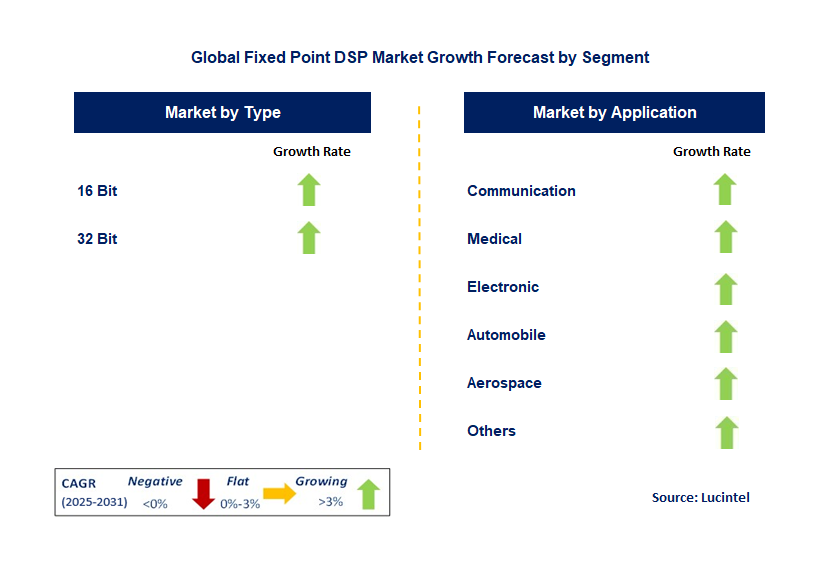
• 16 Bit
• 32 Bit
• Communication
• Medical
• Electronic
• Automobile
• Aerospace
• Others
• North America
• Europe
• Asia Pacific
• The Rest of the World
• United States: The demand for fixed point DSP technology has skyrocketed in the United States, especially in telecommunications, automotive, and defense. Companies like Texas Instruments, Analog Devices, and Xilinx have been leading the way in terms of high-performance, power-efficient DSP solutions. Demand for advanced DSP solutions, particularly for real-time processing and communications, has increased further with the advent of 5G networks and autonomous vehicles. In addition, the adoption of fixed-point DSP technology within edge computing architectures is becoming a mainstream approach to realize applications related to IoT and industrial automation.
• China: China is currently the biggest market for fixed point DSP solutions with most being encouraged by rapid expansion of telecommunications, consumer electronics and automotive industries in this country. With the government's focus on 5G infrastructure and smart manufacturing, fixed point DSP processors have gained popularity for applications such as signal processing, real-time video compression, and industrial control. The Chinese companies are also investing more in research and development to develop customized DSP solutions for local applications. The demand for AI and machine learning-enabled DSP chips has been increasing rapidly.
• Germany: Industry and automotive business of Germany, because it requires an effective fixed-point DSP to realize the critical time, signal-processing, and controlling in such lines. With acceleration of the takeoff of Industry 4.0 and automation in various enterprises and their operations for improving efficiency with effective DSP products, the influence on Germany is high. Meanwhile, Germany has also driven many requirements in autonomous driving and Advanced Driver Assistance System (ADAS). In addition, the country is investing in 5G technology and high-performance computing, which further expands the market for fixed-point DSP solutions.
• India: The fixed point DSP market in India has grown rapidly due to the increasing demand for digital signal processing in the telecommunications, healthcare, automotive, and consumer electronics sectors. Demand for fixed-point DSP solutions is likely to increase with the rise of smart cities, IoT solutions, and 5G technologies. Indian companies are increasingly partnering with international players to deliver customized DSP solutions for local applications. In addition, the growing focus on education and skill development in digital technologies in India is creating opportunities for both local and foreign companies to invest in the DSP sector.
• Japan: The fixed point DSP market is dominated by the advanced electronics, automotive, and robotics industries in Japan. The country's Renesas, Sony, and Mitsubishi Electric companies are leading providers of fixed-point DSP solutions for real-time signal processing, image recognition, and control applications. The country's focus on robotics and automation has driven the demand for DSP technology in these industries. Furthermore, Japan is concentrating on 5G network improvements and research in next-generation communication systems, thus providing growth opportunities for fixed point DSP processors in the telecommunication and industrial IoT sectors.


• Analog Devices
• Cirus Logic
• NXP USA
• Onsemi
• STMicroelectronics
• Texas Instruments
• Zilog Q5. Which fixed point DSP market segment will be the largest in future? Answer: Lucintel forecasts that, within the type category, 32 bit is expected to witness higher growth over the forecast period due to these processors are more energy-efficient compared to higher bit-width DSPs. Q6. In fixed point DSP market, which region is expected to be the largest in next 5 years? Answer: In terms of region, APAC is expected to witness the highest growth over the forecast period due to technological advancements and manufacturing hub, large consumer electronics market. Q7. Do we receive customization in this report? Answer: Yes, Lucintel provides 10% customization without any additional cost.


Choose a license that fits your team. Instant PDF delivery.
Prices exclude taxes. Instant delivery. Custom licensing available on request.
Market Report · July 22, 2026
Market Report · July 17, 2026
Market Report · July 17, 2026
Trusted partner for strategic intelligence and business growth


Receive a complimentary market analysis tailored to your industry. Our analysts will identify key growth opportunities and competitive dynamics specific to your business.

Market size, growth rate, and key trend analysis for your specific sector.

Top competitor positioning and market share analysis.

Strategic recommendations backed by data-driven insights.
Get curated market intelligence and competitive moves straight to your inbox.
By subscribing, you agree to receive our monthly insights. Unsubscribe anytime.
Receive a complimentary market analysis tailored to your industry. Our analysts will identify key growth opportunities and competitive dynamics specific to your business.
Market size, growth rate, and key trend analysis for your specific sector.
Top competitor positioning and market share analysis.
Strategic recommendations backed by data-driven insights.
Get curated market intelligence, emerging trends, and competitive moves straight to your inbox each month.
By subscribing, you agree to receive our monthly insights. Unsubscribe anytime.
We'll send your sample report shortly.