
Market Report · July 15, 2026

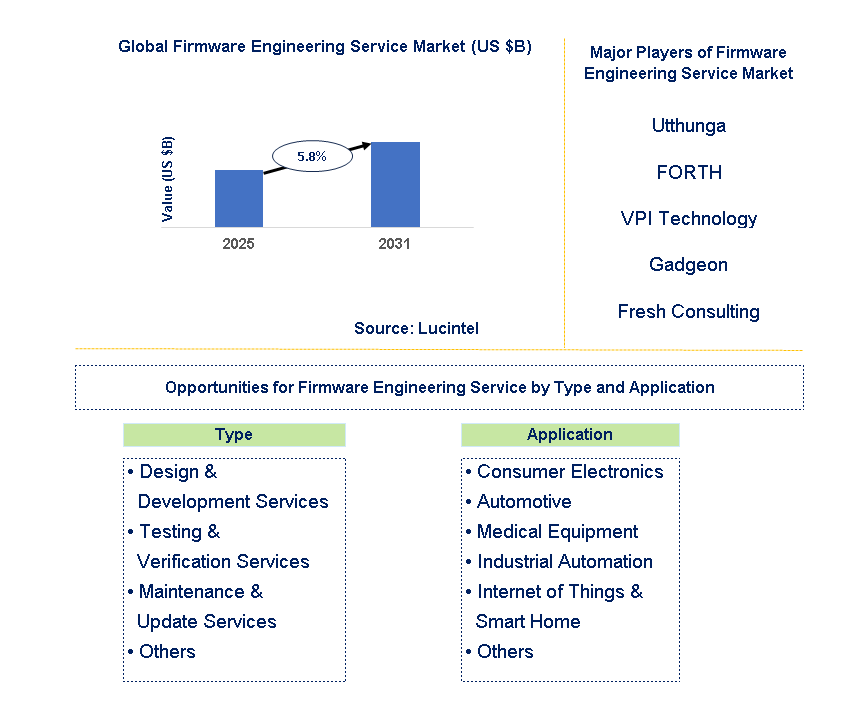
Key data points: The growth forecast = 5.8% annually for the next 7 years. Scroll below to get more insights. This market report covers trends, opportunities and forecasts in firmware engineering service market to 2031 by type (design & development services, testing & verification services, maintenance & update services, and others), application (consumer electronics, automotive, medical equipment, industrial automation, internet of things & smart home, and others), and region (North America, Europe, Asia Pacific, and the Rest of the World)
We'll send your sample report shortly.
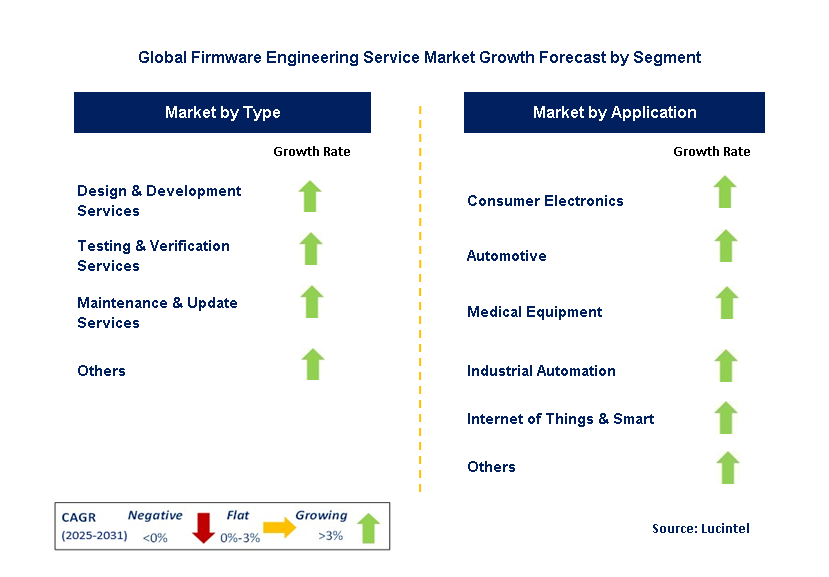
• Lucintel forecasts that, within the type category, design & development service is expected to witness the highest growth over the forecast period.
• Within the application category, consumer electronics is expected to witness the highest growth.
• In terms of region, North America is expected to witness the highest growth over the forecast period. Gain valuable insights for your business decisions with our comprehensive 150+ page report. Sample figures with some insights are shown below.
• AI Integration in Embedded Firmware: Machine learning functionalities are being enhanced into firmware for real-time decisions based on sensors input in automotive, healthcare, industrial, or IoT use cases. This enables higher device autonomy and faster response times. Furthermore, it reduces bandwidth and enhances data privacy by processing information locally. The addition of AI at the firmware level requires specialized circuitry to balance memory and power restrictions with precision regarding the algorithms employed. With the rise of edge AI, there is an increased demand for real-time tools, and the firmware services are adapting to streamline the engineering of real-time AI model updates.
• Need for Over-The-Air Updates (OTA): As the number of connected devices continues to grow, the ability to update software remotely is critical for device security and functionality. OTA updates minimizes operational downtime, decreases recall expenses, and enhances overall user satisfaction. This trend is being adopted in the automotive, telecom industries, and in smart appliances in order to enable feature deployment after installation.
• Prioritized Security-Centric Firmware Design: The embedded system security risks have fundamentally changed the way firmware is developed. Primary modern firmware services begin with secure coding, cryptographic verification, and anti-tampering features. The evolving risks of firmware-level threats due to IoT advancements and critical infrastructure interconnections enables developers to add firmware integrity verification, signing, and secured provisioning. Compliance with GDPR, HIPAA, and ISO/SAE 21434 also falls under security-first firmware engineering. IVDR and GDPR require more transparency. IVDR and GDPR force companies to more actively respond to third-party audits and penetration tests aimed at reinforcing cybersecurity defense measures in embedded systems.
• Emergence of Firmware DevOps and Continuous: In the past, firmware development had a fixed and siloed approach. Now, companies are starting to implement DevOps workflows for embedded projects, which allow for faster iteration, automated testing, and quicker deployment cycles. Principles of firmware-as-code and CI/CD pipelines are being adopted to maintain modular codebases, run regression tests, and enable team collaboration. This method minimizes bugs, reduces the time needed to develop systems, and makes it easier to adapt to changes in the hardware design. Cloud-enabled tools for simulating firmware and conducting tests are speeding up the debugging and validation processes. The faster evolution of consumer electronics and automotive products, where speed and quality are both essential, makes the emergence of Firmware DevOps even more relevant.
• Low-Power Firmware Optimization: The advent of portable and remote sensors has placed optimizing firmware for energy consumption at the forefront. Energy management now involves careful coordination of clock cycles and memory with the hardware teams, while sleep states are managed within dynamic frameworks. Innovations include dynamic voltage scaling, adaptive duty cycling, and interrupt driven programming. This is especially dominant in healthcare, agriculture, and smart city technologies where devices are expected to operate independently for long periods of time. Tailored energy policies within the device powered features not only maximizes operational longevity but also unsustainably prolongs product life cycle in addition to reducing operational cost and device life is improved with lowered carbon footprint targets towards fierce environmental competition. The energy efficiency driven tends stand out regarding the growth of the firmware engineering service market where rapid change is fueled by interconnecting intelligent technologies, real time data requirements, and a globally digitalized world. Integration of AI, security driven development, OTA functionalities, DevOps policies, and energy efficiency shape the more critical aspects of firmware design. Industry adaption of Intelligent, secure, and flexible embedded systems is accelerated with precision and speed enabled by these new frameworks. The US, China, Germany, India, and Japan as a group are advancing parallelly applying it through their industrial ecosystem. These are together enabling tangible shifts in still regarded fixed firmware engineering into technology advancement enablers.
• Integration of AI and Machine Learning in Firmware Development: The incorporation of AI and machine learning into embedded systems has already been witnessed, further enhancing the capabilities of intelligent behaviors. These devices will no longer be functional units; rather they will be smart systems that are capable of evolving over time. AI can be utilized in firmware services to perform predictive maintenance, optimize performance, and enhance energy efficiency. Adaptive systems are particularly important in the automotive and industrial IoT sectors where these innovations will be highly valuable.
• Movement Towards Cloud-Linked Firmware Development: Cloud based innovation changes the landscape of firmware engineering and deployment by letting developers retrieve and edit firmware from remote locations. Firmware update procedures have also been simplified owing to OTA (Over the Air) updates which minimize the need to physically interact with devices. Centralized cloud-based backup also offers enhanced collaboration among engineering teams and improved security control due to centralized updates and diagnostics. This is especially useful in consumer electronics and healthcare industries where regular updates are required to enhance the performance level and compliance of the devices.
• Shrink Wrap Increased Focus on Security and Encryption in Firmware: With the rise in networking of IoT devices, the security of firmware is crucial. There has been some development towards embedding higher level encryption alongside secure boot features directly into the firmware to insulate them from cyber threats. There is an increasing involvement of firmware engineering services tasked with other parts of the more advanced security features like hardware encryption, secure update procedure, and secure communication protocols. This is especially important for automotive, healthcare, and defense industries that suffer significant consequences due to cybersecurity threats.
• Integration of Agile Development Methodologies: In the field of firmware engineering, the adoption of Agile methodologies is on the rise, enabling improved iteration, flexibility, and management. Agile principles allow development teams to respond to changes in requirements more rapidly by incrementally updating firmware and releasing new features on a set schedule. This change is especially useful in high-velocity sectors such as consumer electronics and telecommunications, where the speed of the product lifecycle is of utmost importance. Additionally, Agile boosts collaboration out of cross-functional silos, enhancing productivity as well as time to market for new devices.
• Development of Open-Source Firmware Evolution: With the collaboration of various companies and developers towards designing effective and economical firmware solutions, open-source firmware development is gaining popularity. Development cycles as well as innovation is enhanced with the availability of open-source firmware frameworks. A growing number of firms are actively participating in open-source projects to take advantage of community updates and enhancements. While this trend is useful for startup firms and small businesses in need of quality services at reduced development costs, it also enables easier integration with other open-source platforms for home automation and robotics. The Service Firmware Engineering market is undergoing changes due to the implementation of AI, cloud computing, and agile practices which drive security, open-source initiatives, and greater emphasis on overall flexibility and speed. These factors enhance the performance, usability, and security of proprietary embedded systems firmware. Industry-wide investment and innovation to harness these opportunities is further expanding the market.
• Cars and Self Driving Car: The development of firmware for the automotive sector is relatively new, due to systems like self driving cars and smart automotive systems. Car manufacturers require firmware solutions for driver assistance systems (ADAS), electric vehicle (EV) components, infotainment systems, and telematic subsystems. With the growing complexity of automotive technologies, there is a marked shortage of firmware engineers who are capable of designing, testing, and maintaining embedded systems within safety and operational benchmarks as industry standards. This development gives room for firmware service providers to design specialized, refined solutions aimed at the dynamic needs of the automotive industry.
• Healthcare and Medical Device: The healthcare sector’s use of connected medical devices is increasing the availability of sophisticated medical firmware solutions. From wearables, health monitoring devices to scanning and diagnostic devices, firmware engineering plays a big part in ensuring the functionality, safe use, and compliance with requirements set out by regulators. The surge in demand for Internet of Things (IoT) medical devices increases the market for firmware services that support filed data, remote observation, secure exchange of patient information, and adherence to HIPAA and U.S. FDA guidelines. With these solutions and the expanding scope of telemedicine and healthcare, there is increasing demand for tailored firmware solutions which translates to growth opportunities for firmware engineers.
• Industrial Automation and IoT: The growth of industrial IoT (IIoT) and automation systems is a promising area for industrial firmware engineering services. Specialized predictive maintenance, sensor integration, and real-time industrial analytics needs embedded systems. These systems, particularly in the plant, energy, and logistics system applications, have to be dependable, secure, and responsive and require critical firmware for mission-centric environments. Each industry undergoes continual digital transformation and there is an increasing demand for automated firmware solutions to integrate intelligent devices effortlessly into deeper systems thinking, making them more agile and responsive.
• Consumer Electronics and Smart Home Devices: Media devices, especially the so-called smart home services, are one of the key generators of growth in new firmware. Advanced smart devices including speakers, thermostats, cameras, and wearables require sophisticated firmware to operate in concert with other devices. As consumers expect more ease of use and smart power management, so their integration demands smart firmware engineering. This is a further growth opportunity as consumer electronics companies strive to have competitive edges through accelerated time to market and improved overall product experiences through ongoing firmware maintenance.
• Telecommunications and 5G Network: 5G network deployment has dramatically increased the demand for engineering services in firmware with its new technology rollout and optimization. Equipment such as 5G routers, base stations, and edge computing devices operate using proprietary firmware to maintain high-speed data throughput, secure communication, and dependable operation. Furthermore, firmware development for network infrastructure equipment is also needed to handle expanding 5G networks complexities. This market provides remarkable prospects for firmware engineers to significantly participate in transforming telecommunications industry. The strategic growth opportunities understudy today showcase opportunities in automotive, healthcare, industrial IoT, consumer electronics, and telecommunications as complete industries undergo transformation. Specialized sophisticated firmware and meticulously designed soft engineering are highly expected in emerging sectors which will undoubtedly create unmatched growth opportunities for service providers.
• Utthunga
• FORTH
• VPI Technology
• Gadgeon
• Fresh Consulting
• VOLANSYS
• Srushty
• Keystride
• NOVO Engineering
• Sigma Design
• Design & Development Services
• Testing & Verification Services
• Maintenance & Update Services
• Others
• Consumer Electronics
• Automotive
• Medical Equipment
• Industrial Automation
• Internet Of Things & Smart Home
• Others
• North America
• Europe
• Asia Pacific
• The Rest of the World
• United States: In the United States, the IoT and healthcare sectors are seeing major shifts as enterprises pump more dollars into autonomous vehicles and AI-powered embedded systems. Coordination between companies and firmware service providers empowers the construction of ultra-secure edge-enabled real-time systems. Some recently achieved milestones include OTA firmware update integrate mechanisms for continuous optimization. Firmware updates ensures compliance and optimization. Defense and aerospace industries also require advanced firmware engineering like secure boot applications with robust standards. The ultra-competitive landscape because of numerous distinct semiconductor firms and startups foster enhanced rapid prototyping time and market innovations through advanced firmware services.
• China: The growing electronics manufacturing ecosystem and the rollout of 5G infrastructure are interlinked with the expanding firmware engineering market in China. Other recent developments include custom firmware solutions for smart city infrastructure, electric vehicles, and industrial automation systems. Proprietary firmware for IoT devices and consumer electronics is self-sufficient for Chinese companies, and the focus is on local firmware development to reduce dependency on foreign IPs. In robotics and surveillance technologies, the integration of firmware with AI chips and machine vision systems is emerging trends. Greater domestic manufacturing drives regional semiconductor firms and fiducial marker suppliers to form more alliances, which in turn fosters the growth of China’s firmware engineering market.
• Germany: Efforts are being made to enhance Germany's capabilities in firmware engineering embedded within the overarching framework of Industry 4.0. System interfaces are undergoing embedded firmware development for industrial control systems, autonomous robotic systems, and automotive ECUs (Electronic Control Units). The automotive industry, in particular, is leading developments in real-time firmware tuning, secure inter-ECU communication, and over-the-air (OTA) updates. In Germany, automobile manufacturers are collaborating with firmware service providers to meet safety and cybersecurity controls. The combination of firmware and IoT platforms in manufacturing is facilitating predictive maintenance and operational efficiency. Germany has maintained strong industrial and engineering standards, driving cross sectoral adoption of integrated firmware solutions.
• India: India's electronics sector, particularly the demand for outsourced services, is rapidly growing. This, in turn, is spurring growth in the manufacturing of powered-on electronics. Indian startups and software service companies are now providing comprehensive embedded firmware services by design and test engineering. Embedded systems design alternatives now include firmware for low-power constantly-on wearable devices like wristbands, energy meters, and other smart appliances. For global market access, Indian companies are investing in obtaining international certificates and compliance standards for regulated medical devices, automotive electronics, and industrial IoT. Initiatives such as "Make in India" coupled with the semiconductor mission are fostering partnerships between hardware startups and firmware engineers, localizing innovation and export-driven strategic development.
• Japan: Japan focuses on robotics, automotive, and consumer electronics industries with precision-driven firmware development. Recent development includes real-time processing capable of autonomous systems and next-generation appliances firmware platforms. Industrial automation also benefits from the addition of AI processing at the firmware level due to increased responsiveness and enhanced efficacy from decreased latency. Cybersecurity integrated firmware is spearheaded by the automotive industry, with OEMs complying to ISO/SAE 21434 standards for vehicle systems. Smart infrastructure and healthcare devices also uses Japan’s specialized aging population firmware. Convergence of traditional electronics companies and agile system-level integration provided by mid-scale firmware engineering firms enables advanced collaboration.


• Utthunga
• FORTH
• VPI Technology
• Gadgeon
• Fresh Consulting
• VOLANSYS
• Srushty
• Keystride
• NOVO Engineering
• Sigma Design Q5. Which firmware engineering service market segment will be the largest in future? Answer: Lucintel forecasts that, within the type category, design & development service is expected to witness the highest growth over the forecast period. Q6. In firmware engineering service market, which region is expected to be the largest in next 5 years? Answer: In terms of region, North America is expected to witness the highest growth over the forecast period. Q7. Do we receive customization in this report? Answer: Yes, Lucintel provides 10% customization without any additional cost.


Choose a license that fits your team. Instant PDF delivery.
Prices exclude taxes. Instant delivery. Custom licensing available on request.
Market Report · July 15, 2026
Market Report · June 26, 2026
Market Report · June 24, 2026
Trusted partner for strategic intelligence and business growth


Receive a complimentary market analysis tailored to your industry. Our analysts will identify key growth opportunities and competitive dynamics specific to your business.

Market size, growth rate, and key trend analysis for your specific sector.

Top competitor positioning and market share analysis.

Strategic recommendations backed by data-driven insights.
Get curated market intelligence and competitive moves straight to your inbox.
By subscribing, you agree to receive our monthly insights. Unsubscribe anytime.
Receive a complimentary market analysis tailored to your industry. Our analysts will identify key growth opportunities and competitive dynamics specific to your business.
Market size, growth rate, and key trend analysis for your specific sector.
Top competitor positioning and market share analysis.
Strategic recommendations backed by data-driven insights.
Get curated market intelligence, emerging trends, and competitive moves straight to your inbox each month.
By subscribing, you agree to receive our monthly insights. Unsubscribe anytime.
We'll send your sample report shortly.