
Market Report · July 15, 2026

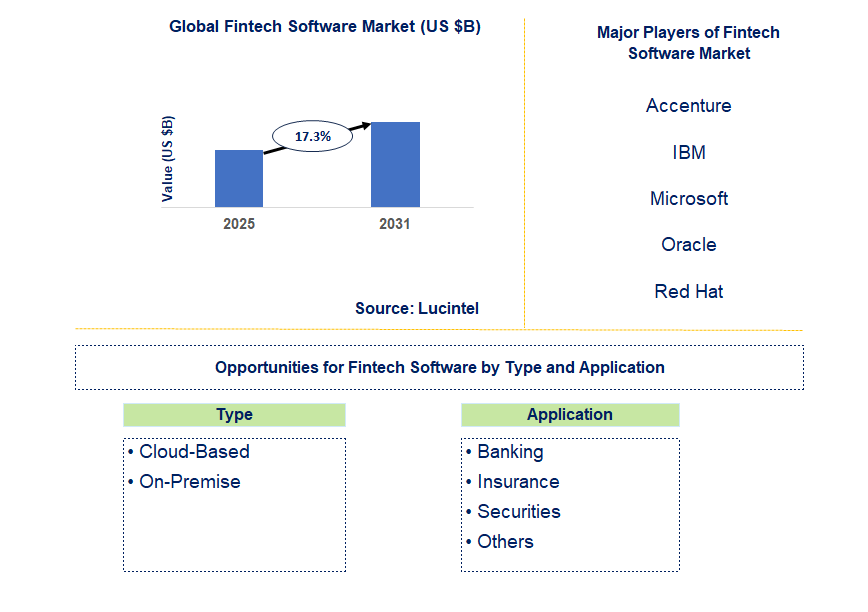
Key data points: The growth forecast = 17.3% annually for the next 7 years. Scroll below to get more insights. This market report covers Trends, opportunity and forecast in FinTech software market to 2031 by type (cloud-based and on-premise), application (banking, insurance, securities, and others), and region (North America, Europe, Asia Pacific, and the Rest of the World)
We'll send your sample report shortly.
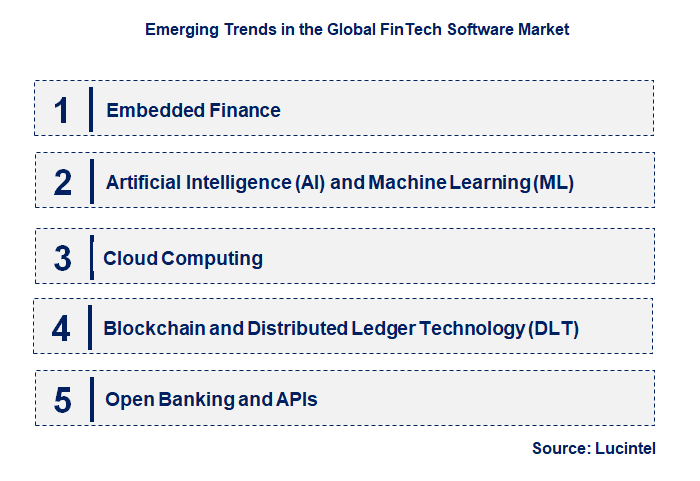
• Embedded Finance: Integrating financial services into non-financial platforms and applications. This allows businesses to offer financial products and services directly to their customers, enhancing user experience and creating new revenue streams. For example, e-commerce platforms can offer embedded lending or insurance options at the point of sale. This trend democratizes access to financial services by making them readily available within familiar environments, boosting customer engagement and loyalty for both the platform and the embedded financial provider.
• Artificial Intelligence (AI) and Machine Learning (ML): Leveraging AI and ML for personalized financial advice, fraud detection, risk management, and automated customer service. These technologies enable more efficient operations, better decision-making, and enhanced customer experiences. AI-powered chatbots can provide instant customer support, while ML algorithms can analyze transaction data to identify fraudulent activity. The use of AI/ML is transforming customer interaction, operational efficiency, and risk management, leading to more personalized and secure financial services.
• Cloud Computing: Migrating fintech software and infrastructure to the cloud. This offers scalability, cost-efficiency, and enhanced security. Cloud-based solutions enable faster deployment of new features and improved data management. Fintech companies can leverage cloud infrastructure to scale their operations quickly and efficiently, reducing IT overhead and allowing them to focus on innovation. Cloud adoption is enabling greater agility, scalability, and cost-effectiveness in the fintech sector.
• Blockchain and Distributed Ledger Technology (DLT): Utilizing blockchain and DLT for secure and transparent transactions, supply chain finance, and digital asset management. These technologies offer enhanced security, immutability, and efficiency. Blockchain can be used to create secure digital identities and facilitate cross-border payments. Blockchain/DLT is revolutionizing areas like payments, supply chain finance, and asset management by improving security, transparency, and efficiency.
• Open Banking and APIs: Enabling third-party access to customer financial data through APIs. This fosters innovation by allowing developers to create new financial products and services. Open banking facilitates data sharing between financial institutions and third-party providers, leading to personalized financial management tools and innovative financial products. Open banking promotes competition and innovation, empowering customers with greater control over their financial data and access to tailored financial solutions. These trends are reshaping the fintech software market by driving innovation, increasing competition, and empowering customers. They are leading to the development of more personalized, accessible, and efficient financial services, ultimately transforming the way we interact with money.
• Increased Adoption of AI and Machine Learning: AI and ML are being integrated into various fintech applications, from fraud detection and risk management to personalized financial advice and customer service. These technologies enable automated processes, improve decision-making, and enhance customer experiences. AI-powered chatbots provide instant support, while ML algorithms analyze vast datasets to identify patterns and predict future trends. The integration of AI/ML is leading to more efficient operations, improved risk assessment, and personalized financial services, transforming customer interaction and driving innovation across the fintech sector.
• Growth of Embedded Finance: Embedded finance allows businesses to integrate financial services directly into their platforms, offering seamless financial products and services within non-financial contexts. E-commerce platforms can offer embedded lending or insurance options at the point of sale, enhancing customer convenience and creating new revenue streams. This trend democratizes access to financial services by making them readily available within familiar environments, boosting customer engagement and loyalty for both the platform and the embedded financial provider.
• Rise of Decentralized Finance (DeFi): DeFi leverages blockchain technology to create decentralized financial applications, offering peer-to-peer lending, borrowing, and trading without intermediaries. This has the potential to disrupt traditional financial institutions and provide greater access to financial services. DeFi platforms offer greater transparency and control, enabling users to interact directly with each other without relying on centralized authorities. DeFi is challenging traditional finance models and promoting financial inclusion by offering alternative financial solutions.
• Focus on Cybersecurity and Data Privacy: With increasing data breaches and cyberattacks, fintech companies are prioritizing cybersecurity and data privacy. Robust security measures, encryption technologies, and compliance with data privacy regulations are crucial for maintaining customer trust and protecting sensitive financial information. Fintech companies are investing heavily in cybersecurity infrastructure and expertise to mitigate risks and ensure the safety of user data. The growing emphasis on cybersecurity and data privacy is crucial for building trust and fostering the sustainable growth of the fintech market.
• Expansion of Open Banking and APIs: Open banking and APIs are enabling third-party access to customer financial data, fostering innovation and creating new financial products and services. This allows developers to build personalized financial management tools and integrate financial services into various applications. Open banking empowers customers with greater control over their financial data and promotes competition among financial service providers. The expansion of open banking is driving innovation and creating a more interconnected and collaborative financial ecosystem. These developments are collectively reshaping the fintech software market by driving innovation, increasing competition, and empowering customers. They are leading to the development of more personalized, accessible, and efficient financial services, ultimately transforming the way we interact with money and manage our finances.
• Personalized Financial Management: Developing AI-powered personal finance management (PFM) tools that provide tailored financial advice, budgeting assistance, and investment recommendations. These tools can analyze user spending patterns, identify saving opportunities, and offer personalized financial planning. The demand for personalized financial guidance is growing, and AI-driven PFM tools can empower users to take control of their finances. This presents a significant opportunity for fintech companies to build customer loyalty and drive revenue growth.
• Embedded Finance in E-commerce: Integrating financial services, such as lending, insurance, and payments, directly into e-commerce platforms. This allows businesses to offer seamless financial products and services at the point of sale, enhancing customer experience and increasing conversion rates. Embedded finance creates new revenue streams for both e-commerce platforms and fintech companies. This is a high-growth area with significant potential for expanding access to financial services.
• Digital Lending for SMEs: Providing accessible and efficient digital lending solutions to small and medium-sized enterprises (SMEs). Traditional lending processes can be cumbersome and time-consuming for SMEs. Fintech companies can leverage data analytics and AI to assess creditworthiness and offer quick and easy access to loans. This addresses a significant funding gap for SMEs and presents a large market opportunity for fintech lenders.
• Decentralized Finance (DeFi) Applications: Building innovative DeFi applications that offer decentralized lending, borrowing, trading, and other financial services. DeFi has the potential to disrupt traditional finance by offering greater transparency, accessibility, and efficiency. This is a rapidly evolving space with significant growth potential for fintech companies that can develop secure and user-friendly DeFi platforms.
• Regtech Solutions for Compliance: Developing regulatory technology (Regtech) solutions that help financial institutions comply with complex regulations. Regtech solutions can automate compliance processes, reduce costs, and minimize risks. With increasing regulatory scrutiny, the demand for Regtech solutions is growing. This presents a valuable opportunity for fintech companies to provide essential compliance tools to financial institutions. These growth opportunities are collectively shaping the fintech software market by driving innovation, increasing competition, and expanding access to financial services. They are leading to the development of more personalized, accessible, and efficient financial solutions, ultimately transforming the way individuals and businesses manage their finances.
• Accenture
• IBM
• Microsoft
• Oracle
• Red Hat
• Cloud-Based
• On-Premise
• Banking
• Insurance
• Securities
• Others
• North America
• Europe
• Asia Pacific
• The Rest of the World
• United States: The US fintech market is characterized by its diverse ecosystem and focus on innovation. Key trends include the rise of neobanks like Chime, which offer digital banking services, and the growing adoption of embedded finance, where financial services are integrated into non-financial platforms. Regulatory sandboxes are being used to foster innovation while ensuring consumer protection. The US is also seeing a surge in AI-powered financial management tools and the use of blockchain technology for secure transactions.
• China: The Chinese fintech market is dominated by mobile payments, with Alipay and WeChat Pay being widely used. The country is also a leader in digital lending and has seen the rapid growth of super-apps that integrate various financial and lifestyle services. The Chinese government has been supportive of fintech innovation but has also increased regulatory scrutiny in recent years, particularly regarding data privacy and anti-monopoly practices.
• Germany: The German fintech market is characterized by a strong focus on traditional banking and a growing interest in digital solutions. The country has seen the emergence of neobanks like N26 and the adoption of open banking, which allows third-party access to customer financial data. German regulators have been supportive of fintech innovation but have also emphasized the importance of data security and consumer protection.
• India: The Indian fintech market has witnessed explosive growth in recent years, driven by the government's push for digitalization and financial inclusion. The country is a leader in mobile payments, with UPI being a popular platform. India has also seen the rise of digital lending platforms and the adoption of Aadhaar-based KYC for streamlined customer onboarding. The Indian government has been supportive of fintech innovation and has implemented regulations to ensure data privacy and security.
• Japan: The Japanese fintech market is characterized by a strong focus on traditional financial institutions and a growing interest in digital solutions. The country has seen the adoption of cashless payments and the emergence of neobanks. Japanese regulators have been supportive of fintech innovation but have also emphasized the importance of cybersecurity and consumer protection.


• Accenture
• IBM
• Microsoft
• Oracle
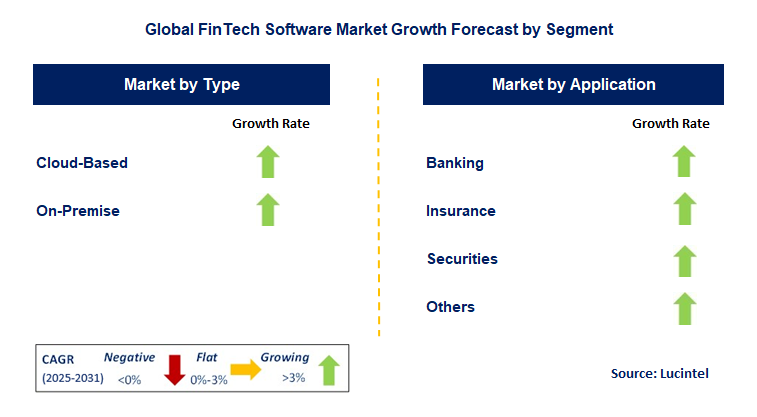
• Red Hat Q5. Which FinTech software market segment will be the largest in future? Answer: Lucintel forecasts that cloud-based is expected to witness higher growth over the forecast period. Q6. In FinTech software market, which region is expected to be the largest in next 5 years? Answer: APAC is expected to witness the highest growth over the forecast period. Q7. Do we receive customization in this report? Answer: Yes, Lucintel provides 10% customization without any additional cost.


Choose a license that fits your team. Instant PDF delivery.
Prices exclude taxes. Instant delivery. Custom licensing available on request.
Market Report · July 15, 2026
Market Report · June 26, 2026
Market Report · June 24, 2026
Trusted partner for strategic intelligence and business growth


Receive a complimentary market analysis tailored to your industry. Our analysts will identify key growth opportunities and competitive dynamics specific to your business.

Market size, growth rate, and key trend analysis for your specific sector.

Top competitor positioning and market share analysis.

Strategic recommendations backed by data-driven insights.
Get curated market intelligence and competitive moves straight to your inbox.
By subscribing, you agree to receive our monthly insights. Unsubscribe anytime.
Receive a complimentary market analysis tailored to your industry. Our analysts will identify key growth opportunities and competitive dynamics specific to your business.
Market size, growth rate, and key trend analysis for your specific sector.
Top competitor positioning and market share analysis.
Strategic recommendations backed by data-driven insights.
Get curated market intelligence, emerging trends, and competitive moves straight to your inbox each month.
By subscribing, you agree to receive our monthly insights. Unsubscribe anytime.
We'll send your sample report shortly.